The Royal Trinity Hospice

Hospice gardens do not immediately spring to mind as ‘must go to visit attraction’. However while on child care duties in south London last weekend I took the opportunity to visit The Royal Trinity Hospice, Clapham Common which kindly opened its gates to the public in aid of the National Garden Scheme.
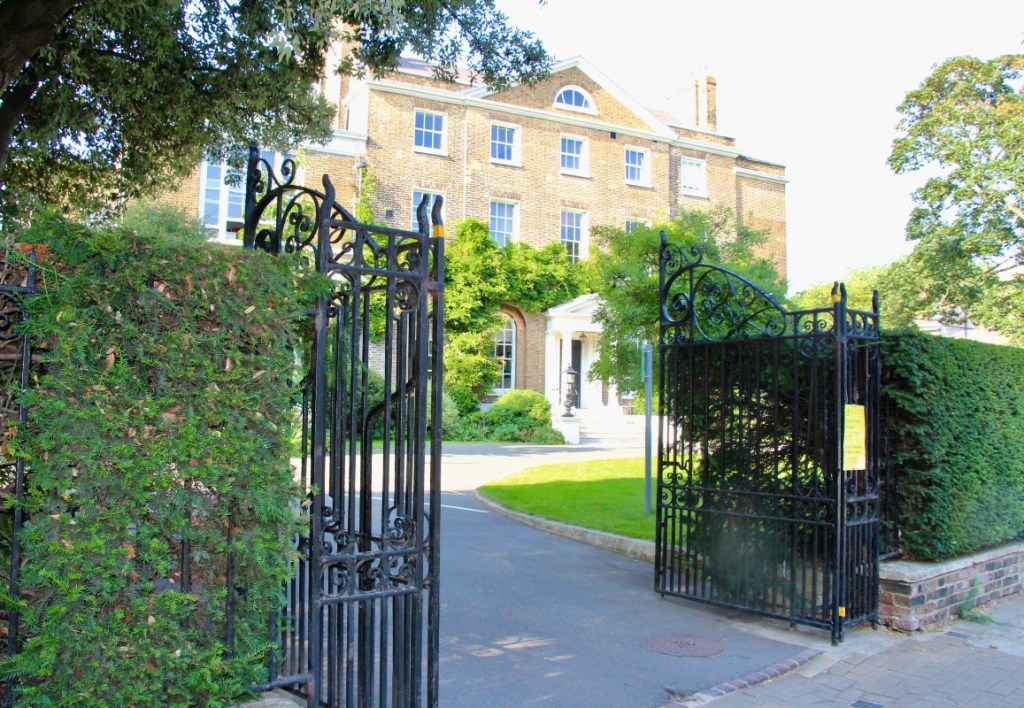
The Hospice, with its elegant facade situated on the north side of Clapham Common is the oldest hospice in the UK and was created in 1891 with thanks to the generosity of William Hoare who donated £1,000 of the £2,000 needed to set up what was known as The Hostel of God, the remainder of the funds being raised by public subscription. Originally situated around the corner in The Chase, the hospice by 1894 had 10 beds and patients were cared for by an order of nuns. In 1899 the hospice moved here to Clapham Common Northside, where it has expanded and evolved over the years with the late 1970s – 1980s seeing a significant rebuilding programme in order to improve the facilities and patient care environment.

It was during this time that the renowned landscape architect Lanning Roper visited the site and, waiving his fee, drew up plans for the 2 acre garden.

Photo borrowed from Lanning Roper and his Gardens by Jane Brown

Roper did not live to see his plans carried out, dying in 1983. So landscape architect John Medhurst was commissioned to lay out the garden, and included in his design such details as Roper’s generous curving brick paths which not only gently lead you to a hidden area but help those in a wheelchair glide seamlessly through the garden so as to enjoy the planting.

The majority of hospices rely on an army of volunteers, several of whom last Sunday gave up their time to greet us at the gate, directing us in through a side door. An easy access, with neither gravel nor steps, a joy for wheelchair or buggy users and something many garden owners where possible, might seriously think about.

You might be forgiven for expecting an uninteresting hospitalised space, a touch morbid even; instead however, you would in that first moment immediately feel that this is indeed a very special green space.
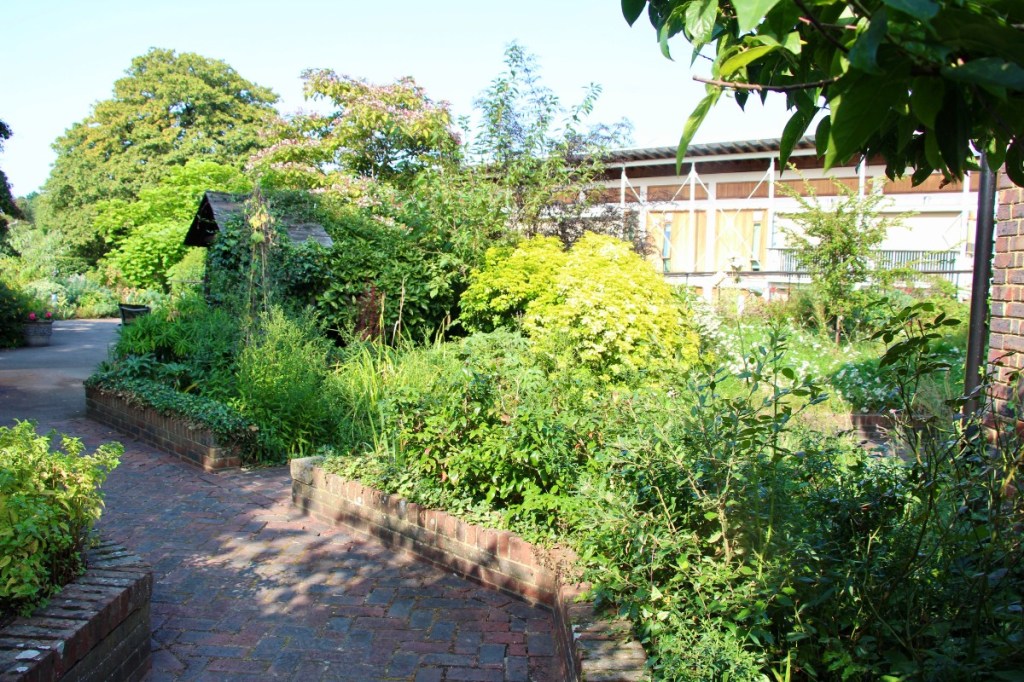
The raised beds on either side are well planted and display a rich variety: aromatic herbs mingle together along the left hand side,

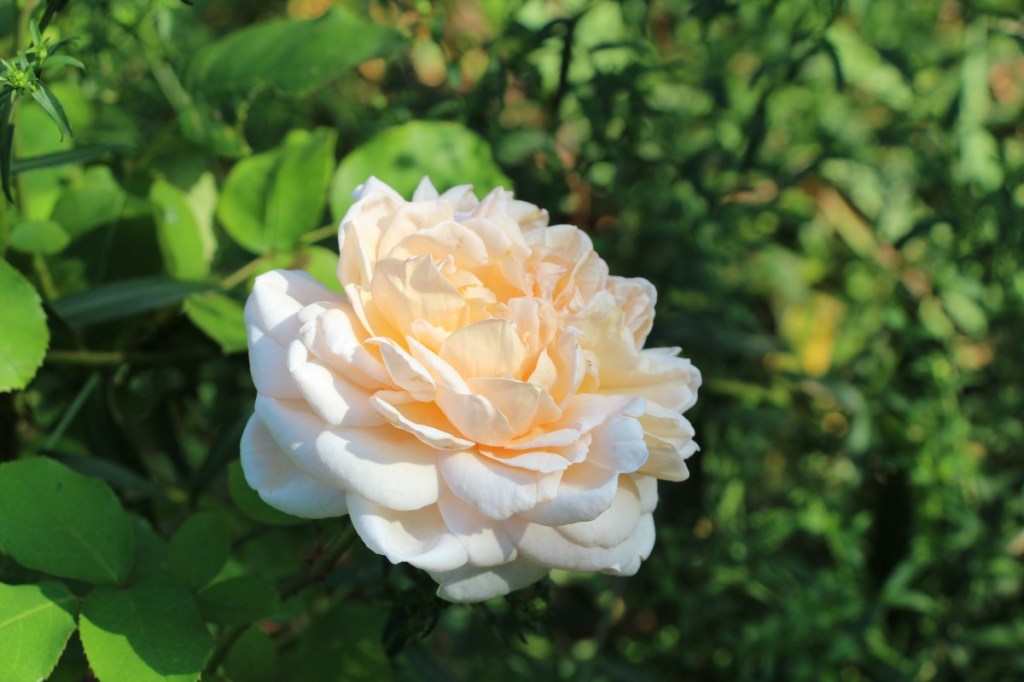
on the other, a rose defies the approach of autumn and flowers steadily as if it is June
whilst the rugosas are into their autumn hips.

There is even a touch of wilding to be enjoyed.

Paths bend and flow, and as in life, choices need to be made….

it is the benign sound of water trickling down into the ornamental pond that beckons us round to the right.

Climbing up the steps it is the generous colourful pots which bring a splash of joy to those hard landscaping areas,

and from the balcony above the circular pond there is an opportunity to look out and take in the serenity and size of this mature two-acre London garden.
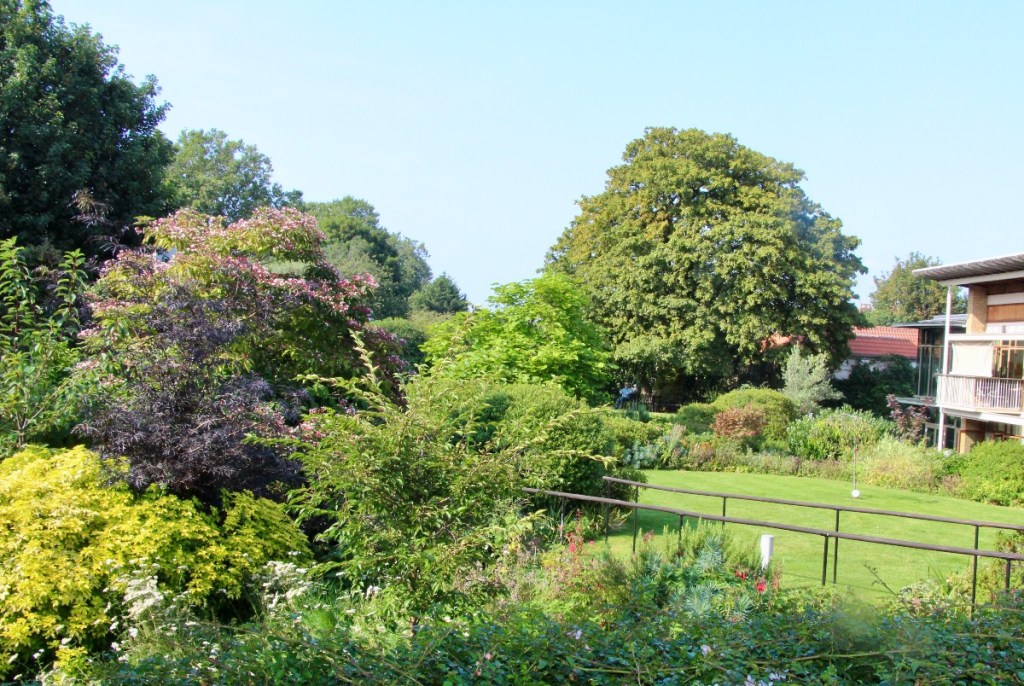
Descending the steps we begin to explore the many hidden areas. A substantial clerodendron grows beside an intimate area. This shrub is very happy here sending up suckers across the path; a native to China it is a quirky coincidence that the roof behind has a slightly oriental feel.

A grassy enclave is home to a fine Catalpa tree , its trunk needing support, it happily grows on.

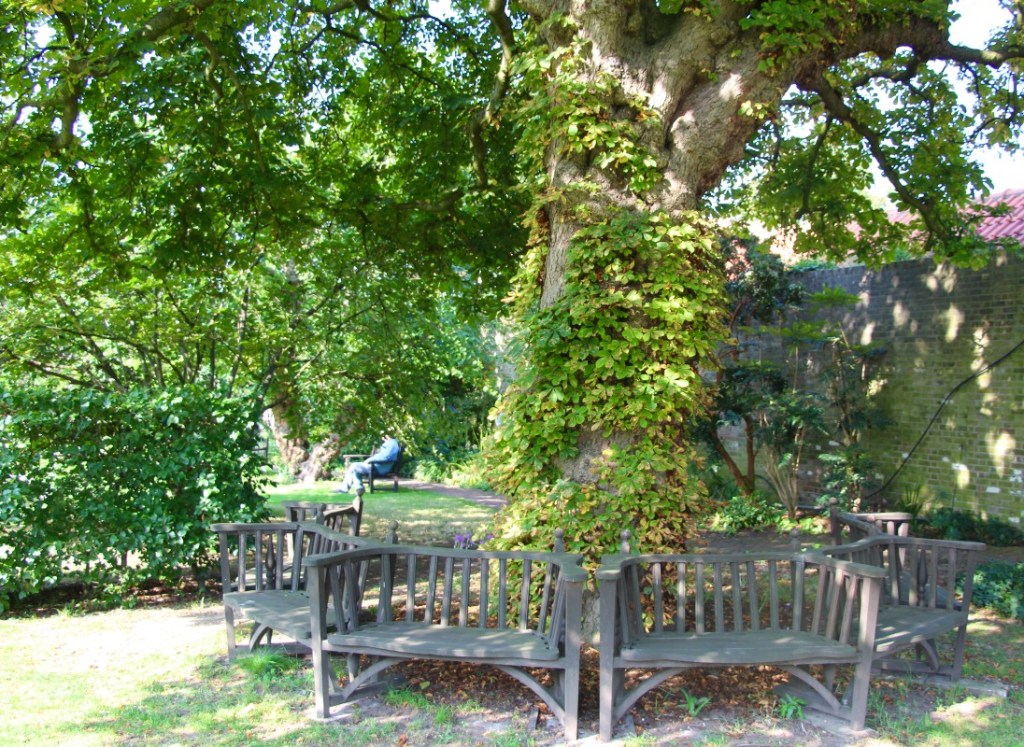
The gardens were very dilapidated before Roper was involved and his first priority were the trees. This old Horse Chestnut tree provides not only a point of interest but also a marker between two separate areas. Its branches must hold many a secret of those conversations shared beneath on the deep seated benches.
Beyond the tree there is quite a different feel as we enter the pond area. Hospices are not just about the patients who are dying but also for those who remain to live on. Here is a perfect place to absorb all the many emotions that go with that unknown future. This afternoon it is pure joy for the first time in weeks, to benefit from the sunshine and the dappled shade.

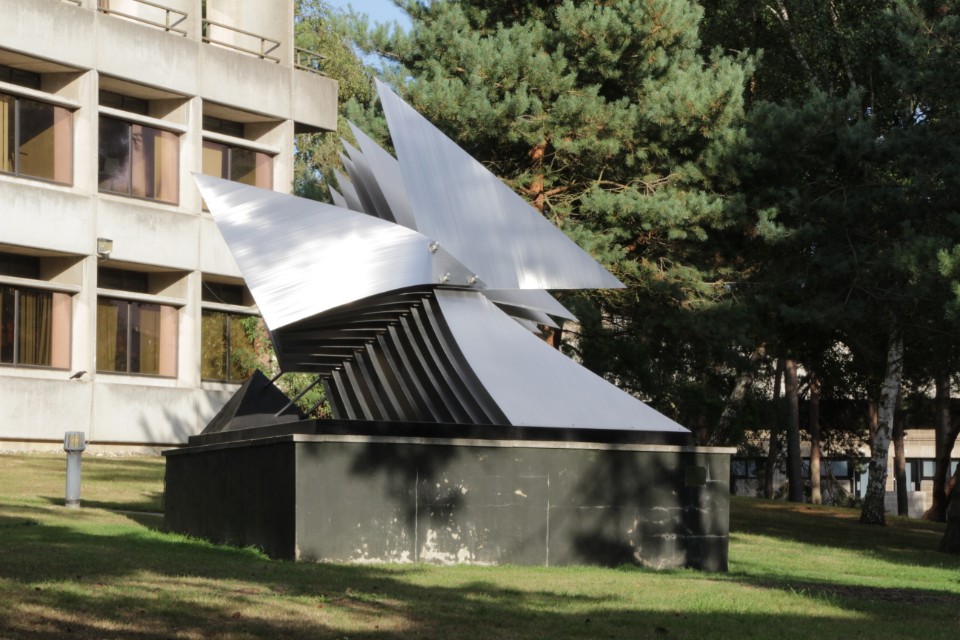
Situated on one side of the pond is the kinetic sculpture entitled ‘Four Open Squares Horizontal Tapered’ (1984) by George Rickey, its subtle movement by the breeze from time to time provides an absorbing distraction,
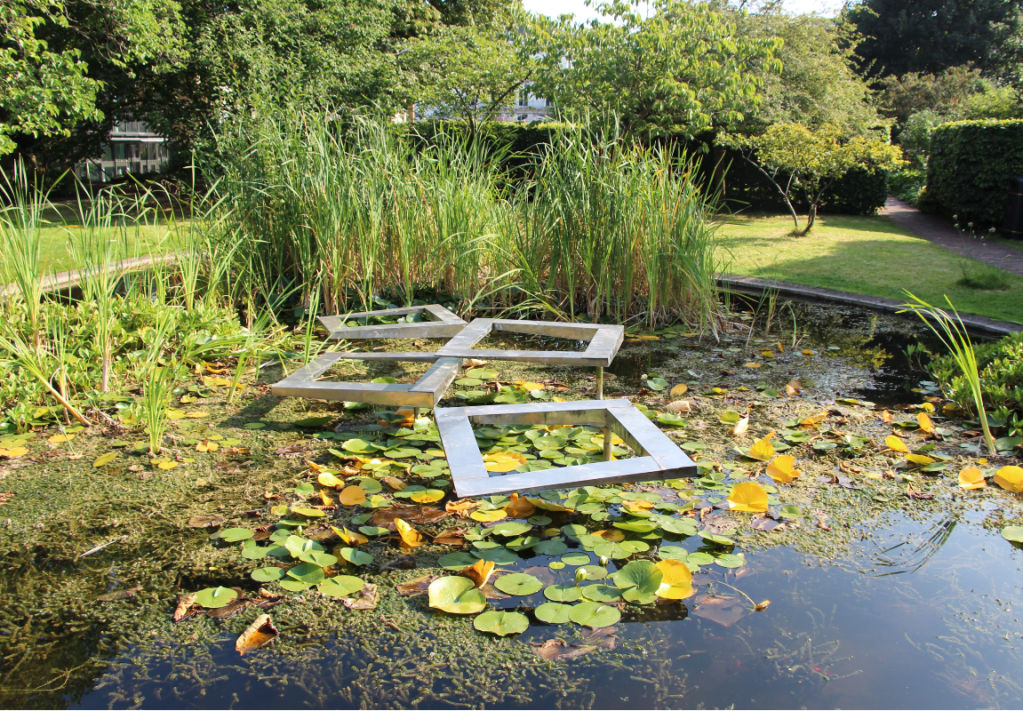
whilst a monster lurks in the deep below.
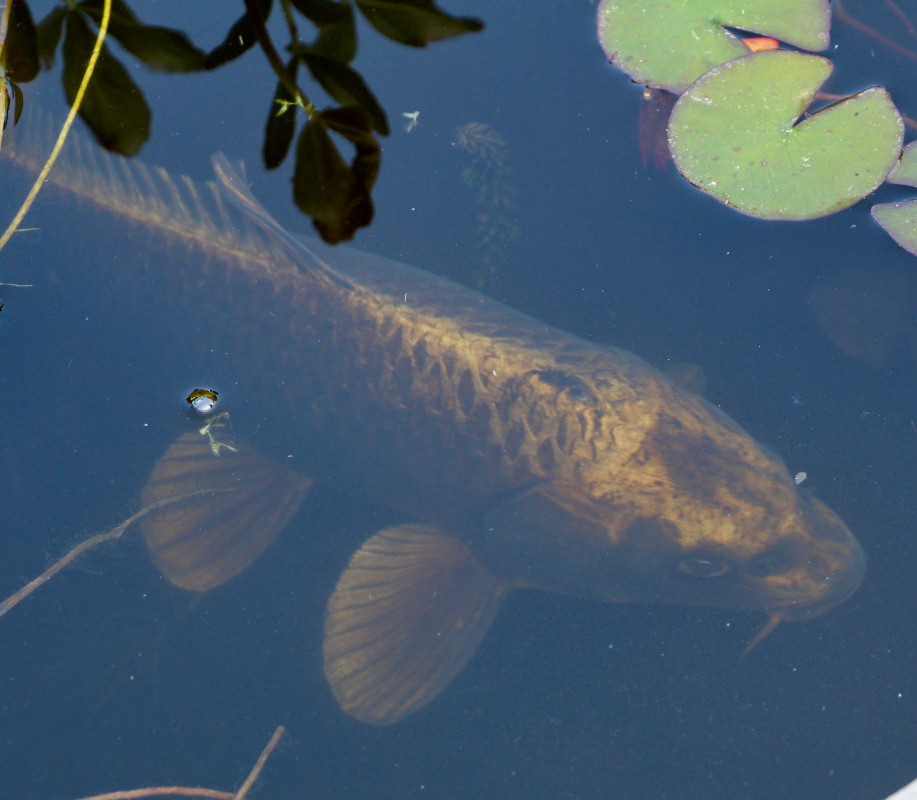
There is a high standard of horticulture here and the Head Gardener has 28 volunteers to keep in order; it looks a serious business.

Behind the pond stands a substantial greenhouse,
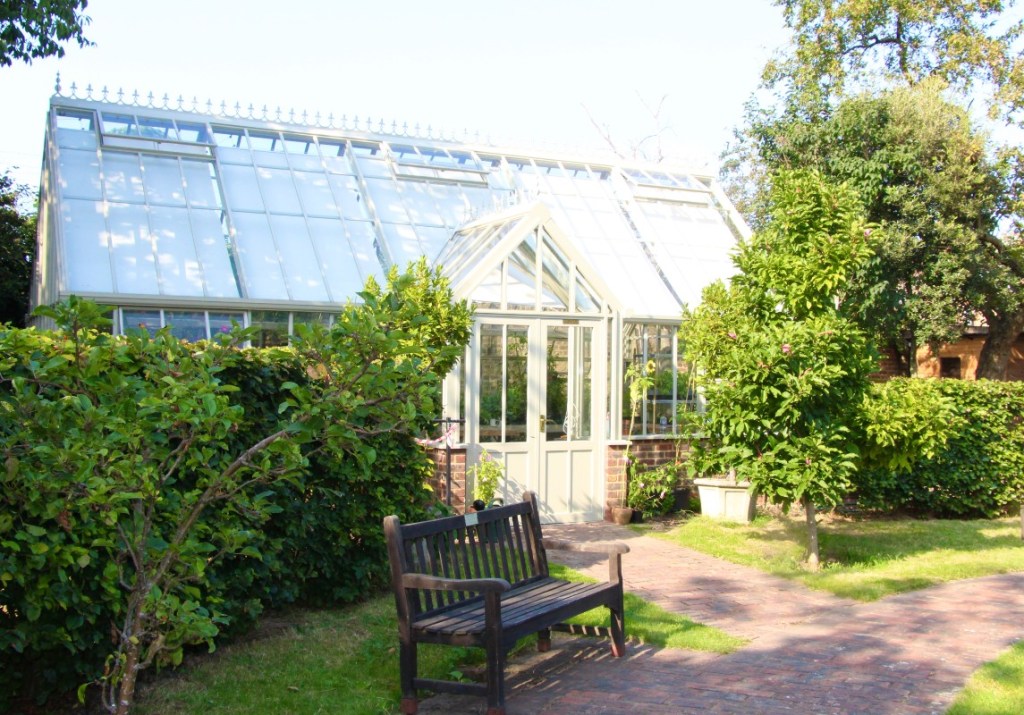
next to which is the productive area providing an air of home-grown; the runner beans are prolific,
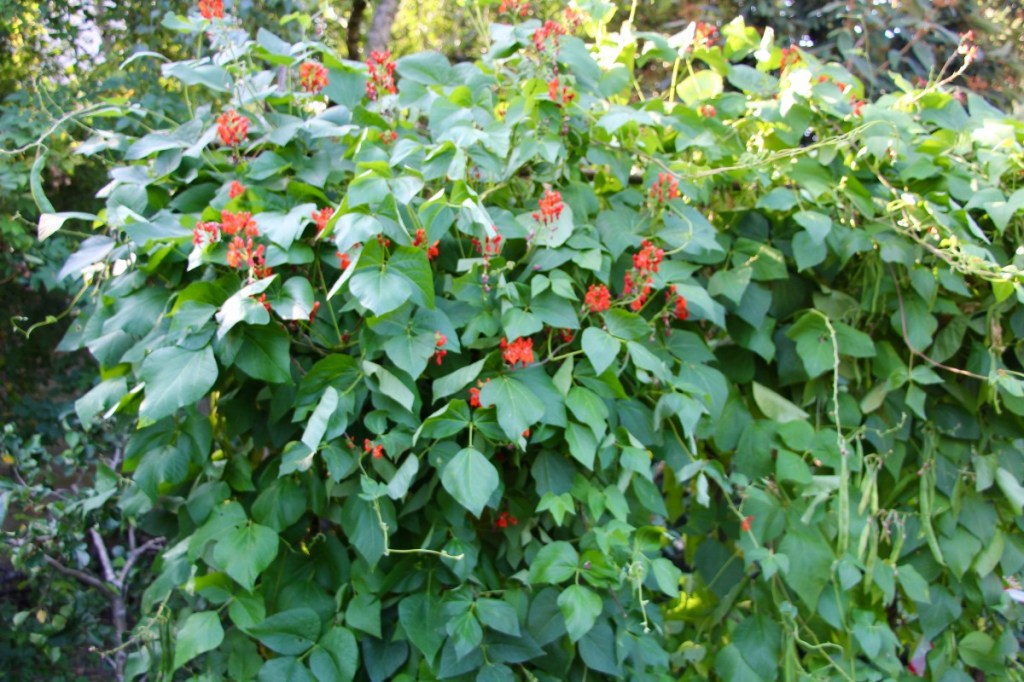
and strawberries too, in their own patch.

There is even an active and busy bee hive which produces Trinity House Honey.
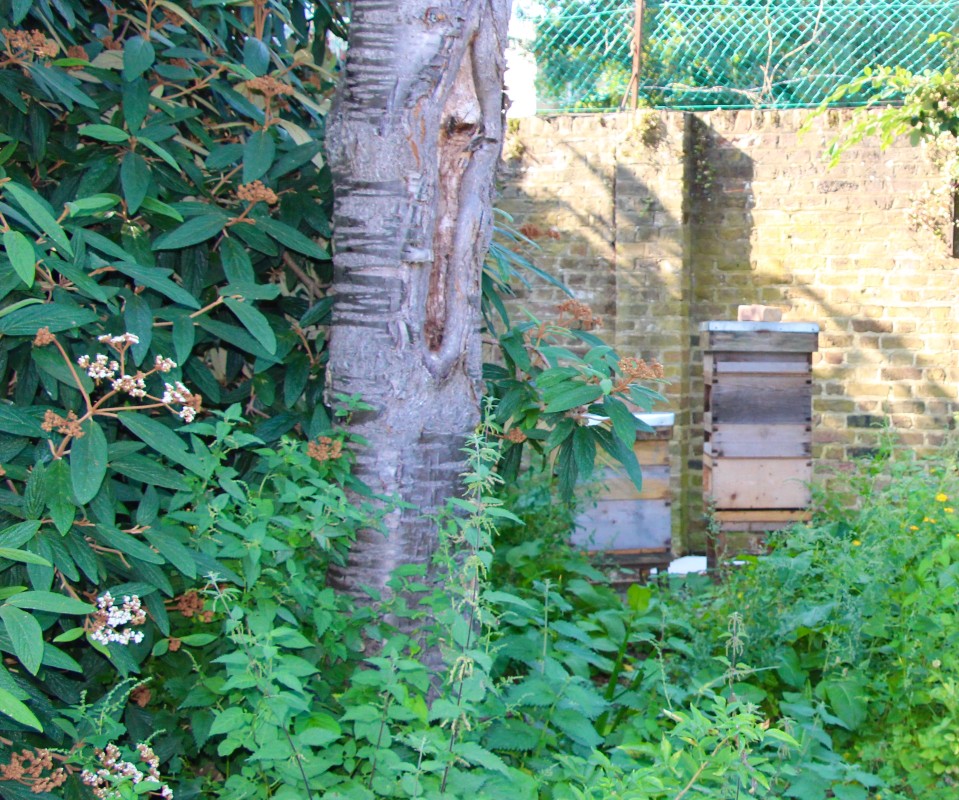
Roper suggested the paths be kept clean with neatly trimmed hedges enticing you to journey into the next space.

He also suggested a palette of soft blue, silver, pink and white which continues to this day. Patients can enjoy the mix from their rooms.

The site is divided in two parts with the modern inpatient complex at the centre. We walk up the steps to where mature trees dominate a fine circular lawn. The Plane tree provides a good meeting place,

with elegant circular seating around its base.
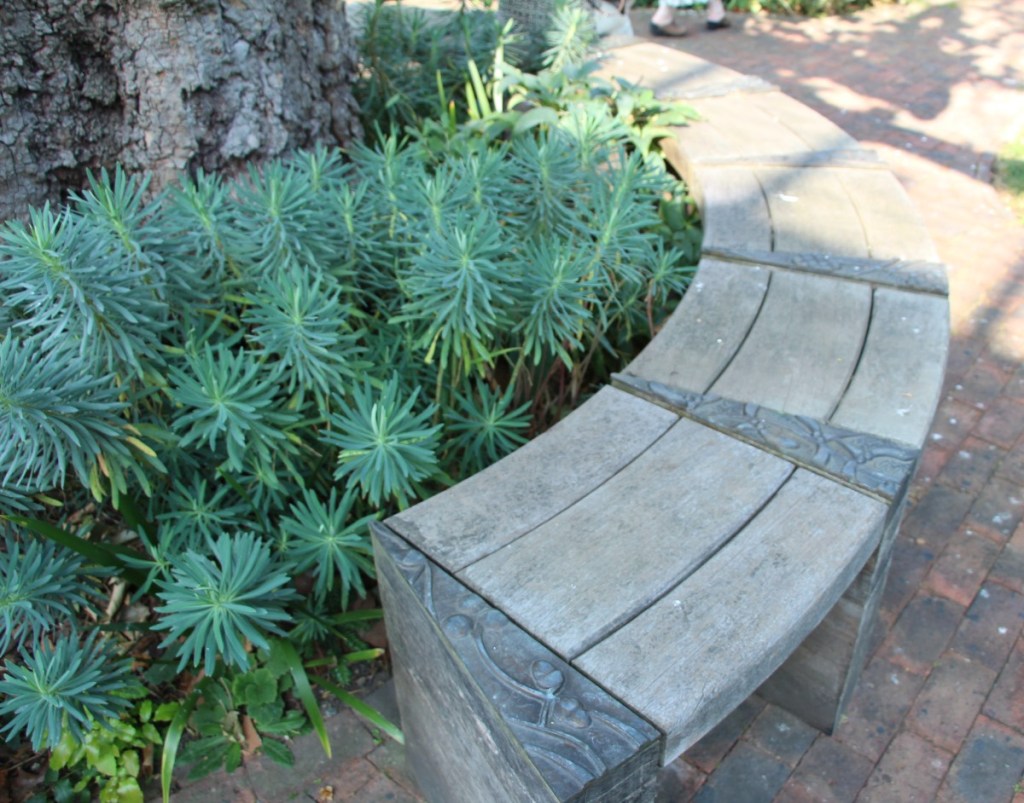
The circular theme is echoed in the perimeter path from where
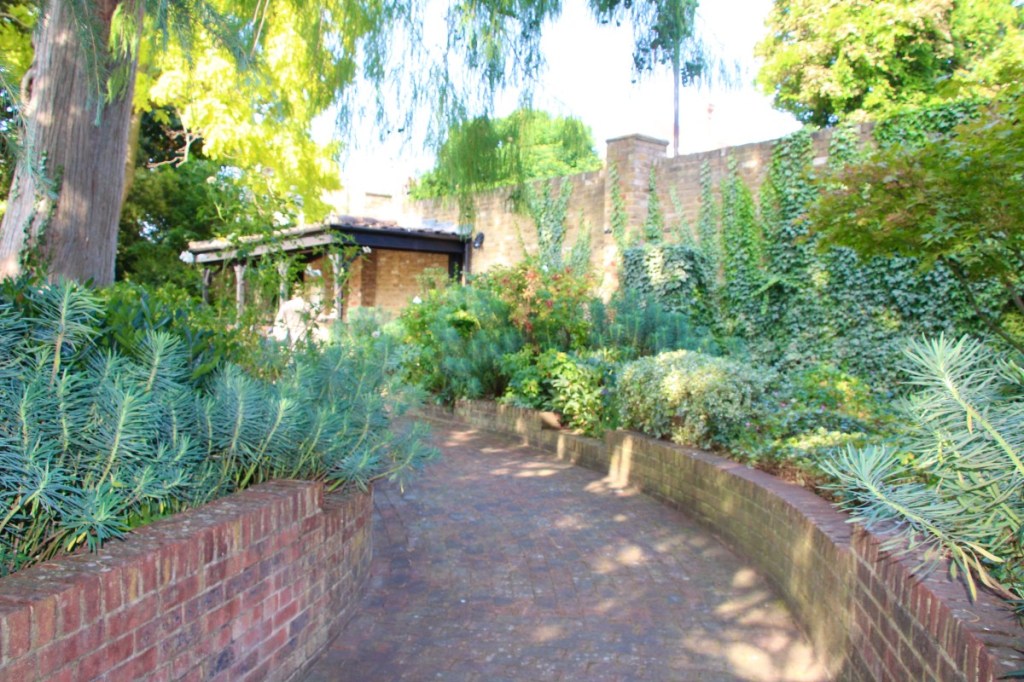
you can glimpse through the shrubs and trees the sun shining down onto the mown lawn where stands the round pleasing pebble sculpture.

Completed after his death the garden became a memorial for Lanning Roper and has been open every year since for the National Garden Scheme.

The Scheme is the largest funder of Hospice UK and has donated more than £5 million since 1996. To understand a little more of the work of Hospice UK click on this link and have a listen to the video too: https://www.hospiceuk.org/support-us/work-with-us/corporate-partnerships/our-corporate-partners/the-national-garden-scheme

Our local hospice in West Norfolk has only recently been built and with it, a beautiful garden planted by volunteers. Let us hope they will sometime soon find a way to open their gates so that visitors can not only appreciate the valuable contribution that hospices make but also help raise funds for the National Garden Scheme.

——-2021——-

Beguiling Burghley

Set within a large delightful park designed by Capability Brown, there is much for a visitor to do at Burghley in normal times: https://www.burghley.co.uk/about-us . Many will know the landscape from enjoying walks around the park, or a visit to the Sculpture Garden and the Garden of Surprises, and many will know Burghley from the famous horse trials held each September. However many may not know the Private South Garden which is seldom open but is hidden away behind the Great House. In 2019 I had a very enjoyable afternoon with a friend when the South Garden was open for the National Garden Scheme.

A far too great a distance for us to bike, but I wish I could have done so, if only to use this ingenious bicycle rack.

The entrance to the South Garden is via the Orangery and it feels strange ascending stairs in order to get out into a garden.

The Orangery restaurant on my left (closed at the moment but soon to re-open) and the garden gate to the South Garden is open through the Orangery Garden.

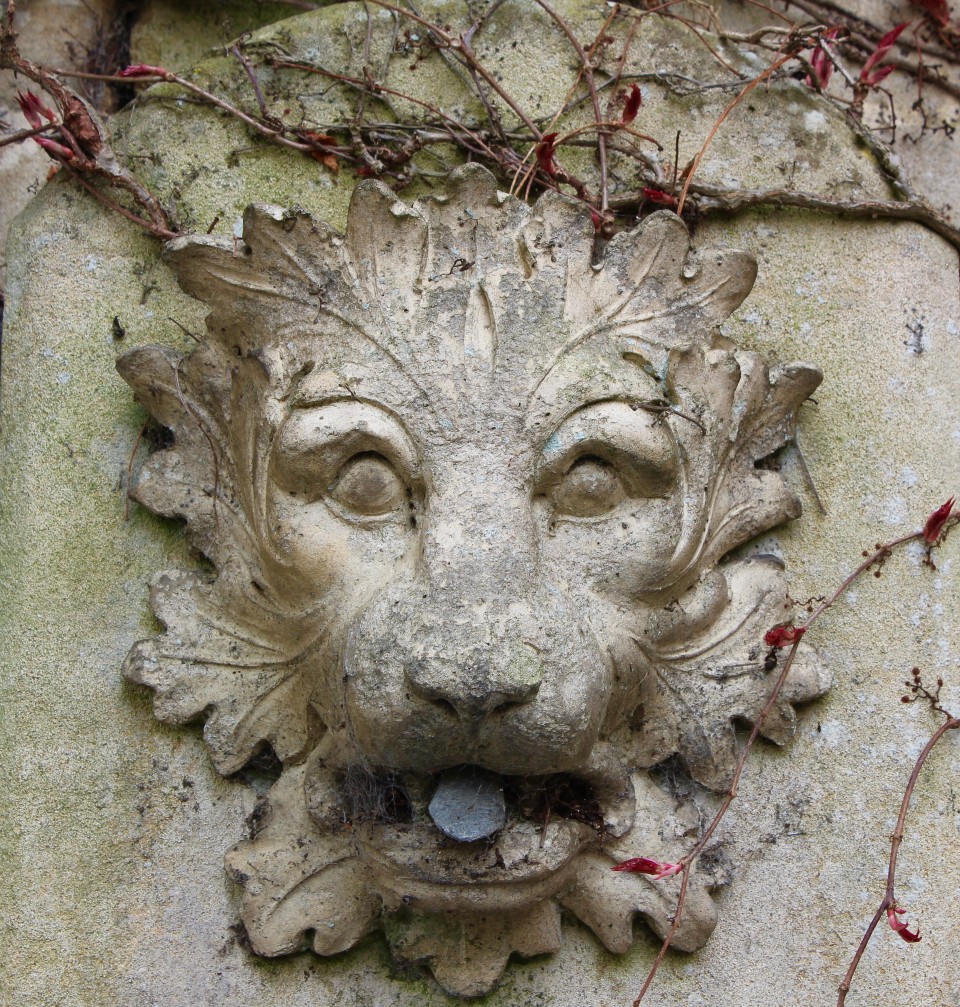
Such a handsome lion watches us quietly,

and a fountain drips gently through the aged moss into the formal pond,

whilst at the base of a pillar a splash of blue catches our eye growing miraculously from within the stonework.

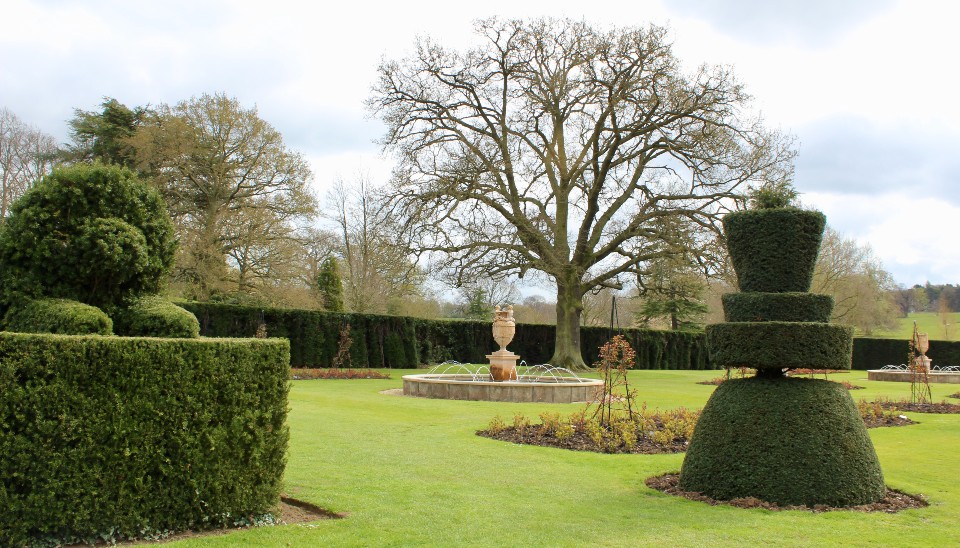
Through the gate a vast expanse of croquet lawn appears before us, and we are drawn towards the dark forms of yew in the distance. Space is certainly not a problem here,

and it is what is required to compliment this great building, one of the largest and grandest houses of the first Elizabethan age. Built between 1555 and 1587 by William Cecil, Lord Burghley, the Lord High Treasurer to Queen Elizabeth I.

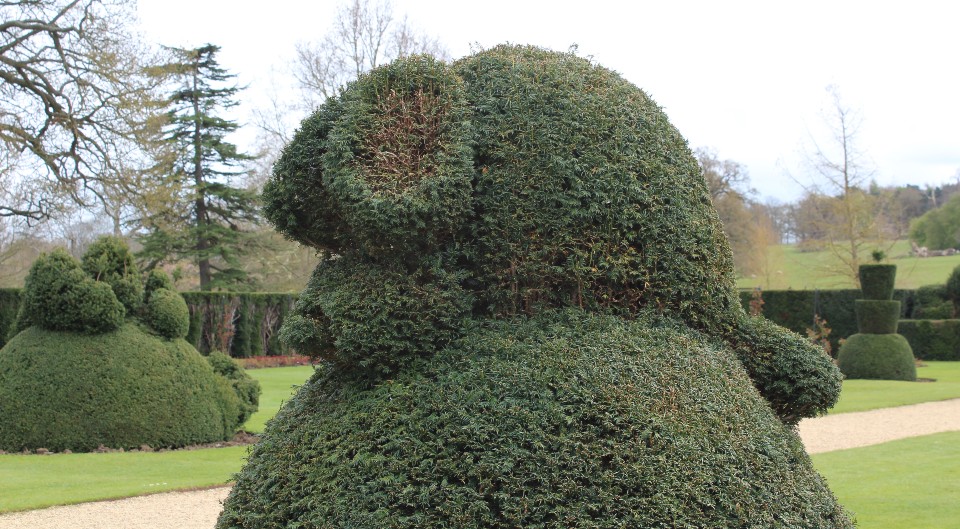
The dark green forms are clipped into shapes, some still work-in-progress, this one perhaps awaiting the emergence of a lion?

Here we see a display of loyalty to the Crown of which the first Lord Burghley would surely have approved.

Who could have imagined such a splendid march of whimsical topiary?

Beds of roses, pruned, trained and mulched are awaiting the warmer weather, and the seasonal lack of colour gives us the opportunity to appreciate the layout and beauty of the many fountains and urns,

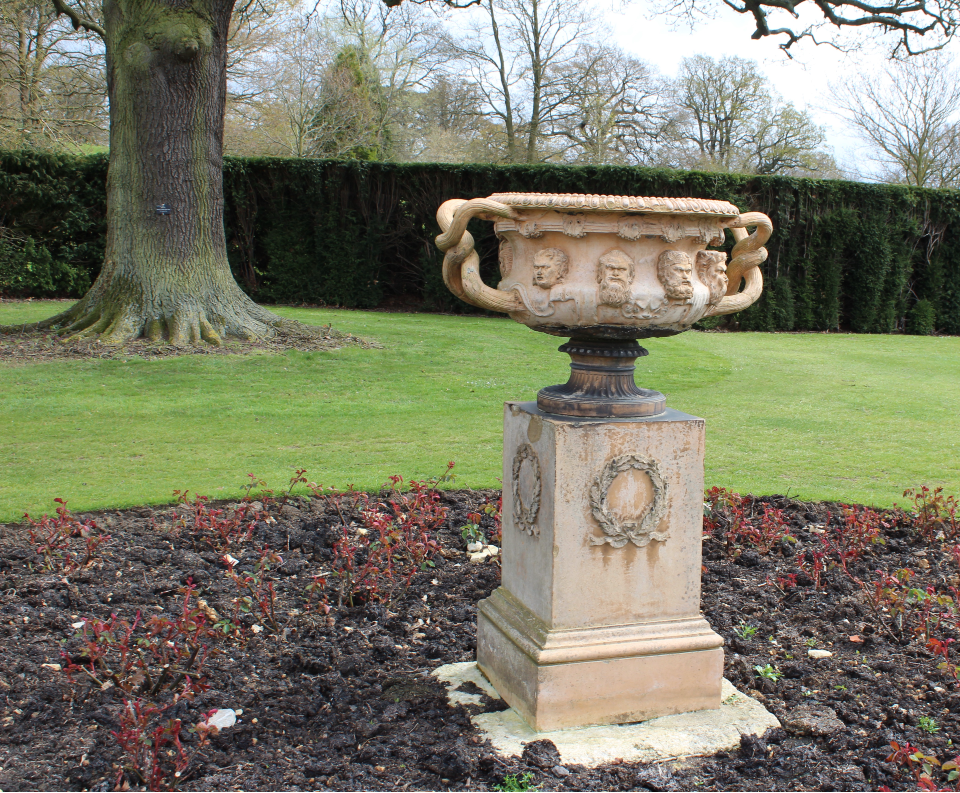
Look at the detail of the intertwined serpent handles and wise old faces. To the side stands a mighty English oak Quercus robur described by the Woodland Trust as ‘The ruling majesty of the woods, the wise old English oak holds a special place in our culture, history, and hearts.’ A description truly appropriate to this fine specimen which was planted in 1844 by Her Majesty Queen Victoria.

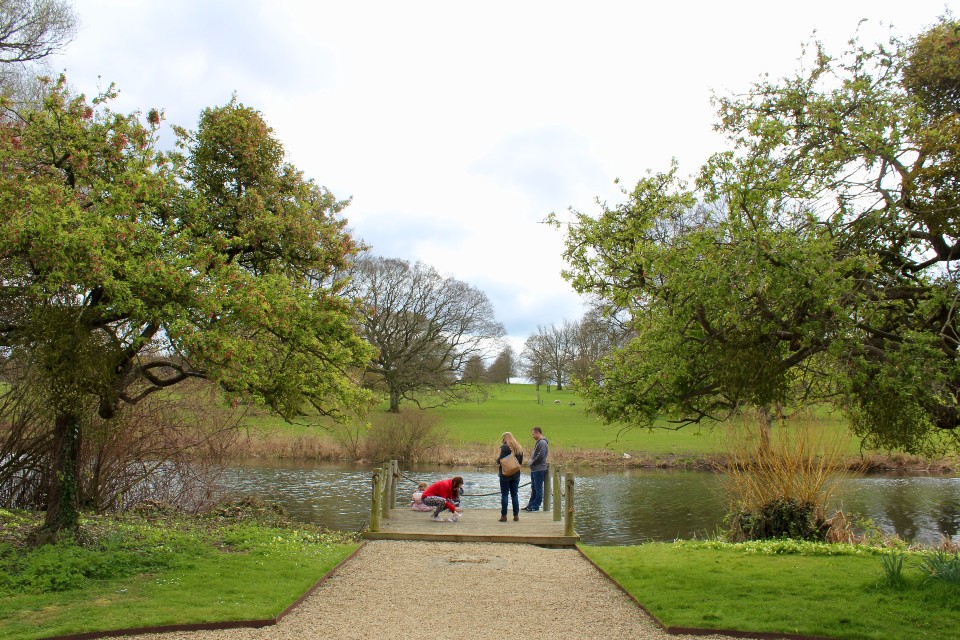
At the far end of the walk is the jetty extending out over the lake; a perfect spot for that wild swimming we are encouraged to enjoy nowadays. It is a freezing cold day and I am relieved to find nobody is tempted, and so we turn to face the house,

the view of which is far more exhilarating than taking the plunge.

I always think there is something rather mystical about mistletoe growing high up in a tree but now it is a joy to see it close up on the lower branches.

We move around from the south side to the west; little wonder that Horace Walpole referred to Burghley as “A noble pile! ” We marvel at all things ancient, including the trees. Queen Elizabeth I is reputed to have planted this Lime tree.

I am sure those twisted branches could tell a tale or two…..

One would not wish to leap the Ha Ha, as it is quite deep. A cunning device, the Ha Ha physically separates the lawns from this Brownian park without dividing it visually.

and if you did wish to attempt to climb the fence, you might be restrained by this ornate but effective barrier.

In fact everything has been designed with beauty in mind, nothing more so than these golden gates made by Jean Tijou in 1693; just imagine taking your sundowner with this as the backdrop.

We retrace our steps around the south side taking in the charm of more topiary creatures, this time a snail,

and here, a wee mouse,

and a cunningly created two-faced fox, or is it a bear?

We leave the characters on the flat but sunny south side of the house and ascend the hill towards the east.

In front of a bank of blossom stands yet another magnificent urn where even the snakes seem to smile.

It is less formal here with a variety of narcissi bringing a feel of springtime under foot,

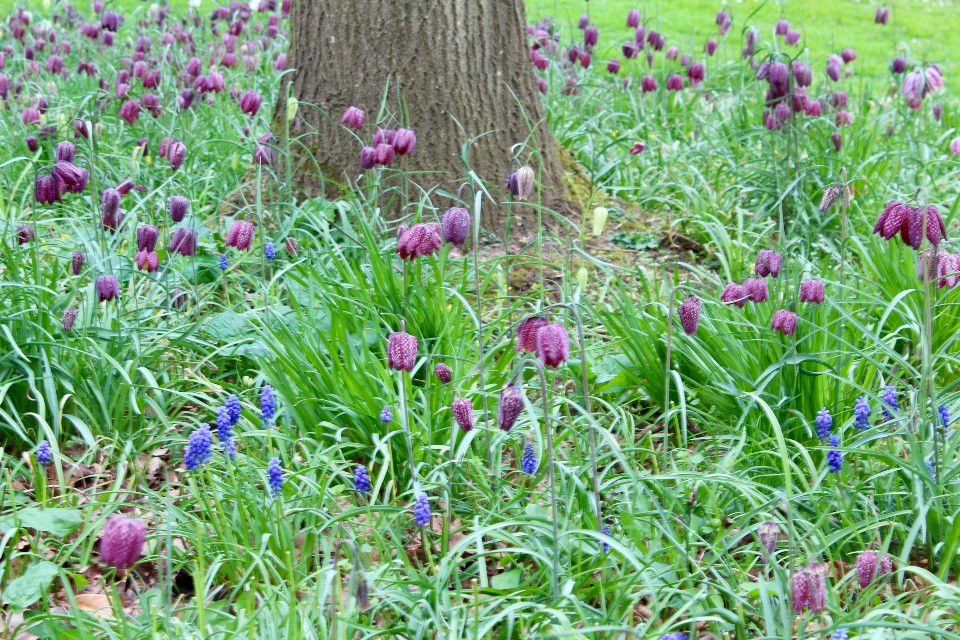
and Snake’s head fritillary Fritillaria meleagris nodding in the breeze. Years ago one might buy these delicate flowers in Covent Garden for just a penny or two, supplied by children who would gather them from the meadows along the River Thames where they grew in abundance.

However good the faithful hounds of the household were, they are surely not forgotten; how a headstone can say it all.

Around the corner is a charming neo-Jacobean banqueting house set on a sloping lawn. The front overlooks the lake,

with a simply stunning back door.

It is behind here that a tennis court has been sited; I am not sure whether Brown would approve but I am sure he would find the ornate bench the perfect place from which to watch the game.

A boat house sited across the other side of the lake was built in 1871 and replaced an earlier building. 

This is a shrubby area with mature cedars growing elegantly by the lake.

We return to the orangery garden and my friend admires the neat chestnut paling fence.

The south garden was one of the original gardens to open for the National Garden Scheme back in 1927 and if you have missed this weekend’s opening, I thoroughly recommend a visit when it next opens for the Scheme this time next year. https://ngs.org.uk/view-garden/1387

It is also the 500th anniversary of the birth of Lord Burghley, with a series of lectures intended at Burghley House https://www.burghley.co.uk/news/lord-burghley-500th-anniversay-lecture-series and I am looking forward to learning more about the great man at the symposium to be delivered via Zoom from the Garden Museum later this month https://gardenmuseum.org.uk/events/burghley-500-symposium/

Snowdrops

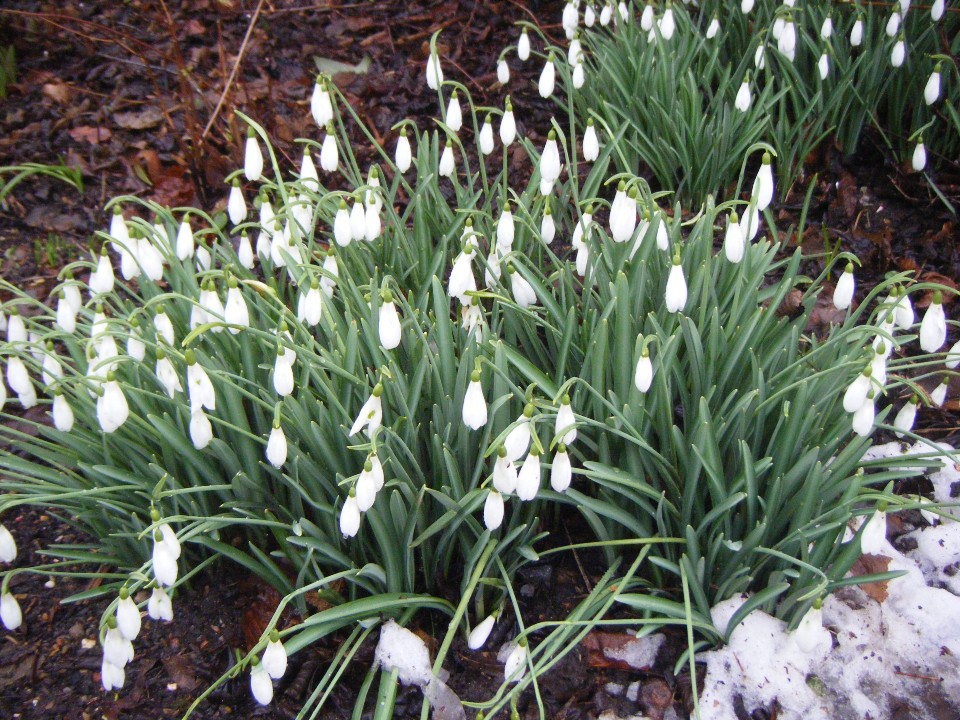
Through all these cheerless covid months and ghastly weather, the snowdrops have been silently pushing up through the cold, sodden ground. Their delicate flowers, surely could not be more welcome. Restrictions have forced the abandonment of the National Garden Scheme Snowdrop Festival however, some gates of a smattering of gardens will be open across the country this February, for those visitors lucky enough to be local to them. However in the eastern region, deep snow has forced many closures. More details can be found at https://ngs.org.uk/february-openings-2021/.

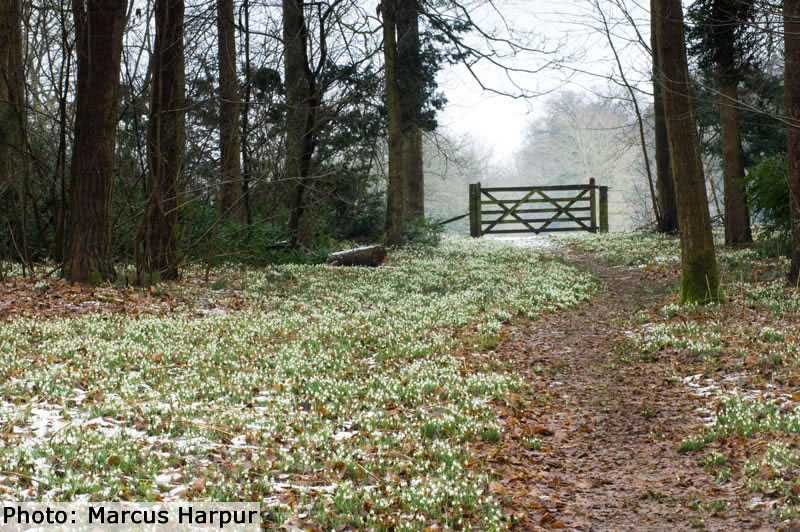
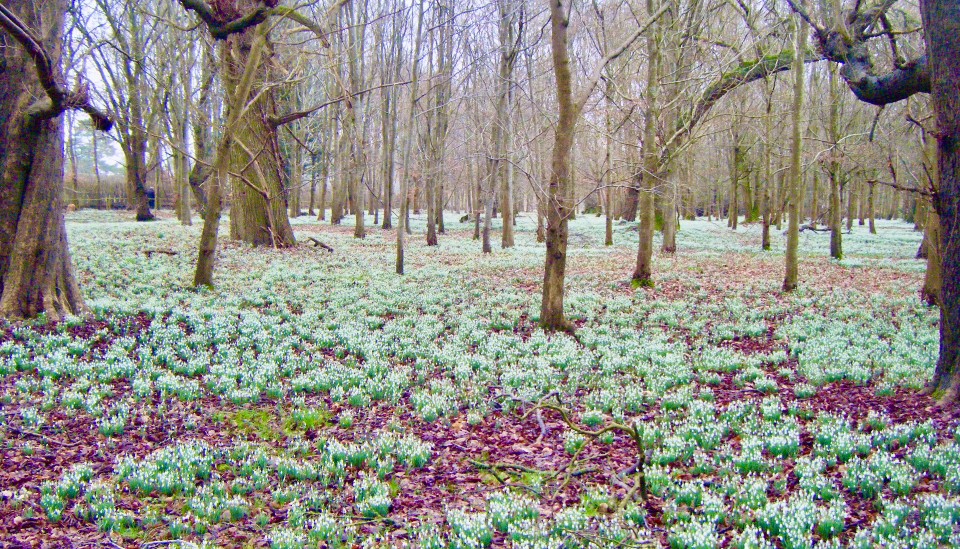
Back in 2017 when travelling was unrestricted and I was able to visit some 90 gardens throughout the year in celebration of the 90th anniversary of The National Garden Scheme, the snowdrop gardens were memorable; and I would identify three different types of snowdrop landscape: The snowdrop walk such as at Welford Park in Berkshire where the sight of millions of these tiny flowers carpeting the woodland floor was a sheer delight.

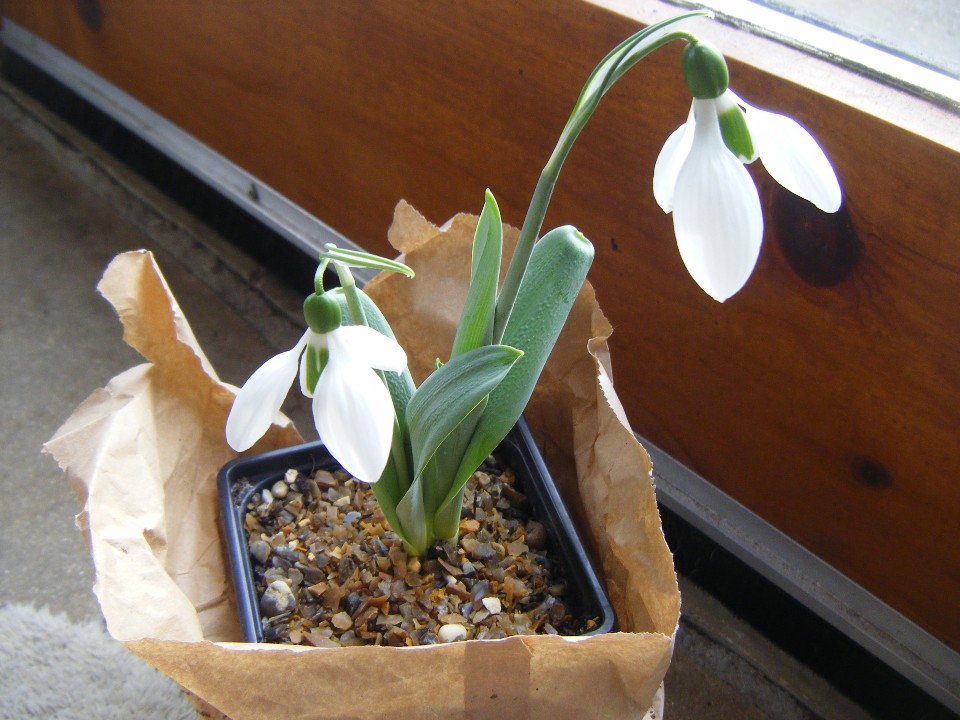
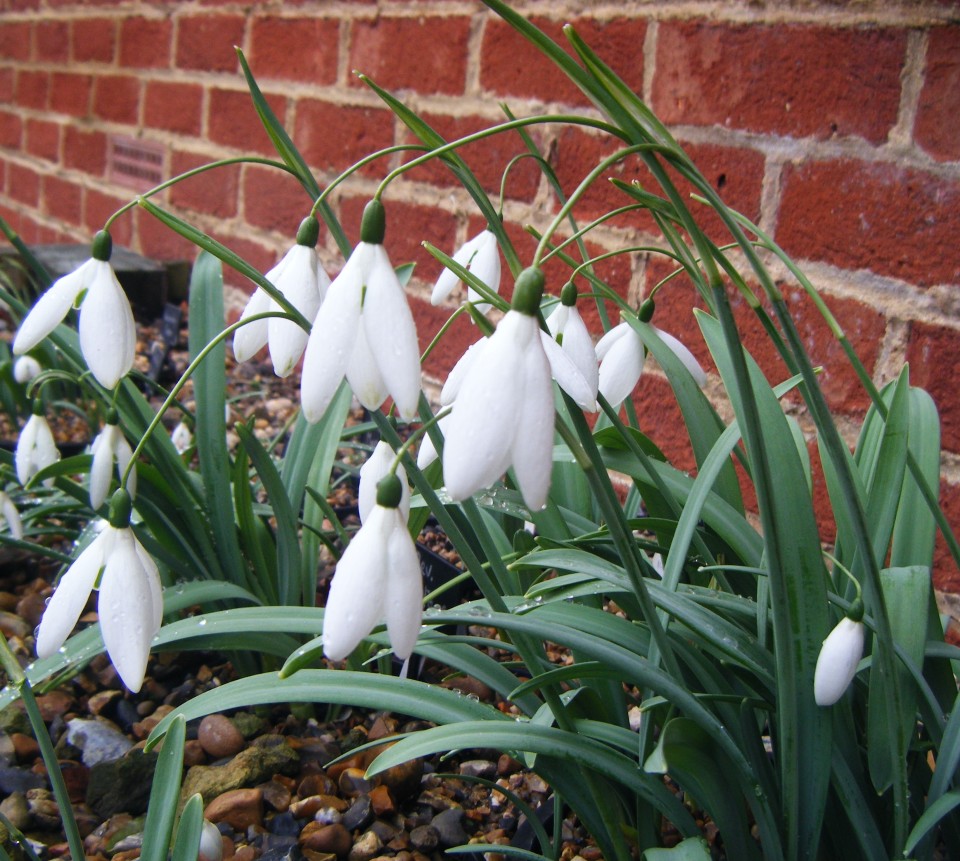
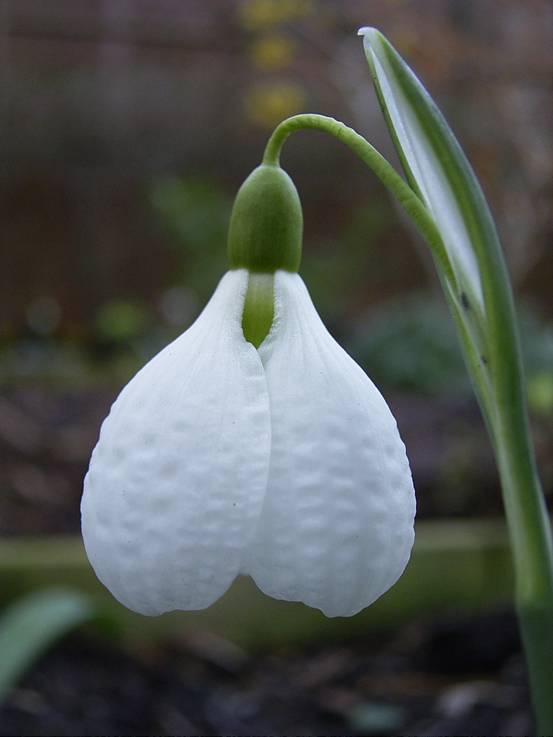
Of course you cannot come away from any of these landscapes without buying some little temptation, and so I bought Galanthus ‘Brenda Troyle’ and in my blog which followed I airily asked the question who is Brenda Troyle and was delighted to receive a knowledgeable reply. https://thegardengateisopen.blog/2017/02/14/snowdrops-spike-and-baked-off-at-welford-park-8

The second type of landscape is the simple but lovely Snowdrop garden where you find clumps of snowdrop scattered beneath winter shrubs, and bringing life to dormant borders, such as here at Gable House near Beccles, where Galanthus ‘Atkinsii’ is prolific.

Here amongst the plant sales I could not resist Galanthus elwesii ‘Brian Matthews’ who is now doing well in my own border.

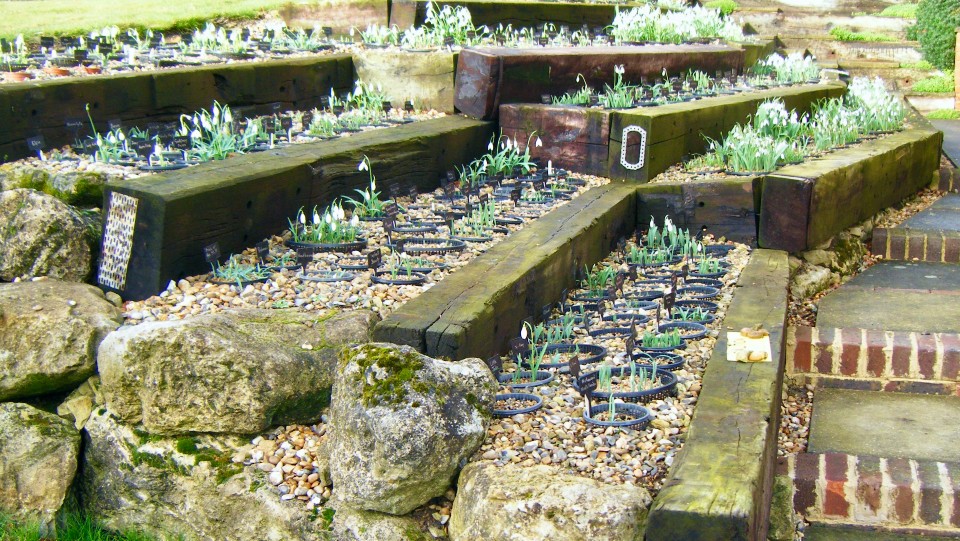
The third type of landscape is quite different and fascinating; that of the The snowdrop specialist, such as at Spring Platt in Kent https://kentsnowdrops.com/#home. A snowdrop spectacle, where they are arranged in a display, individually potted, seemingly different and labelled, each with a beguiling name. You could say, and although I am not fond of the word, it was here that I experienced the first stirrings of becoming a ‘galanthophile’.

It was ‘Fly Fishing’ that was my purchase here, a must for any fisherman and so it grows just outside my husband’s office, a bending rod gently moving in the breeze.

Then things began to get expensive; at £40.00 per tiny bulb (and that is nothing in this world I can assure you ), I could not resist ‘Tilly’. She is spreading nicely so I am not feeling quite so bad about that reckless expenditure.

Then my first granddaughter was born, so in celebration I planted Galanthus plicatus ‘Florence Baker’ (please could someone please breed an Alfie), and my small collection began to expand, and all around the garden I have the names of friends and family growing gracefully, all different and doing their own thing. Last year I painstakingly labelled each one, only to be stumped by my dogs who thought this was a great idea and spent the summer months finding and helpfully retrieving them.

The names always intrigue me and I like to know their origin, so I bought, begged and borrowed books on the subject, the snowdrop ‘bible’ being the most elusive Snowdrops A Monograph of Cultivated Galanthus by Matt Bishop, Aaron Davis and John Grimshaw, which I was fortunate to be lent and I notice that although currently unavailable on Amazon it is a mere £550 on ebay.

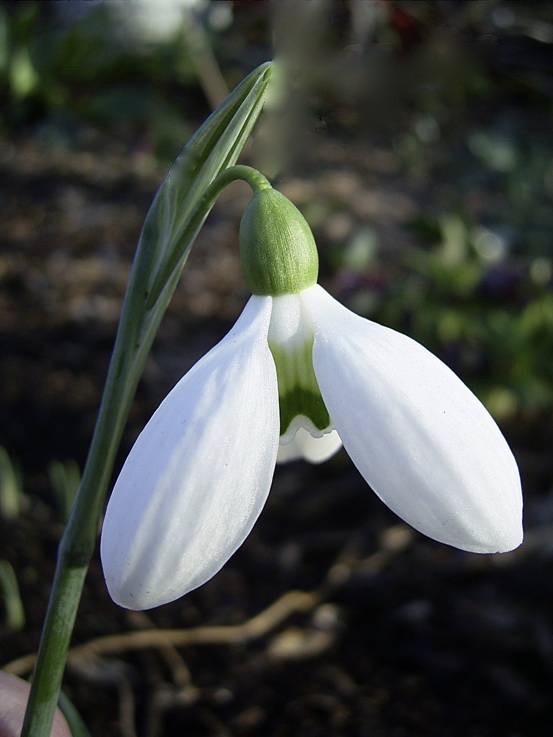
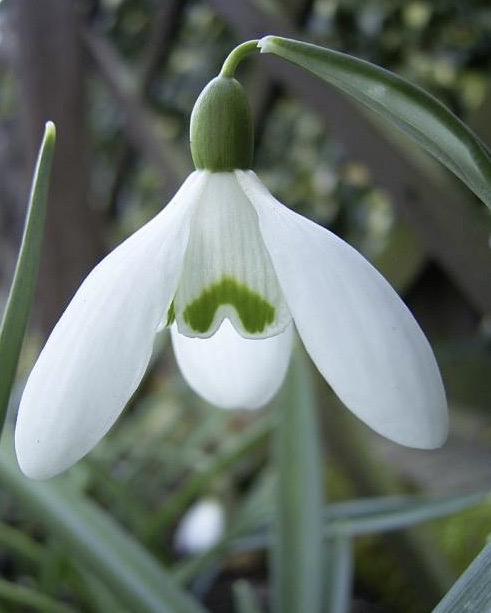
I also find this website invaluable and the photography sublime. https://www.judyssnowdrops.co.uk/Plant_Profiles/plant_profiles.htm. This is from the website and shows Galanthus ‘S Arnott’ a lovely tall snowdrop with a scent of almond and recommended by ‘The Land Gardeners’ http://www.thelandgardeners.com/home as a cut flower which however they suggest potting up and bringing indoors rather than picking.

Snowdrops do come in other guises; I loved this giant wicker snowdrop standing at fifteen feet high at Trentham Gardens in Staffordshire,

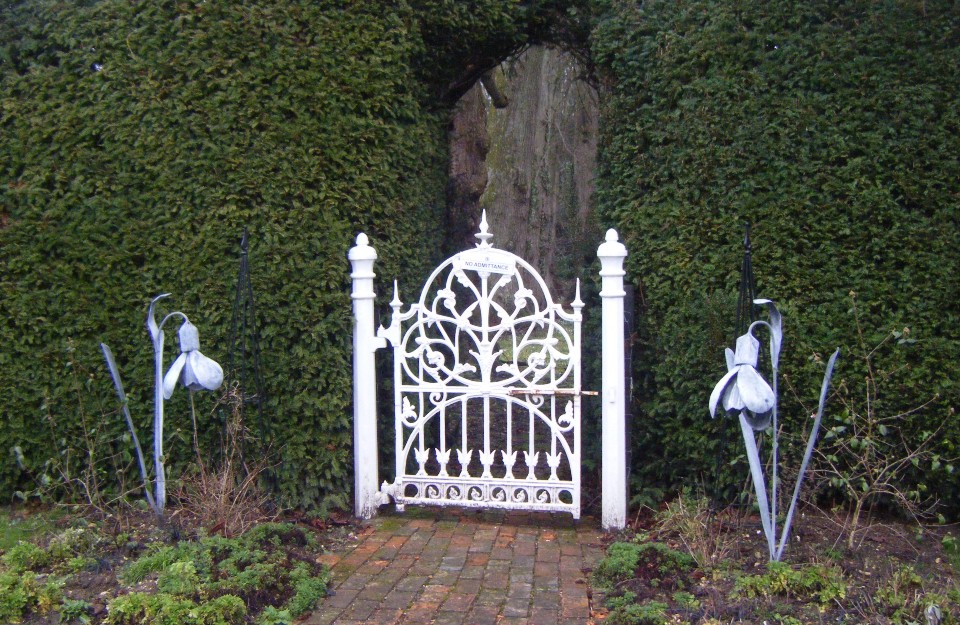
and these metal ones either side standing guard at a gate in Welford Park.

My garden is deep in snow with not a single snowdrop in sight, just a metal sculpture, a reminder of what will be there when the thaw comes.

I have already made this year’s purchases, Galanthus plicatus ‘Three ships’ which should flower before next Christmas from friend, plantswoman and instagrammer Jane Anne Walton, and the other in aid of St John Ambulance Galanthus plicatus ‘Diggory’, a Norfolk boy, he is a beauty.

Luckily for me I have a Snowdrop Walk local to me and which will be open next Sunday 21st February in aid of the National Garden Scheme https://ngs.org.uk/view-garden/4388. If that path isn’t just the perfect place for a little exercise, then I don’t know what is.

There has never been a greater time than now for us to support the nursing and care sector and so if you are unable to take your exercise in a local snowdrop garden why not consider making a donation by visiting the just giving page https://www.justgiving.com/fundraising/norfolk-ngs

——-14-02-21——-

Thralling Thenford

Last month I was delighted to be able to visit Thenford, Northamptonshire on one of its open days. A very private and expansive garden it is the stately home of Lord and Lady Heseltine who acquired it in 1976.

As we swept through the imposing gates we had no idea what to expect, other than we knew there was a walled garden and an arboretum. The afternoon sunshine welcomed us in.

We thought this would be a pleasant distraction from the Covid troubles only to find as we parked in the field north of the house, that many other visitors were decked out in face masks; surely not necessary for an afternoon outside?

Heading straight ahead of us to the sunken rose garden which is south west of the house, it is the Barn owl which catches our eye; so realistic in its stance we wonder if it might take flight.

The roses, all helpfully labelled are understandably not at their best now but the putti provides entertainment instead.

This heavenly bench must be the perfect place to linger and enjoy the heady scent on a summer’s day.

We decide to visit the arboretum first and so take the path along the south front of the handsome Grade 1 listed house. On the lawn Guy Taplin’s graceful cormorants enjoy the unspoilt view from the ha ha.

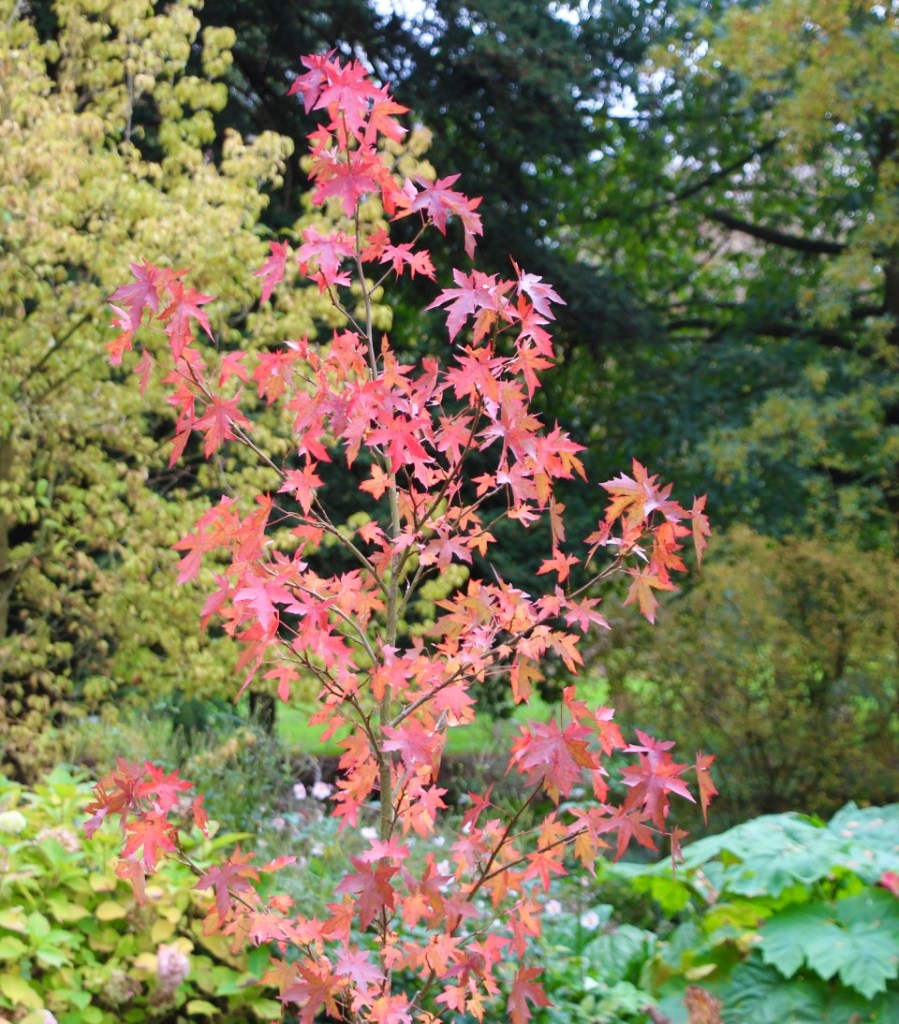
October is the best time to visit an arboretum, and Thenford did not disappoint. An enviable collection of trees; approximately 4,000 different types. The maples (Acers) in particular are in glorious technicolour, some have turned golden

others bright red, and all showing how nature can age so majestically.

The berries delight too, from the simple Spindle Euonymous hamilton English Charm,

to the scarlet berries of the Rowan Sorbus matsumuranu

and to the small black berries of Aronia melanocorpa grandiflora, the black Chokeberry.

Take a look at the litchen growing on the bark and how well-armed is the trunk of Gleditsia japonica koraiensis.

The arboretum is spread out over 70 acres and, following the path through there are tranquil glimpses of pasture, sheep and lake.

There are some 113 champion trees (individual trees that are exceptional examples of their species because of their enormous size, great age, rarity or historical significance) here planted well before the Heseltines arrived here, however this young liquidamber demonstrates that planting is ongoing.

A few flowers are evident, the white flowers on the Viburnum plicatum f. tomentosum ‘Dart’s Red Robin’ determinedly project upwards,

and the low growing shrub Heimia salicifolia which has tiny yellow flowers. Native to S. America you can obtain your legal high from this little gem but, I am informed, it is quite short lived.

It is also a watery landscape with the three medieval fish ponds planted decoratively with not only trees but also a diverse selection of shrubs and perennials, with an abundance of bridges that span and reflect; there is a green, a red,

a blue

and a neat brick, the shape of which

is similar to that of the ice house.

Sited above the fishponds and best viewed from near the ice house is the parish church of St Mary caught in the afternoon sun.

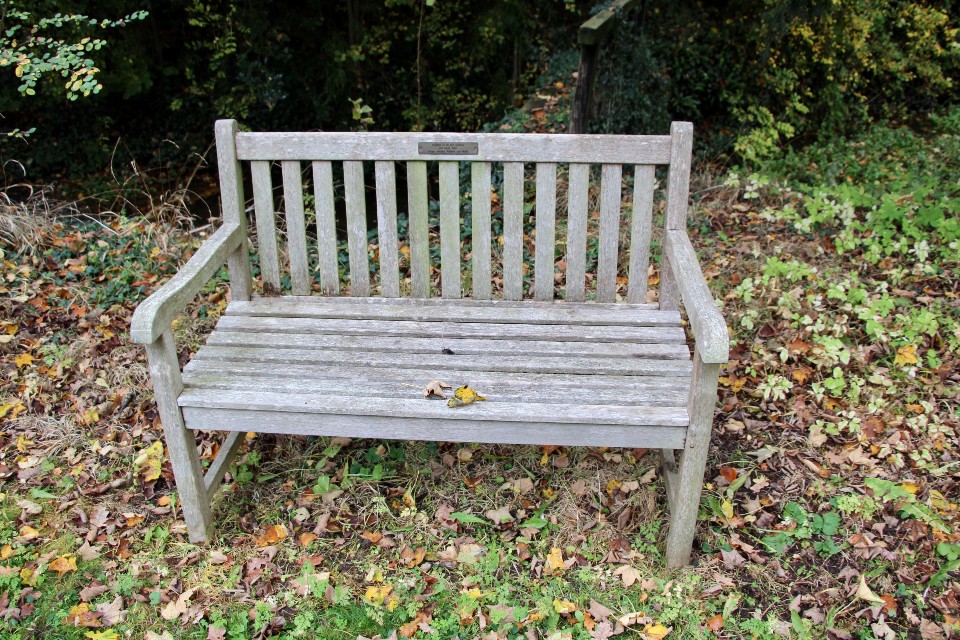
In such a vast area benches are a necessity and so often in public spaces they are there to commemorate a person. This one, a birthday present from the grandchildren, perhaps touchingly displays something of the owner’s character ‘Grandpa to sit and scheme’.

The leaves beneath our feet give off a delicious aroma of caramel; they have fallen from the Katsura tree, Cercidiphylum japonicum.

It is hard to believe that a tree trunk could be quite so white; in this grove the low sun highlights the brilliance of the silver birches.

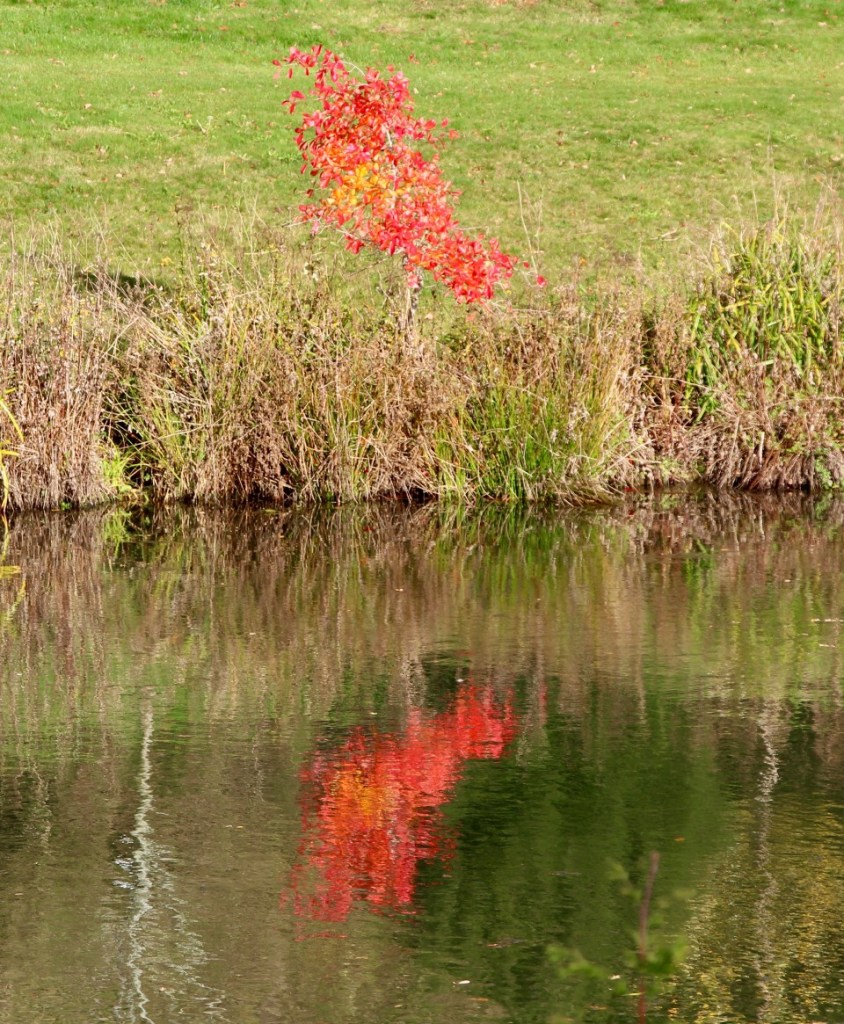
Moving on we come to yet more water, the New Lake where reflections seem brighter than the actual image.

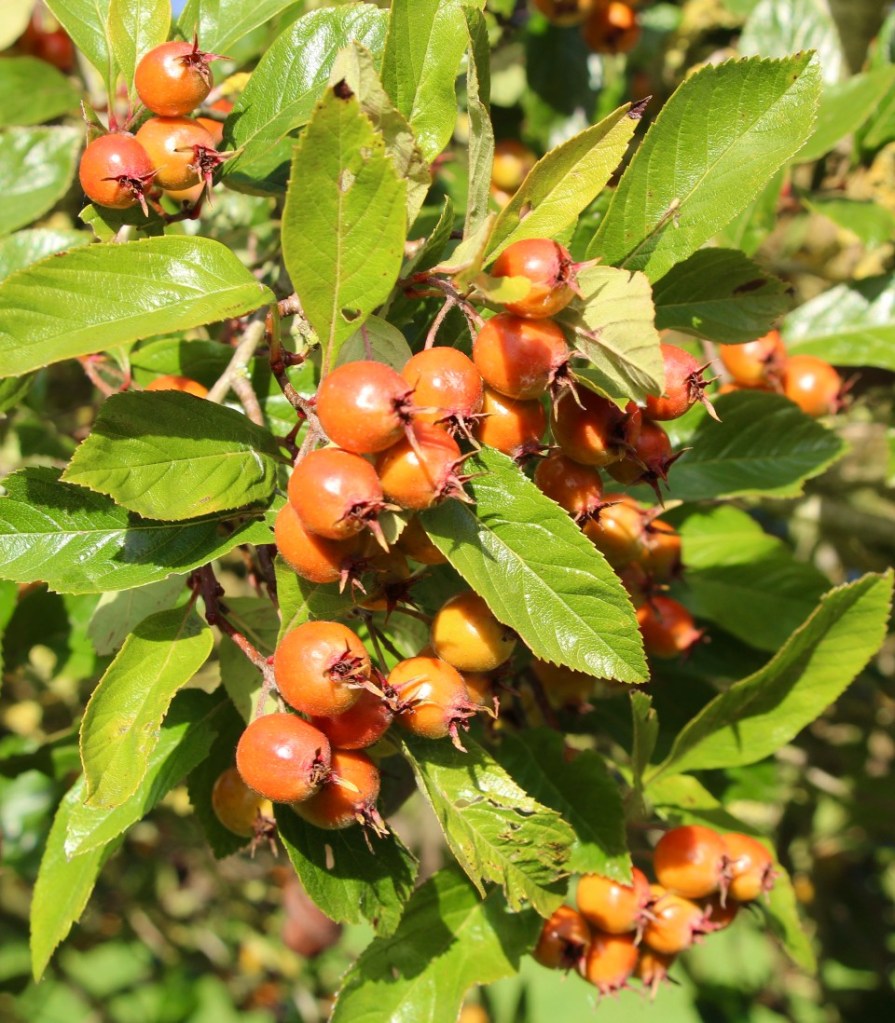
Along the lake is a gathering of humble but handsome hawthorns, cratageus crus galli,

similar but smaller cratageus canbyi

and looking good enough to eat, the orange-coloured hips of cratageus x lavallei carrierei.

This is the southernmost tip of the arboretum and before turning back we pause awhile and admire what has been achieved here over the past forty odd years and wonder what it will look like in another forty years.

On the hillside we come across three conifers looking like some weird and wonderful beasts.

Passing the house again we head for the walled garden over on the east side and find in Lannings Walk this wicked little chap.

I make a mental note to plant cyclamen hederifolium, they brighten up any woodland floor.

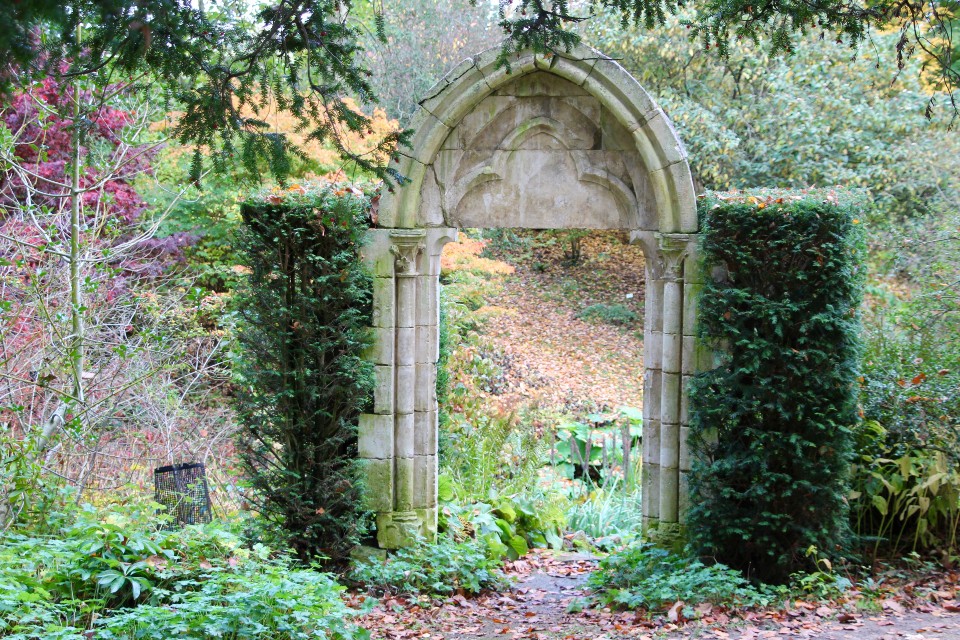
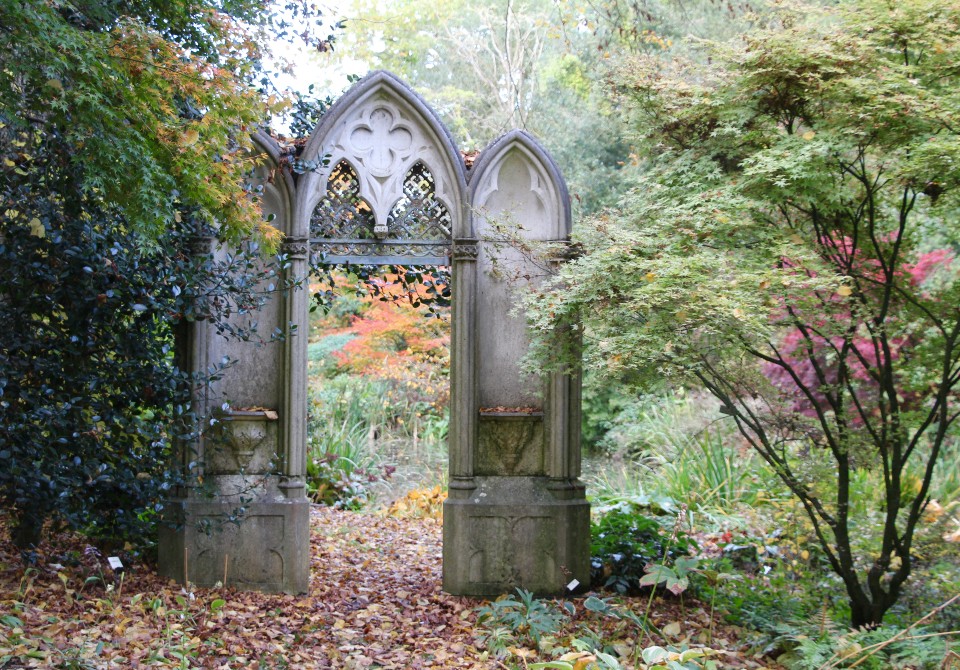
Here and there ruined arches appear,

adding a little interest and a window through which to view yet more.

And what are these dark curious objects lying around the base of the tree?

Close inspection reveals they are fallen suits of armour.

Just to the right of the entrance to the walled garden is an amazing sight. These early snowdrops are not unusual in appearing now but how glorious they look amongst the maple leaves. This variety is Galanthus reginae-olgae ‘Tilebarn Jamie’ and is just one type out of 600 different snowdrop species grown here. Next February there are two afternoons scheduled for snowdrop walks.

It is a very different feel on entering the walled garden where we are greeted by marble elephants.

This space is very organised, neat and overwhelmingly geometrical, a complete contrast to what we have already experienced. Inspired by Andre Le Notre of Versailles and Vaux-Le-Vicomte fame, it was I understand sketched by Lord Heseltine, and then the designer George Carter made it happen. A more appropriate designer you couldn’t have as he specialises in formal gardens inspired by the simple geometry of 17th century gardens http://georgecartergardens.co.uk/. Incidentally George who lives in Norfolk will be opening his garden next year on Sunday 19th September for the National Garden Scheme.

Paths criss cross systematically and continue through rotundas.

The walled garden covers two acres allowing enough space for sizeable greenhouses. There is even an aviary, and it is the call from these birds that is the only sound you hear in these enclosed walls.

In one corner is the head of Goliath, or is it Billy Connolly? Whoever he is he is cleverly in tune with the fig foliage behind.

In another corner diametrically across are two sentry boxes silently waiting to be sat in.

There is an area for vegetables but curiously these artichoke almost look out of place.

From all around you can see the central fountain.

Outside the walls along the south side is a mixed border with all sorts of delights,

interspaced with elegant seats,

and across the strip of grass the border runs along the field side,

where metal moon windows invite you to look out across the distant countryside.

We make our way back through the trees in Lannings Walk,

and into the field where the cars are parked. The head gardener is selling the Heseltine’s book and looking at the front cover I realise that we have missed the rill. He urges us to take a look (at the rill, not the book which is wrapped in plastic – covid precautions) and so we hurry back.

The light is fading as we hurry back to find the splendid rill bubbling away in all its glory.

Just below the rill, water plays off the broad leaf plant, and yes you might be forgiven for not realising it is made of metal.

Just further on we discover the Sculpture Garden. Oh my, how could we have missed this.

Sculptures, many of which are contemporary British, are displayed set out on the grass bays backed by beech. ‘The Dancers’ by Lilly Henry could be straight out of Strictly.

Gracefully tall and thin is ‘The Vessel’ made of slate and fibreglass and has been created by Maryanne Nichols, a sculptor from Suffolk,

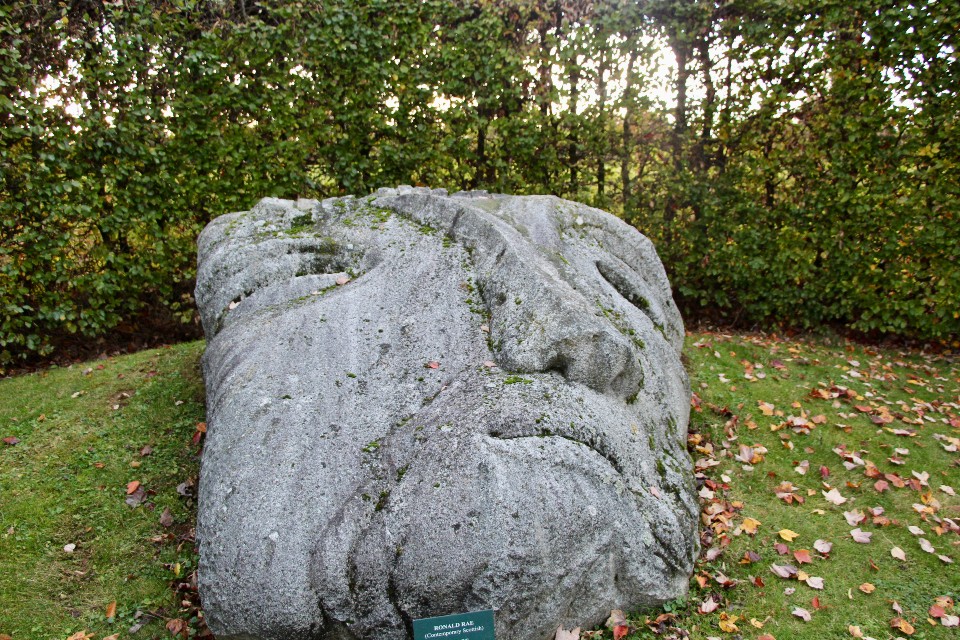
and lying solidly on the ground is Ronald Rae’s ‘Head of John the Baptist’.

It is quite a collection; too many to include all, but Phillip Jackson’s gentle lady ‘Reading Chaucer’ is a delight although her pages are in fact blank.

Lastly we admire the massive ‘Head of Lenin’ by Dzintra Jansone which was removed from a town square in Preili, Latvia.

Returning to the car we slip past the watchful eye of the hounds on the lawn and say our goodbyes, and promising to return the Head Gardener advises us that May is the best time.

Our visit has indeed proved to be a wonderfully refreshing distraction with incidentally, not a face mask in sight.

Covid restrictions might have put garden visiting on hold for the moment but there is no harm in planning for next year: https://bookwhen.com/thenfordarboretum#focus=ev-sz8n-20210203130000

Charismatic Kiftsgate Court

Kiftsgate is a garden that has been on my list for some years, and, staying in Oxfordshire recently we chanced the weather and caught one of the last days of opening for the year. Many of you may already know this famous garden and if you don’t I encourage you to look at its very good website where you can learn about the history, enjoy stunning photographs and read excellent articles http://www.kiftsgate.co.uk/home.

So, you might think, what is the point of reading this. Well you have got this far and the chances are it is raining outside so you might as well read on and follow my steps.

The sky was grey as it so often has been in these past few weeks …

but there was plenty of colour at ground level,

a positive explosion in some places…

and tumbling down in others.

You can read up on a place but nothing quite prepares you for the actual visit; the sounds, the autumnal smells and the far-reaching views. It is often difficult to appreciate the layout of the garden until you are standing there and Kiftsgate is no exception. We begin on the elegant terrace…

which compliments the graceful Georgian portico. This has in fact been recycled having once stood in front of the manor house in Mickleton a mile away, and it was transported here on a specially constructed light railway.

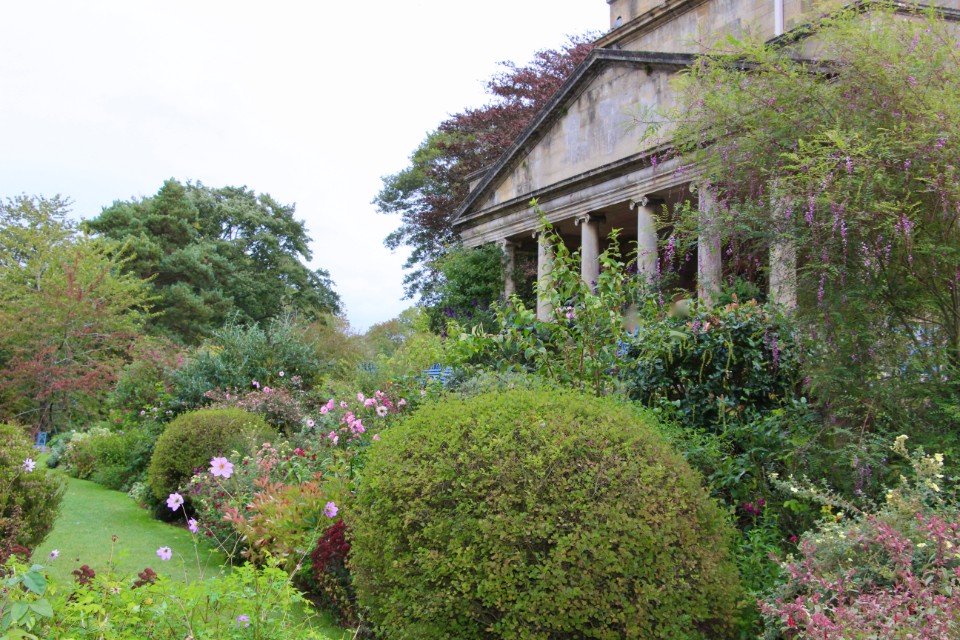
Moving further along this side of the house more columns rise up through the mass of plants.

The long double border has been planted by three generations of the female side of the family; it is floriferous, timeless and familiar.

This garden may be famous for its roses but its planting combinations are a lesson on how to give longevity to the summer season.

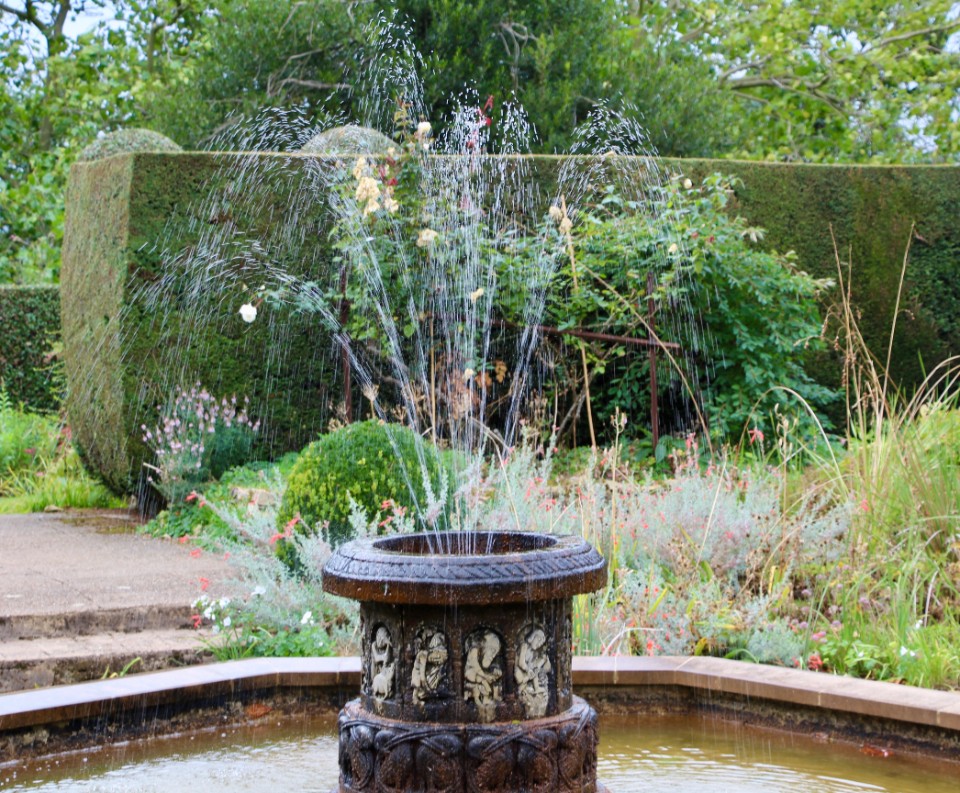
We turn off the long border into the White Sunk Garden where jets of water play in the wind in the centre. The shrubs surrounding the fountain are planted for their white flowers; deutzia, carpentaria, hoheria and staphyllea are not so evident at this time of year, however the varied underplanting provides a mix of colour and texture throughout the year.

Close to the house grows the small tree Staphylea colchica the white flowers of which have morphed into inflated pods, which is presumably why it has the unfortunate name of common bladdernut.

An archway in the hedge invites us into the rose garden where a multitude of roses including the famous Kiftsgate rose, have finished their display; we can do nothing but slip along the path and try to imagine the sight and fragrance.

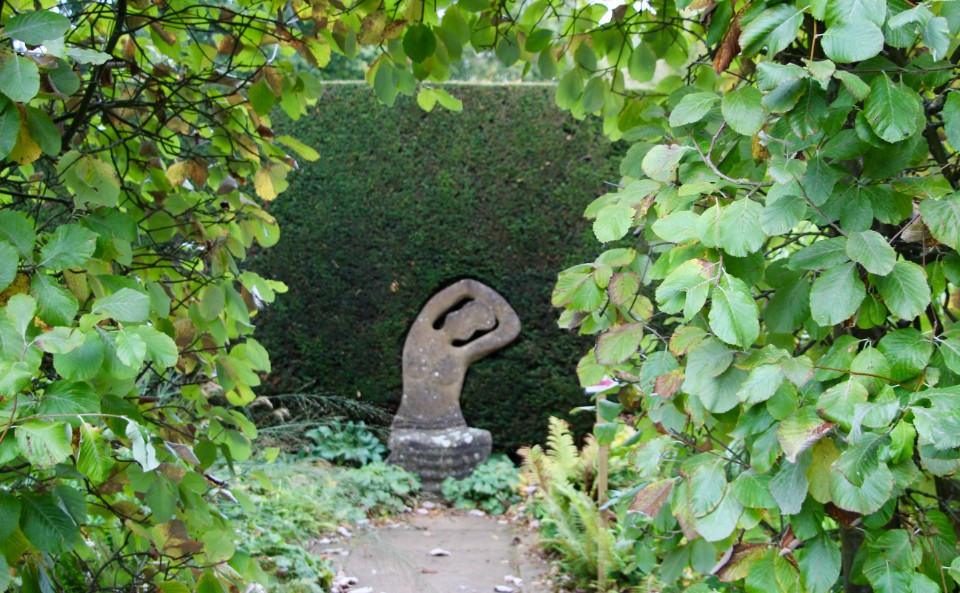
At the far end the statue by Simon Verity subtly nudges us to the right. https://en.wikipedia.org/wiki/Simon_Verity There is a oneway system in place throughout the garden because of Covid and we are delightfully informed that this is a ‘pinch point’.

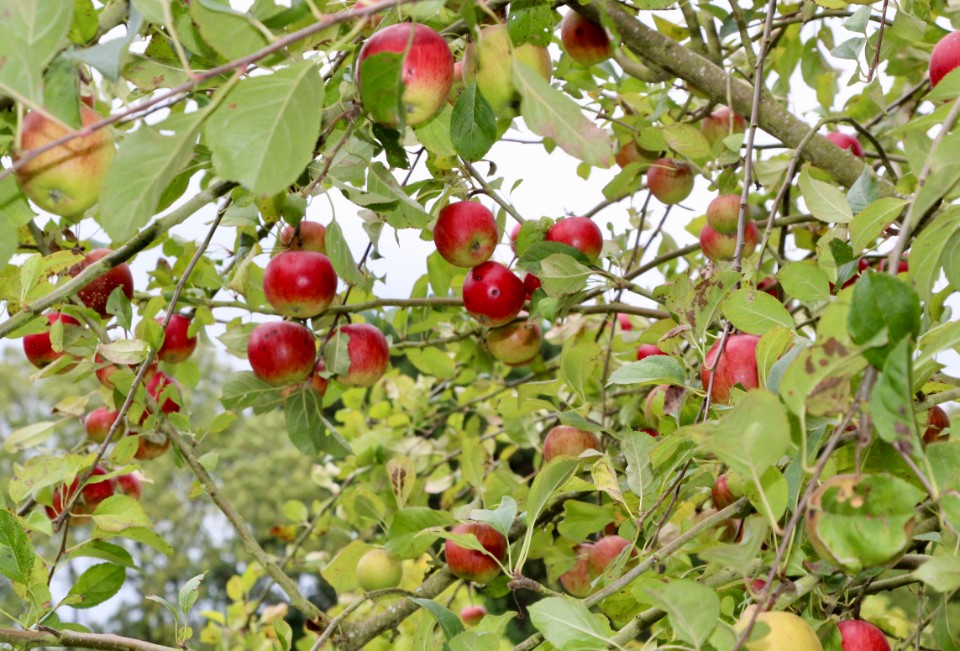
The orchard is small but spacious and the autumnal scent of apples fleetingly summons thoughts of crumbles and pies.

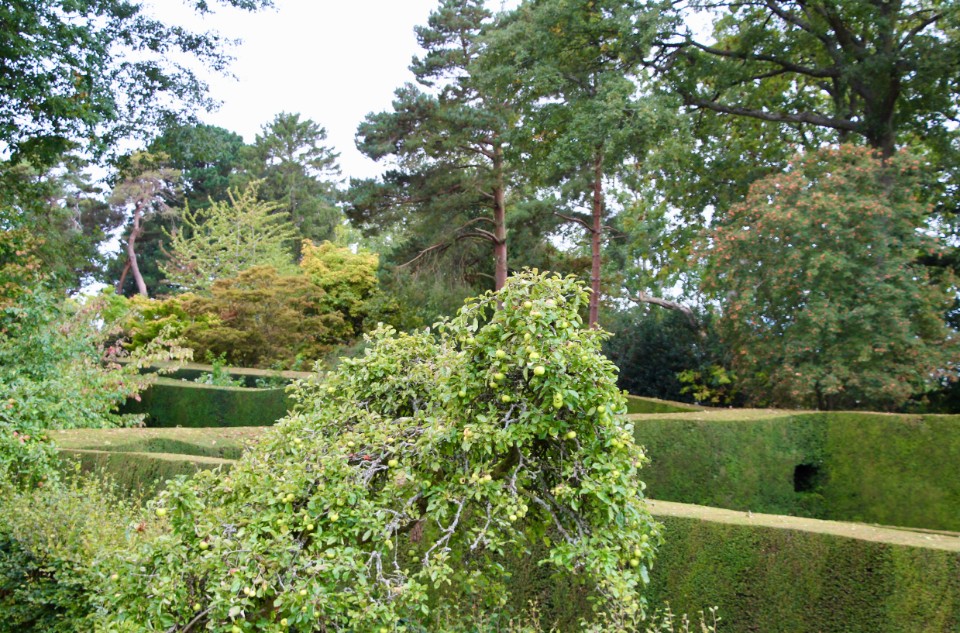
From here we ascend the sturdy wooden stairway up to the mound, and from here you can peep over and admire the fine razor-sharp yew hedging.

The mound which is in the shape of a horse shoe is the most recent addition, and while it develops, its most redeeming feature is the cherry-red hips of the rugosa roses planted along the top.

From the mound an avenue of Liriodendron tulipifera Tulip trees stretches to the skyline. What is so interesting is to see these trees in different stages to one another and presuming that they were all planted at the same time, on closer inspection each tree reveals a slightly different growth pattern; some show signs of greater maturity with larger trunks and leaves normal to large, whilst others are thinner with smaller leaves. Individual trees display variations in height and width and there is also a disparity with autumnal colourations, many leaves turning golden yellow whilst others are still firmly green.

The avenue leads to the tall majestic steel sculpture by Pete Moorhouse. https://www.petemoorhouse.co.uk/

We retrace our steps down the avenue, back through the orchard in search of the water garden, and for a moment I wonder at the greeness of this well-trodden shaded area and am amused to find that it is a strip of artificial turf.

Once a tennis court, the Water Garden is completely enclosed. Shades of dark greens contrast with the verdant grass. However we no longer hear the play of ball on racket, just the gentle sound of water trickling into the stillness.

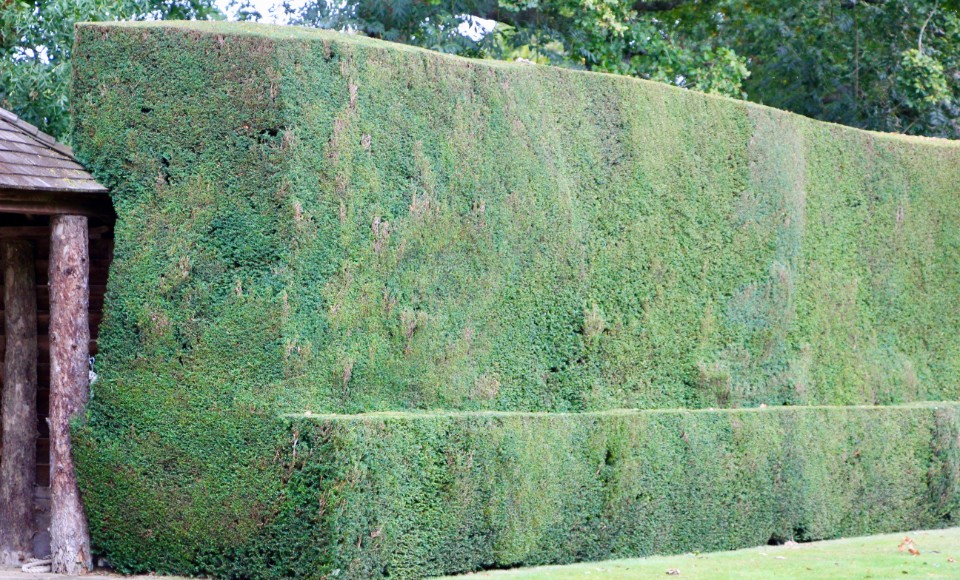
I admire the smoothness of the yew hedge with its lower ledge running all the way around, and a fellow visitor suggests it has been cut so in order to provide a convenient resting place for bottle and glass.

We follow the yellow border which can still boast a little colour with the delightful Rosa Graham Stuart Thomas,

and the slow-growing clump-forming Kirengeshoma palmata.

Walking along the narrow north border back below the house I begin to realise that the garden is perched on quite a steep cliff.

The wind blows through the Scots pines towering above and the feel and atmosphere of the garden is transformed.

Mother and child nod to the direction of the downward path.

Baby Cyclamen hederifolium are so happy to grow in amongst the pine needles.

And so we descend to the lower garden as today’s finale where the temperature is warmer with the suggestion of mediterranean planting. Here the Swimming pool takes centre stage. The view is not at its best today but still provides an impressive vista across to the Malvern Hills.

Looking back up you can appreciate the height of the cliff with summer house half-way and a glimpse of the portico at the top through the Monterey Pines.

Kiftsgate Court is now closed for the season and will open again next spring, with two special open days supporting the National Garden Scheme on Monday 12th April and Monday 9th August 2021.

——-2020——-
The Sculpture Park at the Sainsbury Centre

The other evening I was invited through an alternative Garden Gate, to a special tour of the Sculptures sited around the large campus of the University of East Anglia. Situated in a landscape of some 350 acres, a large lake and the river Yare, this is remarkably, an unknown delight, except maybe to those who are former students.

We met at the Sainsbury Centre, and for those who don’t know, this is not another supermarket but an amazing building designed by the then relatively unknown architect Norman Foster in 1974, which houses an extraordinary collection of art. Our tour began at the west end of the building where woodland curves round behind a grassy area. Four magnificent sculpture are sited here and you might be forgiven for thinking with such an acreage why are they not more spread out across the rest of the landscape. The simple answer is that it is only on this small site that no planning permission is required but because it is a public park, planning permission is needed anywhere else. It had never occurred to me before that you might need planning permission to erect a piece of art.

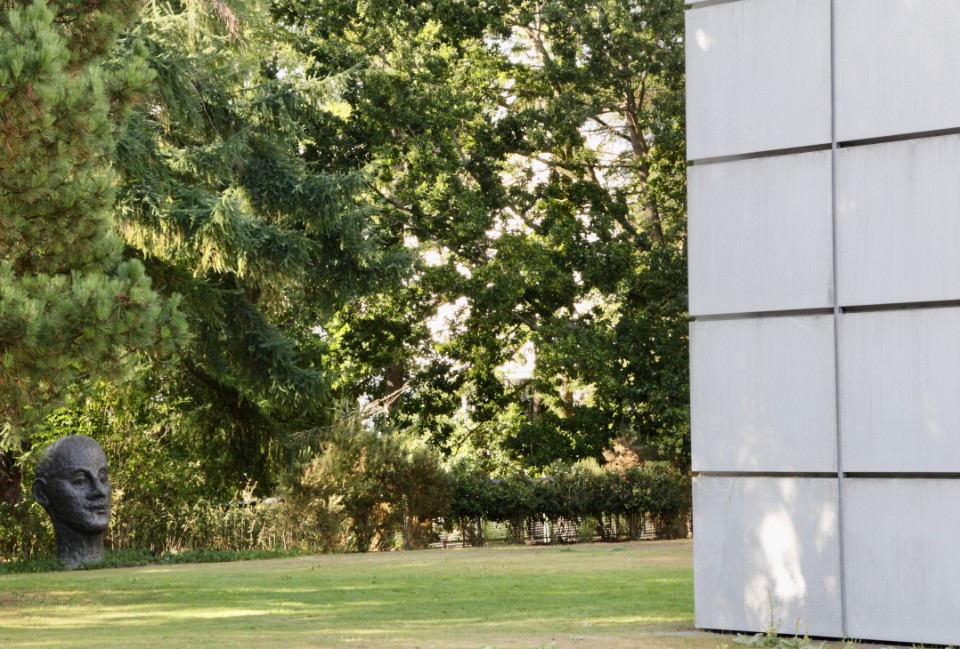
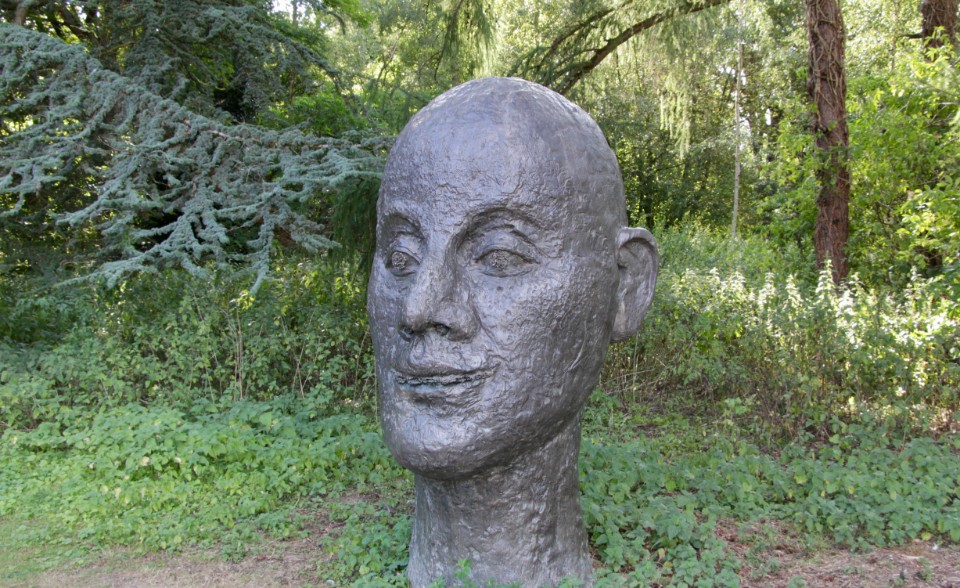
All the pieces are on loan and it is the bronze head created in 1997 by John Davies (b1946) and positioned just at the edge of the woodland that you first see. By the nature of its position you feel it must be looking towards the glass facade of the building,

however on closer inspection the eyes appear from this monumental head to be looking at nothing in particular.

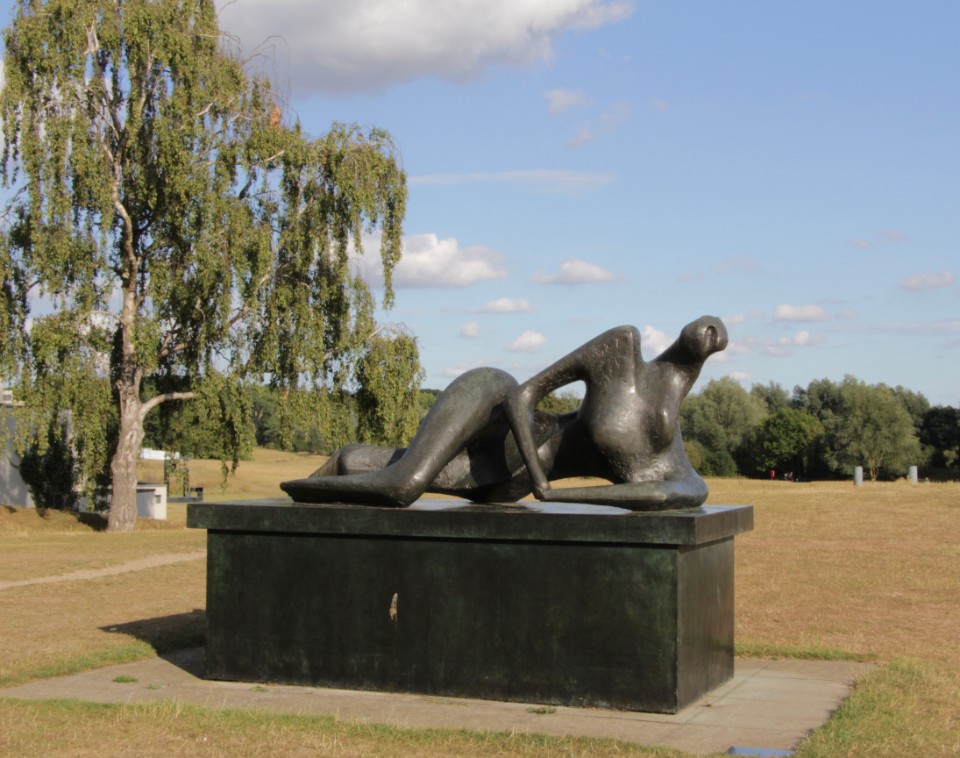
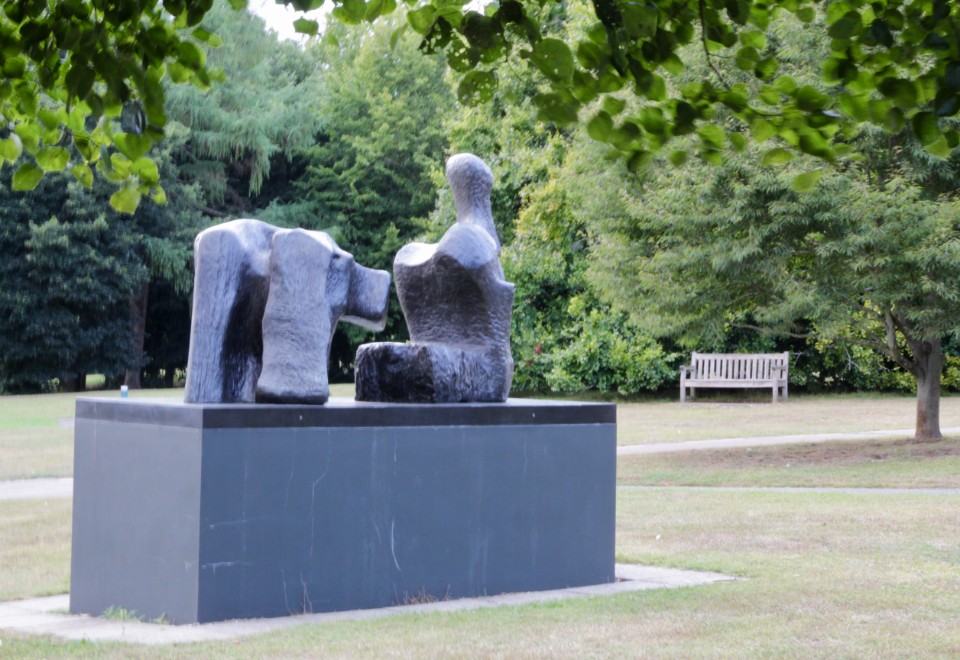
Nearby is a Henry Moore; surely no sculpture park is complete without one and perhaps it was through Moore’s sculptures that so many of us were introduced to the abstract art world. ‘Draped reclining woman ‘ is cast in bronze and dated 1957-58.

So utterly different from Moore’s familiar form is ‘Sun’s roots II’ by Phillip King (b1934) who actually spent a year as an assistant to Moore. Over the course of his career he exhibited all over the world and worked in a variety of media;

this is painted steel and is influenced by his time spent in Japan. Sun meets earth and as you move round …

… the piece seems to flow, move a little and bend too.

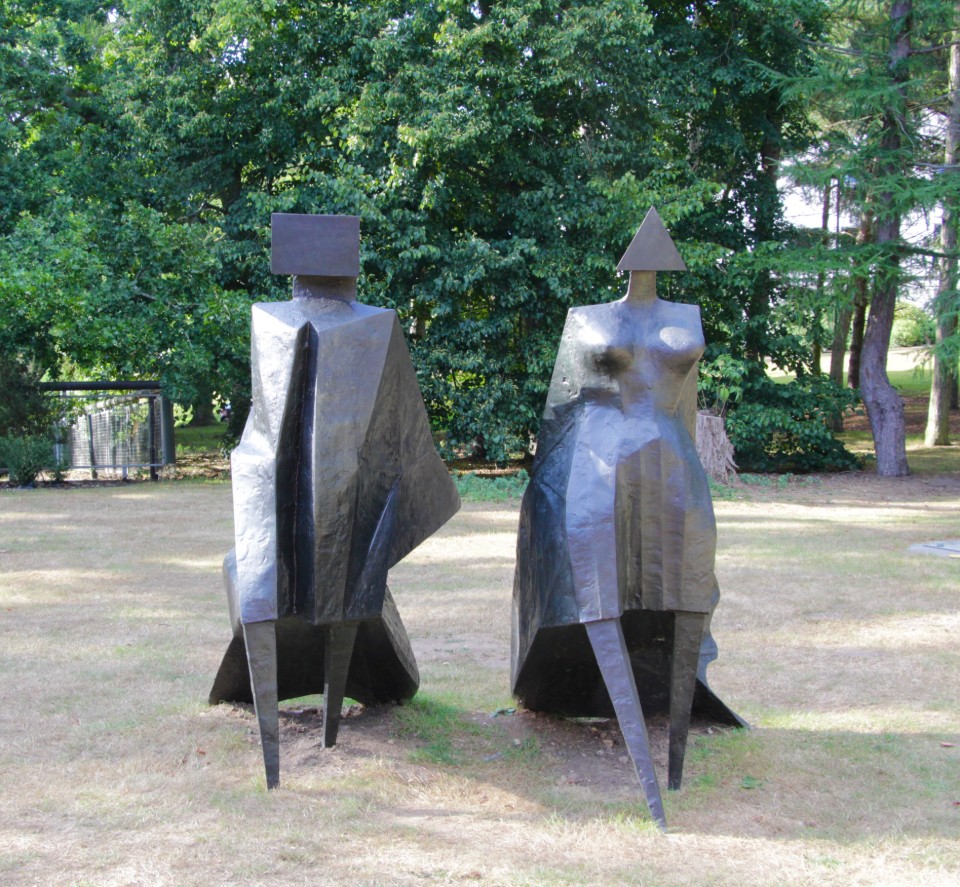
There is also movement from this static couple, ‘Pair of Walking Figures – Jubilee’. They are the final sculpture in this space created in 1977 by Lynn Chadwick (1914 – 2003). Walking towards the Centre,

together they seem intent on visiting the exhibition, currently Art Noveau, and I know they will enjoy it, for it is a dazzling display. Their cloaks ruffle and flow behind,

abstract but expressive, their flat faces are expressionless whilst their bodies hold an air of elegance, perhaps best not to step in their way.

We walk along the south side of the exhibition centre. It is empty of people right now but during lockdown the park became a delightful escape for many Norwich residents. As a consequence the university is having a rethink about the park and its sculpture and an exciting new project is in the planning to increase the number of exhibits and ultimately create the best sculpture park in the country.

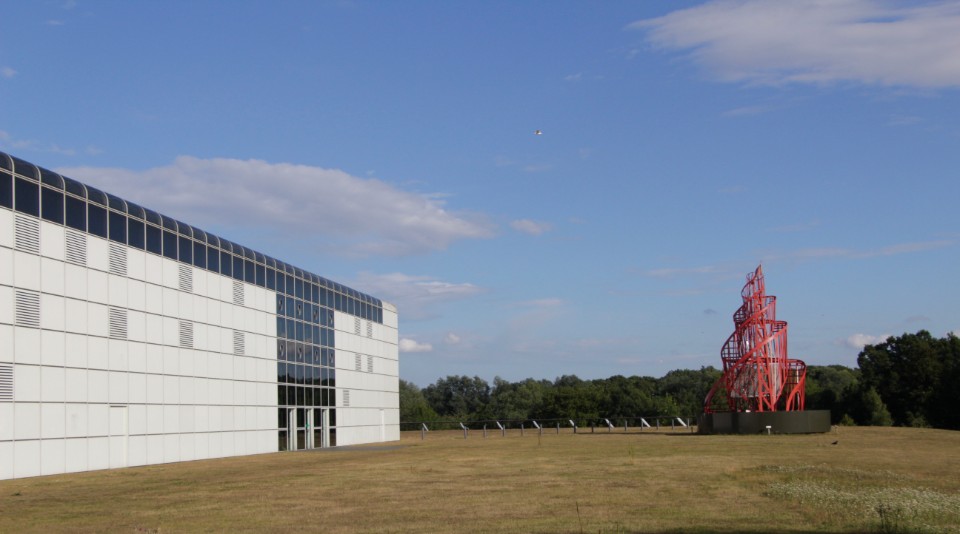
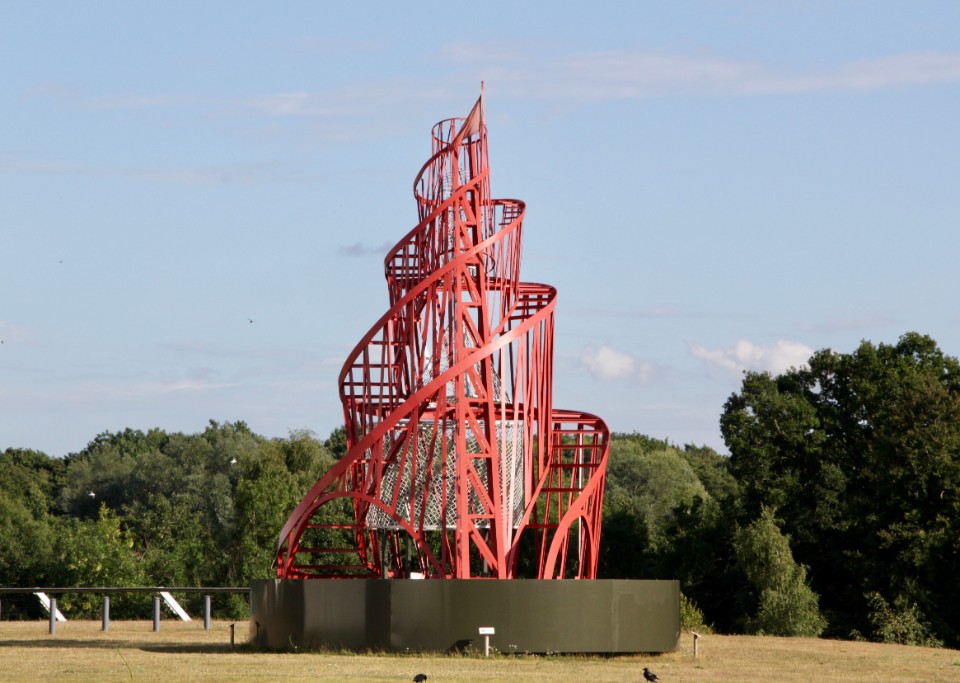
Tatlin’s tower stands prominently. After the Russian revolution Vladimir Tatlin (1885-19530) was charged by Lenin to implement his campaign to replace monuments reflecting the Tsarist period. Tatlin proposed an abstract design that would not only commemorate the revolution but also to serve as the headquarters of the Third International or Comintern. The monument was never realised and this is a reconstruction ‘Model of the Monument to the Third International’

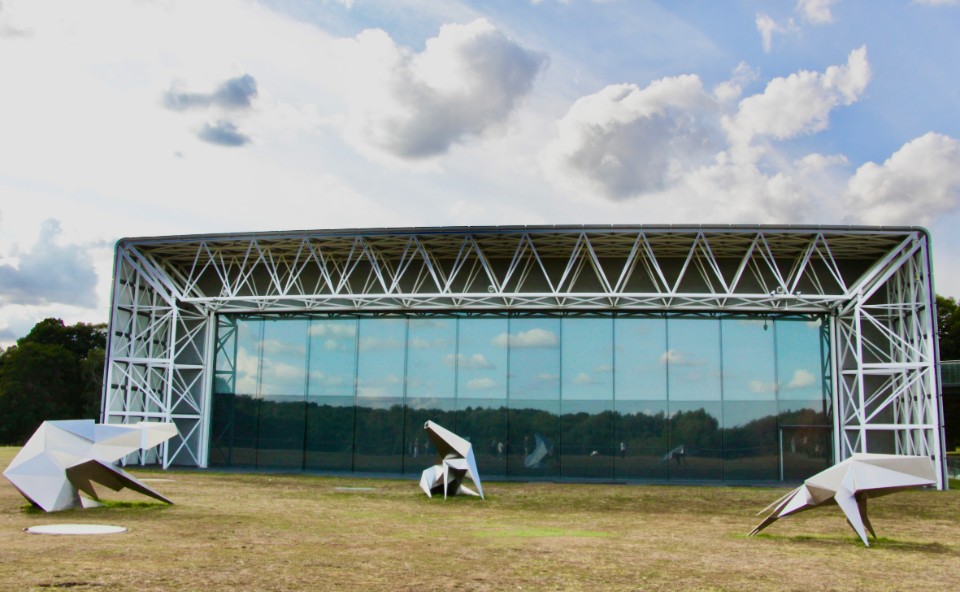
We have arrived at the east end of the Sainsbury Centre where we find Lynn Chadwick’s three beasts captured in various states of action; on the left is ‘Crouching Beast II, in the middle ‘Beast Alerted I’ and on the right ‘Lion I’

They were made in 1990 from welded sheets of stainless steel. Chadwick is said to have delighted in the properties that steel afforded, feeling that no matter how dull the weather some facet of the sculptures would catch and reflect the light. As the sun fades the beasts certainly demonstrate that quality.

How fortunate these students are to be able to gaze upon these sculptures as they go about their studies on campus. Moore’s ‘Reclining Figure’ was acquired in 1962 and I am sure has enjoyed many an undergraduate’s prank.

Sir Denys Lasdun designed the Ziggurats which were completed in 1968. They are unique, pieces of art in their own right, and nestling into the landscape, they are in fact the students’ residential quarters. Placed in front of the Ziggurats is the large tubular metal structure painted in matt black and created in 2006 by Ian Tyson it is appropriately named ‘Proximity’.

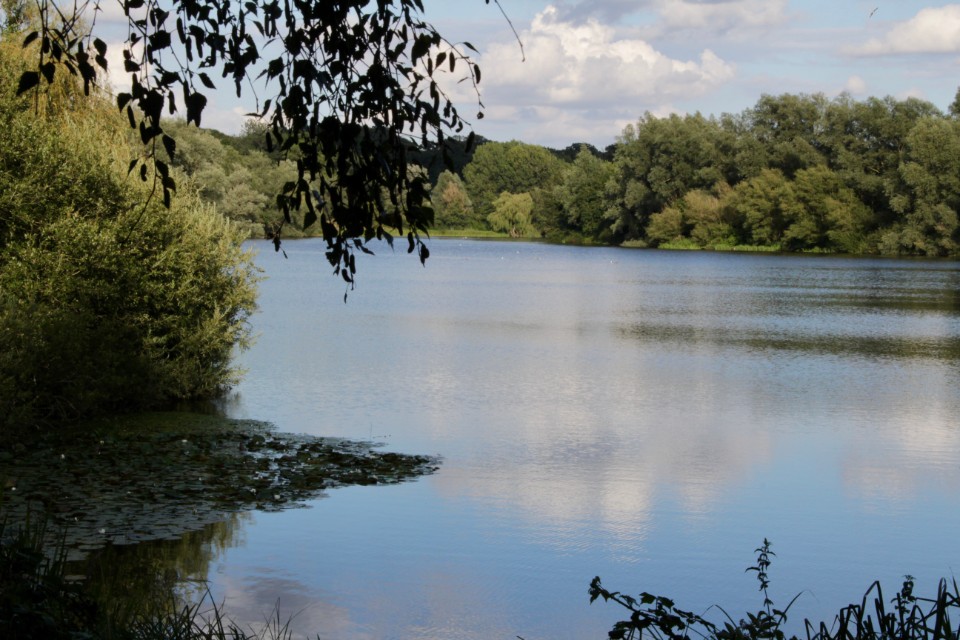
I had never been down to the lake; it is a vast expanse set below the Ziggurats.

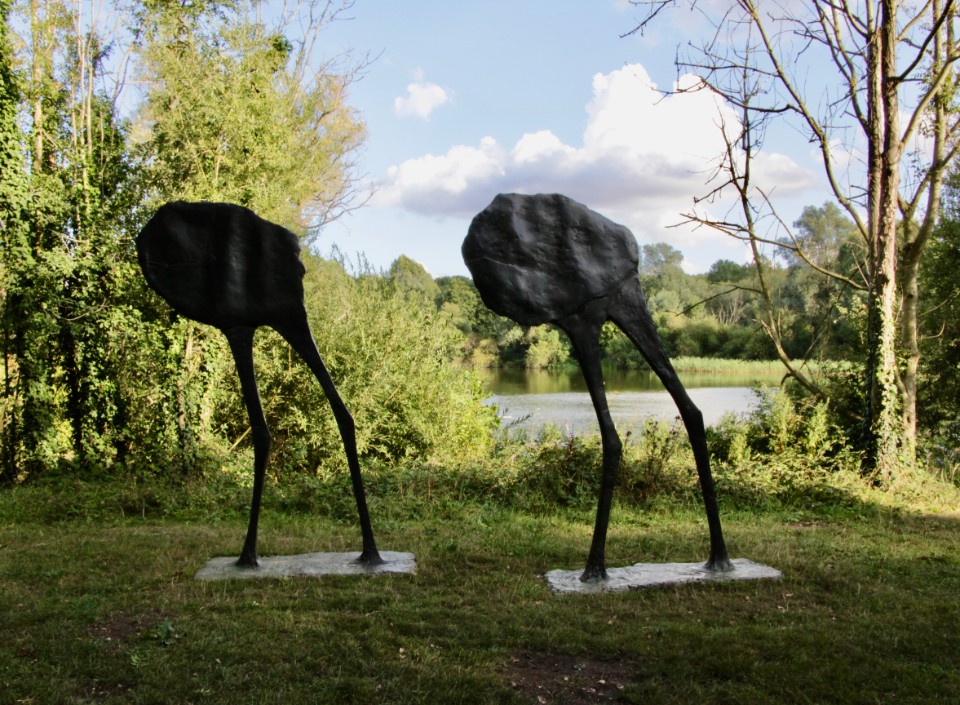
At the water’s edge are Dame Elizabeth Frink’s ‘Mirage I and II’ (1969). These extraordinary shapes were inspired by seeing the heat hazes and flamingoes in the south of France. No heat haze this evening but these part-bird and part-human structures still appear to shimmer.

Looking back towards the university buildings there on top of the central library is Sir Anthony Gormley’s figure ‘Another Time II’. Gormley might be considered as a local now that he lives in Norfolk.

There are actually three of these cast iron figures which were created in 2007, but before we ascend the stairs up to the library level in search of the remaining two, we encounter ‘ Extrapolation’ a structure of ascending steel plates which was originally created for Norwich Central Library in 1982 by the American born artist Liliane Lijn.

At the top of the winding concrete stairs we are met by a little surprise of ‘Another Time IV’.

and over up on the roof of the Biology Department is ‘Another Time II’. Using casts of his own body, Gormley personally selected the locations around the campus.

The pamphlet describes these figures as ‘thought-provoking and uncanny offering spectacle and surprise’, it is a description that could be afforded to all the sculptures in the park .

We end our tour, and close by the car we catch sight of the third Moore ‘Two Piece Reclining figure No 3’. Solid and familiar it is indeed thought-provoking.

The sculpture park is open to all and is free. It is a space to visit and watch with interest. The Sainsbury Centre is a spacious building and for this reason was the first gallery to re-open after lockdown. For further information https://sainsburycentre.ac.uk/

Paget House, an inspired modern design, near Saxmundham, Suffolk

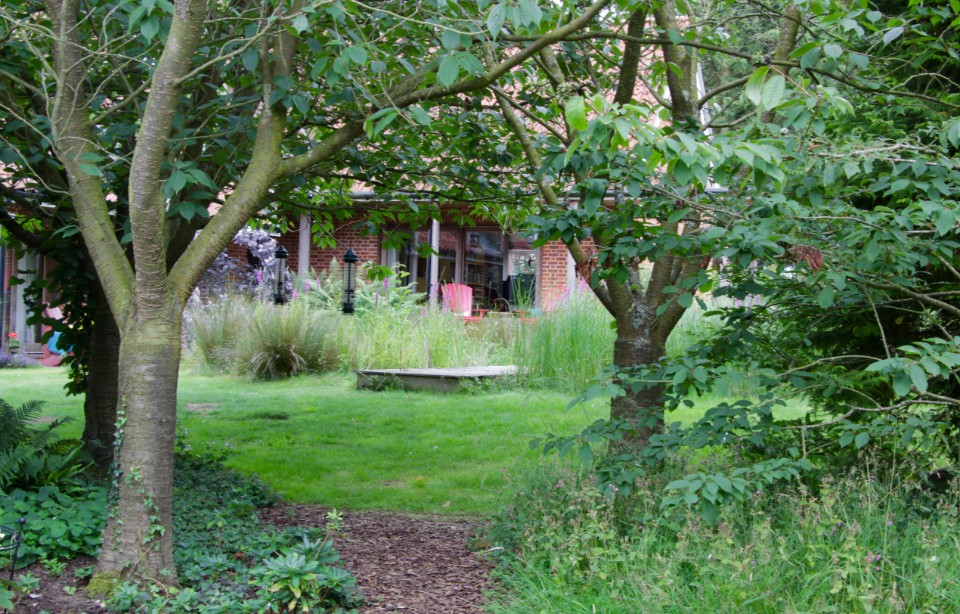
Last Saturday I combined calling in on my cousin with a visit to an intriguing garden open for the National Garden Scheme. Entrance was by slipping through the back gate into an informal area, and for a moment I wondered if I had come the right way.

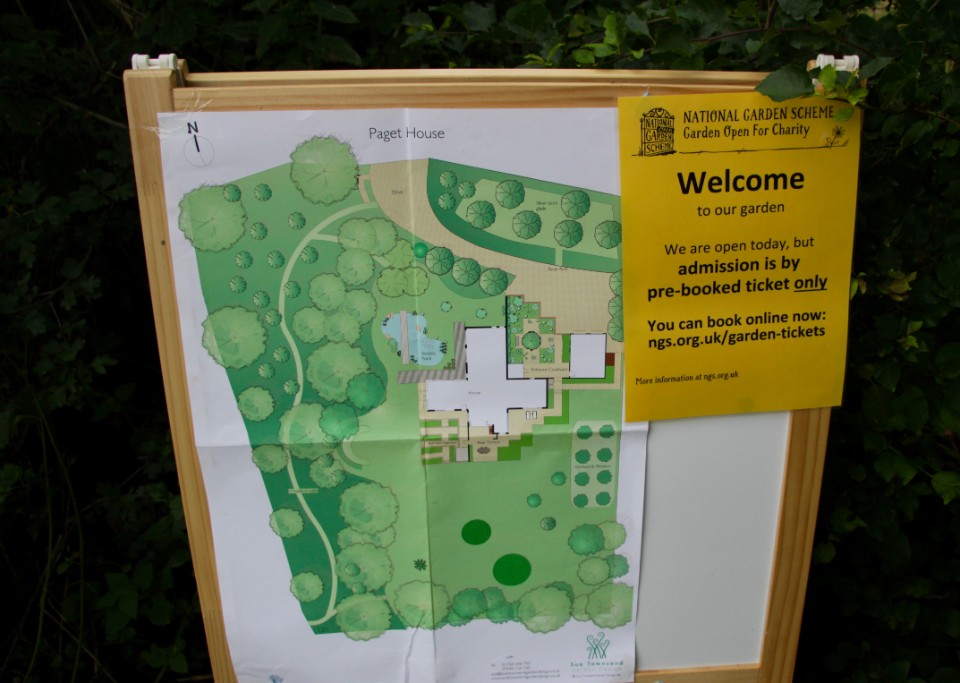
The plan eased my mind and was a promise of greater things ahead, and as with so many gardens open for the National Garden Scheme it did not disappoint. The modern house built by the owners some 9 years ago is in the shape of a cross and is very much at the centre of the garden.

This cross shape in effect dictates the layout of the garden marking out four separate but connecting gardens. Walking down across the roughly mown lawn, I come to west side of the house where raised beds are filled with vegetables and flowers.

It is a marvellous idea to place the productive side of the garden so close to the house rather than banishing it to the far reaches of the garden. It must be a real joy and so convenient to be able to just step outside and pick your vegetables,

and to enjoy the scent of those heavenly sweet peas.

I step through the wooden covered walkway which extends out like an arm from the house and cleverly acts as a division.

Here there is a quite different feel. An informal pond is the point of focus, making good use of this northern aspect. A striking sculpture by Paul Richards sits between pond and house. It must be a delight to watch the visiting wildlife from the comfort of an Adirondack chair.

Further away from the pond is a semi-circular border is bursting with colour;

familiar favourites in amongst the bright crocosmia such as this delightful salvia,

and rich hemoracallis.

Away from the house paths lead between mature trees,

and meander through the long grass,

where there are delightful places to sit and chill. It is as though these two decorative deck chairs are having their own dialogue.

The front door of the house is on the east side where the drive sweeps in, and alongside the yew hedge is softened by sections of ornamental grass.

On the other side of the drive is an arbor which leads you into a secret garden,

where a Lutyens bench sits majestically behind a table. The hand sanitiser a small sign of the times.

The planting by the front door is soft and free flowing.

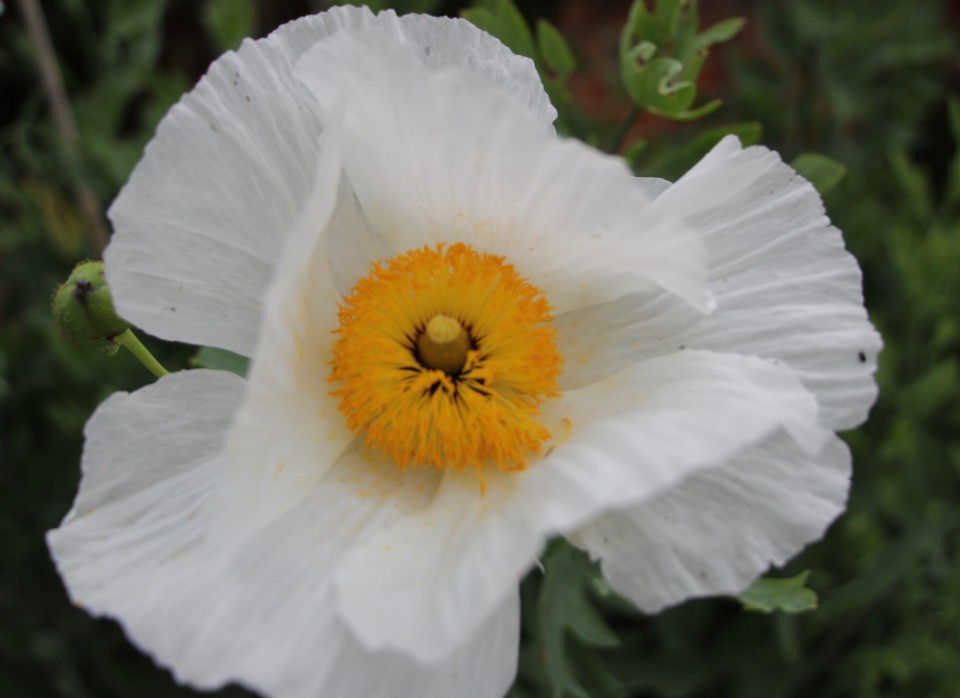
Romneya coulteri, the Californian tree poppy steals the show with petals like finely crumpled tissue paper,

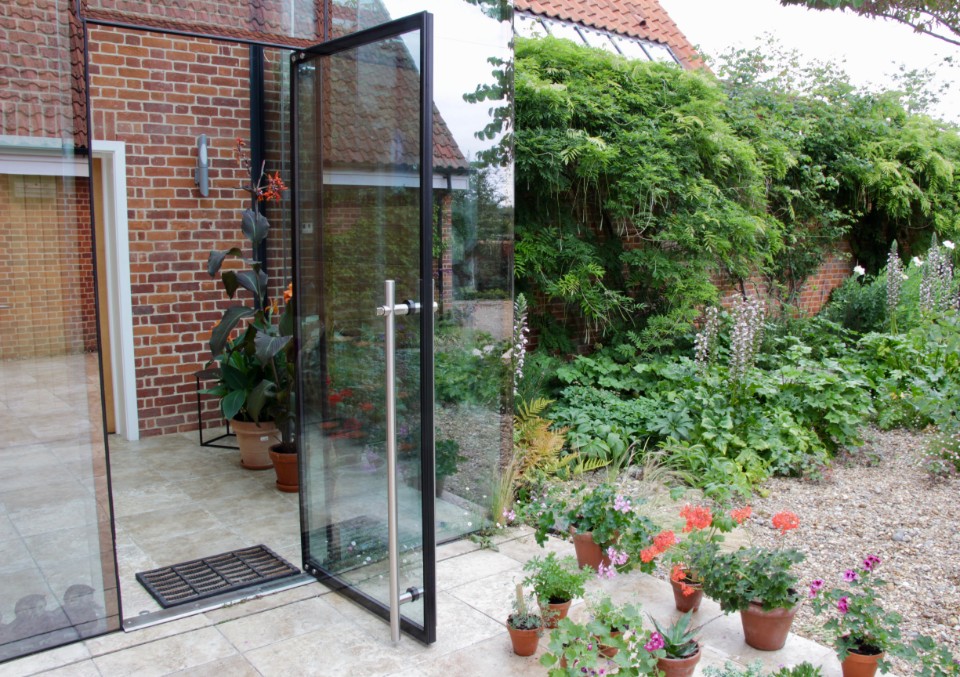
and the pot plants tumble through the front door.

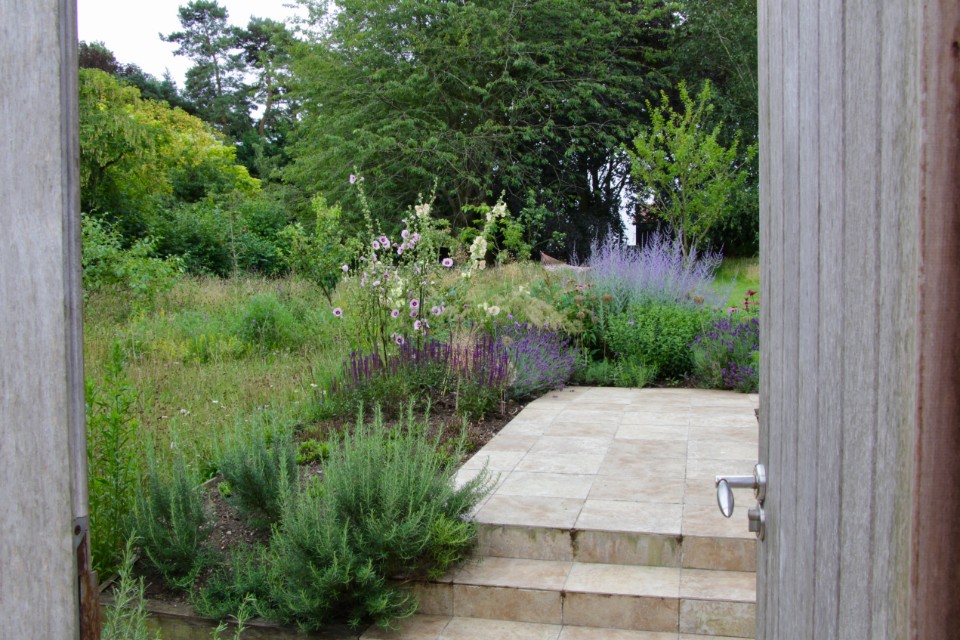
You don’t really appreciate how much this house is on a slope, and now, on the other side of the house and through the door and up the steps, the mood changes again.

A mixed native hedge runs along the boundary on the left hand side and fruit trees grow in this wild meadow,

contrasting with the informal but careful colourful planting next to the house.

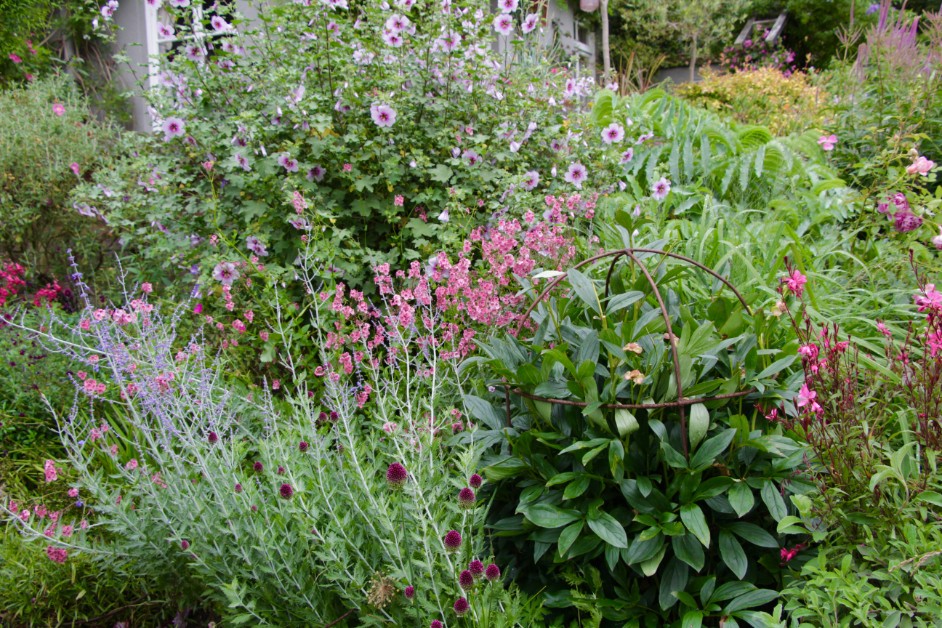
Paving and plants wrap comfortably around the house. Familiar favourites which include lavender, gaura, perovskia and verbena.

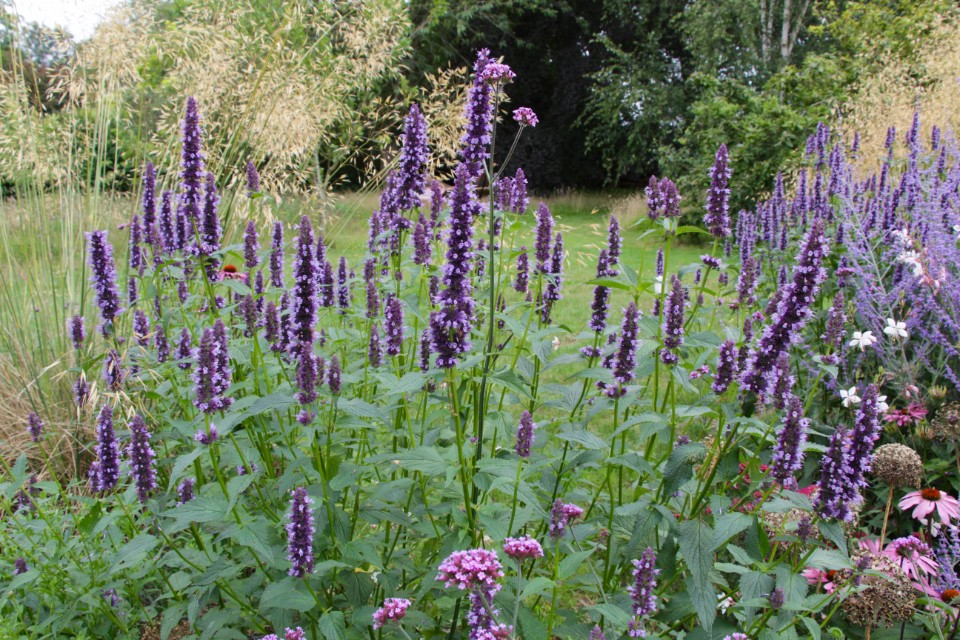
Agastache ‘Black Adder’, Mexican giant hyssop is particularly at home here.

Each side of the house moves effortlessly out into the garden and each side is subtly divided. The wall is smothered in delightfully scented trachelospermum jasminoides and on through the open door,

I am back where I started in the vegetable area.

It has been a delight to see this garden so thoughtfully designed and such an integral part of the house. Wildlife-friendly, it is a pure pleasure and a moment of freedom for all of us in these strange restricted times.

Each Monday a variety of gardens to visit are uploaded onto the website www. ngs.org.uk So why don’t you find one near you, pre-book a ticket, and Help Support Our Nurses.

——-2020——

Furzelea, a fantastic fusion of flora.

It is always a delight to find a garden gate open for the National Garden Scheme on a Wednesday. So on my way to pick up some items for my own garden from Lime Avenue Antiques https://limeavenueantiques.co.uk/ I called into Furzelea at Danbury near Chelmsford in Essex.

As I entered the enforced one way system my eye is drawn to the beautifully trimmed bay leaf, and already in my mind I have re-shaped my dull specimen at home.

Weather-wise it was not really a day for garden visiting but the good thing about the ticketing system is that you have already purchased the ticket so you might as well go. And I was so pleased that I did.

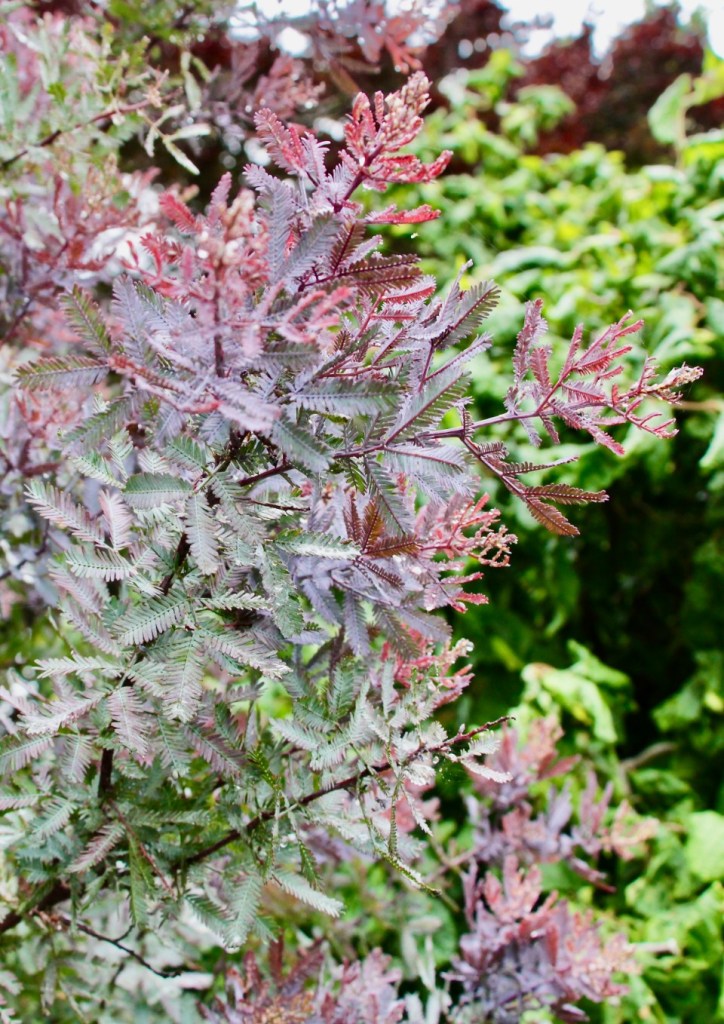
It is a joy to come across a plant that I am unfamiliar with, and there it is at the beginning of my visit, Acacia baileyana Purpurea; sadly my camera skills did not do justice to the silvery purple feathery leaves.

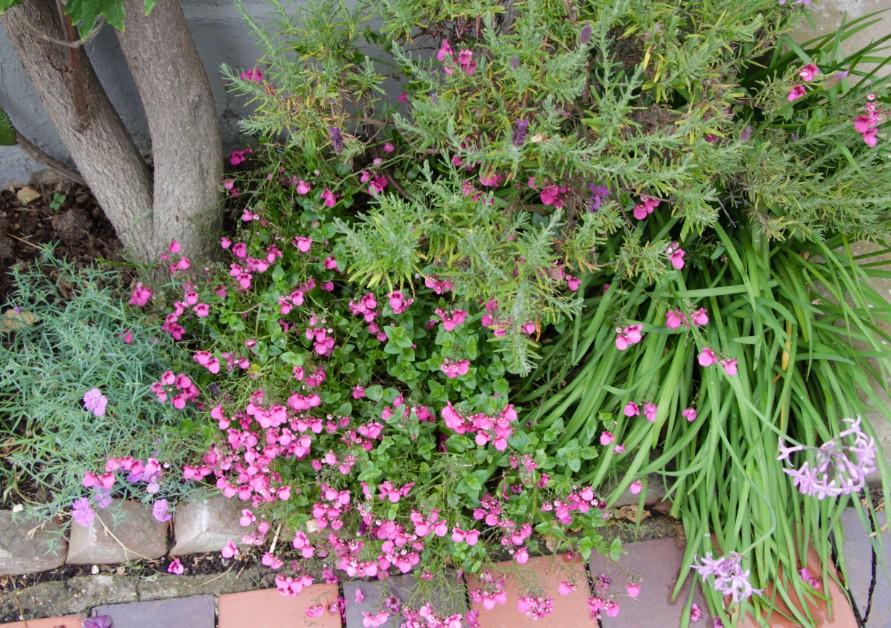
We are directed to the east side of the house, where dainty diascia mingles amongst the rosemary and tulbaghia around the foot of the wall.

Opposite, through the arch, we are drawn to the gap in the hedge which has the effect of extending the path until you realise it is a mirror cleverly placed in the ivy.

It is such a good idea to have the productive part of the garden so close to the house and not far down at the bottom of the garden. Just imagine nipping out to pick a lemon for your g & t before munching your way through a little something with fresh cucumbers, followed by bowlfuls of raspberries.

The path meanders away from the greenhouse down through

such a pretty palette of pinks and purples.

You can take an alternative route down the steps from the terrace by the house through the arch to the lawn,

where curvaceous edges guide you onwards with such rhythm and movement, swirling you around well-planted beds and wonderful shapes.

You can trample the camomile steps down to the little pond or continue round on the lawn,

where you can admire the Angels’ fishing rods Dierama pulcherrimum, dangling daintily over the water.

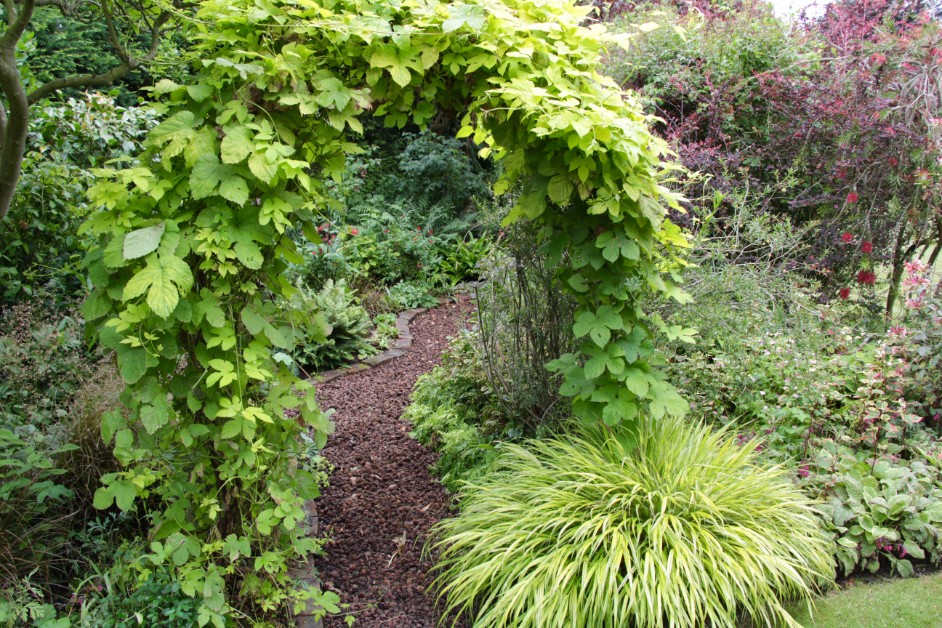
An arch of golden hop with its shaggy boot of ornamental grass Hakonechloa macra ‘Aureola’ makes an entrance to the narrow path made from nut shells collected from the two copper beech trees in the drive.

Roger and Avril have lived here for nearly forty years and it is so hard to believe that this spacious area was once an unkempt field where their daughters’ ponies grazed. Tucked away down in the left hand corner the clipped topiary twirls highlight

a fine thatched summer house which provides the perfect place to sit. I wonder if Roger and Avril ever find time to sit in this plant-packed garden; they employed no help doing all the work themselves.

This area is so cleverly divided; an island bed with a purpose and a magnificent array of planting.

The plant combinations in this garden are a noticeable feature and they are superb. Behind us in this long border there is a blend of yellows not just in flower but also in leaf.

The garden also opens earlier in June for the display of roses and as I walk back up towards the house I can imagine how lovely this arch must have looked.

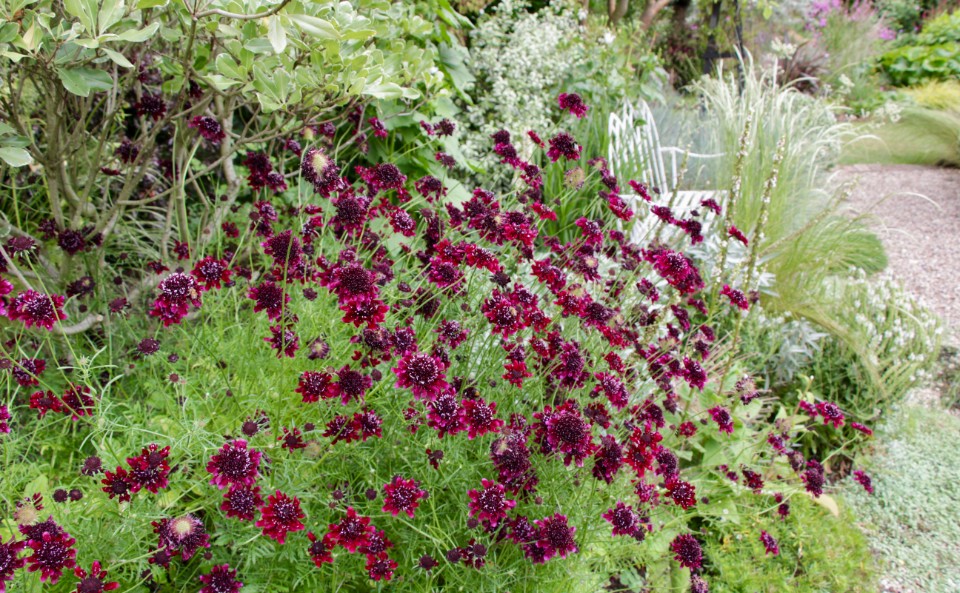
On this dreary day there has been no shortage of colour, a haze of rich burgundy from the cornflower which have happily self-seeded in this part of the garden,

and the roses may be over but the clematis are clambering for attention; either softly adorning a pergola,

growing through the metal support at the back of the border,

or simply scrambling through the wisteria against the house.

Before we leave we make a final visit to the pond where we are reminded that it does rain in the east,

and from the terrace situated by the back door there is a misty view over the garden.

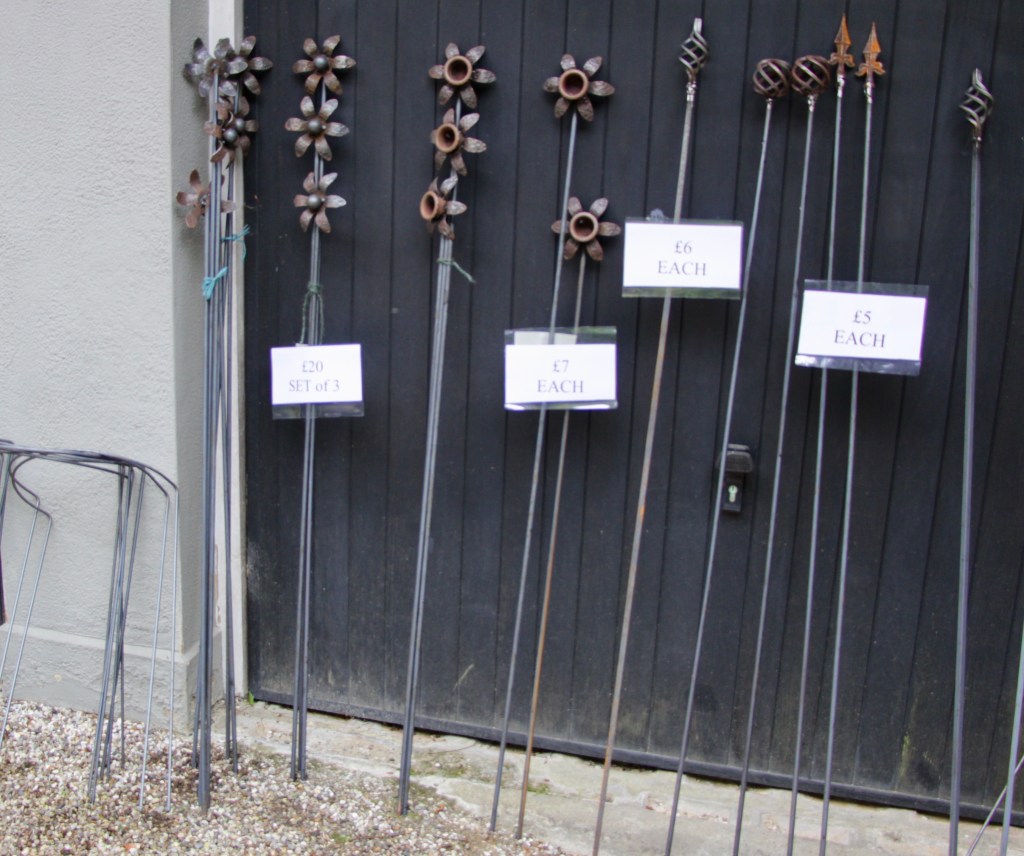
Government guidelines have put the serving of refreshments on hold. So, never wishing to leave a garden empty handed I turn to Roger’s plant supports which he has been making in aid of the National Garden Scheme, this year he has raised an incredible £900. Well, you never have enough supports.

You can visit Furzelea this coming Sunday and it is so easy to purchase a ticket: https://ngs.org.uk/shop/garden-tickets/east/essex-furzelea-sunday-12th-july/

——-2020——-
38 Chapel Street, Ely

Hurrah, the National Garden Scheme has begun to open some of its gardens. The system has changed a little and I had to go the website to pre-book my ticket online beforehand, which was perfectly easy and I found a small garden in Ely. It is such a long time since I have been anywhere so I was quite excited and having made my online purchase I was not going to let the cold miserable rain put me off.

Ely was void of the usual tourists and after managing to remember how to manoeuvre my Mini into a convenient parking slot I walked up the street towards the Cathedral, the grey clouds were pretty threatening.

It was a windy day and by the time I reached the cathedral it was blue sky.

Number 38 is minutes from the historic centre and as I walked along the residential street I received a warm welcome from the roses. The original plan was to open with a group of other gardens but coronavirus prevented this from happening.

The gate was open with a plant stall in front, and garden owner Julia had been busy raising and selling plants during the lockdown making over £600 for the National Garden Scheme. Julia is a retired nurse and she believes this is her way of helping.

I hurry down the west side of the bungalow, as that sky does not look too good.

A garden on heavy clay and with Ely’s dry climate this is surely a welcome load,

despite the threatening clouds there is a sunny feel to this secluded back garden. Julia and Peter have lived here for three years working hard to restore the garden from a jungle of ivy.

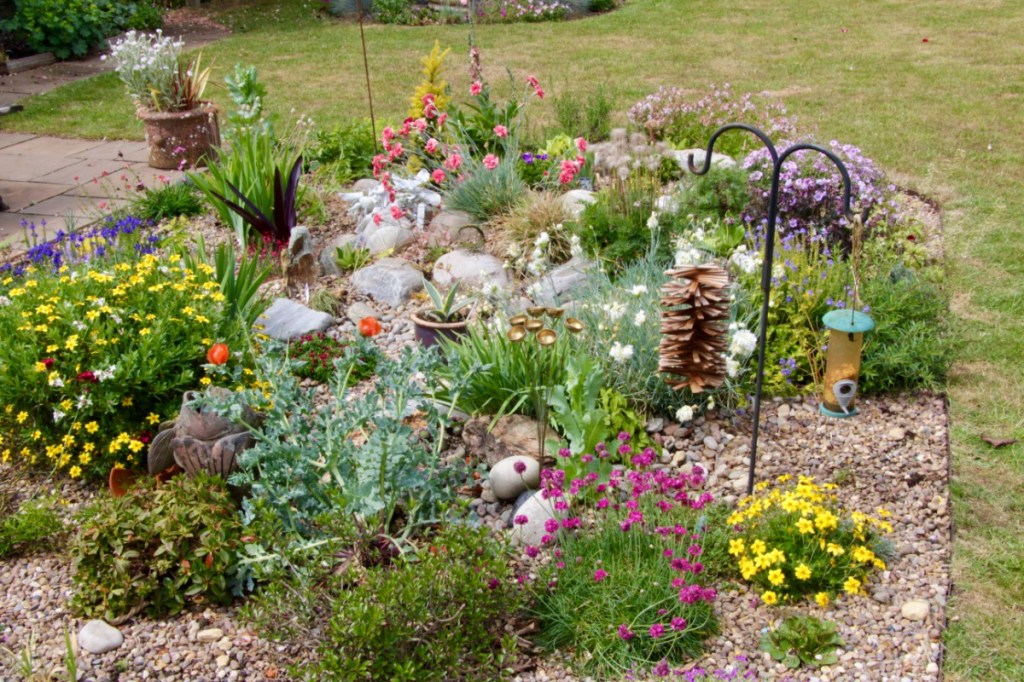
For her 80th birthday, family and friends gave Julia the materials and labour to create a rock garden on a dry piece close to the house.

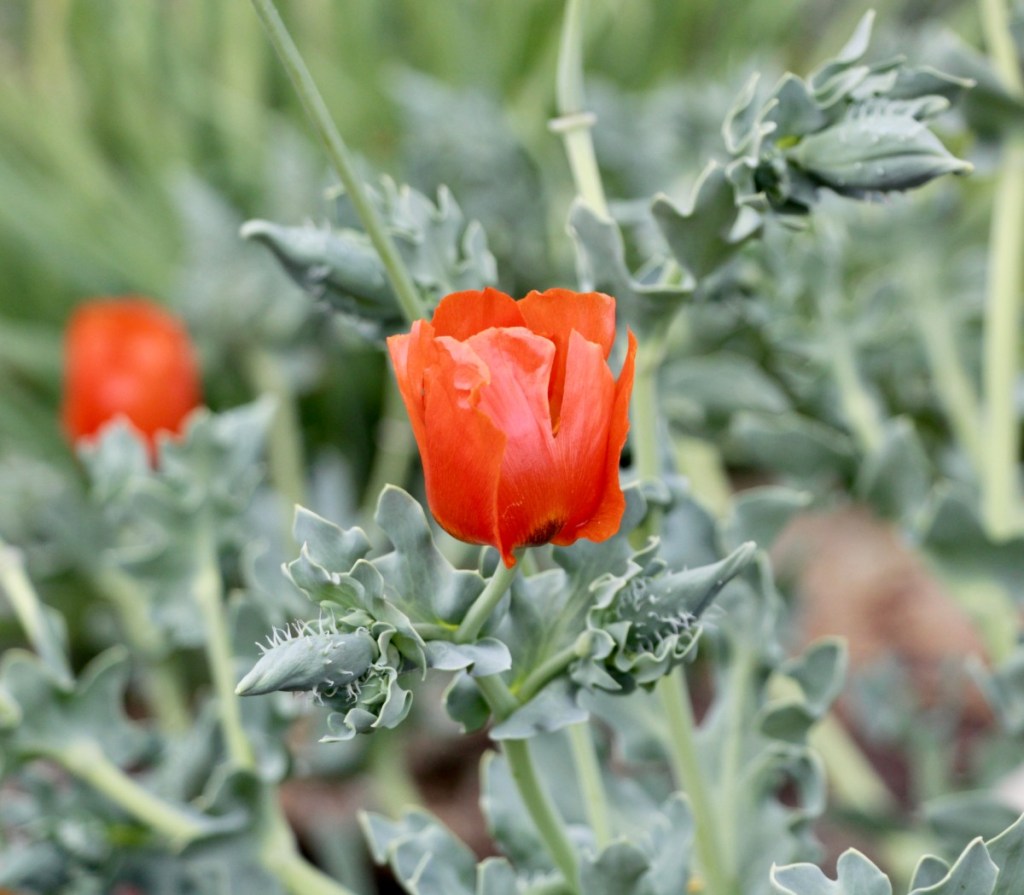
Here grow all sorts of treasures; a bright horned poppy with glaucous leaves,

the enchanting Dianthus cruentis

and a fishy friend.

Beyond this area is the fountain and the glaucous theme is repeated around the base.

The roses have been truly floriferous this year and here is no exception. Through the arch, I walk into a little fruit area

and come face to face with some ripening greengages. The bungalow was originally built on the site of an old orchard and several fruit trees remain providing an abundance of apples, plums and quince.

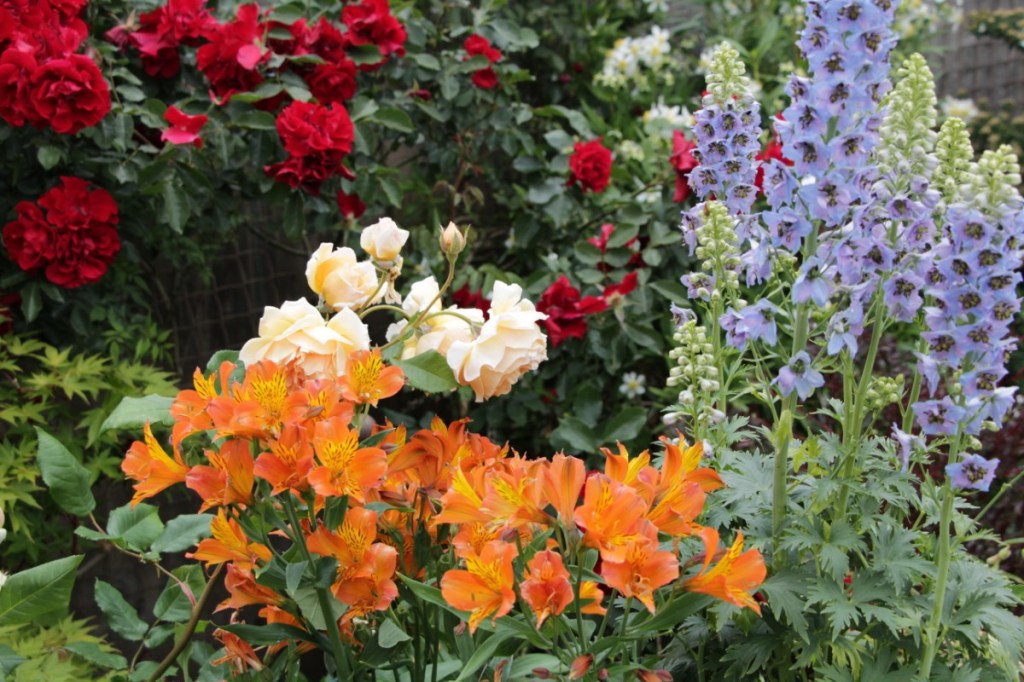
Returning through another arch I am back into the main garden where there is an explosion of colour reminiscent of the sixties, those classic summer plants roses, alstroemeria and delphiniums.

Roses planted by previous owners are blooming everywhere mingling with shrubs including the sweet-scented philadelphus.

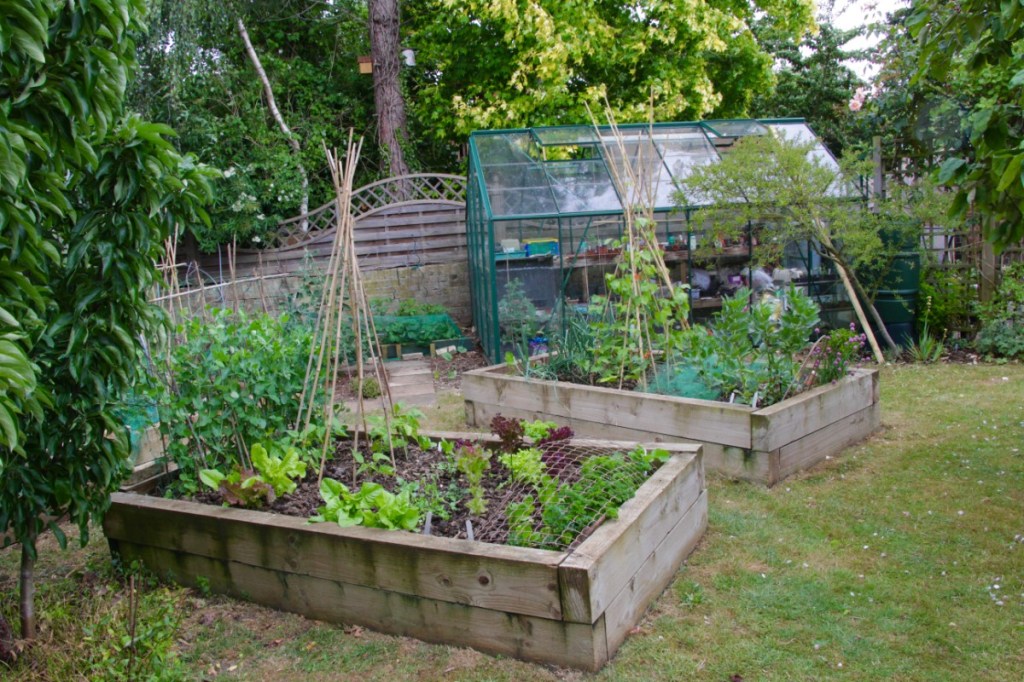
Over in the corner are the raised beds, the perfect size for vegetables, and close by is the all-essential greenhouse where Julia’s skills raise many a plant.

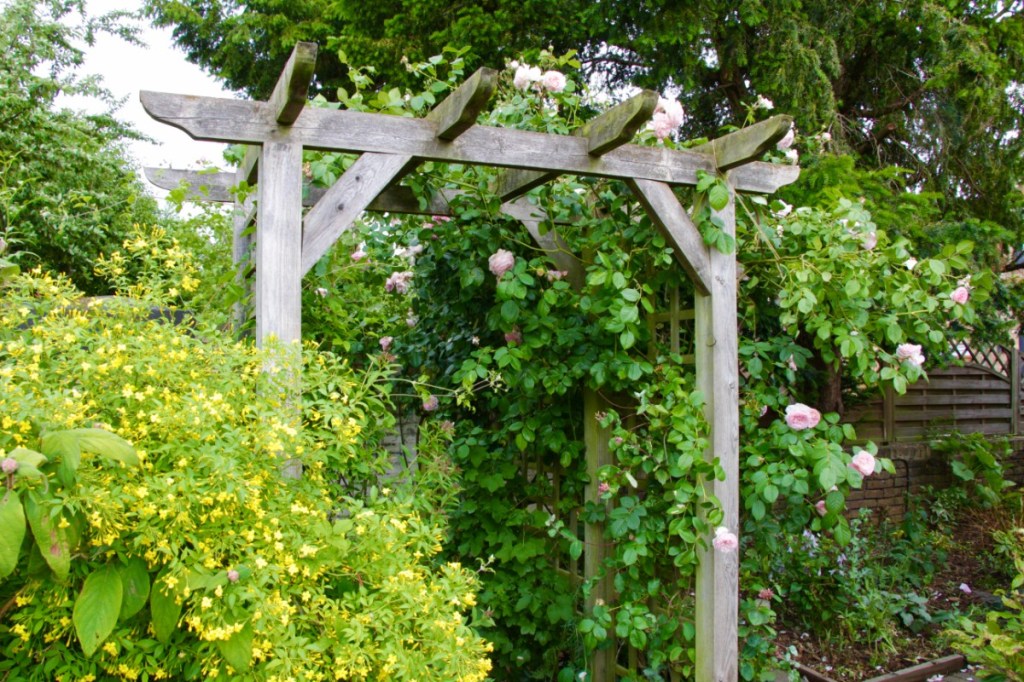
The garden is well screened being surrounded by mature trees, and several wooden arches provide height and interest. Here it is a perfect support for the pink climbing rose, and the yellow jasmine fruticans is pure joy.

Wafts of honey fragrance fill the air and I know it is not from the jasmine but am unsure where it is coming from until I discover this lovely unusual viburnum japonicum just by the house.

There is a convenient one way system, and along the east side of the house a border has been designed to give form and foliage colour,

with astrantia major popping up below to add to the colour.

Out in the front again where the Judas tree is in full leaf, salvias, geraniums alstroemerias are just a few of the plants in this dry open space.

This small daisy-like perennial Erigeron karvinskianus is so useful for softening those hard areas.

Garden owners are prohibited from providing teas, and it is a blessed relief to those of us who have added centimetres to our waist lines during the lockdown. So I head for home, the recommended distance for visiting is about 20 miles, and I must admit to have slightly exceeded this suggestion, but for those of us living in rural places the requirement might have to be more. However, you must remember that no facilities can be available and on the way home I was glad that my journey was not longer and next time I will remember not to have that second cup of coffee before I set out.

Gardens will be uploaded each week on http://www.ngs.org.uk where you can purchase your tickets. If you cannot get to a garden or do not wish to venture out, why not enjoy one of the NGS video virtual tours?

There has been no greater time when we need to support our nurses, and the all-round benefits of visiting a garden are huge.

——-2020——-
Towering above the landscape

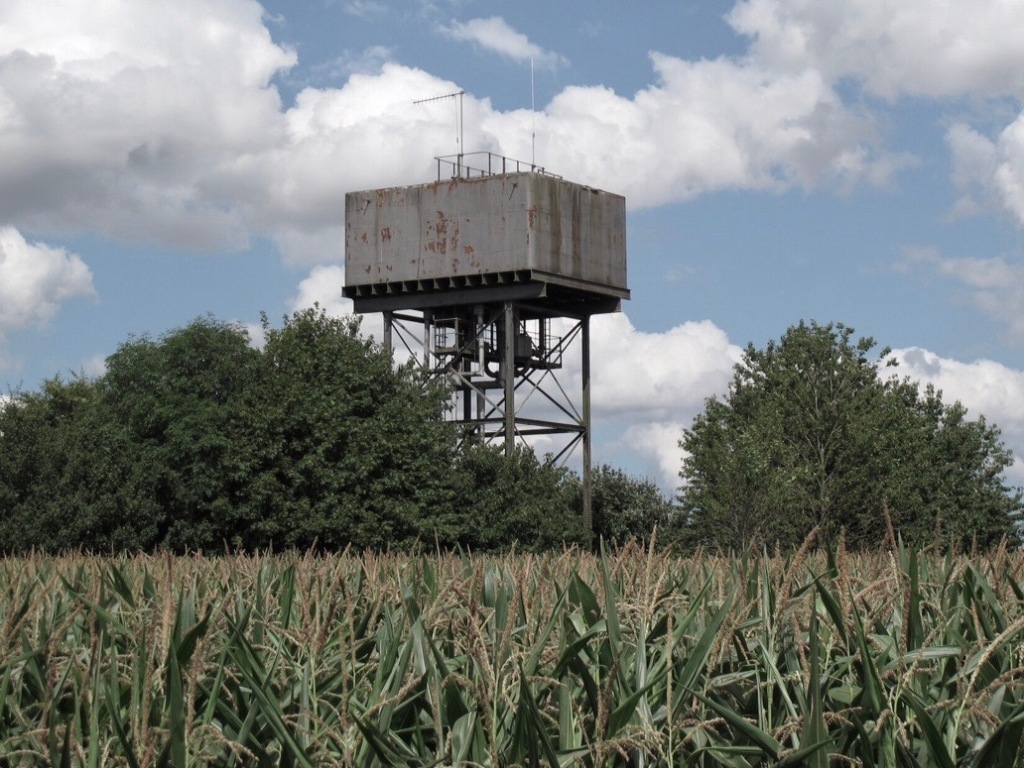
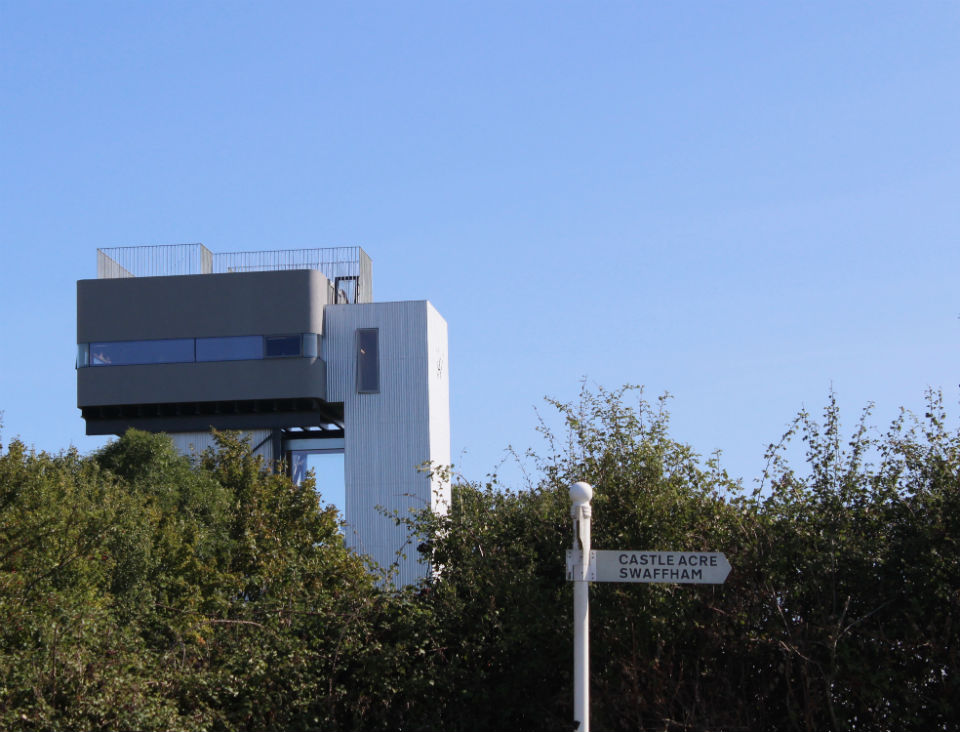
On the edge of Castle Acre village in West Norfolk stands a rusty old water tower. Apparently a Braithwaite type (the name refers to the manufacturer), it was originally constructed for nearby RAF Massingham during WWII, and afterwards recycled and moved to Castle Acre where it was decommissioned in the early 90s. Left to stand and rust, it became a familiar landmark to us locals and in some people’s eyes it was considered a bit of a blot on the lovely landscape, well that is until recently.

Picture: Matthew Usher.

Bought in an auction by a professional photographer from London it has, in the last couple of years been given it a complete face lift. Driving by we have watched the transformation with curiosity.

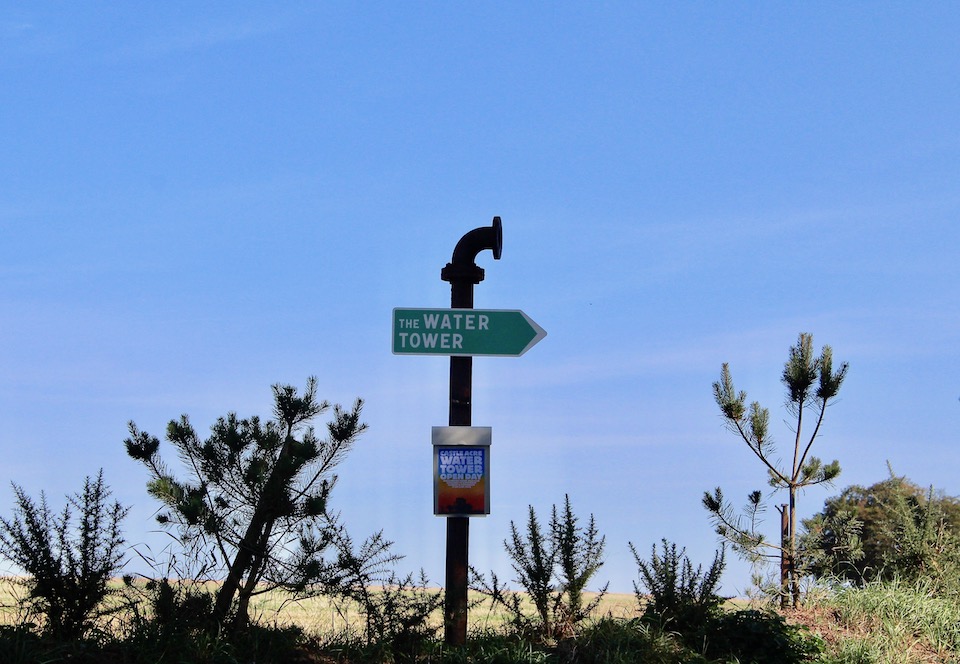
So what joy it was back in September when the new owners kindly held an open day and invited us all in, and free of charge. We went in droves, proving that we all love a good snoop when the opportunity arises. The garden gates were open wide and with a glorious blue sky and a quirky house sign we were welcomed in.

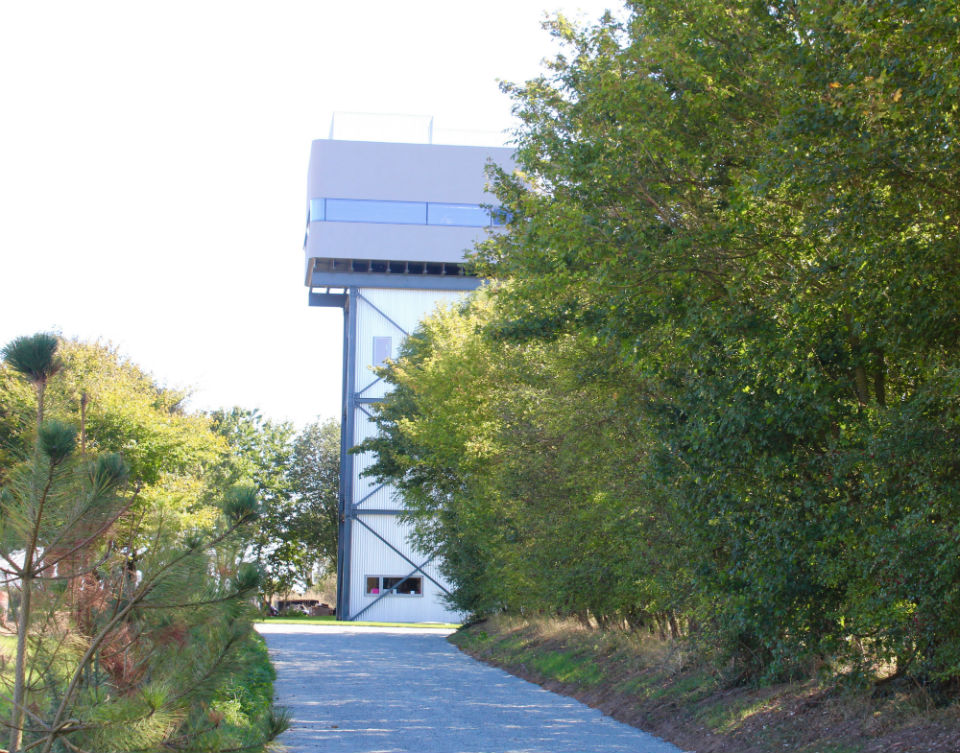
The recently laid drive has on one side a mature mixed hedgerow and on the other newly planted Corsican pines.

At first sight the impressive structure appears almost menacing and I wondered for a brief moment if I might spy a German soldier peering from the slit windows.

The owners employed the clever team of architects tonkin liu https://tonkinliu.co.uk/architecture .

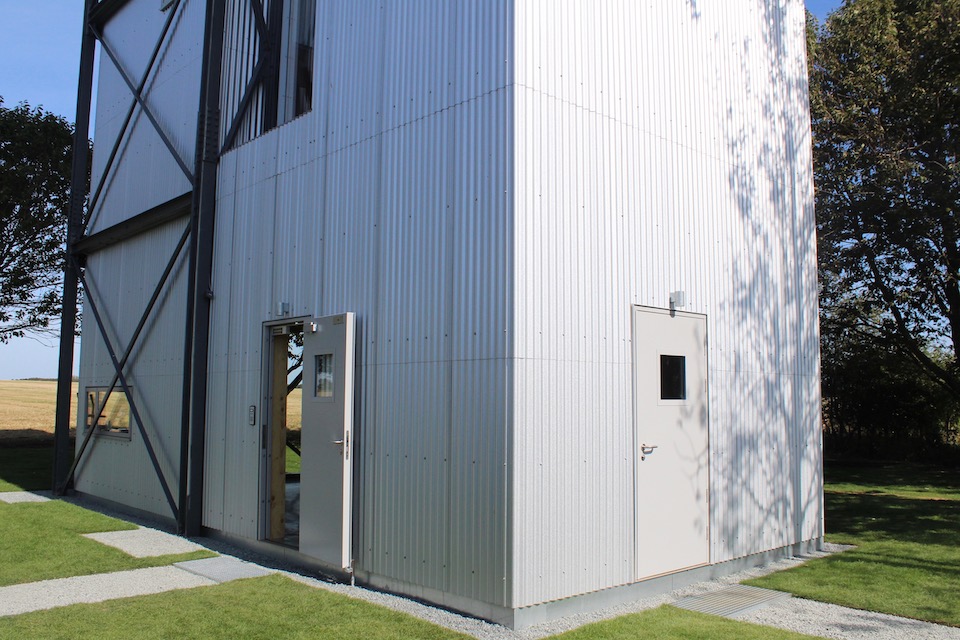
An awesome beast, it is a touch industrial but at the same elegant.The understated front door is pinned open…….

and you enter into a garden room.

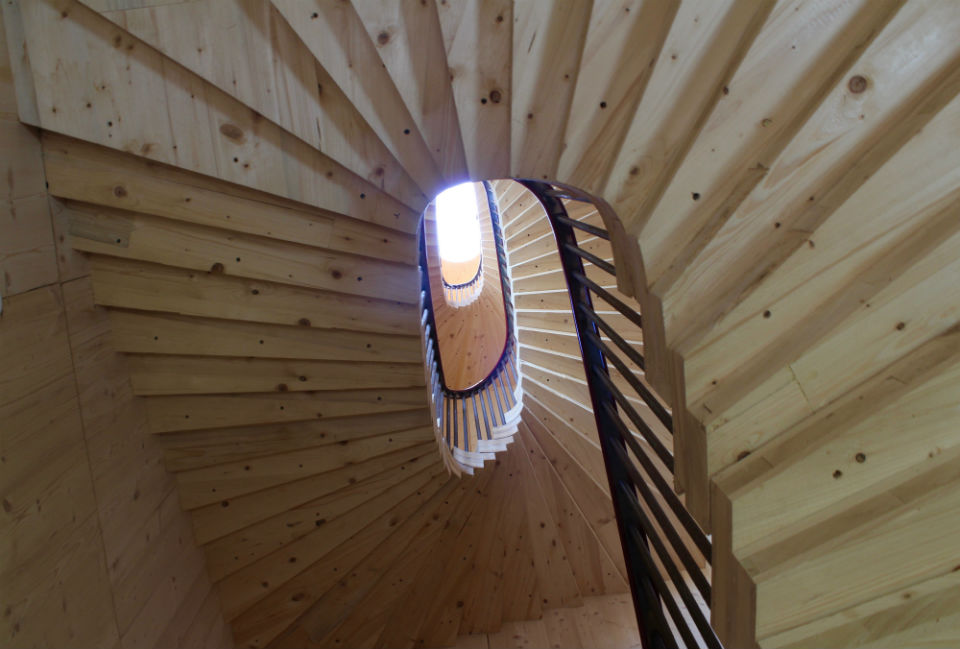
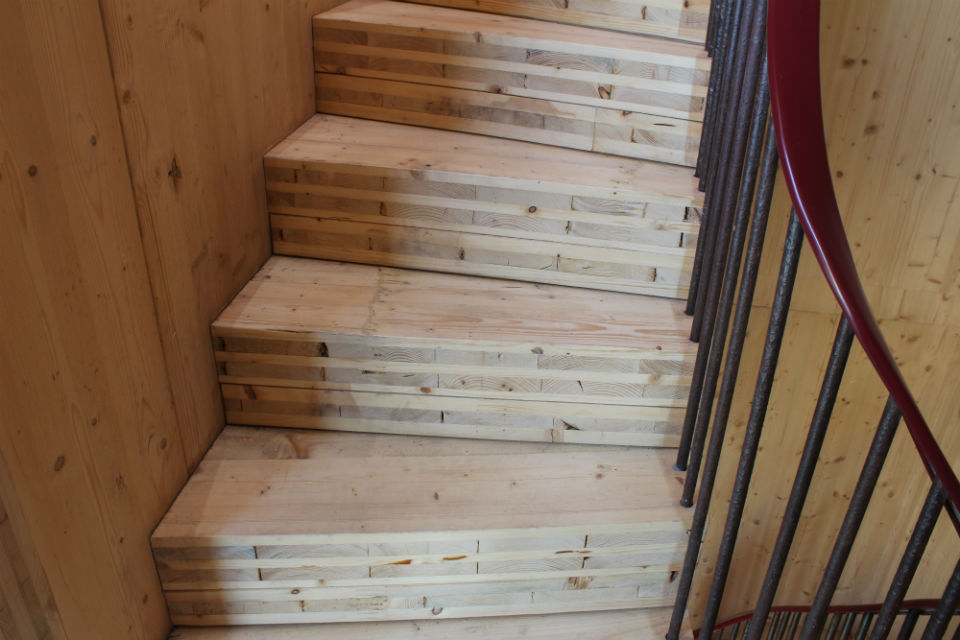
The spiral stairs beckons you upwards

each step crafted into neat wooden sandwiches.

I am keen to get straight to the top just allowing my heavily pregnant daughter-in-law to stop a second to admire the windows,

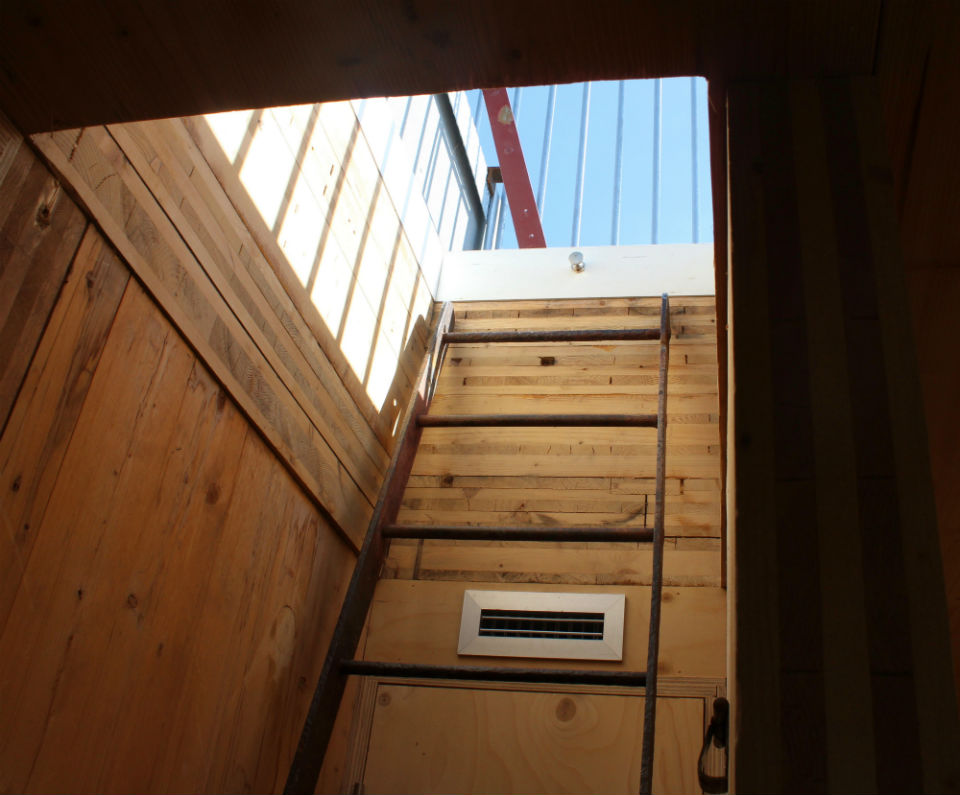
and then the stairs morph into a metal ladder

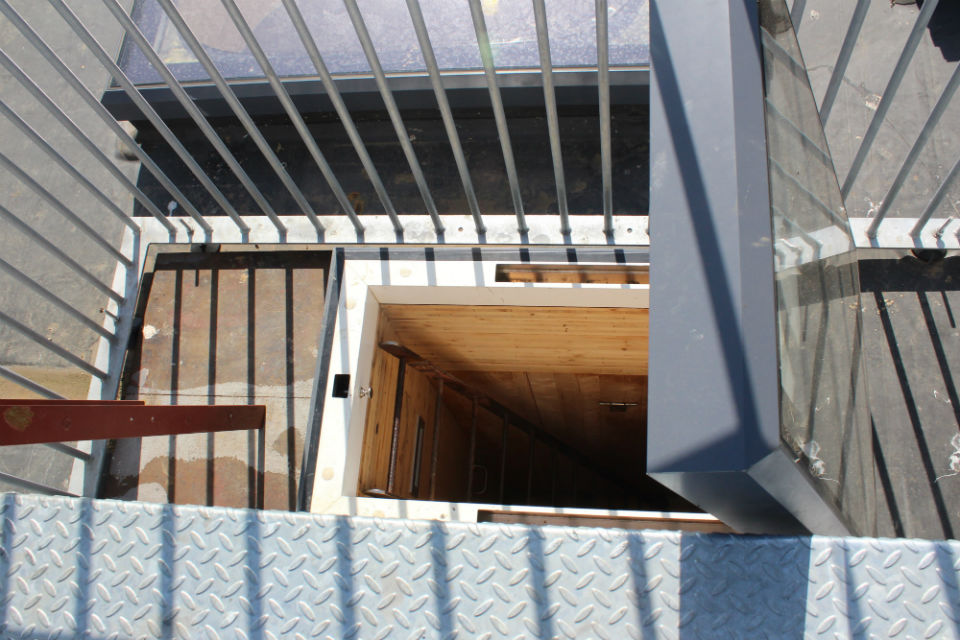
and we clamber up out on to the roof. We thought it a still day but the wind blows up here.

My friend seems to be a very long way down,

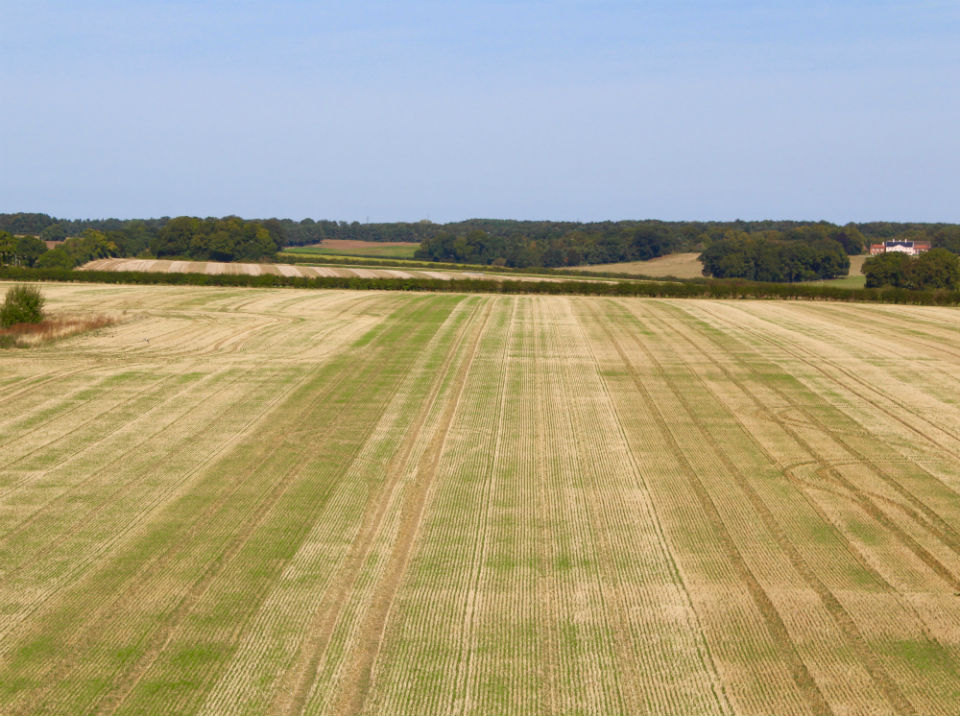
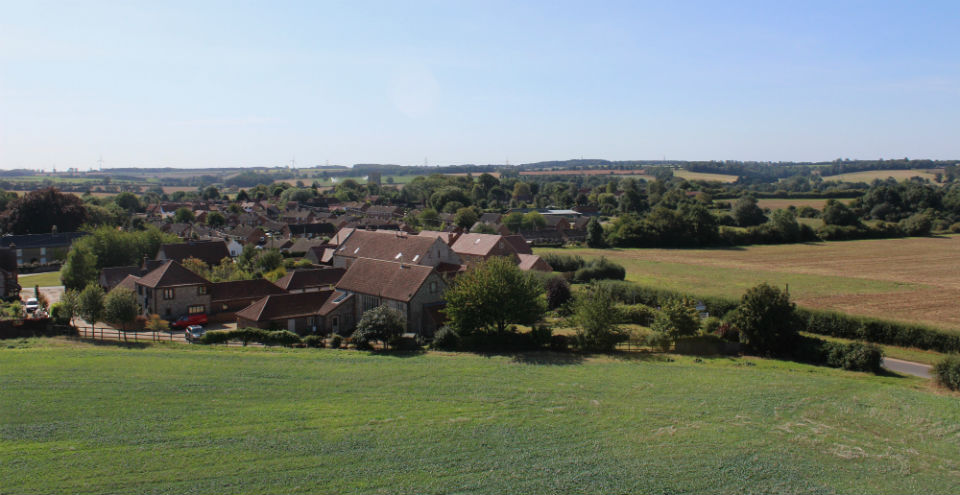
But the views are stunning; stubble fields stretch northwards,

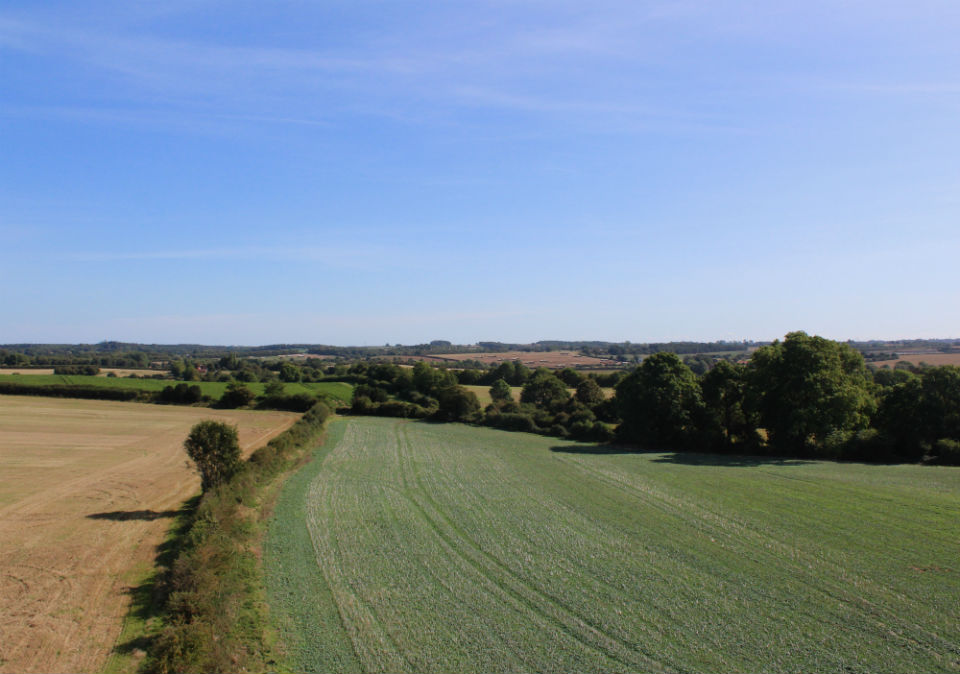
while to the east, the small village of Newton by Castle Acre is hidden by trees.

To the south is the village of Castle Acre, with Southacre beyond,

and to the west, the road winds towards Westacre. Much of these acres are owned by the Holkham estate situated some 18 miles away, the home of the Coke family. The story goes that when Coke was increasing his lands back in the 17th Century, King James 1 was not happy with the acquisition. Coke’s comment was that it was just three more acres he wanted to purchase and so proceeded to acquire Castle Acre, West Acre and South Acre.

It is time to descend, the way down through the hatch somehow does not seem as inviting as it did on the way up.

We go down into the floor below which is in fact the old water tank and now the kitchen,

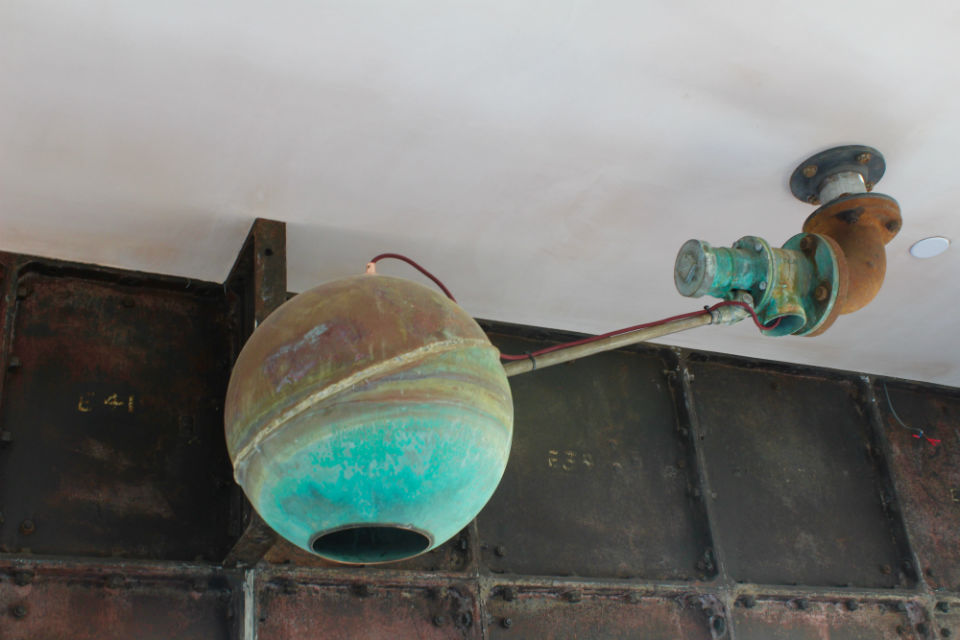
with the large ballcocks cunningly recycled into ceiling lights,

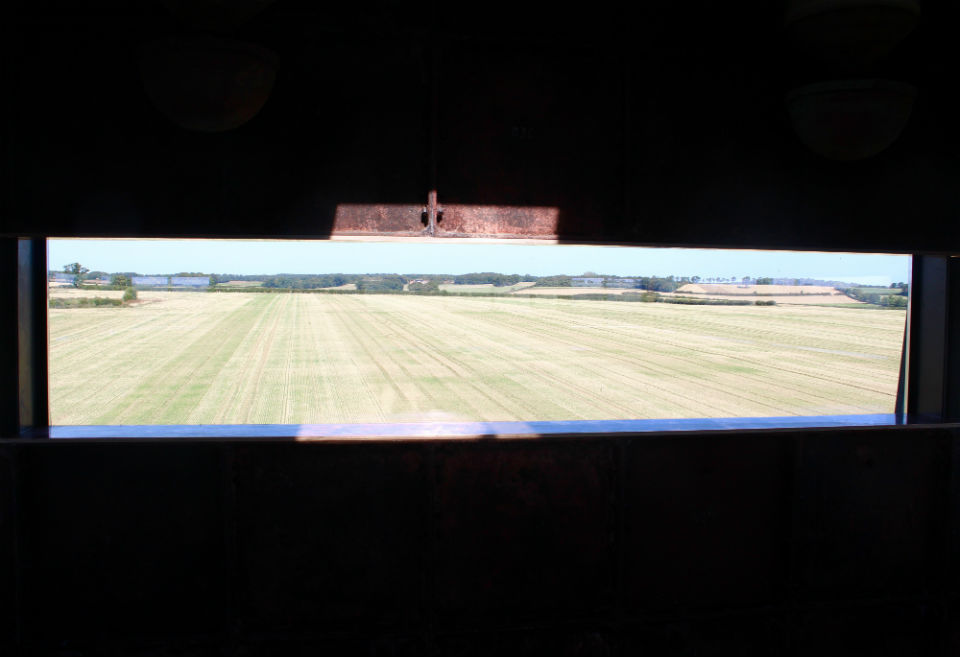
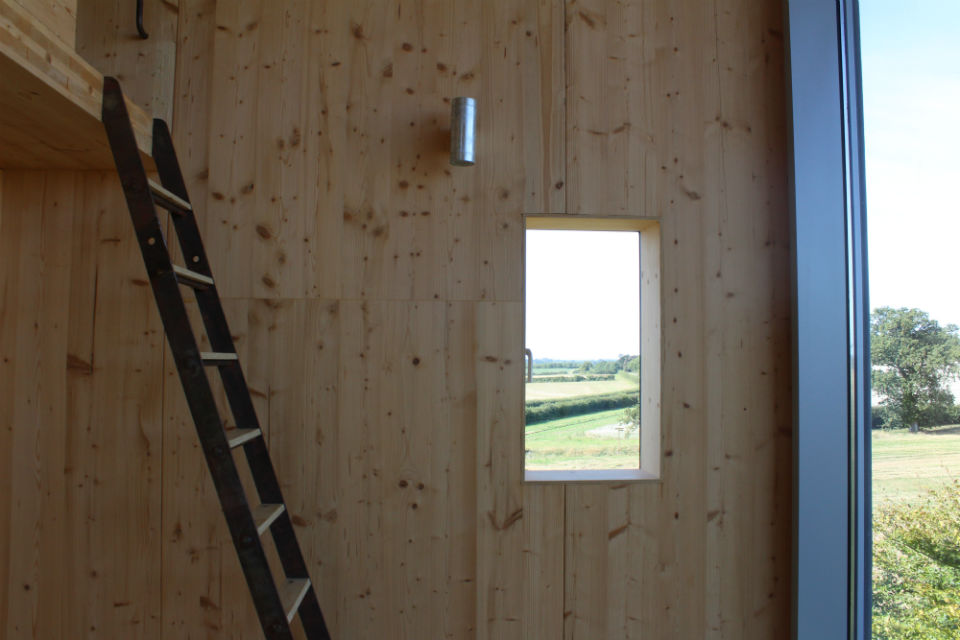
and the windows cut out of the metal sides to reveal the landscape. It is pure art.

Below the kitchen, on different levels are the two bedrooms, a ladder reaches to the raised bed area. No curtains adorn the ceiling to floor windows but why would you want to block out that view.

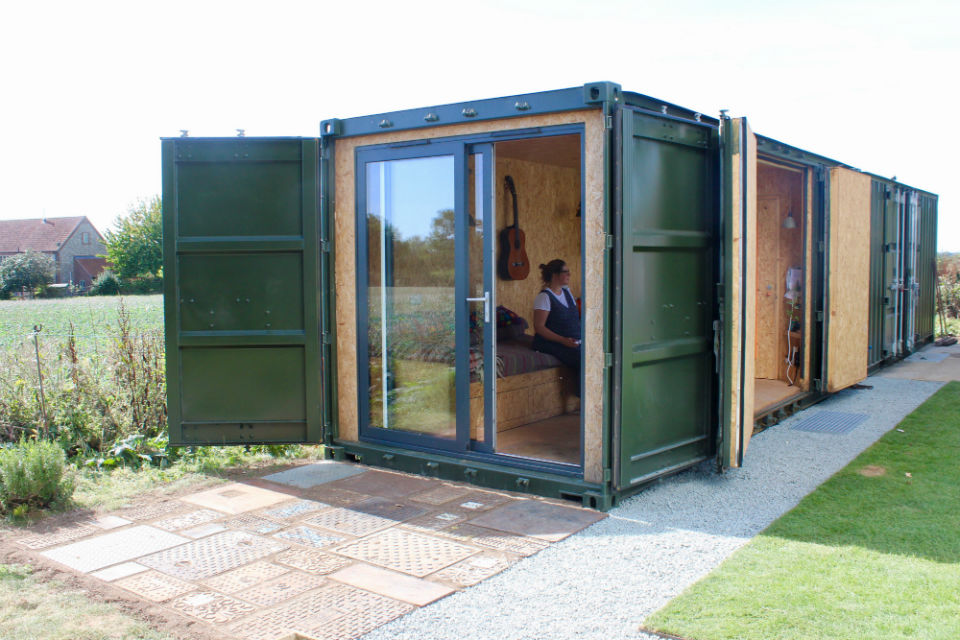
The owner Denis and his wife haven’t quite moved in and have been residing in a double converted container situated by the tower. There is no garden as yet, and indeed surrounded by such landscape there is no need. Outside the container the patio area is decoratively paved with recycled manhole covers,

and from here you can look up and check the time. And for us we realise it is time to go.

Owner Denis is an acclaimed still-life photographer and his profile describes his ability ‘to create spectacular, dynamic imagery from all manner of raw material’, I think it could be said that he displays his talent in this extraordinary building.