Garden visiting, looking at what is through the garden gate, especially those open for National Garden Scheme, with just an occasional foray here and there.
Christmas, for various reasons has not been at the forefront of our lives this year. In fact, if you came into the house you would wonder if it was ‘getting to look like Christmas’ at all. Instead of dusting down those old treasured decorations, unwinding twisted lengths of lights, bringing out the baubles, and welcoming those faithful fairies, we have gone for what one might call the natural and simple look, perhaps I should say, sustainable.
‘All is calm, all is bright’ as vases are filled with the tall bare twigs of Wintersweet, Chimonanthus praecox, and the little pale yellow flowers have filled the house with a wonderful fragrance. It is indeed, an absolute ‘comfort and joy’.
Outside it grows as a shrub, enjoying the warmth of a wall. Situated not far from the back door, you can catch the sweet smell of its divine scent, especially in ‘a bleak mid-winter’ when by chance the sun happens to shine (seemingly a rare occurrence in this neck of the woods).
Two years ago, it was becoming rather ungainly and so, long after it had flowered, I hacked it back. The following year it sulked and did not have its usual profusion of flowers and I was consumed with mighty dread that I may have ruined it for ever. Fear not; this year it has come back better than ever.
O come, O come, for those who are interested, this most highly fragrant lady was introduced from China in around 1766. A quick translation of Chimonanthus reveals it is all in the name; cheimon means winter, anthos is flower and praecox is the latin for ‘very early’ and so there we have it: a very early winter-flowering shrub. I have to agree with Vita Sackville-West who, writing her column in the1960’s and making it hyphenated said that ‘Winter-sweet should have a place of honour among plants that will flower out of doors during the winter months’. Yet nowadays despite the profusion of garden books, very few writers draw our attention to its magnificence and seldom do we see it growing in winter gardens.
Vita goes on to warn her readers that when purchasing a young plant you may have to wait five to six years until it flowers, but that it is well worth the wait. I wholeheartedly agree.
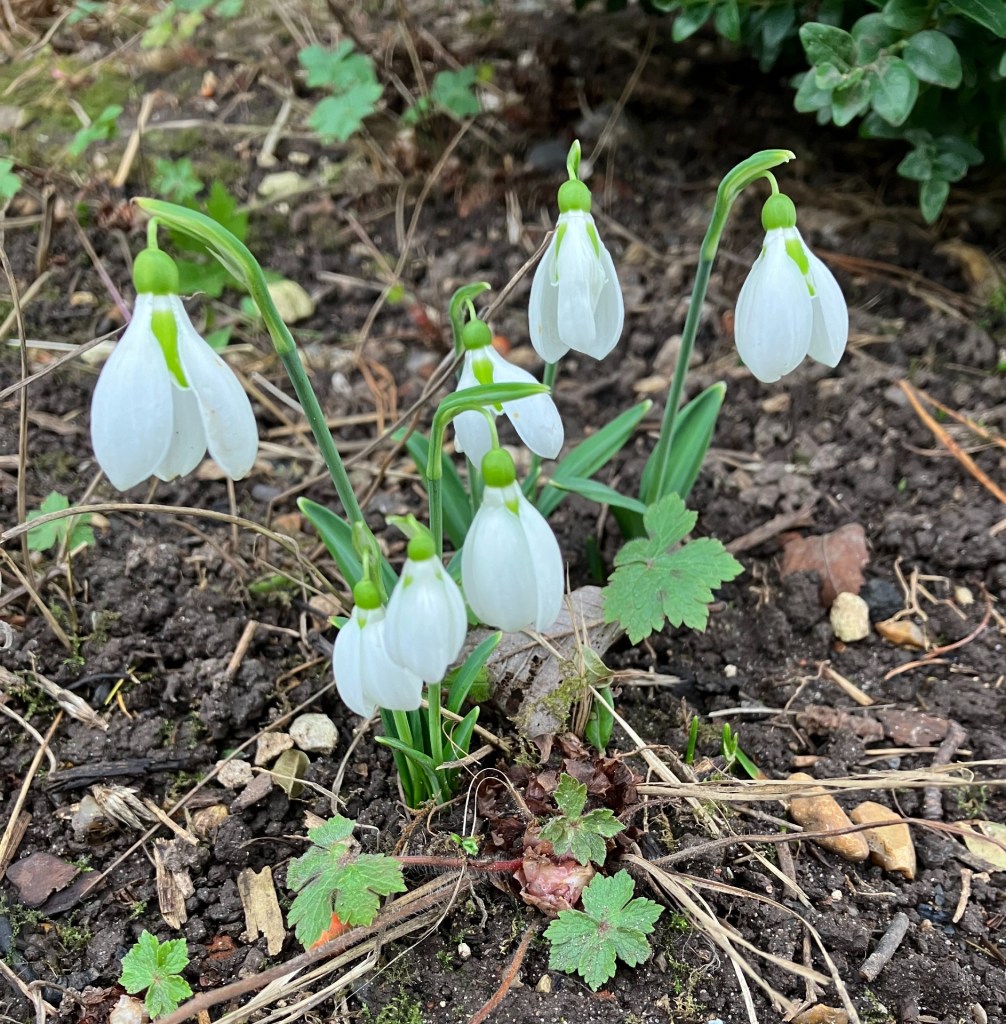
It so happens that nearby to my specimen and also in flower now, is another little star, the appropriately named snowdrop ‘Three Ships”. Plant both so you can enjoy one sailing in before the other begins to flower. Surely better than any Christmas bauble?
So here’s looking forward to visiting gardens next year
It was a joy to be out visiting gardens again and on my way driving to Hay-on-Wye for a jolly weekend, I found a garden open for the National Garden Scheme just the other side of Leominster, and very conveniently for me it was open on the Thursday.
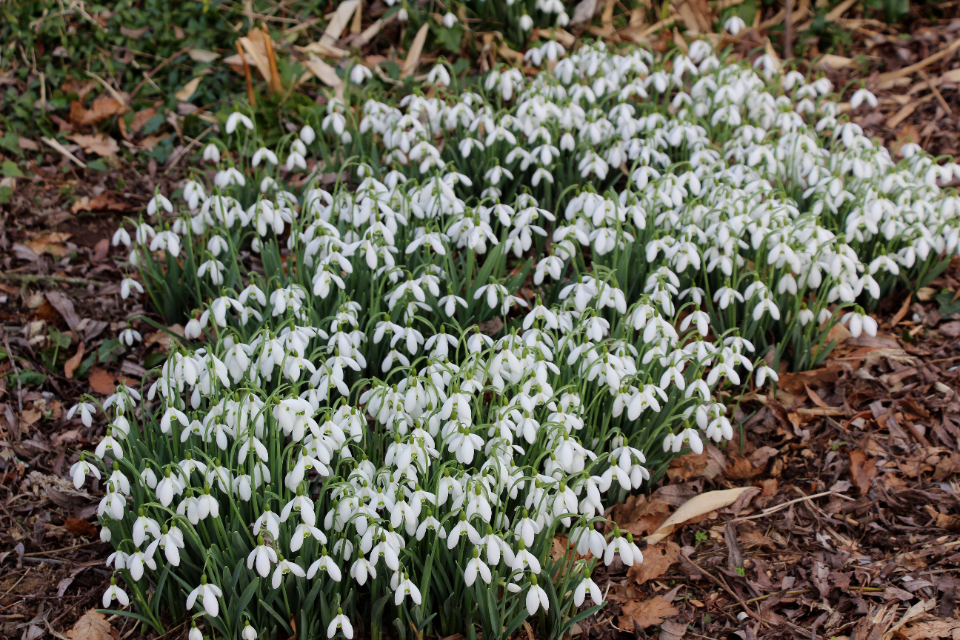
You do not need to be a gardener to know that gardens opening at this time of year are all about snowdrops, and you don’t have to be a gardener to enjoy them. At Ivy Croft splashes of welcoming snowdrops appear all around the garden, either in the borders where they seem to be nudging those perennials to hurry up and push through,
whether in clumps or drifts, growing in grass or under trees, snowdrops look so appealing and just give a little ray of hope.
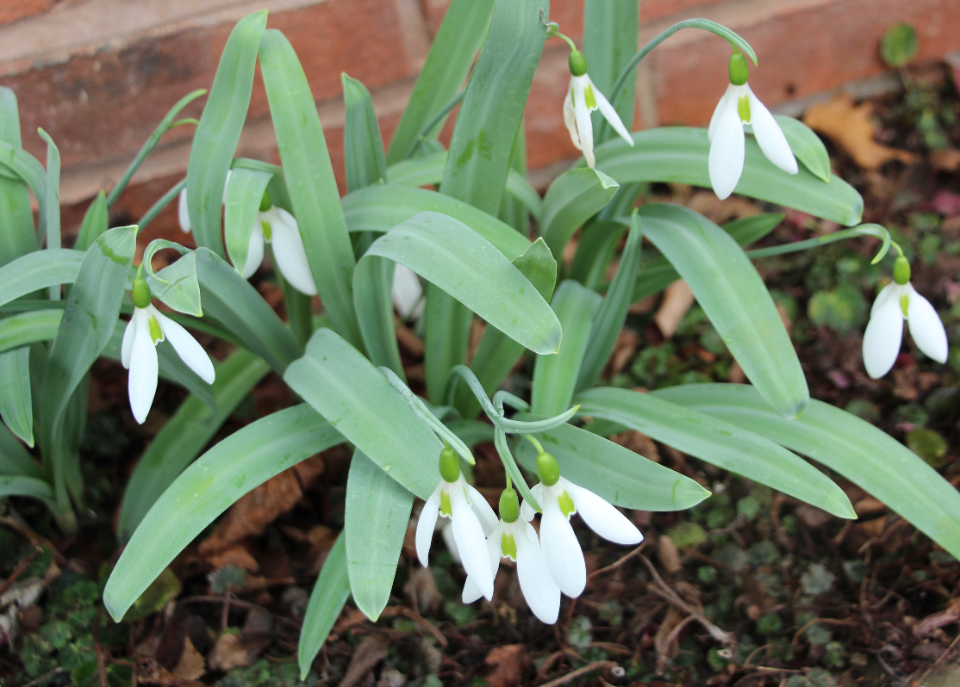
These were keeping warm growing up against the house. Garden owner Roger could not remember the exact name of these ‘Galanthus elwesii, a comfort to me that even the experts can get the labels muddled.
We begin our exploration of this four acre garden with the area by the house. There are those familiar winter gems all around and growing near the front door is the divinely scented Chimonanthus praecox also known appropriately as Wintersweet. I regret taking the saw to mine and if you have not got one I urge you to go and buy one.
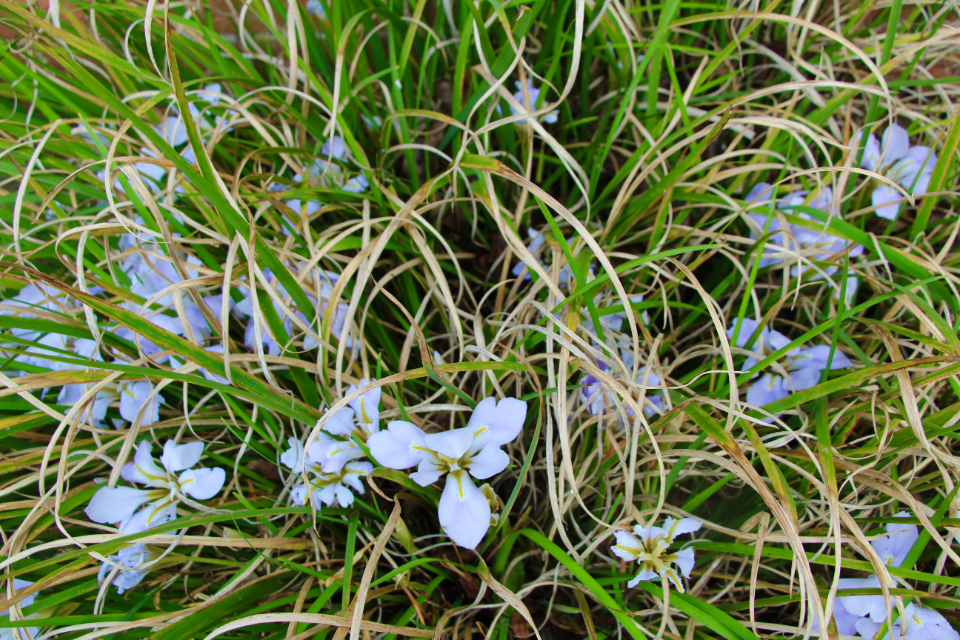
Below, the handsome clump of soft blue winter-flowering iris catches my eye. These Algerian iris Iris unguicularis flower from November through to February, the individual flowers look quite exotic in a vase.
All gardens look a little bare at this time of year but as we venture to the front of the house an elegant seat and stone troughs add another dimension,
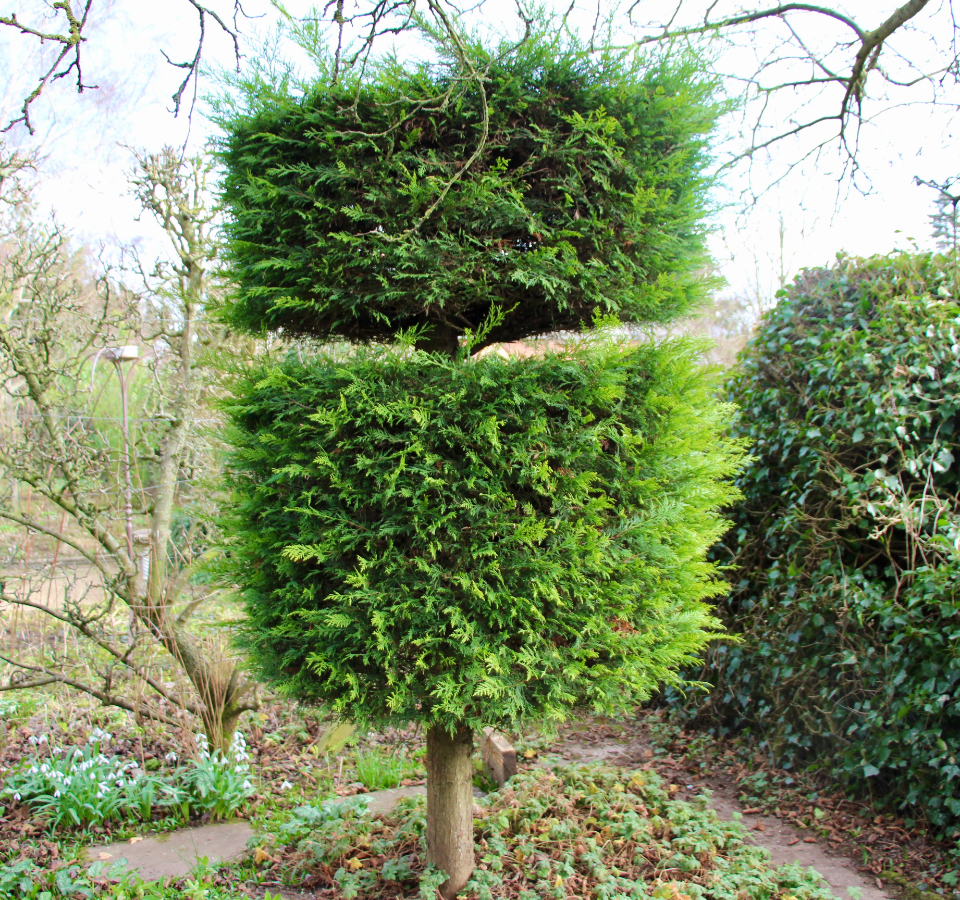
and to embellish the scene there is nothing like a touch of topiary …
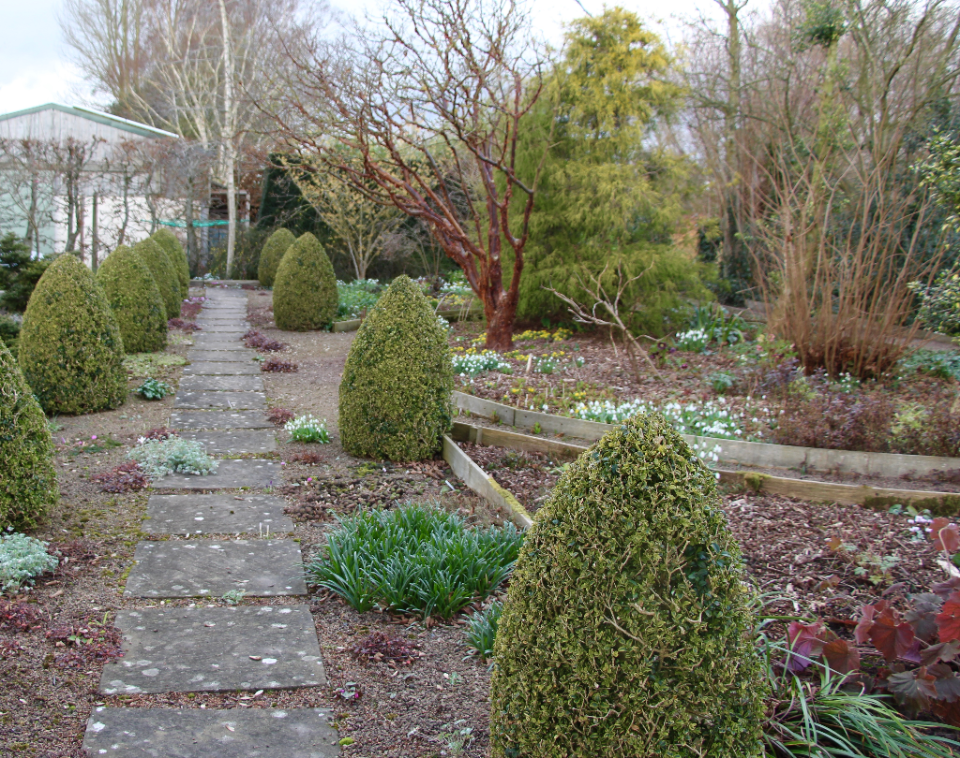
You can see how evergreens are a necessity in any garden particularly in winter; here they soften the hard landscape and guide you along the path past the reddish brown stems of the Acer griseum.
Every Spring I mourn the fact that I have not planted enough hellebores, and as Spring gathers apace, I simply forget. These just look so heavenly.
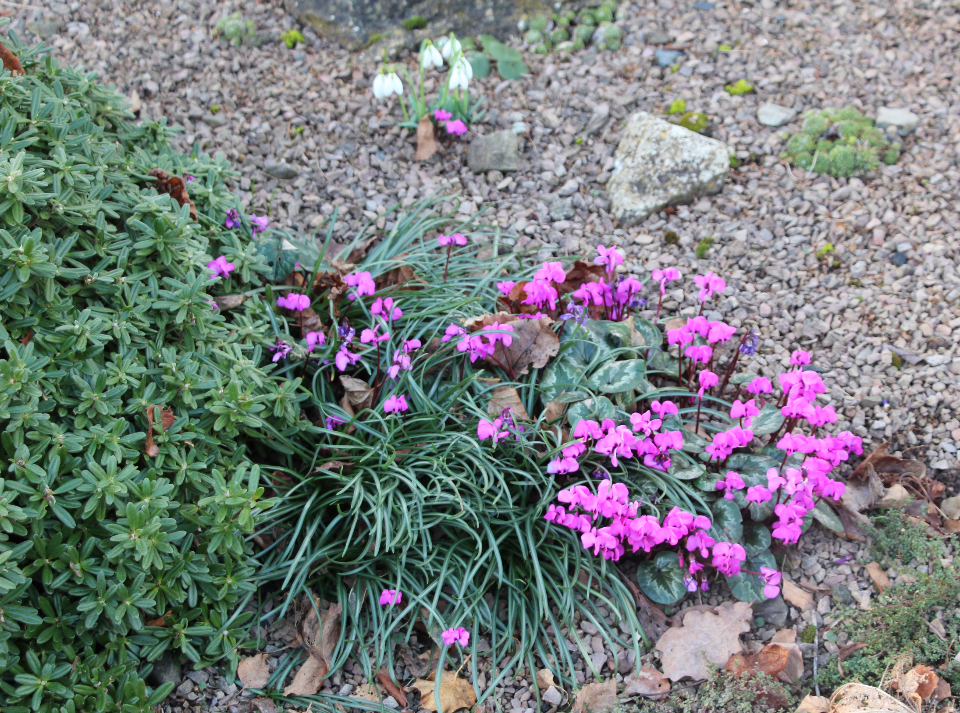
We need some colour at this time of year and what better plant than these cheeky cyclamen emerging out of the grey stone.
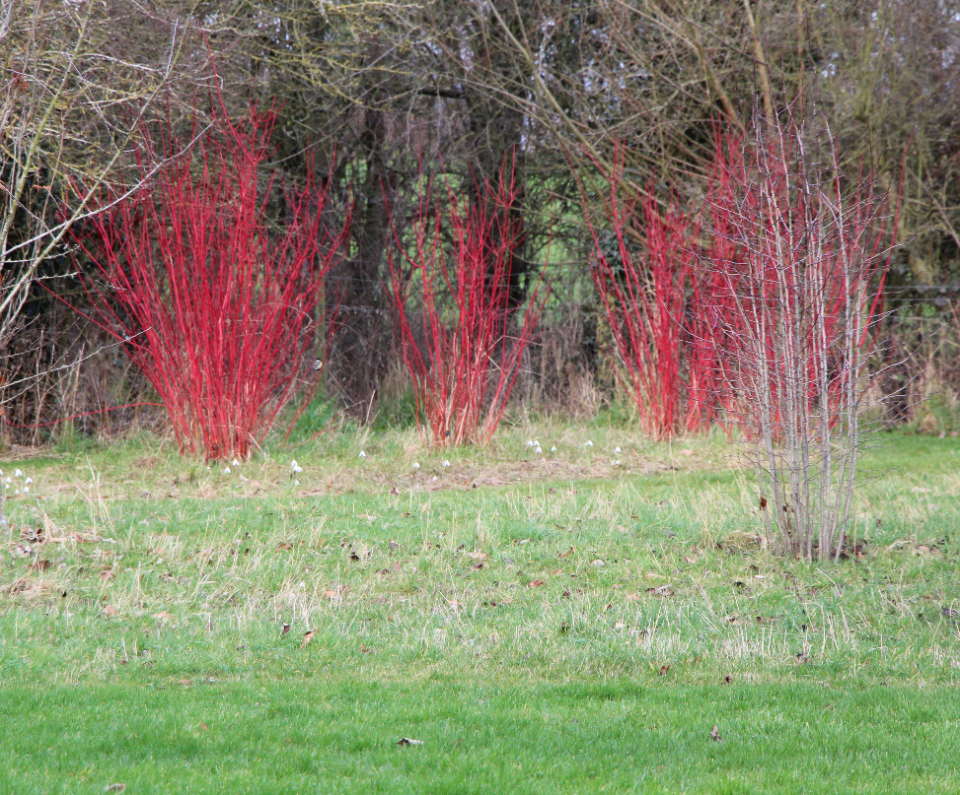
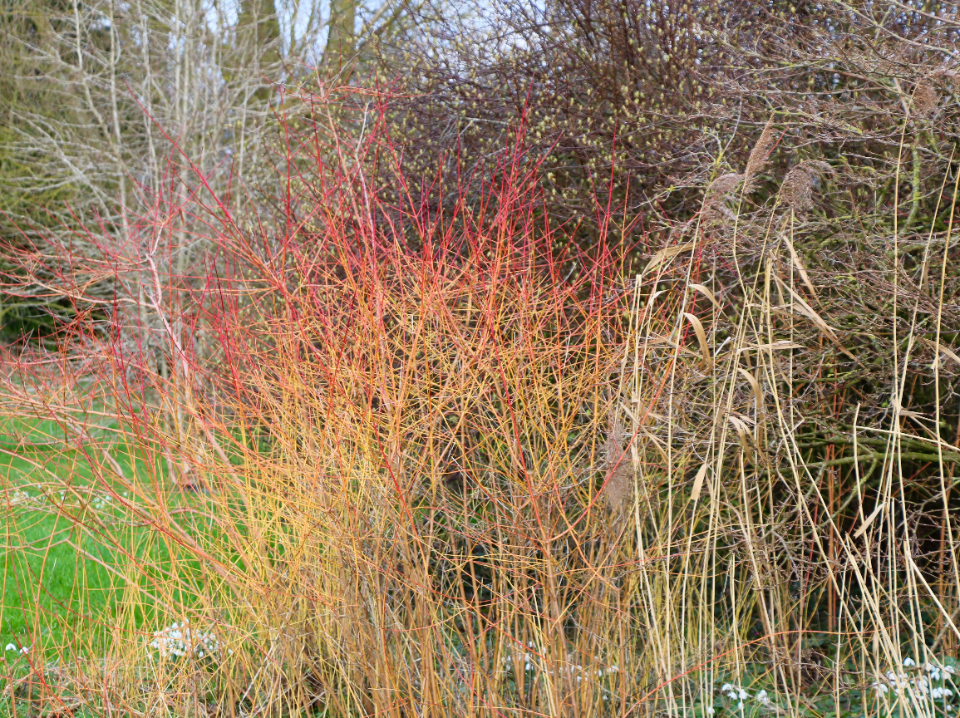
Walking away from the house, the vibrant stems of the Cornus draw us into the wilder area of the garden. Wild it may look but I know these parts of the garden can be a lot of work.
I can’t help but admire the green of the conifer, its branches elegantly flowing down to the ground and am surprised to find it is Chamaecyparis lawsoniana ‘Impricata Pendula’. If you check out The Woodland Trust website it cheerily informs you that the wood is rot-resistant which is popular in Japan for making coffins.
Gardens are not all about flowers; Roger uses woven willow in several places in the garden, either as a screen or as a quirky seat arbour.
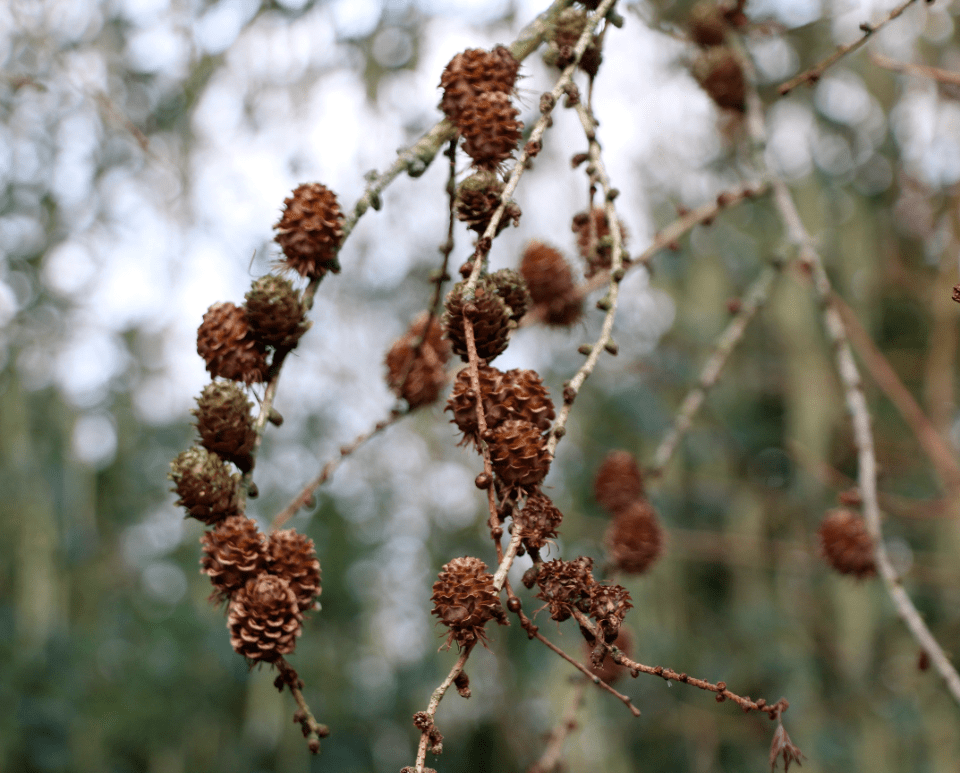
and it is easy to forget the beauty of the small cones of the deciduous common alder Alnus glutinosa,
whilst the evergreen Garrya elliptica, drips with silver tassels. This is a bush which I find suffers the cold but dislikes the wind.
The garden was created some 25 years ago and has an air of maturity about it. Neat paths wander through wintery shrubs and trees, glimpsing every now and again the promise of spring,
and out in the open while the lawn looks so verdant and trim, the ornamental grasses seem to be experiencing a bad hair day.
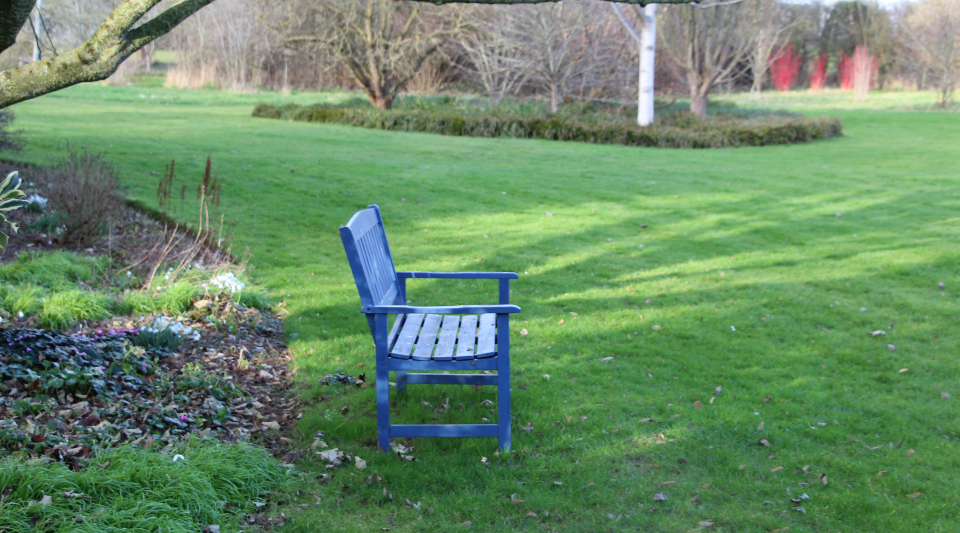
How a drop of paint gives a simple wooden bench a touch of vibrancy, a focal point in a spacious area; the blue seems to blend harmoniously with the bright green.
A Mulberry is the central feature of the working vegetable garden, where paths are sensibly wide and firm waiting for the laden barrow to pass through the organised beds.
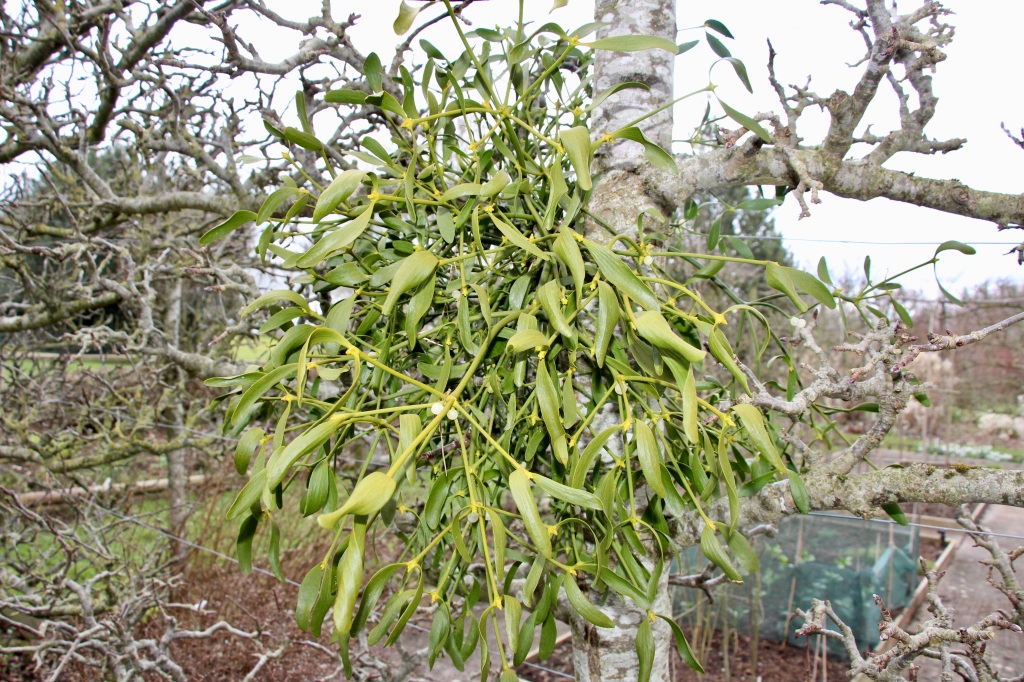
Surrounding the vegetable garden are trained fruit trees, one adorned with the mysterious mistletoe, which grows quite prolifically in the orchards around the county.
It is difficult not to admire this splash of Hamamelis mollis; several varieties grow in the garden, but this is near the car parking area and the scent is uplifting. To the right are the pleached limes underplanted with ‘oh so perfect’ box balls.
Behind the parking area is the whitest of birches contrasting with the evergreen fine yew buttresses, and what a perfect way to cheer up an unremarkable building. I am inspired to recreate the idea.
Roger is a true galanthophile and has collected and cultivated quite a selection: they are clearly labelled boasting endearing names. My friend Jill falls for a beautiful yellow ‘Treasure Island’ until we notice the price. To be fair it is not an unreasonable amount as some Snowdrops can reach staggering prices but we just aren’t in the market. So she goes for a different yellow, Galanthus ‘Spindlestone surprise’ while I settle for the ‘Godfrey Owen’ with its six outer petals, and also the virescent ‘Rosemary Burnham’, whose white petals look as though they have been brushed lightly with green.
Ivy Croft is open for the National Garden Scheme for Snowdrop Thursdays throughout February and March, and is open throughout the year. For details of this garden and other snowdrop gardens near you check out https://ngs.org.uk/view-garden/14669. To see Roger’s list of snowdrops and some lovely photographs of the garden in summer, go to http://www.ivycroftgarden.co.uk/. I hope to pass this way again.














 The Garden Gate is Open