Stoke Mandeville, Horatio’s Garden. (90)

For The Ninetieth garden I was invited to see a very special garden at Stoke Mandeville Hospital, Aylesbury in Buckinghamshire.

The day of the visit, last Monday the sky was a dull grey and there had been heavy snow the previous day.
IMG_0074.jpg

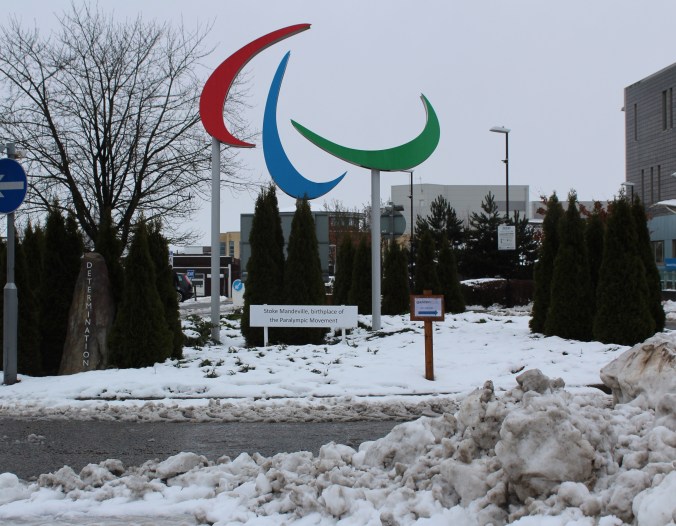
The Hospital is famous for its National Spinal Injuries Centre, one of the largest specialist spinal units in the world. Just outside the entrance is this life size (5’6″/1.70m) statue by Mark ‘Jacko’ Jackson of Professor Sir Ludwig Guttman. Affectionately known as “Poppa”  he was the global founder of successful spinal cord injury treatment. The government asked him in 1948 to set up the specialist spinal ward which then expanded into this amazing centre. He is also father of the Paralympic Games.

IMG_0109.jpg

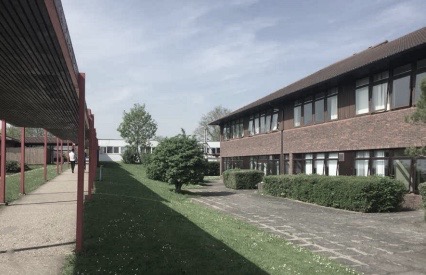
The garden has not actually been created yet, but the intention is to transform this a rather bland paved area adjoining the Spinal Care Wards into a garden; and so bringing a touch of nature and beauty to patients and their families in an accessible oasis of calm attached but away from the clinical environment. This will be Horatio’s Garden.
Screen Shot 2017-12-13 at 22.05.41.jpg

Photo from http://www.horatiosgarden.org.uk

Same site but a rather different scene that greeted us last Monday!

IMG_0084.jpg

Horatio was a young man who was a volunteer in his school holidays at the Duke of Cornwall Spinal Treatment Centre, Salisbury. He and his father, a spinal surgeon at Salisbury Hospital came up with the idea for a garden and Horatio organised a questionnaire to find out what the patients wanted. Horatio was never to see the garden which was created in his memory after he was so tragically killed at the age of 17 by a polar bear in northern Norway.

logo_new.png

http://www.horatiosgarden.org.uk/about-us/what-we-do/

Horatio’s Gardens have been completed in Salisbury and Glasgow, and now Stoke Mandeville is the latest creation. The ‘L’ shaped site is situated in the middle of this busy hospital.
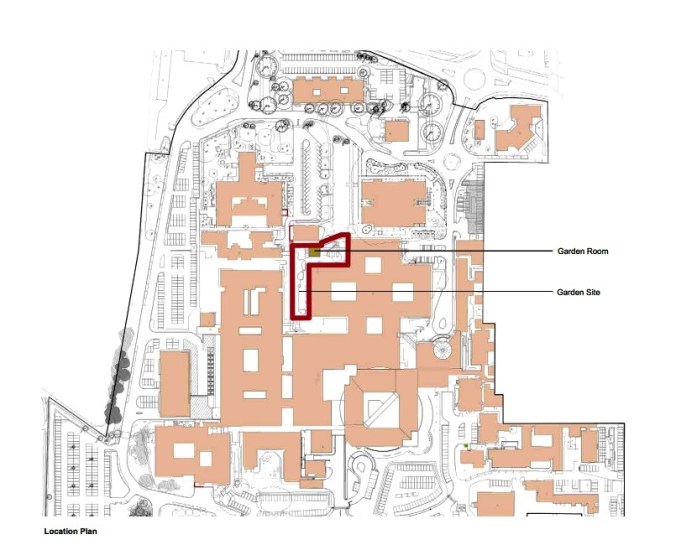
Screen Shot 2017-12-15 at 08.30.12.jpg Garden designer, RHS Gold Medallist and great gardening guru Joe Swift was on hand to explain his design.

IMG_0085 (1).jpg

This is the projection of his perceived plan:

Screen Shot 2017-12-15 at 09.50.04.jpg

Picture taken from http://www.horatiosgarden.org.uk

Excavation work started back in August when Sir Robert McAlpine generously supported the removal of 1,800 tonnes of spoil. The tyre marks show the route of the trucks and lorries that exited the site through the public car park.

IMG_0103.jpg

The site was levelled and is being prepared for the permeable bonded resin paving to be laid, providing a smooth surface and making an easy transition from ward to garden for the patients in beds and wheelchairs.  It is not always easy when you first have to encounter being in a wheelchair and this outdoor area will assist in gaining confidence.
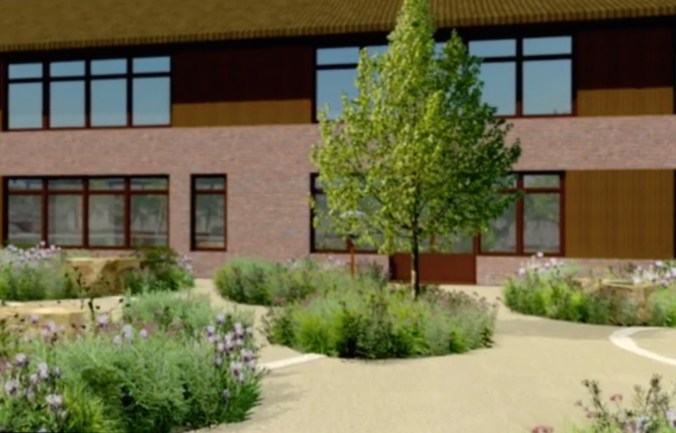
Screen Shot 2017-12-15 at 09.40.35.jpg

Picture borrowed from http://www.horatiosgarden.org.uk

Today a trench was being dug through the heavy clay for the drainage.

DSCF7133 (1).jpg

Of course no site comes without its problems. First the lengthy business of moving the huge NHS power generator; tucked around the corner it is now sporting a smart new turquoise colour which helps it blend in with the building behind.

IMG_0103 (1).jpg

It is difficult to imagine but this will be the water feature,

IMG_0100.jpg

Computer graphics show an elegant raised pool at a height suitable for wheelchairs. I’m afraid you will just have to imagine the sound of the gentle flow of running water.

Screen Shot 2017-12-15 at 10.06.18.png

Picture borrowed from http://www.horatiosgarden.org.uk

Perhaps the red kite soaring above was taking advantage of a bird’s-eye view.

IMG_0105.jpg

The view from above shows the flow of the design with curves providing intimate bays, a place for those private moments never realised whilst on a ward. Spinal injury patients often need to endure a long stay in hospital.

Screen Shot 2017-12-13 at 23.22.08.jpg

Picture borrowed from http://www.horatiosgarden.org.uk

This unremarkable area was where the generator once stood alongside the brick wall;

DSCF7123.jpg

it will soon to be the garden room. Being built off-site, it is expected to be installed in the New Year. Light and airy,  here patients will be able to enjoy the garden even when the weather is inclement. Kitchen facilities will enable them to make a cup of tea and perhaps share lunch with visitors.  Those who wish to, will also be able to participate in the volunteer-led activities that the Horatio’s Garden charity organises.

Outside the garden room a communal space will be used for informal social gatherings of patients perhaps for lunches or even live music.

Screen Shot 2017-12-15 at 09.42.00.jpg

Picture borrowed from http://www.horatiosgarden.org.uk

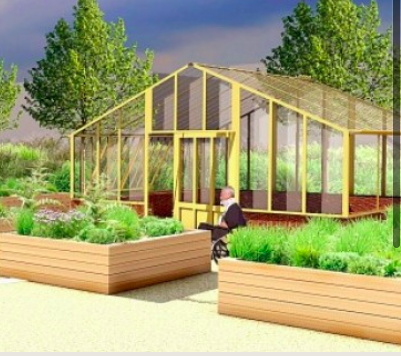
Nearby an accessible spacious greenhouse will be built. Specially equipped for patients to help with the gardening, it will be used to propagate plants for the garden and give an opportunity for patients to get involved with working with the head gardener and volunteers or just come and chat and watch. Regular garden therapy groups will use the greenhouse and the raised beds, for therapeutic activities. Herbs, salad leaves and fruit will be grown for patients to pick and enjoy.
Screen Shot 2017-12-15 at 09.29.49.png

Picture borrowed from http://www.horatiosgarden.org.uk

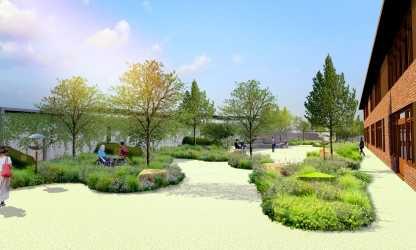
Horatio loved apples and so they will be well represented amongst the variety of trees that will be planted throughout the garden.

Further round the corner is the paediatric ward where the proposed garden will be used by children with spinal cord injuries giving them and their families a beautiful natural space away from the difficulties of hospital life.
download.jpg

Picture borrowed from http://www.horatiosgarden.org.uk

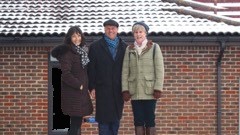
The gentle driving force behind Horatio’s vision is Dr Olivia Chapple, Horatio’s mum. Relinquishing her role as a General Practitioner she now volunteers full time for the charity not only as Chair of the Trustees but also as a porter pushing patients in their beds out into the gardens. Joe is enthusiastic about the garden and Olivia is eternally grateful for all the support her vibrant charity receives. I left Joe in a site meeting and Olivia interviewing for the important role of Head Gardener.
2 (1).jpg


Every charity needs support, and there are plans for gardens at Oswestry and London. Giving is so easy…
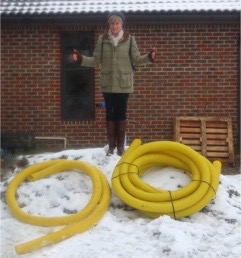
DSCF7117

The National Garden Scheme has donated £130,000 to this project. It is an inspirational concept and with such a brilliant and sympathetic design it cannot help but bring a sense of well-being to the many spinal unit patients.

What a great finish to my Ninety and I do so look forward to reporting on its completion in 2018.
IMG_0092 (2).jpg

——-90——-

The Manor House, Bledlow; sculpture and setting (89)

Back in May we stayed with friends in North Buckinghamshire and they suggested we might visit Bledlow Manor, the home of Lord Carrington. A beautiful drive through the Chilterns brought us to this lovely estate and we were able to park under the line of flowering chestnut trees.

DSCF0867

The house had been in the family since the end of the 18th Century and when the Carringtons moved here in 1946, it was in need of much renovation. There was no garden of mention at that time and work did not begin in that area until 1969. Created together, it was Lady Carrington who had the interest in plants; her obituary in the Telegraph in 2009 reported “My wife,” Lord Carrington always said, “is the plantswoman,” adding (in a reference to her encyclopaedic knowledge of botanical names): “She doesn’t really talk English, she talks Latin.”

Lord Carrington, the last surviving member of Churchill’s cabinet, and just short of age 98 was standing outside the front door ready to greet visitors. After exchanging a few pleasantries we slipped through the tall pineapple-topped gate posts to the right of the house.

DSCF0871

We decided to head straight down to the water garden, known as the Lyde Garden, and just for the moment snatching a view of the terrace running in front of the house,

DSCF0872.jpg

and swiftly passing the armillary sphere to the right, with the intention of returning to this part of the garden later on. The yew and box are trimmed like perfect cut slices of cake.

DSCF0874.jpg

The Lyde Garden is situated across the road and is actually accessible at all times of the year. Well-made steps guide us down through the leafy wilderness,

DSCF0875.jpg

and at the base level the path bends gently round and through an oriental wooden structure,

DSCF0877.jpg

from where you can sit awhile and enjoy the peace and the circular pond, the centre of which has a group of metallic flowers poking up above the still waters.

DSCF0880.jpg

The river Lyde rises here and is a tributary of the Thames. Originally watercress beds, it is now planted with ferns, gunnera and hostas.

DSCF0883.jpg

Cool and watery, the weeping willows have now replaced the diseased wych elms.

DSCF0884.jpg

Crossing back over the road we arrive onto the lawn in front of the charming Adam house which sits gracefully amongst low summer borders.

DSCF0893.jpg

At one end of the lawn are crisply cut buns of yew,

DSCF0892.jpg

and at the other, ornamental fish ponds surrounded in brick, a design which perhaps reflects the time of construction.

The garden is not just about the plants but is a glorious setting for a fabulous collection of sculptures which the Carringtons began collecting in the early 1990s.

DSCF0942.jpg

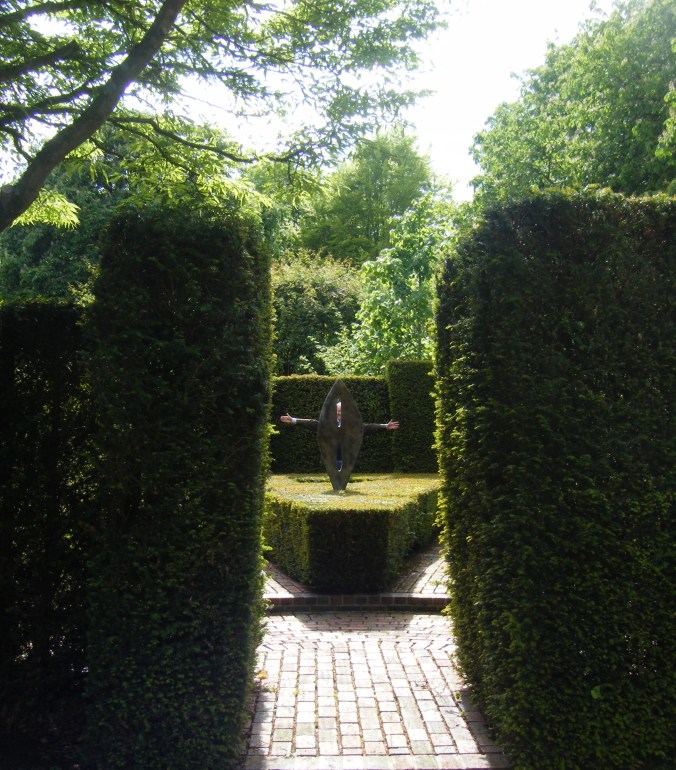
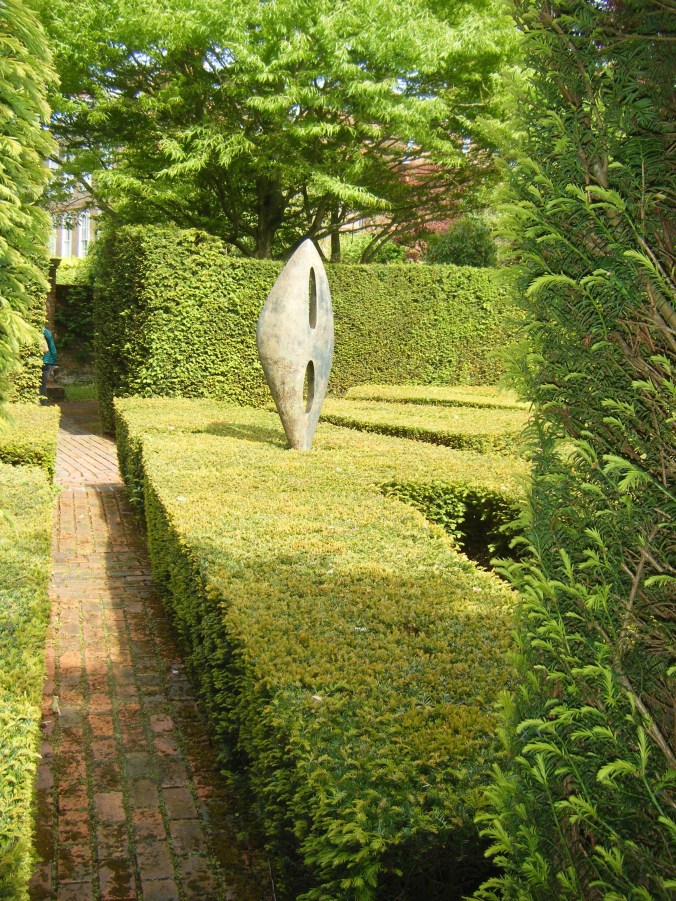
The first piece of art, strategically placed and called ‘Primitive Form’ is by the Italian born Marzia Colonna. Today it has been enhanced by outstretched arms.

DSCF0898.jpg

Purchased in 2005 it fits perfectly amongst wedges of box where it can be viewed from all angles.

DSCF0901.jpg

The brick pathways lead out into an open, less structured area. Mown lawns sweep around borders packed with a huge variety of shrubs.

DSCF0934.jpg

Then around the corner we meet gorgeous ‘Gorilla’ by Michael Cooper and made from Belgian fossil marble commissioned in 1993. Lord Carrington explains how it came about:

“Michael Cooper is a friend and near neighbour of mine and, some years ago, I asked him whether he would be prepared to do a piece for a new garden I was making at that time and in which there was an empty plinth. ‘I will do you a gorilla’, he said and there it stands, or rather sits, today – greatly admired and loved by all the children who visit the garden during the summer. Michael has the most wonderful talent for portraying animals, as those of you that have seen his sculpture in many public places will know .”

DSCF0902.jpg

The Carringtons were keen to support young artists, and this piece was commissioned in 1991 when Alastair Lambert was still a student at The Royal College of Art.

DSCF0903.jpg

Paul Vanstone was also still a student at the Royal College of Art.  Vanstone recalls that following a visit to the College in 1993, Lord Carrington invited him to the garden and after spending a day there he commissioned Fallen Angel.

DSCF0905.jpg

In 1998 Barry Mason’s Water Sculpture was added to the collection. Mason’s early work was conceived to be installed in landscape settings rather than art galleries. This catches the sunlight as it magically spins around.

DSCF0906.jpg

Some way from its homeland and happy amongst the cow parsley, “Rainbird”, a Ground Hornbill is by the Showa sculptor Saidi Sabiti. It was purchased in Harare in 1993.

DSCF0908.jpg

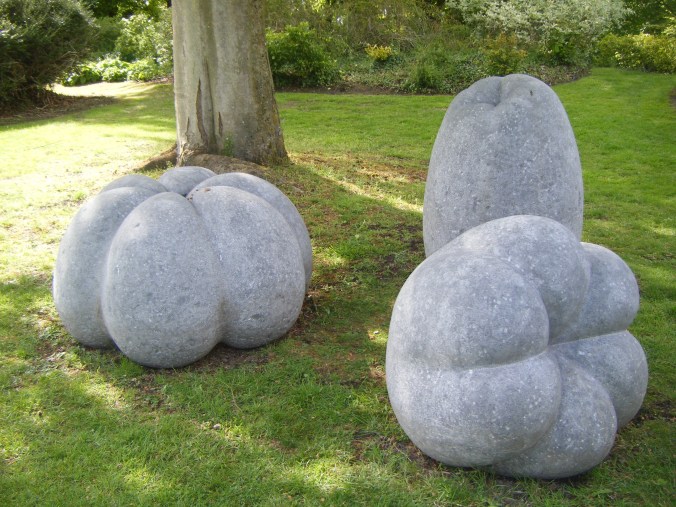
It was a charming moment when I saw a child hop up and sit for some time on one of these ‘Three Fruits’. Enjoying their natural shape, he rubbed their smooth surface with his hands. No restrictions of an art gallery here. These were created by the British artist Peter Randall-Page in 1991,

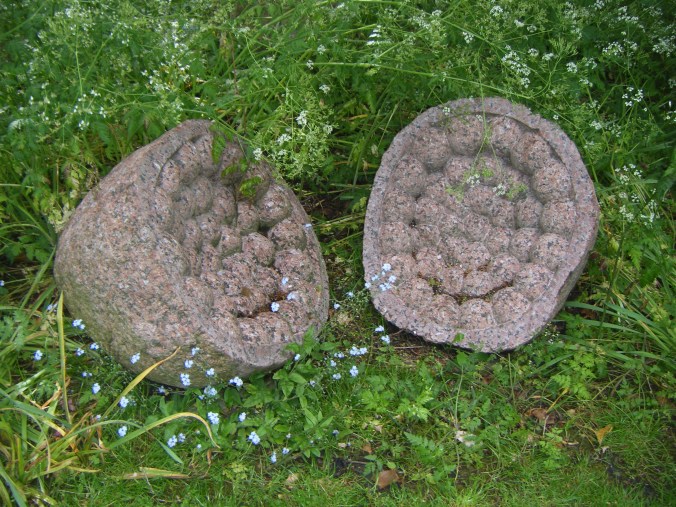
DSCF0920.jpg

who also produced, four years later ‘pomegranates’.

DSCF0911.jpg

Sheep can be heard grazing in the field beyond, and Red Kites fly overhead. John Robinson’s (1935 – 2007) ‘Immortality’ in polished bronze was purchased in 1992. Robinson describes its conception:

“Soon after my mother’s death, our eldest son married, and as these things go, after a while his wife was expecting a baby. My position had suddenly changed. Instead of being the middle generation, I became the older one, a grandfather. I began to think of doing a sculpture that would capture the passing on of the precious flame of existence within a family, and I needed a symbol.

I believe that Immortality is made up of one’s memories of the past, as well as those one leaves behind. I see this Symbolic Sculpture not only as a continuous journey through generations, but also the scroll on which all of life’s experience (DNA) is recorded. “


DSCF0913.jpg

‘Rondo’ is by Charlotte Mayer and was acquired in 1997, A Fellow of the Royal British Society of Sculptors,  she says:

“A work of art should speak for itself. It should need no verbal description although a title may give a subtle hint of what is in the sculptor’s mind”.

DSCF0915.jpg

I never discovered who this was by, small but not insignificant nestling by a buddleia; perhaps its identity will be revealed.

DSCF0925.jpg

Nestling amongst the shrubs since 2006 is ‘Torus’ a piece by Jonathan Loxley, who usually now works in marble.

DSCF0929.jpg

Perfectly positioned in a small clearing is the serene ‘New Renaissance’ created in 1993 by Patricia Volk, the Belfast-born ceramic sculptor.

DSCF0917.jpg

Terence Coventry’s ‘Avian Form’ has stood here since 1999. Lord Carrington happened to be nearby when we were admiring it, and jokingly he said ‘he doesn’t like you, you know’. And perhaps he was right.

DSCF0933 (1).jpg

Oh, and this little figure is actually alive. Lord C names his wire-haired dachsunds after prime ministers; having already a Margaret but before Theresa, he decided on Dame Norma Minor, ‘”well, she couldn’t be Major” he laughed.

DSCF0932

A fleet of wheelbarrows raised against the hedge are almost an art form.

DSCF0936.jpg

Skirting around the tennis courts we come into the south garden. A magnificent metal bowl decorated with swirling fish stands at the head of a double row of viburnum carlesii which lead up to a sunken pond,

DSCF0954.jpg

where ornamental herons are enjoying an afternoon’s fishing.

DSCF0949.jpgOver the hedge is the two storey gazebo; made of Buckinghamshire material it was inspired by a visit to Hidcote.

DSCF0947.jpg

Steps lead up from this south garden to a small enclosed area. From the raised urn you walk diagonally across to arrive at the front of the house where we originally entered.

DSCF0952.jpg

Tea is served in the open cart sheds and today there is a specially large cake in celebration of 50 years opening with the NGS.

Time is running out and we have not seen half the garden yet. We race back across to the armillary sphere where we turn right through the archway in the yew hedge. Here is ‘Coracle’  by William Pye commissioned in 2001. Its gentle ebb of water is mesmerising.

DSCF0981.jpg

In the next section of garden this unidentified piece at the end of the brick path seems to dance, its outline lifted by the dark background hedge.

DSCF0985.jpg

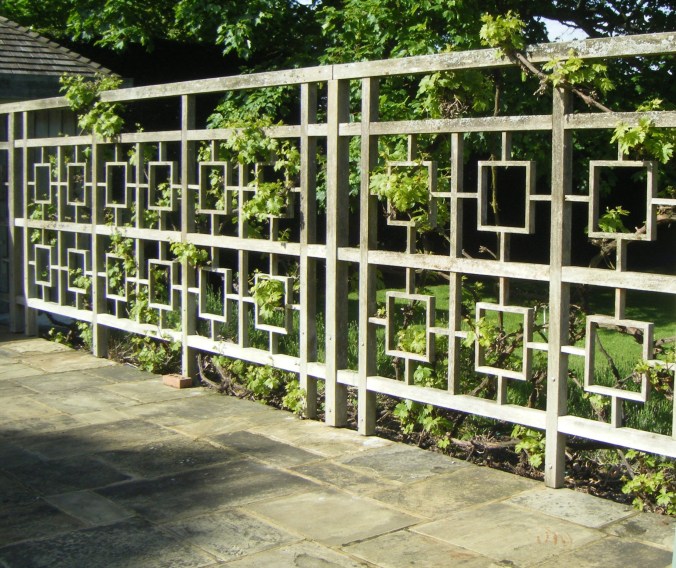
We wonder at the rhythmical design of this slightly oriental trellis.

DSCF0989.jpg

The map describes a snail garden and we think we have found it.

DSCF0992

Another set of pineapple-clad gate posts welcome us into the walled garden where a haze of lavender lines the path up to the gazebo.

DSCF0995 (1).jpg

It can’t all be works of art; there is a practical side to this garden too. Over to the left rows of vegetables, not yet in full production, are being prepared, and over to the right the alliums are flowering with the peonies still tightly in bud.

In the centre of the wall is the a mural of  Vertumnus, God of Vegetation: painted in the manner of Guiseppe Archimboldo, it is by Owen Turville.

DSCF1001.jpg

Out onto the lawn near the main entrance is Barry Mason’s Oculus. Originally commissioned by English Heritage as part of the ‘Year of the Artist’ celebrations it was sited in the ruined nave of Hailes Abbey near Cheltenham and was donated to Lord Carrington in 2003.

5748 (02)-1500.jpg

Photo taken from https://www.ngs.org.uk

Only 2 gardeners look after these noble acres and it really is time to go now for they are sweeping up behind us and the shadows are long. We purchase some honey and say our goodbyes. The great man is still here and must be pleased with his 350 visitors or so,

I say once again ‘you don’t have to be a gardener to enjoy a garden’. Here the garden is not without its many features of herbaceous borders, mature shrubs and hedges, fine lawns, ornament, parterres, topiary and water but it also combines as a gallery.

An inspiration and a visit hard to beat.

——-89——-