Horncastle; a heavenly haven. (16)

It was lovely to have a friend accompany me on the drive to Horncastle. We had not met up for awhile so inevitably there was a lot of catching up to be done and consequently we missed a turning!

It did not matter;  it was  a lovely day, sunshine at last and Spring was forcing through the Fens. We were cheered  by the profusion of daffodils growing along the verges and the soft green of the willows.

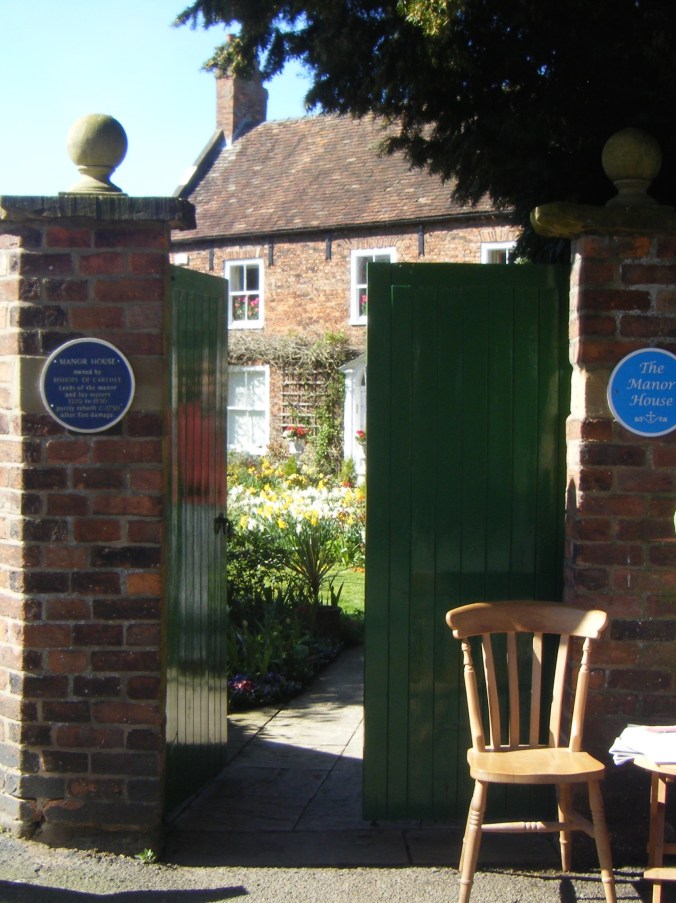
Parking  by the church in the town centre, we  found The Manor House nearby hidden away behind high walls. The entrance was attended by two charming gentleman who politely opened the Glossy Green Garden Gate for us.
DSCF8539

In through this doorway we are greeted by an explosion of spring flowers edging a neat lawn and growing on up the path to the front door. It is an endearing house and from the upstairs windows the faces of geraniums eagerly look out at the arriving visitors; a tradition carried on by the present owners who have been here for five years.
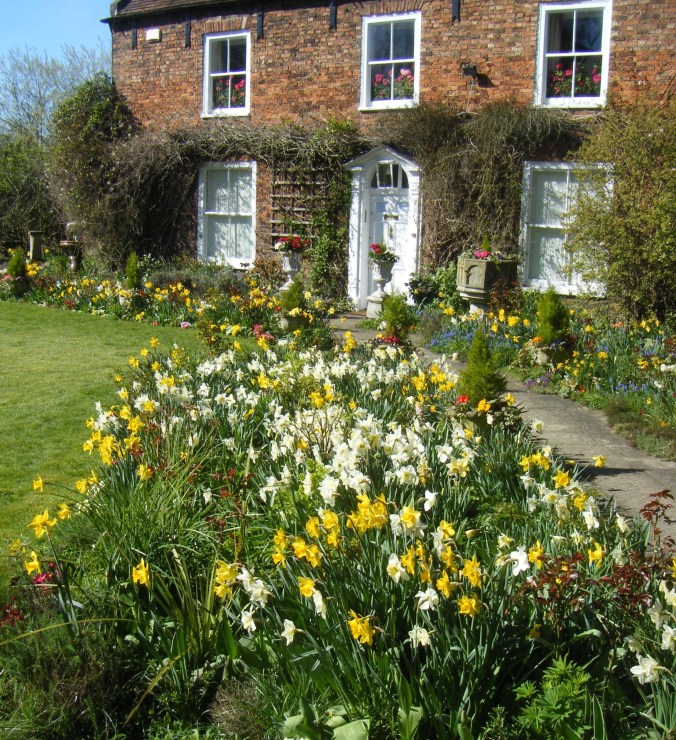
DSCF8544.jpgThe simple planting is so effective; daffodils, yellow and white,  large and small. Hyacinths, Polyanthus, Violets, Tulips and Wood Anemones mingle together to provide a delightful tapestry of colour.

DSCF8541.jpg

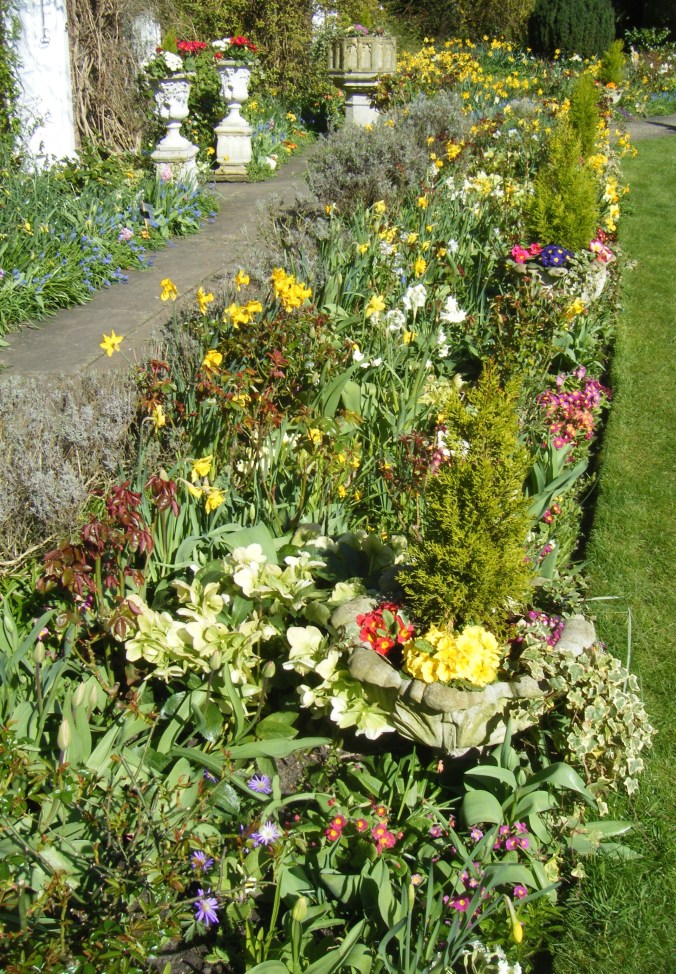
The bright border runs along the edge of the path and along front of the house. Either side of the front door is a pair of urns or should I call them jardinieres?

I am reminded of Gertrude Jekyll who wrote ‘There are some English words which have no equivalent in French, but then there are a great many more French words for which we have no English. One of these is jardiniere.’ I won’t go on.
DSCF8555.jpg

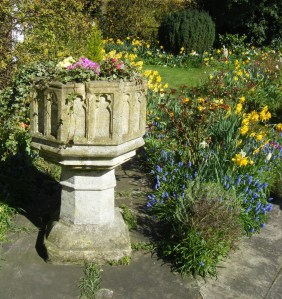
What might she have said about the font which stands solidly near the door positioned to be seen from all directions.
DSCF8547

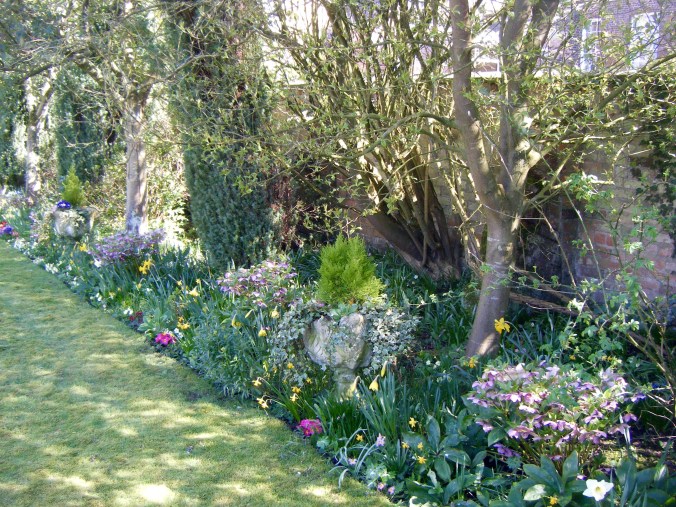
Directly opposite the house is a border running along the boundary wall. Traditional repeat planting consists of sky rocket juniper and a type of cotoneaster tree  with planters  alternated with clumps of hellebores interwoven amongst spring bulbs.
DSCF8548.jpg

The planters are repeated all around this part of the garden, they provide some structure and a softening  green.
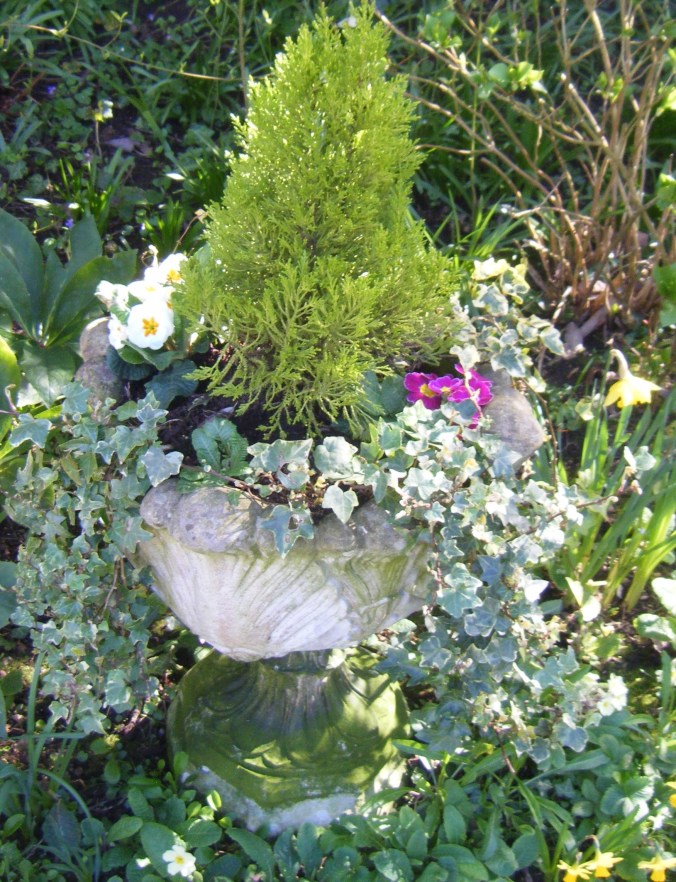
DSCF8551

Big handfuls of Hellebores  enjoy the dappled shade.

DSCF8552.jpg

At the end of the bed and in the corner of the lawn is an elegant metal tree seat.
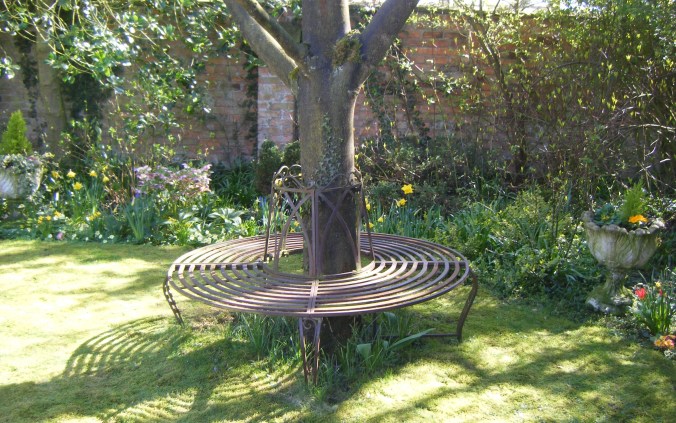
DSCF8554.jpg

By the house an empty pot sits amongst a tangle of fig branches.
DSCF8558

We edge along the side of the house, shaded at this time of the day.
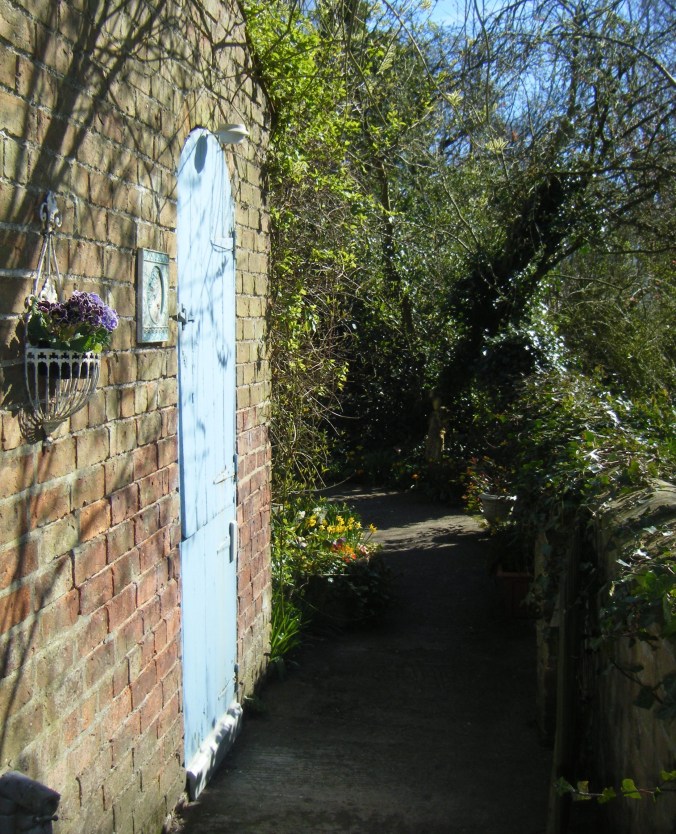
DSCF8583.jpg

and down the covered ramp which links us to a lower area of garden.
DSCF8564.jpg

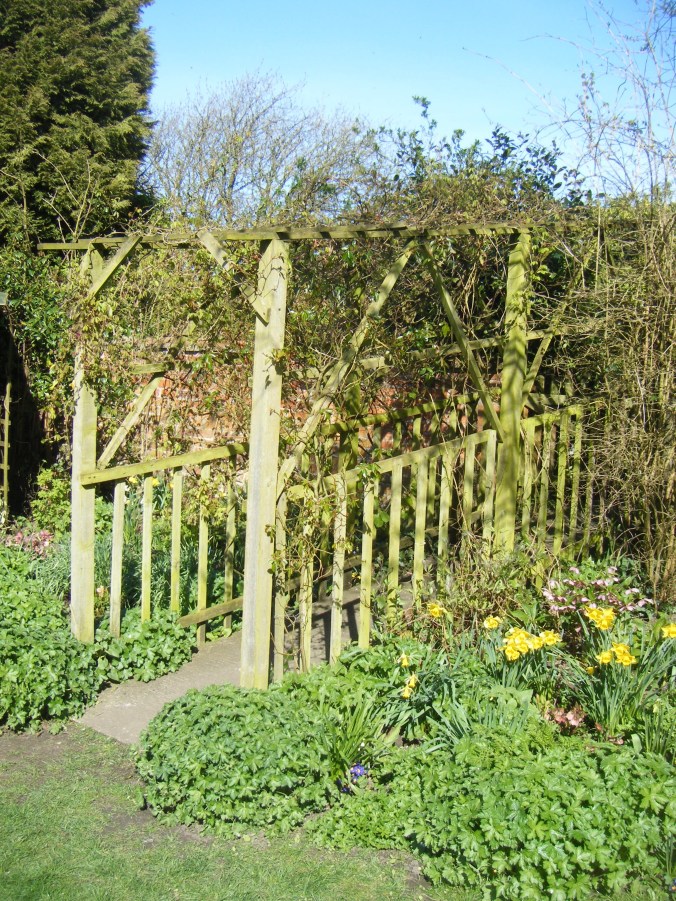
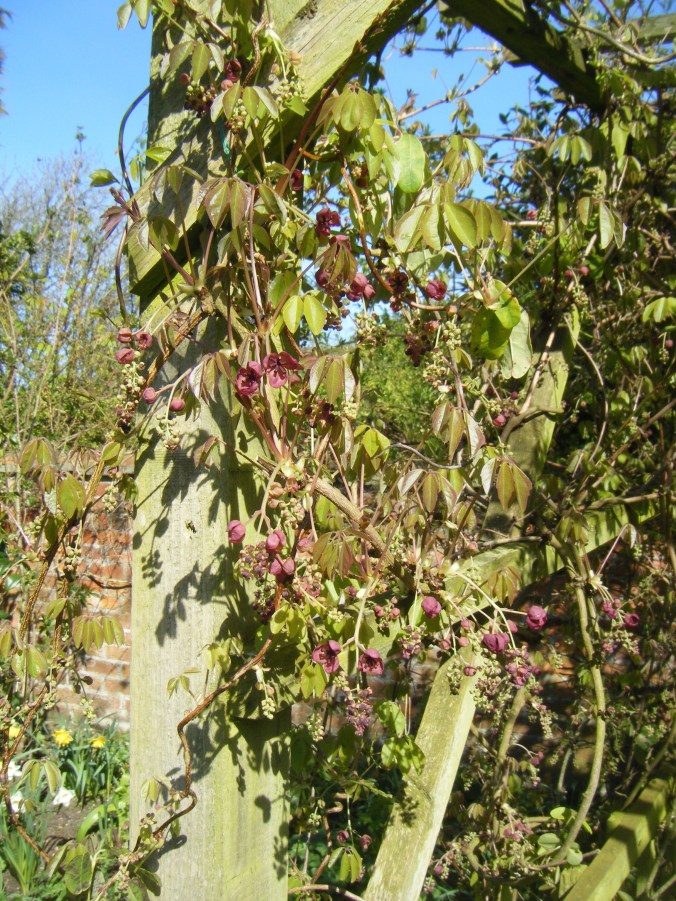
Akebia quinata twines amongst the trellis and is just coming into flower.
DSCF8563.jpg

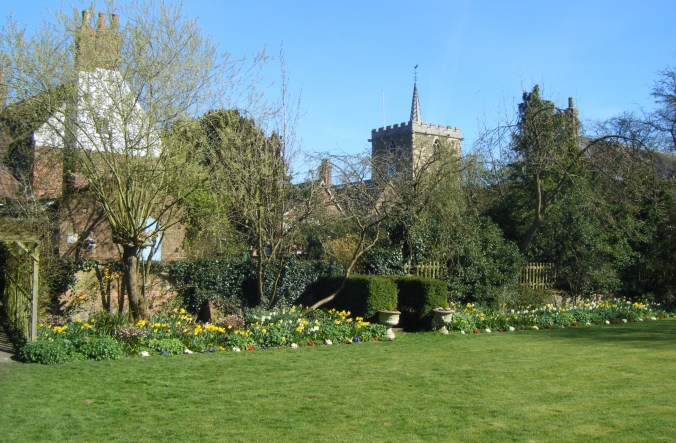
The level lawn under the watchful tower of the church, is surely the perfect place for a game of croquet.
DSCF8584.jpg

A small gentle coloured chaenomeles grows against the wall enjoying the full sunshine.
DSCF8565

There are not only single-headed hellebores but also a rich double.  Why can’t they raise their heads a little?

Version 2

An old apple tree is also underplanted with spring bulbs and stands in front of the vegetable plot.

DSCF8574.jpg

Behind all this, it is a surprise to find even more. A large informal orchard stretches down to the River Bain. Visitors are able to sit and enjoying the peace.

DSCF8588.jpg

I had forgotten what it was like to look up at the blue sky.
DSCF8587

At home I spend a lot of time pulling out comfrey and here it is looking good controlled and in the shade under a tree.

DSCF8579

A medieval well is backed by a short section of ancient wall.

DSCF8577 (1).jpg

By the back door is a small enclosed square garden.

DSCF8581.jpg

Visitors like to look everywhere and we are no exception. Even the seemingly uninteresting places around the back become fascinating.

DSCF8589.jpg

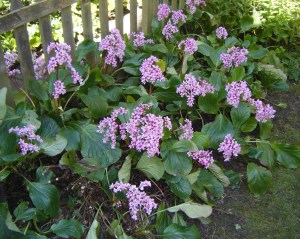
Pink bergenia fill a space in the shade to the North of house.
DSCF8591

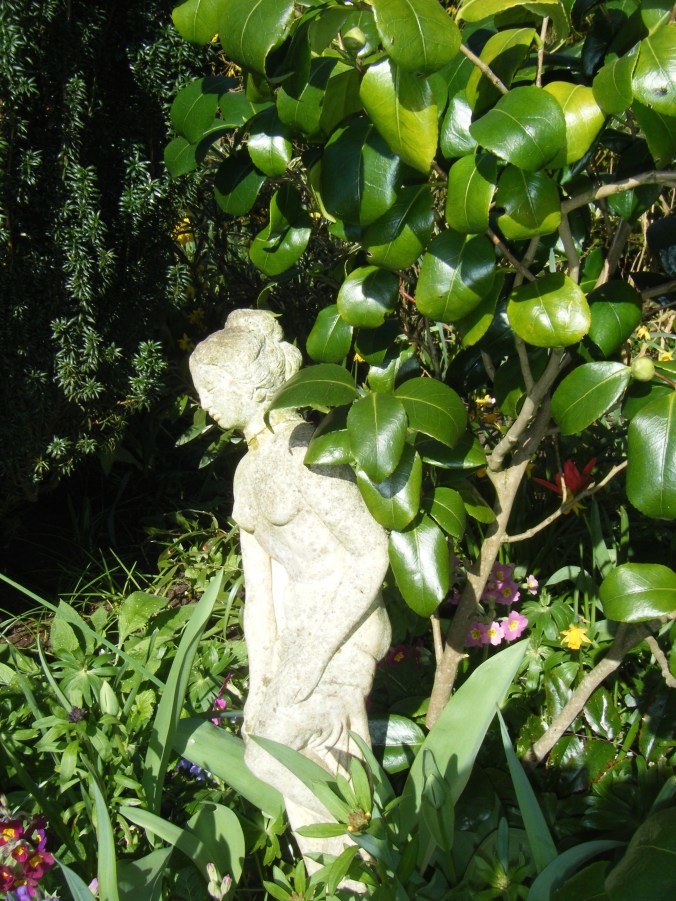
Several small statues appear around the garden and this little lady enjoys the shelter of the evergreen shrubs.
DSCF8594

We retrace our steps back along the sunny path to the gate.

DSCF8557.jpg

And feel the contrast of dappled shade just to the right of the gate

DSCF8595.jpg

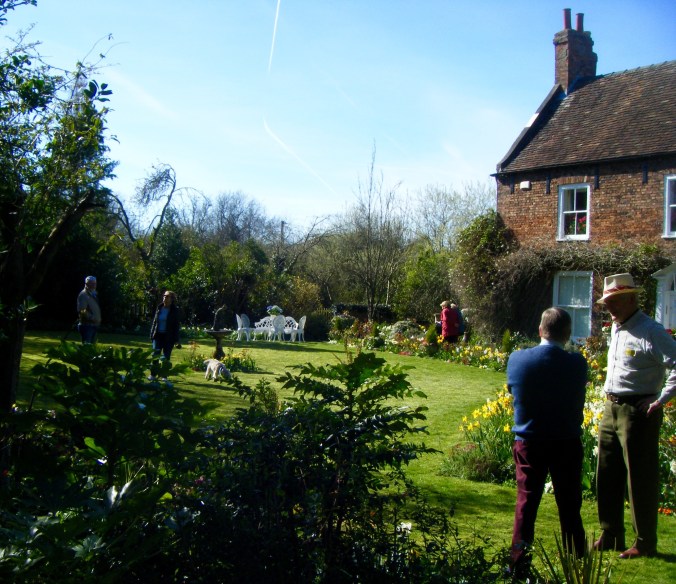
There has been a good flow of visitors, some with their children others with well-behaved dogs. They appear to be in no hurry to leave.

We do have just one criticism which we share with the owner, surely the entrance fee should be a little more. It is his first opening and he is too modest to agree.
DSCF8597.jpg

The kind gentlemen are still content at the gate. They explain to us that this was for many years the holiday home of  the Bishops of Carlisle who owned much of the land around here. We wonder where they go now?

DSCF8599

Across the way back to the Church of St. Mary’s, we enjoy our cheese scones and fruit cake under the watchful eye of the most beautiful gilded angels

——-16——-

Wickets; where Spring is on the way. (15)

Wickets, Upper Langley in Essex was the only private garden to be open for the NGS in East Anglia last Sunday. I was fortunate to be able to bowl along and have a sneak preview the day before.  It was yet another of those steely grey days.

At a time when most of us are only just emerging into our gardens, Doug and Sue were way ahead of the game and had the place ship shape and ready for the Spring invasion.  The garden gate was really wide open:

DSCF8420.jpg

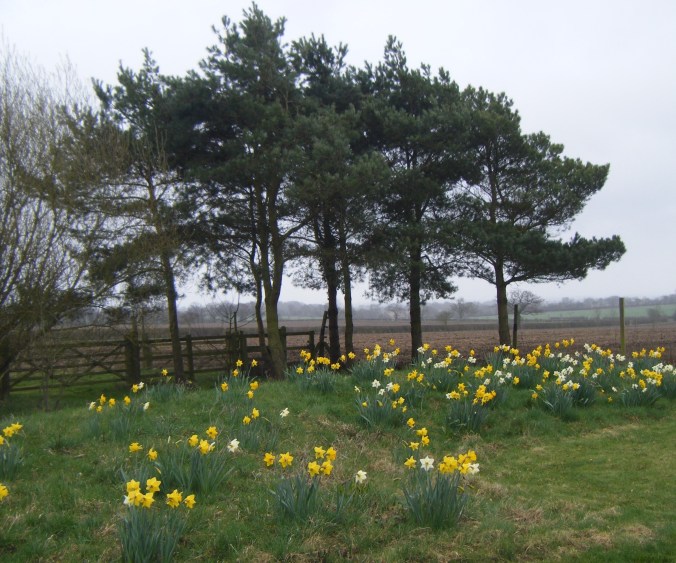
The soft green grass, trunks of silver birch and a show of daffodils drew us in. Growing near the entrance by a small log pile were these charming cowslips .

DSCF8425

Several years ago Doug and Sue added to their garden by buying a piece of land. Sue’s mother was not in favour of the purchase but like all good children they took no notice, naming the area in her memory.

DSCF8419

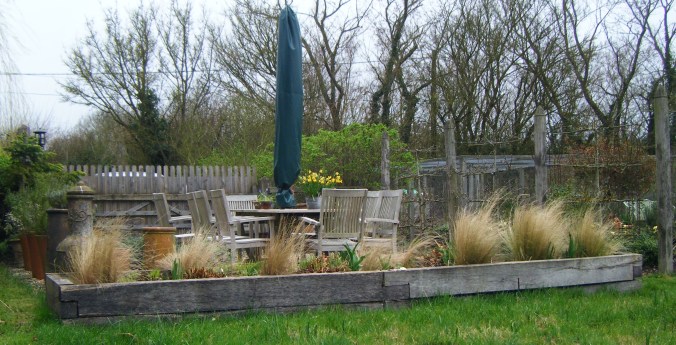
Bessie if she was still around, would I am sure admire what has been created here. This is the area designed for fun; eating, harvesting and chilling. The large table (there are children and grandchildren), is tucked in beside the small parterre.

DSCF8418 (1).jpg A variety of planters surround the gravel space and this pleasingly shaped terracotta pot stands in the corner.

DSCF8410

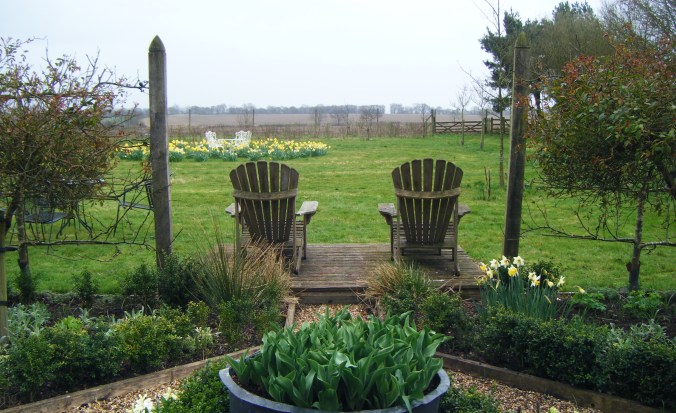
Espaliered apples surround the parterre and fruit cage combining ornament with production.  These adirondack chairs beckon you to sit, but do Sue & Doug have the time?

DSCF8413.jpg

The view looks out across the Essex  countryside to the far off long-distance footpath of the Harcamlow Way.

DSCF8400.jpg

There is actually a footpath which runs  diagonally across Bessie’s End. Instead of ignoring it, or even trying to divert it,  a hawthorn hedge has been planted accentuating angle and length. It is a path which is seldom taken. Perhaps for many walkers it might seem an intrusion.

DSCF8390.jpg

Why bother with walking when there is a Shepherd Hut to sit and read in.

DSCF8383.jpg

Wickets is divided into three sections and so leaving Bessie’s End we move into the informal meadow area  which is dominated by the pond.

DSCF8429.jpg

A group of pines, cleverly planted provide a welcome touch of evergreen without blocking the view.

DSCF8430.jpg

Hermes or rather Herpes, as Doug calls him, looks downcast while he waits for the summer months. There are all sorts of characters who live in this garden.

DSCF8441.jpg

A stoney Owl peers across at the penned-in cockerel and his hens.

DSCF8433


DSCF8434


Mad March hares are boxing in the border.

DSCF8450

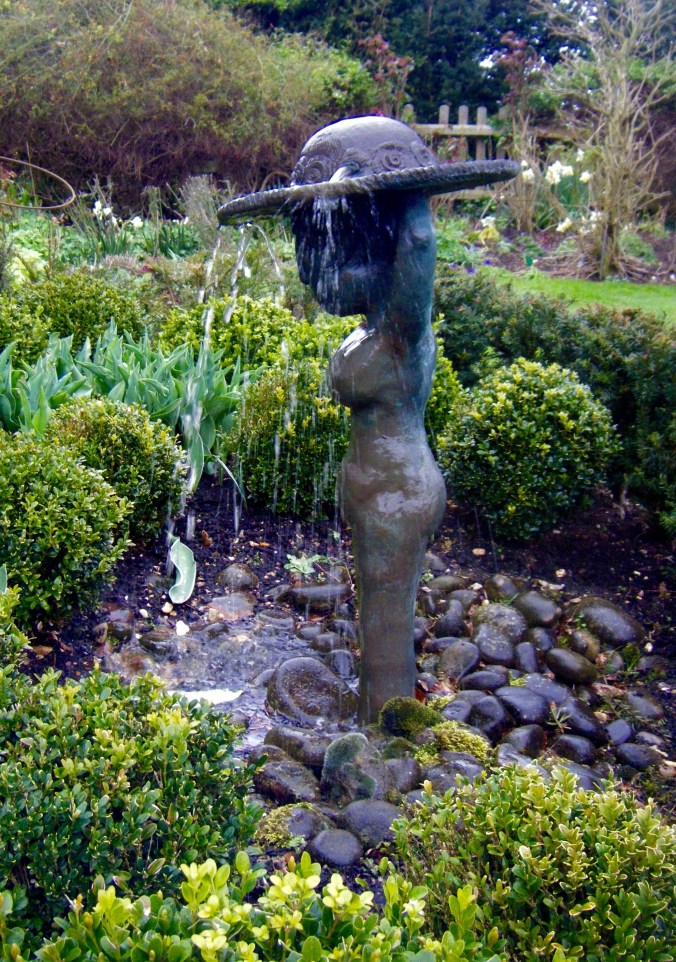
By the house stands this little lady. An air of charm under that hat, she sounds just lovely.

DSCF8497.jpg

An ancient face is pinned against the wall of the house. What better way to use this black grass ophiopogon planiscapus.

DSCF8499

While this person seems wrapped up in thought. Doug says its George but surely it is Georgina?

DSCF8527.jpg

The third part of the garden surrounds the house;  a more intimate space with great attention to detail. It is evident that Sue trained as a garden designer. How different it will all look in May when the garden opens again.

DSCF8445 (1).jpg

Beds curve around the lawn. All year round planting provide dabs of colour and delicious scents. The hedge running along the back divides but does not dominate, allowing glimpses over into the pond garden.

DSCF8502 (1).jpg

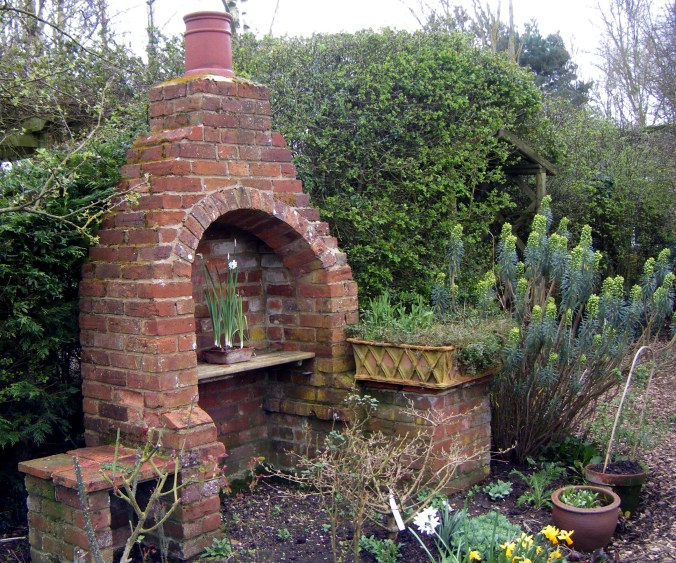
There are lots of interesting features such as the redundant barbeque.

DSCF8448.jpg

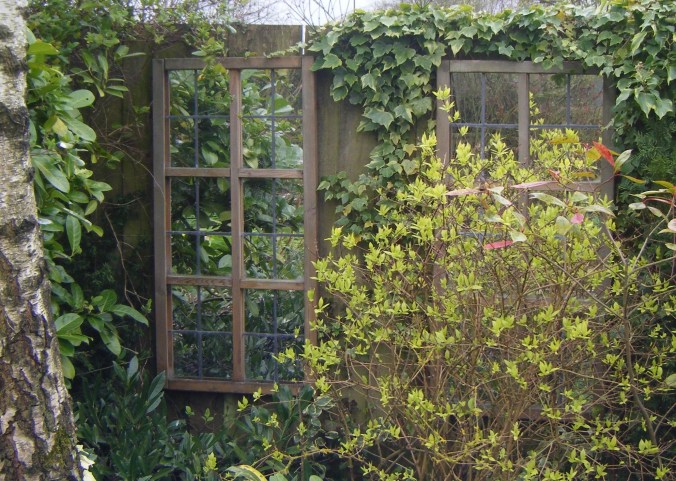
A mirror on the fence cunningly reflects and broadens the space.

DSCF8466.jpg

A Pergola attached to the house, covered with roses gives height and frames the pots of tulips and the imaginative bird table.

DSCF8462.jpg

There is a place to pause and be on your own.

DSCF8459

Daffodils cunningly hide a recent mole run.

DSCF8454.jpg

There is plenty of brightness now.

and it is not all yellow

DSCF8475

Sweet violets grow prettily amongst the shingle.

DSCF8480.jpg

A leafy stepping stone embedded in the dark earth allows me to hop over to the border.

DSCF8504

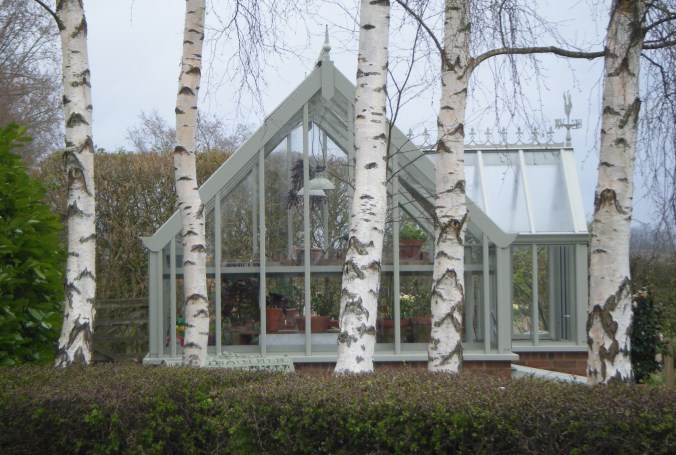
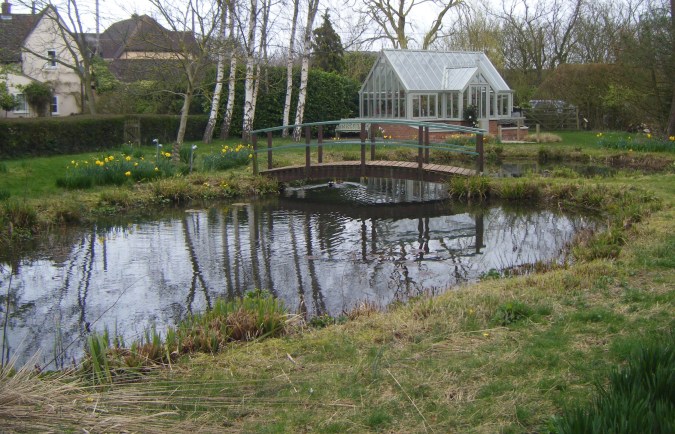
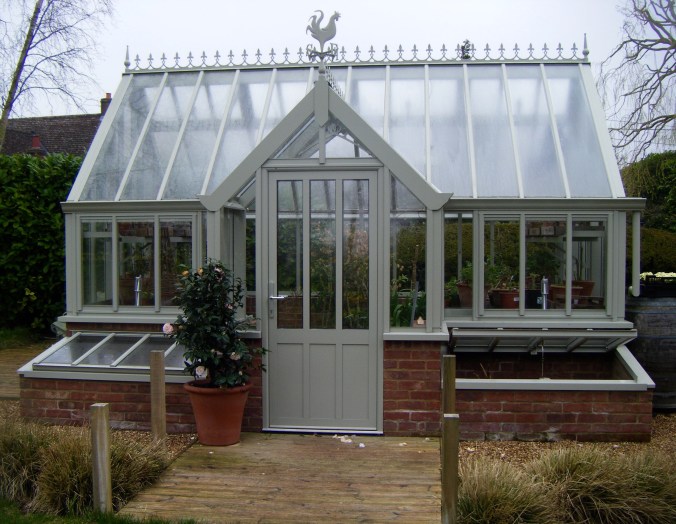
I can’t help but covet the glass house and it is this rather than the main house, that seems to have the greatest presence in the garden. Seen from various angles either beyond the clipped silver pear pyrus salicifolia ‘Pendula’.

DSCF8464.jpg

Or over the hawthorn hedge and through the silver birch.

DSCF8452.jpg Further away across the reflecting water

DSCF8438.jpg

It is a very pleasing design and beautifully made. A Griffin Glasshouse, and the NGS receives a small percentage of the sale of every glasshouse in the NGS range.

DSCF8522.jpg

It is a joy inside, a welcome relief from the wretched rain.

DSCF8521

The weather does not bode well for tomorrow’s open day. Visitor numbers are unpredictable especially at this time of year. Doug has already made the soup and we leave Sue baking in the kitchen;  the smell of fresh home-made cake will surely help to bring the people in to this engaging garden.

——-15——-


The Elusive Tilly.(**)


Some time ago I discovered that there is a snow drop called Tilly.  John, a trusty galanthophile from Gable House thought he had one but could not lay his hands on it when I visited some weeks ago (blog 9).

Tilly is a hybrid between galanthus gracilis and galanthus plicatus “Trym” which I have to say is completely meaningless to me. I like the idea that having found it in her garden, Valerie Cross, a notable lady in the snow drop world, named the flower after her terrier.

I am delighted to report that John has now supplied me with Tilly. I was a little surprised at the going rate of £40.00. A serious amount for such a tiny bulb. Think of how many other plants  I might buy for the same price. However my daughter Tilly has been living in Argentina for the past year. I miss her and really need a little something to celebrate her birthday. She of course reminded me that she is priceless.

IMG_1508

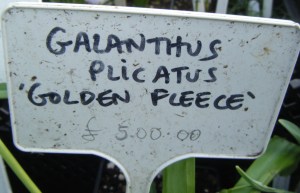
Indeed the price paled into insignificance when I noticed this label at Monksilver Nursery the other day:

DSCF8359

John also sent me some Galanthus Allenii , cheaper than our Tilly. They came through the post in beautiful condition carefully tied up with green twine and wrapped in damp moss. Unlike the aconites which arrived a day later from a commercial bulb grower, putrid and rotten. Thank heaven for NGS plantsmen.

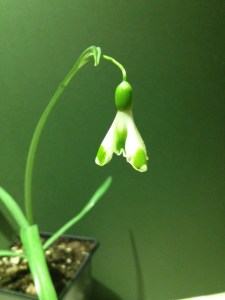
I am busy dividing my snowdrops at home now but will nurture my Tilly. She is indeed a bit of a beauty; I hope you agree:


——-o——-


Ballymaloe Cookery School Garden; a horticultural delight (*)

Last week I decided to celebrate the arrival of my Senior rail card by hopping over to Cork with for a two night stay at Ballymaloe (http://www.ballymaloe.ie/).

Forgive me if I wander from the 90 but it is such a special place.

Having arrived in the sunshine it was a wretched day when we awoke on our first morning.  I am not sure if Ireland does a light drizzle; it was pouring. From our bedroom window  a magnolia standing on the lawn brought a little cheer. It was difficult to capture the colour photgraphically but if you look carefully at the bottom of the wooded tangle there is a single unopened bud………

DSCF8160.jpg

…..which on closer inspection is a beautiful shade of pink  and that was the very colour that glowed in the gloom.

Version 2

We spent a  long time over breakfast in the comfortable dining room. Ballymaloe is a family affair. Ivan and Myrtle Allen bought the farm and house in 1948, he farmed and blessed with so much produce she opened up the restaurant in 1964.

Reluctant to embrace the weather we moved into another charming room where we spent more time over coffee and the inevitable slice of cake.

We had to do something other than eat. A cliff walk was eventually proposed. By the time we got to the sea the rain had stopped. However the fog set in and so a walk without a view was deemed rather pointless. Accompanied by two non gardeners I was hesitant in suggesting a visit to the Ballymaloe Cookery School Garden. It proved to be a great idea, although not the best day for photography.

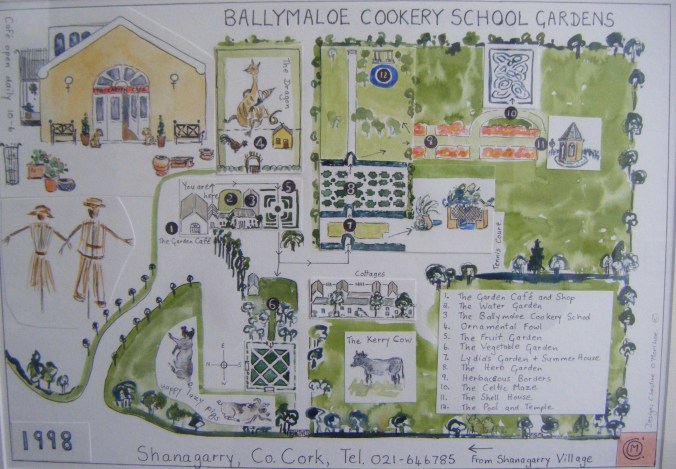
It was Darina the daughter-in-law who started this famous Cookery School back in 1983. You enter the garden through the Shop where we bought our tickets, and passing by the garden cafe which was closed (such a relief as we were still full from breakfast), and found the fun map on the wall.:

DSCF8199.jpg

There is  no sign of the chickens as a recent outbreak of Avian flu has confined them to barracks. Unsightly bins are also hidden away behind these unique but firmly closed gates.

DSCF8203.jpg

Before entering the fruit garden we catch sight of fungi growing on the tree trunk; It is during these winter months when you notice these patterns of nature.

DSCF8205

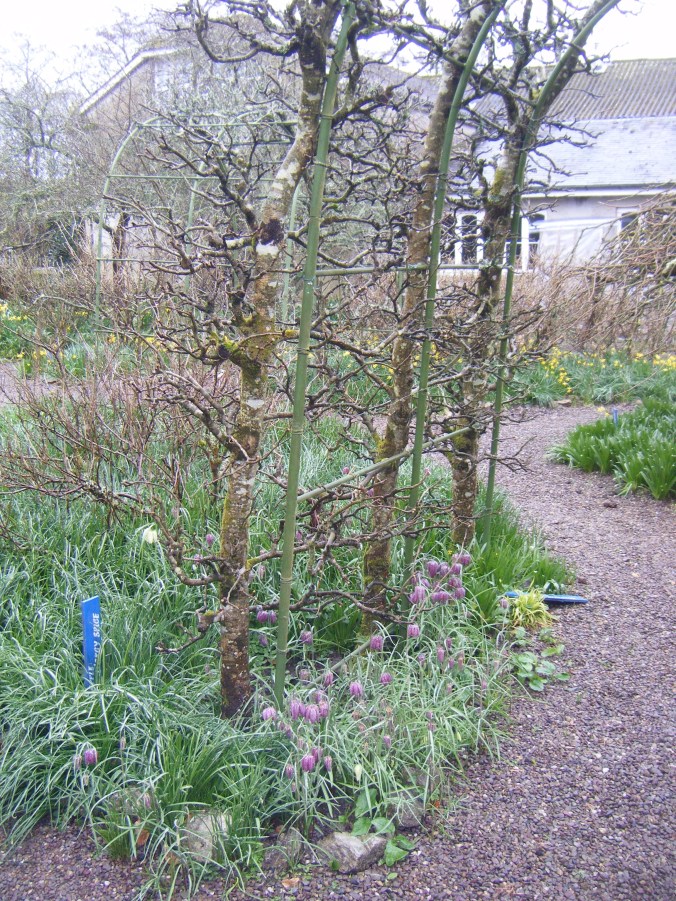
Apples are trained over metal arches. Our eyes are drawn away from the grey sky to the verdant underplanting of spring bulbs.

DSCF8207.jpg

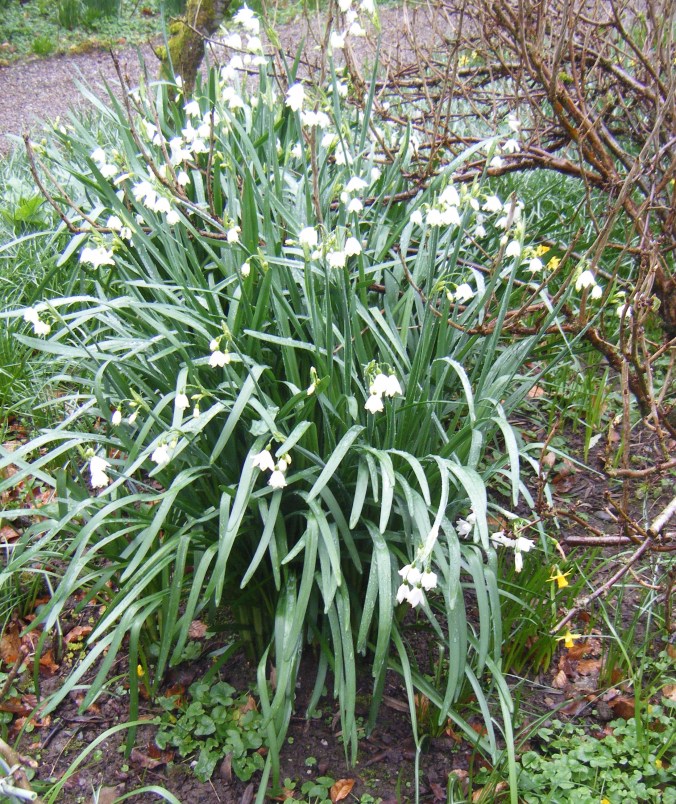
A variety of daffodil with small heads are blooming and clumps of snowflake Leucojum aestivium,  a big cousin to the snowdrop, brighten up the dormant trees.

DSCF8208.jpg

The combination drifting together looks good.

DSCF8215.jpg

It is a sheltered garden and Snake’s head fritillary, fritillaria meleagris are also out, a few grow at the bottom of the trained apple trees

DSCF8210.jpg

while others make a decorative carpet:

DSCF8213.jpg

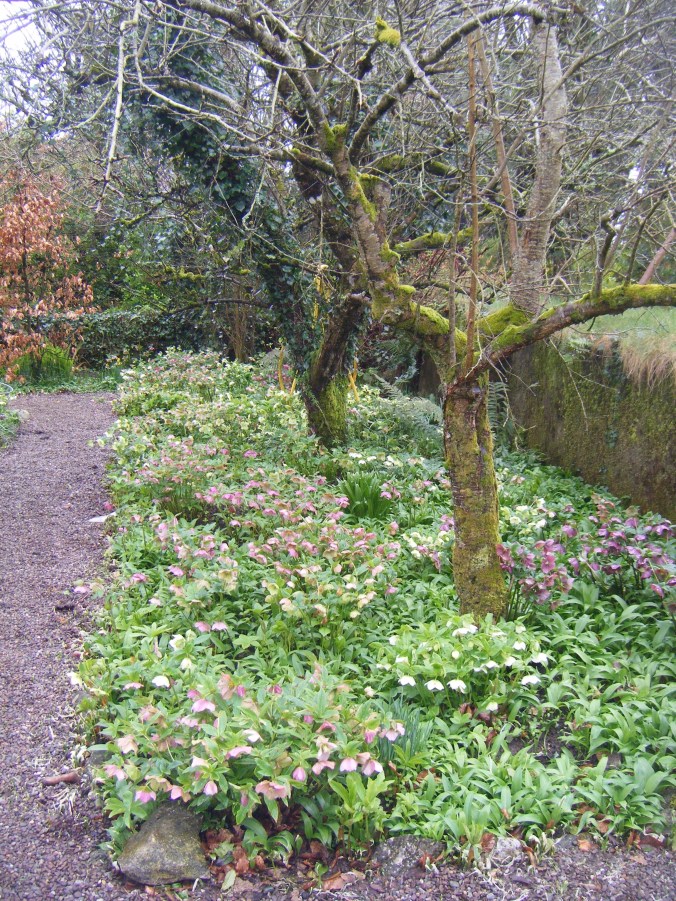
Spring has surely sprung.  There is hardly a bare patch amongst the hellebores.

DSCF8216.jpg

The students, who have access to the gardens are accommodated in the collection of cottages which are adorned with climbers of all types.

DSCF8222 (1)

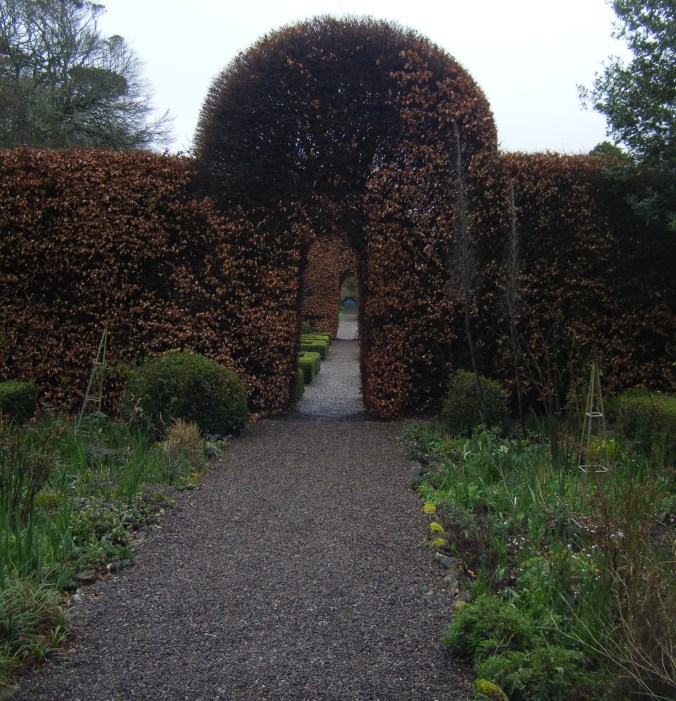
Opposite is the entrance into Lydia’s Garden and hey, the garden gate is open!

DSCF8223.jpg

Through the gate we could carry on through the hoops of beech hedges but we veer off towards the right.

DSCF8225.jpg

It is not so much about the planting in this garden but the objects;  A Summer House, Terracotta pot and small circular pool.

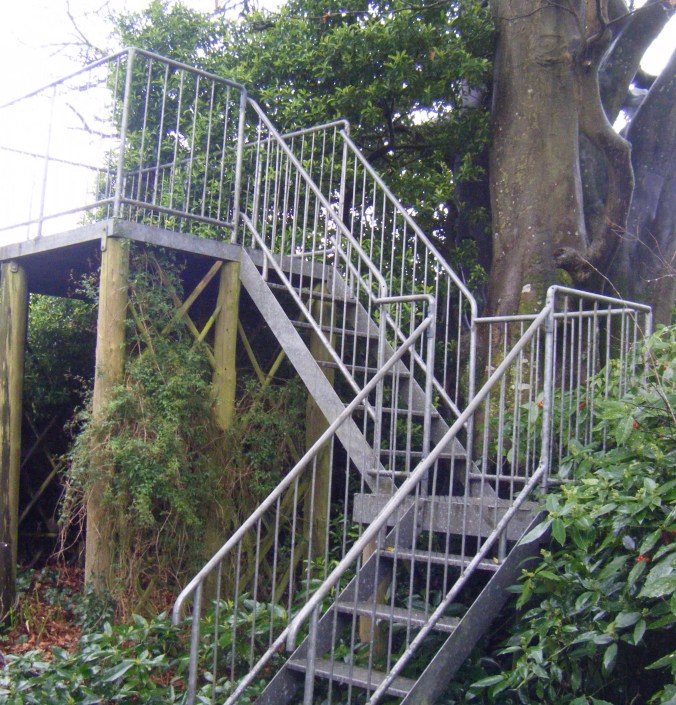
Behind the pond we climb the grey galvanised steps up towards the grey ungalvanised sky.

DSCF8233.jpg

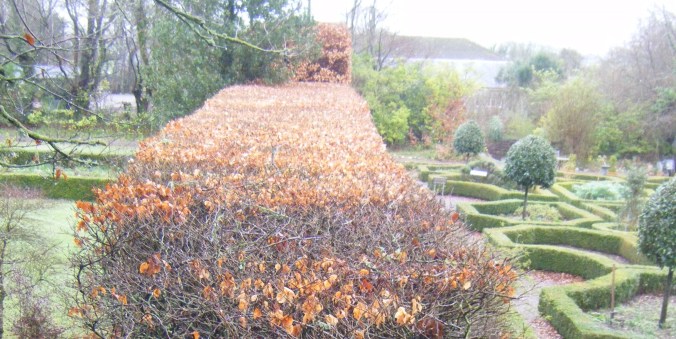
It feels like being in a tree house. From the viewing platform we can see over the  beech hedge, and what a thickness. To the left is Lydia’s garden which we have just walked through and to the right is the herb garden.

DSCF8231.jpg

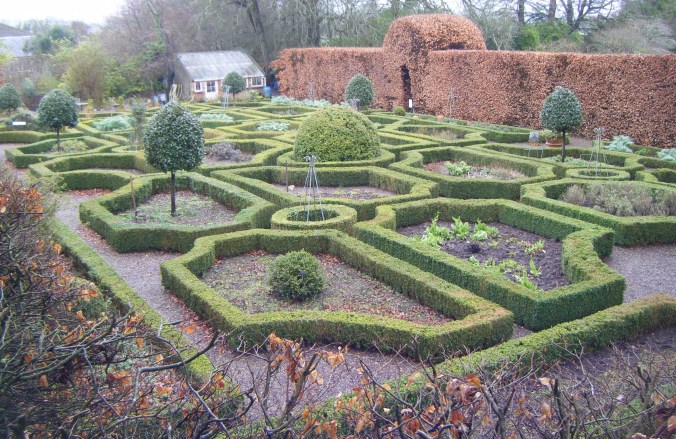
Herbs will billow out colourfully in the box compartments in the summer. For now we have to be content to appreciate the design; the joy of having such a planted structure.

DSCF8230.jpg

Beyond this area and out into the wet spacious field, we come across a wooden edifice; recently constructed we wonder at its purpose and can only conclude that it is perhaps a place for students to recite their recipes. The food here is outstanding; the recipes must indeed be pure poetry.

DSCF8234.jpg

Not far away, this large cauldron sits in splendid isolation.

DSCF8236.jpg

Then we discover  this little gothic folly.

DSCF8256.jpg

We have the key which is attached to a curiously culinary ring, and unlock the padlock.

DSCF8241

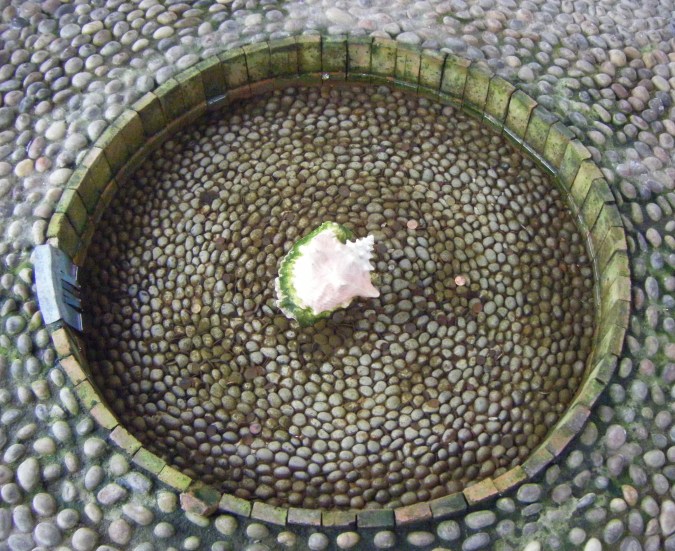
The interior is adorned with shells – in fact at least 20,000 assorted shells.  They pattern the walls…

DSCF8248.jpg

the floor…

DSCF8247.jpg

and the ceiling. Even the chandelier is encrusted.DSCF8246.jpg

The attention to detail is stunning:

DSCF8254

It is quite beautiful, a work of art.

DSCF8253.jpg

Even outside around the base.

DSCF8255

From the Shell House you look back towards the long, long herbaceous borders. Like us they are waiting for the sunshine and warmth of the summer months.

DSCF8239.jpg

Behind the Shell House a twiggy monster is woven into the grass,

DSCF8262.jpg

there is also a metallic folly,

DSCF8261

and a shiny brass cupula rises above the celtic maze.

DSCF8265.jpg


Leaving this entertaining space behind we walk through a hedge into the horticultural heart of Ballymaloe.

It is hard to miss the two water towers which brightly encourage the growing of food. And that is exactly what is being done.

DSCF8273.jpg

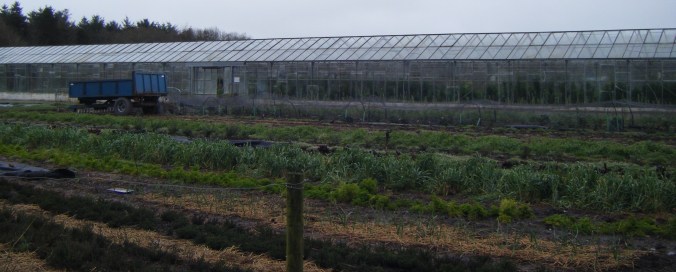
Darina’s husband Tim is responsible for supplying the school and restaurant. Vegetables are grown outside,

DSCF8271.jpg

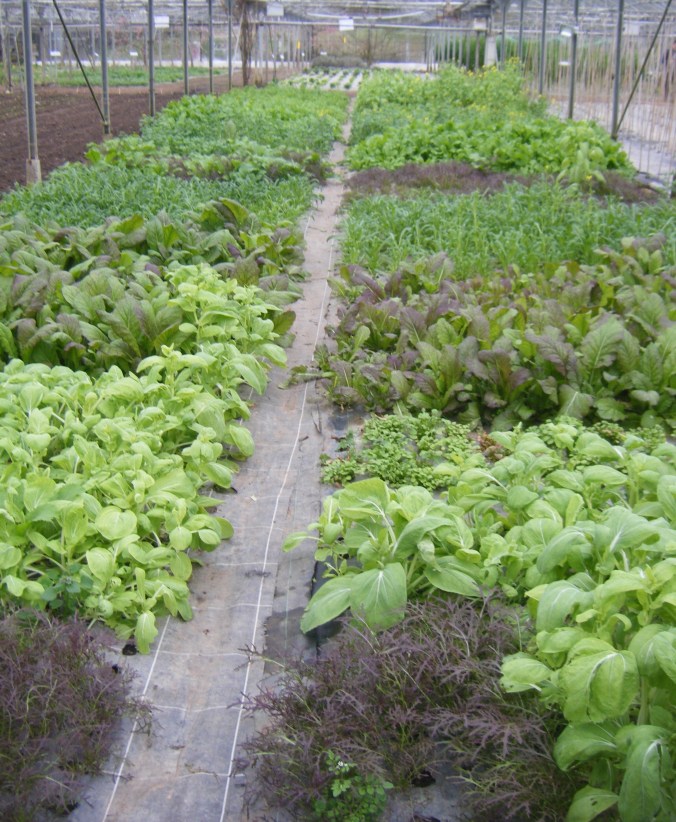
and, inside the acre of greenhouse there is an horticulture explosion. A large range of salads

DSCF8293.jpg

From tiny young pea shoots in old fish boxes,

DSCF8283

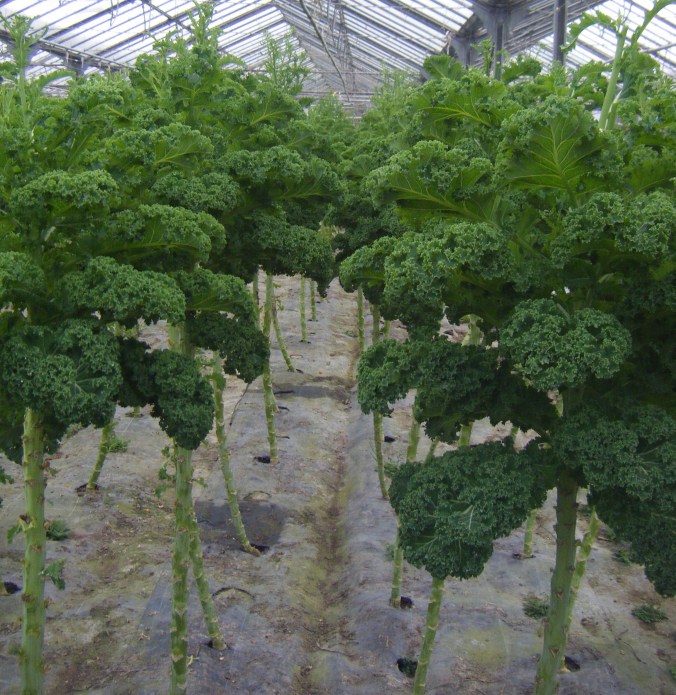
to triffid height kale.

DSCF8282.jpg

All parts of the greenhouse are used with Kiwi plants growing on the ceiling above us.

DSCF8301.jpg

and either end of the glasshouse are brightened with Nectarine Fantasia,

DSCF8277.jpg

and Plum Lizzie.

DSCF8294.jpg

We head back out past the rows of leeks, spring onions and rhubarb growing in ordered lines.

DSCF8307.jpg

We pass the fields with cows and pigs; they are not out today but sheltering in their sheds. There is a handsome gate to admire.

DSCF8308.jpg

and we enter the old pleasure garden. This is dominated by a large pond with a classical summer house at the end.

DSCF8311.jpg

A Japanese cherry with twisted trunk stretches out elegantly

DSCF8320 (1).jpg

its dripping buds soon to open.

DSCF8313.jpg

Even a decomposed leaf lying on the ground has a beauty:

DSCF8322

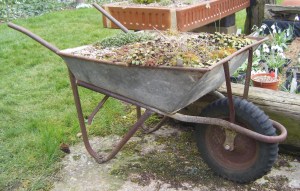
It must have escaped being tidied into the wheel barrow

DSCF8327.jpg

It is not a day for sitting around but the blue benches are beautiful either single:

DSCF8328.jpg

or double:

DSCF8340.jpg

Through the first of the beech hoops

DSCF8323.jpg

We find ourselves back in the herb garden. Clipped to perfection. The viewing platform which we stood on earlier is tucked away up on the right.

DSCF8332.jpg

Back in the yard, we are alerted to the sound of a cockerel; he is shut away in his Palais.

DSCF8218 (1).jpg From here we walk towards the vegetable garden.

DSCF8220.jpg

Which is having a revamp. In spite of this we are not prevented from entering but notices warn of slippery paths,  and they are.

DSCF8343

Back in the yard we admire the trough

DSCF8221.jpg

and the pots, so effective placed out in odd numbers:

DSCF8349

or even just one on its own.

DSCF8350.jpg

Many overseas visitors come to the garden during the summer, however the Irish garden visitors are reluctant to pay. Rachel Allen who runs the hotel explains that they feel they have a right to just enter a garden. There are plenty of beautiful gardens in Southern Ireland  but visiting a garden for charity is unheard of.  So, sadly no National Garden Scheme here.

We have begun to build up an appetite and so it is time to return down the drive lined with the evergreen oaks of Quercus ilex, back to Ballymaloe House for a gourmet meal.

Blow the weather, what better way to have spent a birthday.

DSCF8352.jpg


——-x——-


St. Helens; Wooded and Watery. (14)

Last weekend, expecting to be a bit busy on the Sunday I was pleased to find a garden open on the Saturday.  So I drove down to near Great Dunmow in Essex and slipped into St. Helens, a small garden in the attractive village of Stebbings. Wondering if the name might be inspired by saintly connections or simply a reminder of the place in Merseyside, I discovered that the previous owner had named it after her house at the school she attended.

Now owned by a retired dentist and his wife, the garden was created out of a former area used for the growing of Salix alba Caerulea, more commonly known as the Cricket Bat Willow.

An ivy covered arch enticed us through into the open garden.

DSCF8090.jpg

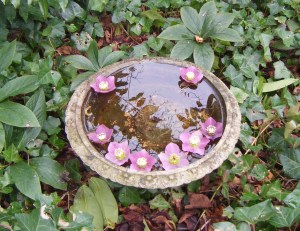
On the patio in a bird bath, Hellebore flowers float exotically. This surely must be the best way to view them.

dscf8092

Another archway, a keyhole perhaps, in a slightly more formal hedge beckons us in a little further.

DSCF8094.jpg

However before entering through we decide to bear off right and pass through the vegetable garden. Here growth is still dormant but the beds are ready, weeded and prepared. A face in the hedge is content to watch and wait for the season’s growth.

dscf8095

Behind the vegetable patch and through the deciduous hedge is the millennium parterre. The box hedging comes from cuttings prepared by the owner, nearly 200 plants; it is a labour of love. Best viewed from the platform of the garden building on the far side….

DSCF8100.jpg

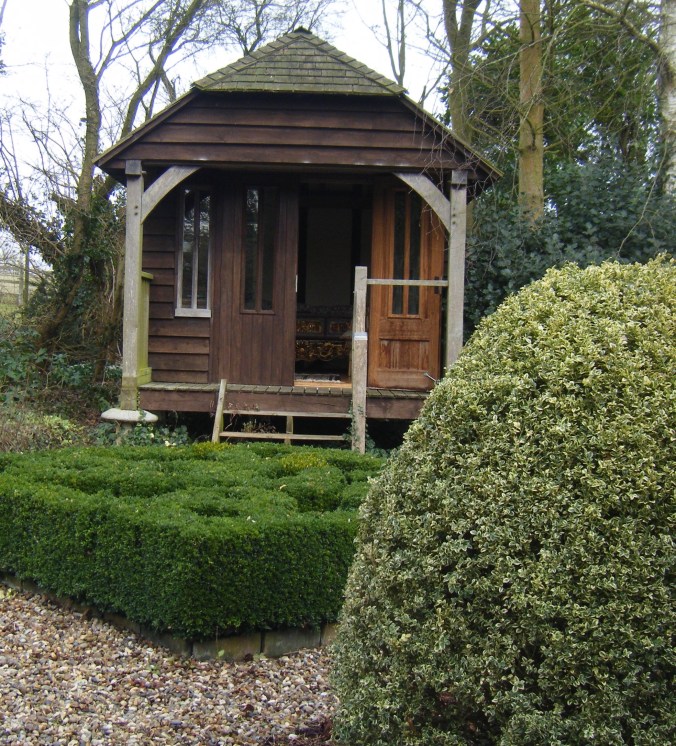
….which nestles amongst unclipped deciduous and evergreens. It looks just the place to chill for awhile and it has all the necessary facilities

DSCF8096.jpg

which are neatly tucked away at the back out of sight.

dscf8108

The garden is predominately woodland and the laurels are particularly healthy and handsome. This tall variety has large glossy leaves and has  witch hazel timidly growing at its feet.

DSCF8145.jpg

The shorter more solid cherry laurel Prunus laurocerasus ‘Otto Luyken’, is a perfect foil for the smooth trunks of the deciduous trees.

DSCF8147.jpg

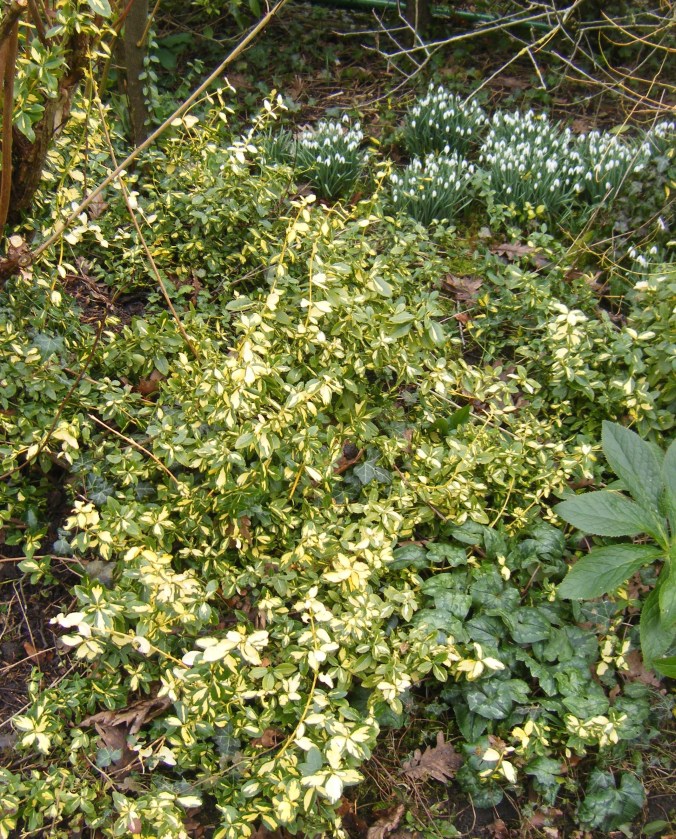
Variegated shrubs play their part too, lighting up areas with a scattering of snowdrops. Some variegation is golden:

dscf8093

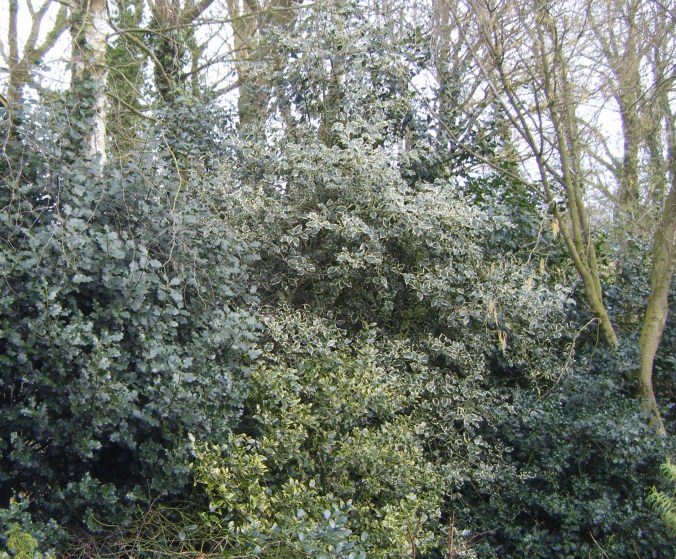
Whilst others are silver:

dscf8098

We find a very unusual shrub, and are perplexed by the tangle of sharp thorns. The owner enlightens us; this is the Japanese bitter orange poncirus trifoliate, a close relative to the citrus family. In the summer it will produce fragrant cup shaped flowers which will turn into satsuma-like fruit. Another new plant to add to my list.

DSCF8106.jpg

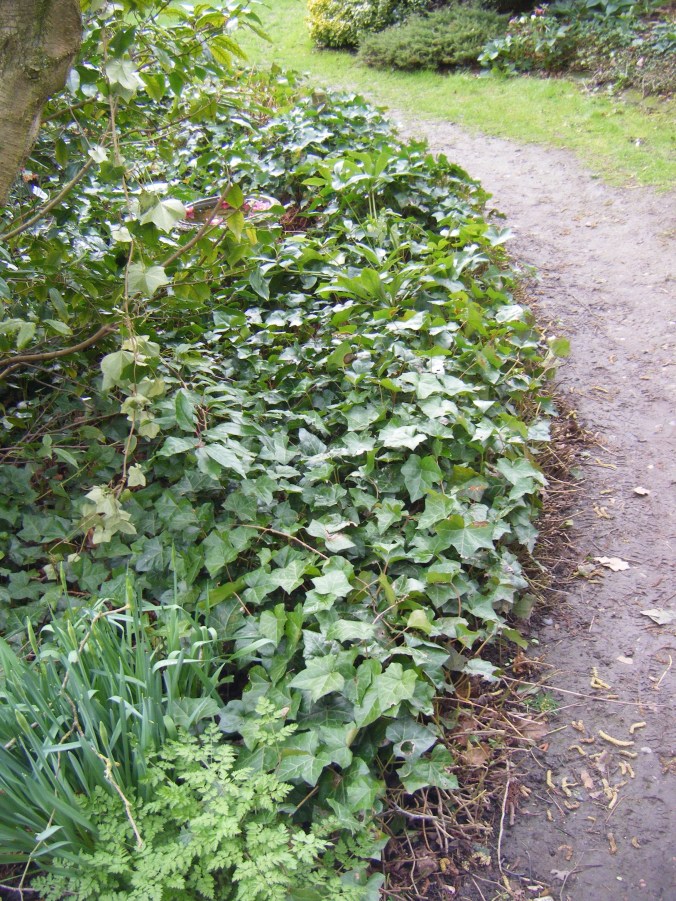
Ivy creeps everywhere and it would be impossible to eradicate it. Gently controlled, it becomes an attractive ground cover. Paths wind around the garden and I imagine this would be a delight for children, with little feet running about to explore what might be just around the corner.

DSCF8144.jpg

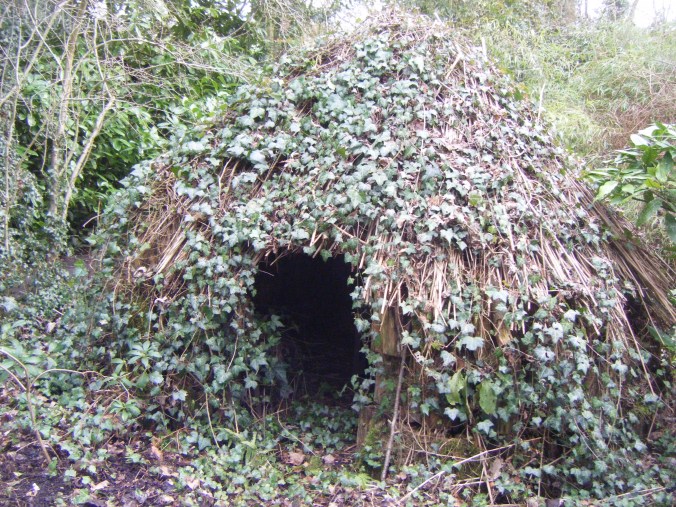
And then there is a secret hideaway. Who lives here? Made out of logs it is far too solid and organised for any Eeyore.

DSCF8103.jpg

Ivy also covers a mound, the last of the Cricket bat willows, 90 feet tall it fell during a storm a few years ago, narrowly missing a rarity;

DSCF8149.jpg

the erect Chinese swamp cypress Glypostrobus pensilis:

dscf8151

There are lovely ornaments positioned about the garden.  More floating hellebores, this time pink.

dscf8101

A stone urn sits on a mound; a mini roundabout in the pathway:

DSCF8102.jpg

And an armillary sphere is tucked into the shrubs.

DSCF8111

While another urn, raised on a plinth  provides a focal point across the water and a feel of antiquity.

DSCF8120.jpg

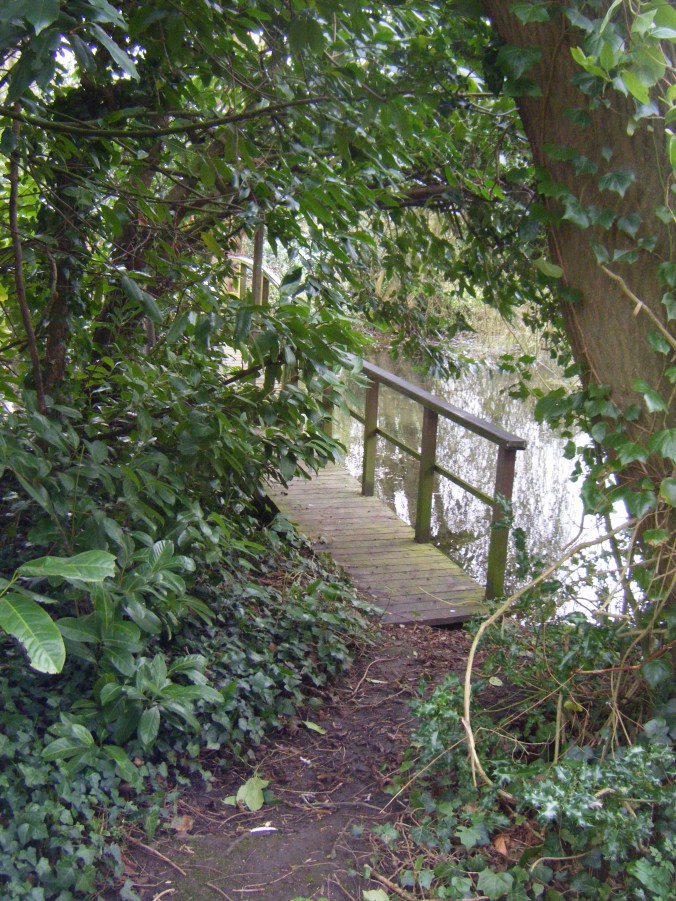
Wooded and  watery, the paths and bridges lead you over and around the ponds.

DSCF8114.jpg

Wintery reflections are captured on the water’s surface either side of the moored dinghy.

DSCF8116.jpg

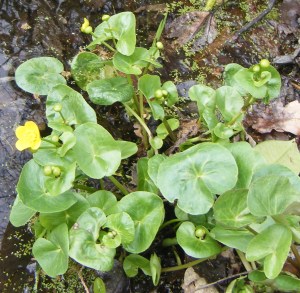
Marsh Marigolds caltha palustris luxuriate in the damp habitat.

DSCF8129

It is also a perfect place for the giant butterbur Petasitis japonica, a perennial  rhizome whose leaves in the summer will grow up to 3 feet tall.

DSCF8131.jpg

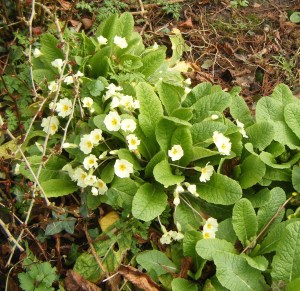
Clumps of pulmonaria are also showing through, as are joyful primroses.

dscf8133dscf8136

There is no lack of places to sit.  Either to enjoy a watery view.

DSCF8142.jpg

Or simply under a tree.

DSCF8135.jpg

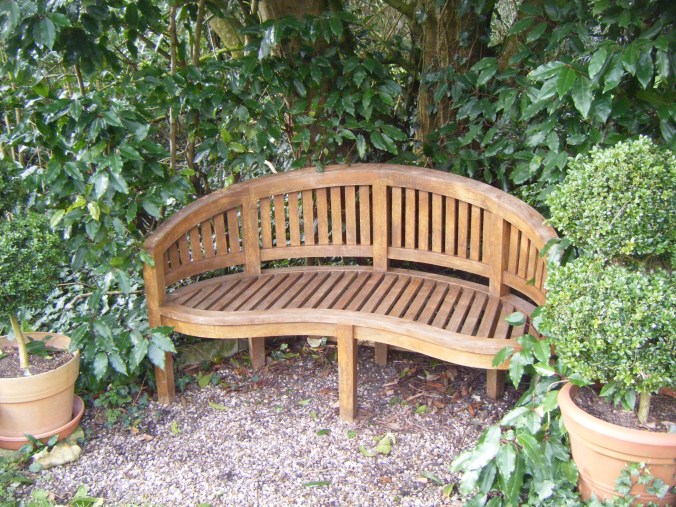
The curvature of this bench is perfectly placed in the indentation of the planting behind.

DSCF8138.jpg

While the box either side of this solid bench is clipped to imitate the shape of the spire of the distant church.

DSCF8119.jpg

We adjourn for coffee and cannot resist this french elegance sited in an intimate space by the house.

DSCF8083.jpg

There is indeed seating for all sizes.

dscf8123

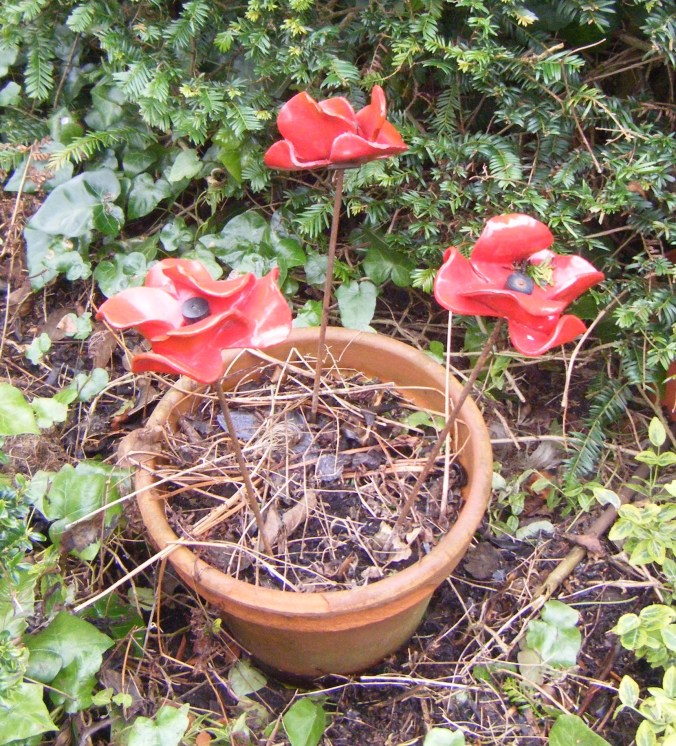
A splash of colour from 3 ceramic poppies used in the installation at Tower of London. Blood Swept Lands and Seas of Red, marked the centenary of the outbreak of the First World War, I wonder where the other 888,243 have now been planted?

DSCF8124.jpg

In the little room where the teas are served, a book  Dream gardens of England, is open at the right page; St Helens pictured in the summer is one of those 100 inspirational gardens.

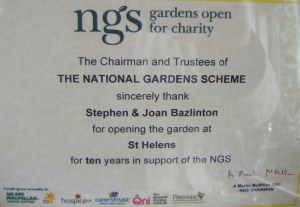
On the wall the certificate is proudly displayed marking a commendable 10 years of opening for the NGS.

DSCF8156

The sun has at last broken through. This garden largely wooded and watery, has something for everyone. From rare specimens to common species. Horticulture and humour are displayed on our exit as we walk down the drive; on the one side are vines trained against the wall,

DSCF8158.jpg

while on the other, a curiously clipped creature. Children too, would love it here, but there is no sign of a young visitor today; a pity because entrance for children is free in all NGS gardens.

DSCF8159.jpg

——-14——-

Chapel Street; galanthus,crocus and signs of Spring. (13)

The A17 is an intensely horticultural road; the flat fenland fields are of sprouts and cabbages. Last Sunday  driving to a garden in Lincolnshire, many of the fields were yellowing not with wintering vegetables but rows of daffodils and pickers bent over double. As I turned off left onto the A52, the level landscape soon changed to gentle undulations with the road lined by thick hedgerows, recently cut.

Today The Garden Gate is Open in the small village of Hacconby. The scent of winter honeysuckle lonicera fragrantissima combined with that great stalwart,  winter box sarcococca confusa greeted our arrival. On the gravel foreground is an assortment of stone containers growing alpines.

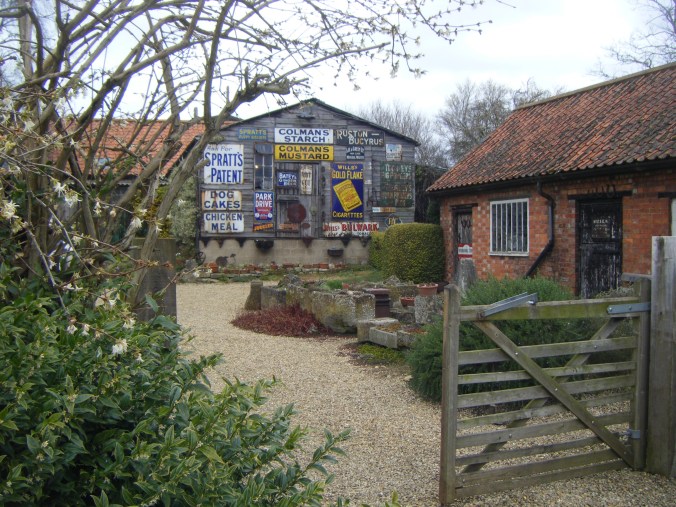
This was once a working farmyard where, before becoming a galanthophile the owner kept pigs. One day his barn developed a hole so he temporarily patched it up with an old metal advertisement sign. I don’t know if more holes appeared over the years but it has now become a delightful collection; an amusing back drop to a very neat yard.

DSCF8074.jpg

The sun was reluctant to shine today but it did not matter. A cheerful lady, possibly a neighbour was skilled in her welcome, pointing out the loo and handing me the Lincolnshire NGS booklet!

A nearby archway beckons you up the garden path directly behind the house.  The borders seem to be packed with plants. The owners are clearly knowledgeable as well as being snowdrop experts. In younger days they used to open the garden frequently and a visitor tells me how after many years of coming to the garden she has been able to learn so much. Each week she says there was something new to discover.

DSCF8012.jpg

Roses are pruned ready to climb up and over another wooden arch. These structures not only add height, but also help to divide the garden into areas while maintaining a look of transparency.

DSCF8013.jpg

In a sheltered corner this young chap bestows a little charm, holding his collar up; perhaps he is feeling the effects of the wind.

dscf8015

A water trough is attractively incorporated into the flower bed surrounded by the first colours of Spring.
DSCF8016.jpg

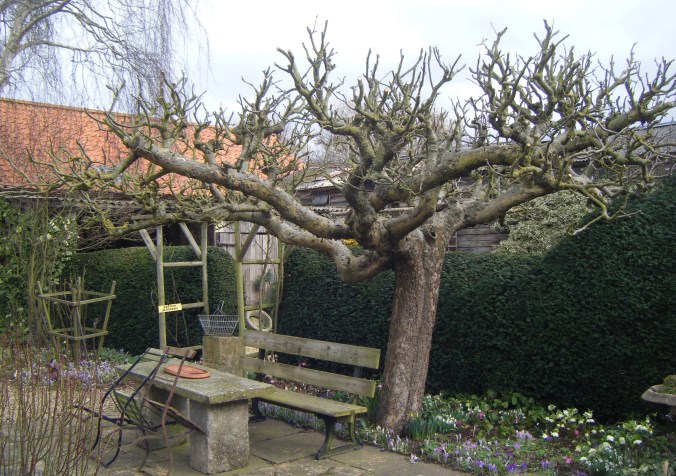
An old and majestic apple tree provides a pleasant area to sit.

DSCF8017.jpg

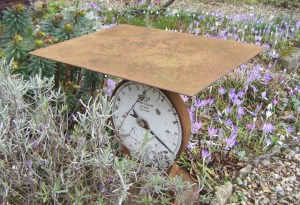
All sorts of items are incorporated into this garden including a set of weighing scales! Placed by the lavender they are eye-catching and maybe a perfect platform for something.

dscf8018

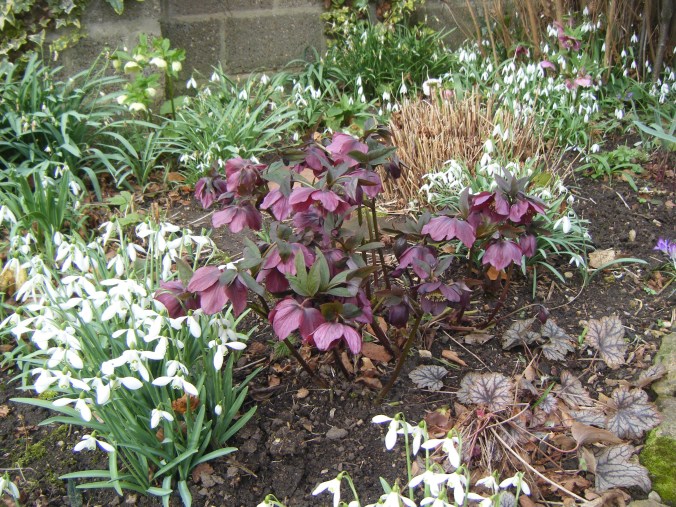
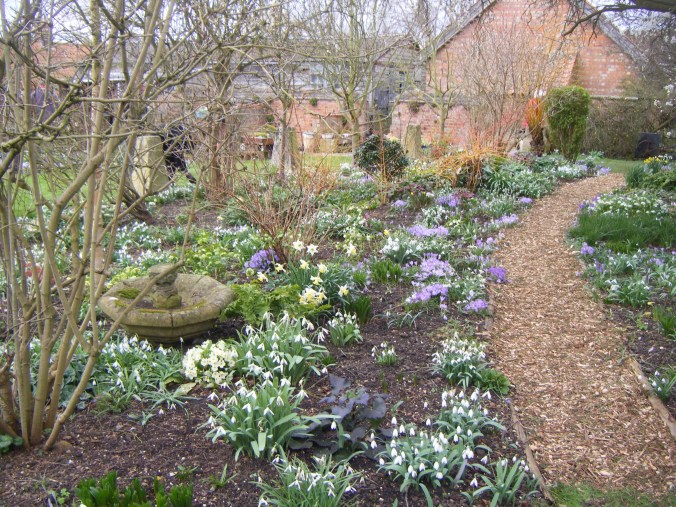
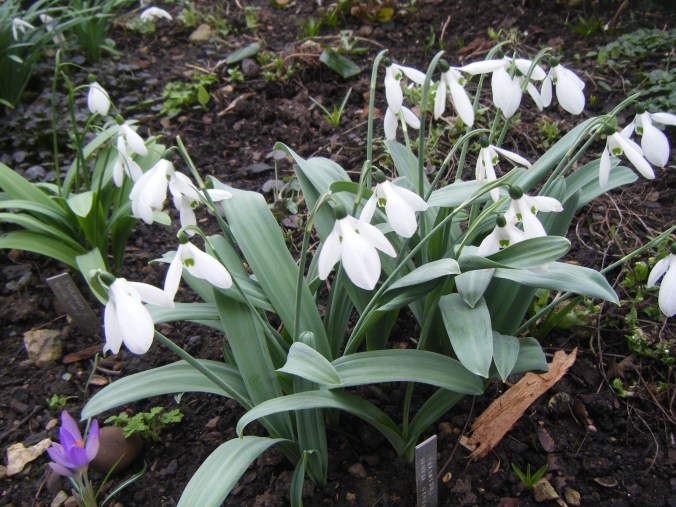
Clumps of Snowdrops and colourful hellebores are in abundance.

DSCF8020.jpg

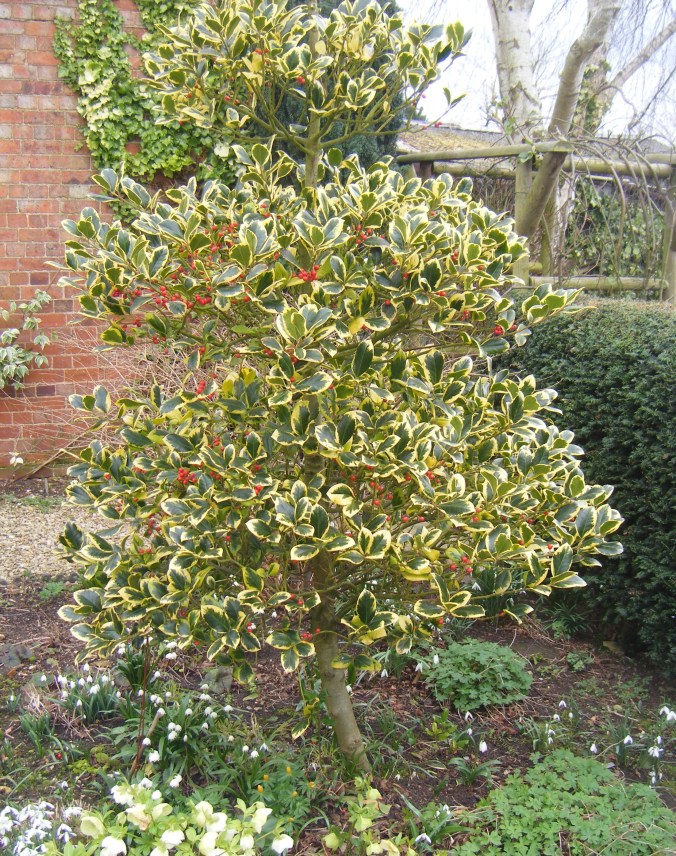
The birds must love this garden yet I am surprised to see there are still berries on this variegated Holly in February.

DSCF8021.jpg

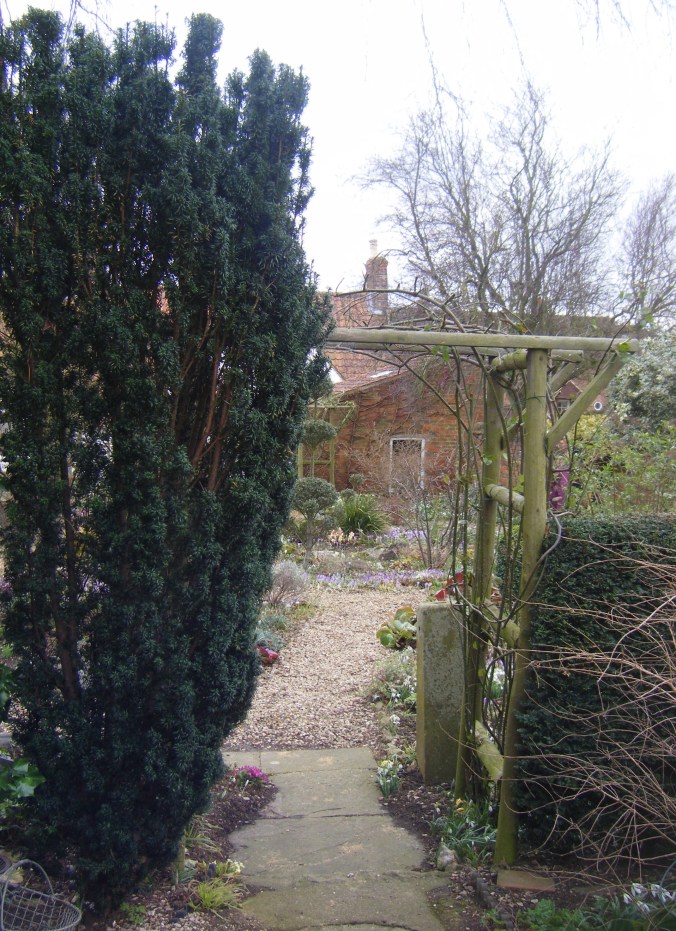
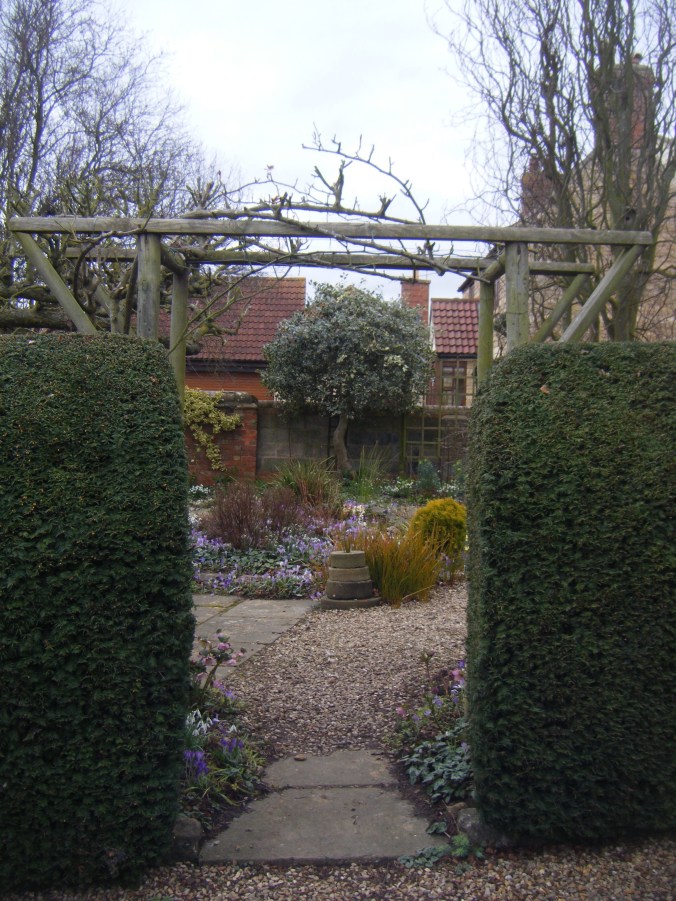
A tall yew gives a gentle touch of evergreen and provides further structure by another archway.

dscf8025

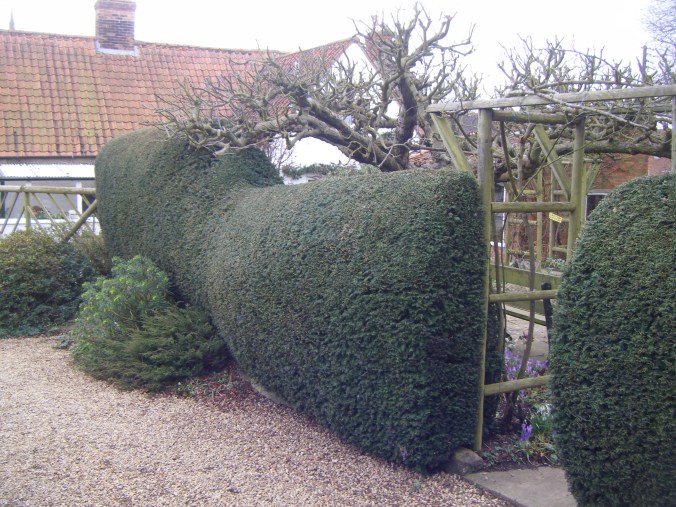
The cleanly clipped yew hedge smoothly separates the flower garden from the drive. The old apple tree has dictated the height and shape.

DSCF8068.jpg

The garden owner’s daughter Sharon apologises for the lack of design but I feel that this garden has been carefully thought out.

DSCF8066.jpg

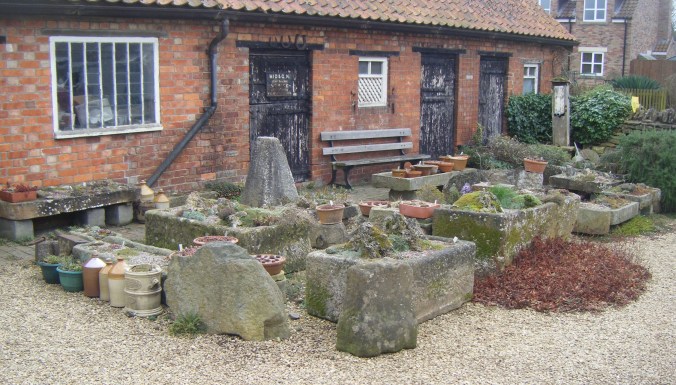
Across the yard tiny alpines inhabit the collection of stone troughs .

DSCF8027.jpg

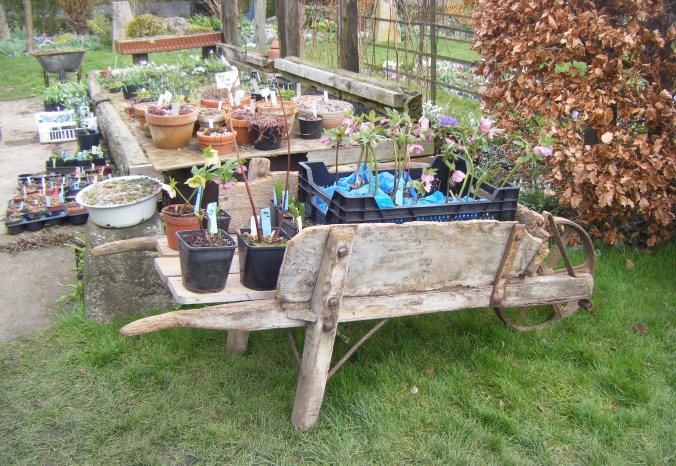
An area which once housed pigs has become a nursery bed and plants are for sale in a lovely old wooden barrow.

DSCF8030.jpg

Whilst another barrow, more modern and metal becomes an interesting planter and is filled with even more alpines.

dscf8031

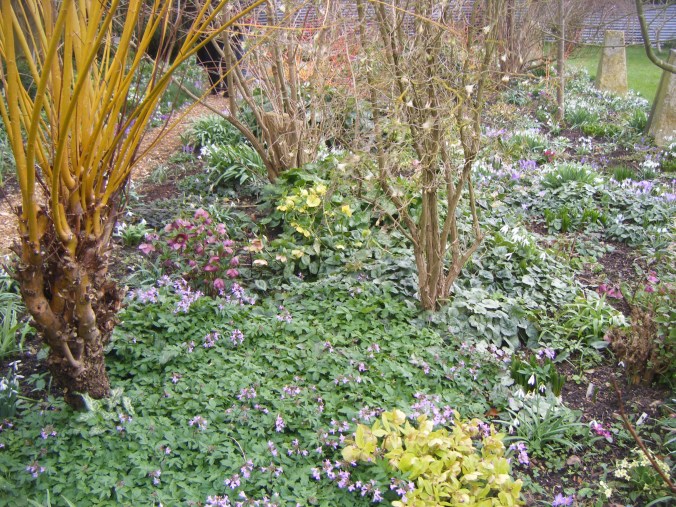
The variety of shrubs have a good underplanting  and there is much promise of plenty to come.

DSCF8033.jpg

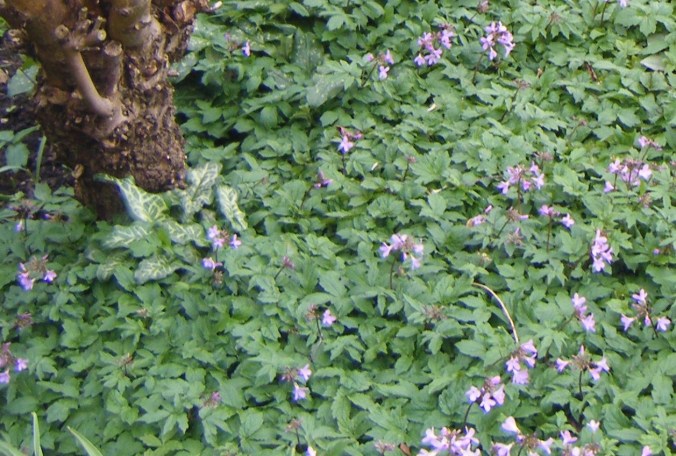
On closer inspection it is Cardamine quinquefolia, no relation to the spice, which spreads triumphantly through the spring flowers. Happy in shade it will die down soon to let summer plants push through.

DSCF8033.jpg

Sharon tells me that her father was one of the first to open his garden for snowdrops some 25 years ago. So popular are they now, the NGS has turned it into a national festival.

DSCF8037.jpg

I cannot begin to list the number of varieties that grow here but Galanthus Global Glory looks pretty impressive.

DSCF8036.jpg

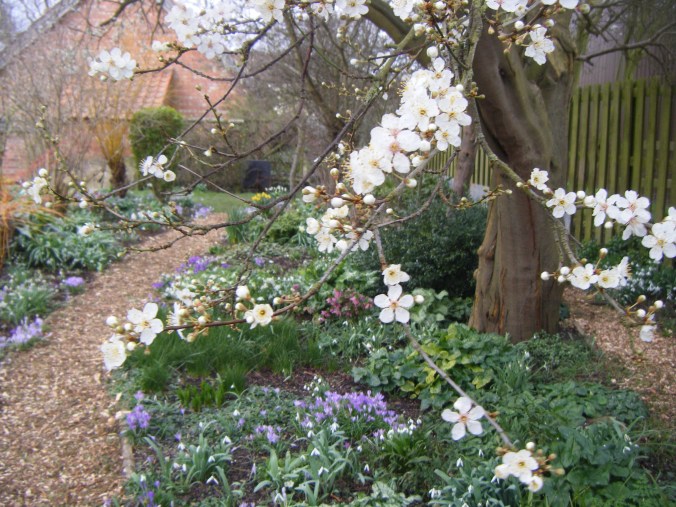
At last the blossom is emerging and here it is on a wild plum.

DSCF8040.jpg

You would not know that this is a bed for raspberry canes. Taken over by the Spring flora, they will remain dormant for awhile yet.

DSCF8053.jpg

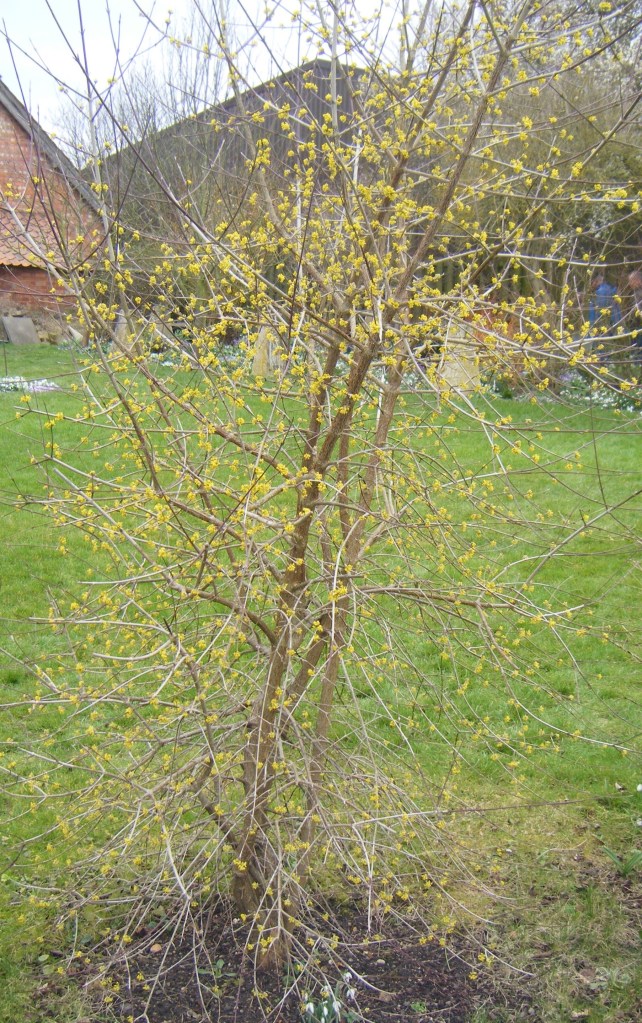
A Cornus mas grows brightly at the edge of the lawn.

dscf8056-1

Close by, a neat path invites you into the vegetable garden.
DSCF8048.jpg

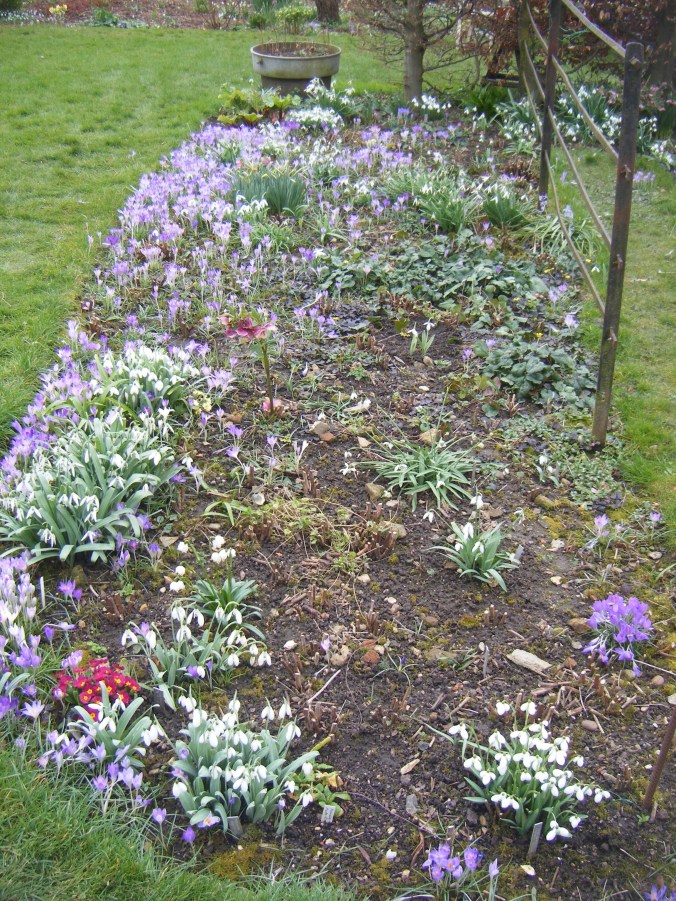
I find enthusiasm and great discussions being held over a bed entirely devoted to snowdrops. Hundreds of varieties all carefully labelled have been inherited by Sharon from a friend. There are still more for her to collect and I wonder whether this vegetable patch will eventually be taken over entirely.

DSCF8047.jpg

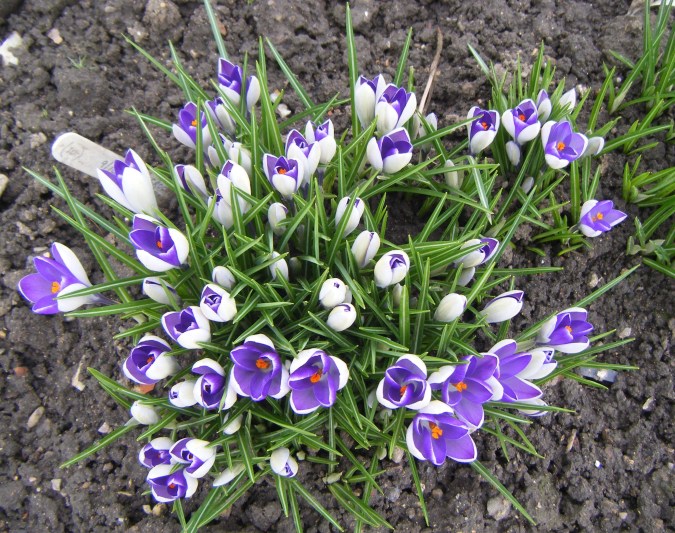
Crocus are also invading.

DSCF8060.jpg

There are still some vegetables but I am not sure that they are winning.

DSCF8045.jpg

Cyclamen find their feet along the path behind apple trees and under the hedge.

DSCF8044.jpg

This glorious crocus is called Margot, recently found it is not yet on the market.

DSCF8059 (1).jpg

On my way out I pass the plant sales again. I ponder on buying yet more snowdrops but instead weaken to some hellebores. Well you can’t have enough.
DSCF8052.jpg

By the front door there is a collection of pots: on the left Ophiogon planiscapus ‘Nigrescens’ surrounds is a quirky Privet. In the middle, Hellebore Penny’s Pink looks stunning but is sadly not for sale. On the right, a new plant to me, is the intriguing and rare Scoliopus bigelowii; A member of the lily family it is native to North America and also goes by the name of Footed Adder’s Tongue! Which ever name you choose, it looks happy enough here in Lincolnshire!

It has been a charming garden sprinkled with curiosities and early Spring colour even though it is hardly March. There is so much to interest the intrepid snowdrop enthusiast.

As I slip out through the gate those early signs of Spring have followed, spilling through the hedge onto the edge of the pavement.

dscf8076

——-13——-