Garden visiting, looking at what is through the garden gate, especially those open for National Garden Scheme, with just an occasional foray here and there.
Hurrah, the National Garden Scheme has begun to open some of its gardens. The system has changed a little and I had to go the website to pre-book my ticket online beforehand, which was perfectly easy and I found a small garden in Ely. It is such a long time since I have been anywhere so I was quite excited and having made my online purchase I was not going to let the cold miserable rain put me off.
Ely was void of the usual tourists and after managing to remember how to manoeuvre my Mini into a convenient parking slot I walked up the street towards the Cathedral, the grey clouds were pretty threatening.
It was a windy day and by the time I reached the cathedral it was blue sky.
Number 38 is minutes from the historic centre and as I walked along the residential street I received a warm welcome from the roses. The original plan was to open with a group of other gardens but coronavirus prevented this from happening.
The gate was open with a plant stall in front, and garden owner Julia had been busy raising and selling plants during the lockdown making over £600 for the National Garden Scheme. Julia is a retired nurse and she believes this is her way of helping.
I hurry down the west side of the bungalow, as that sky does not look too good.
A garden on heavy clay and with Ely’s dry climate this is surely a welcome load,
despite the threatening clouds there is a sunny feel to this secluded back garden. Julia and Peter have lived here for three years working hard to restore the garden from a jungle of ivy.
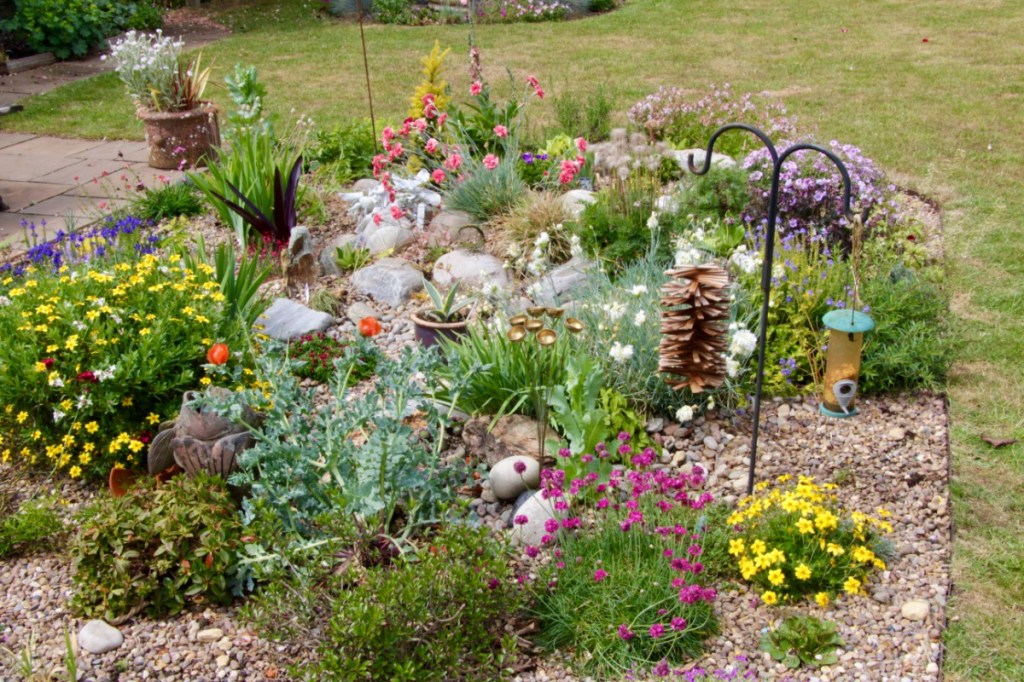
For her 80th birthday, family and friends gave Julia the materials and labour to create a rock garden on a dry piece close to the house.
Here grow all sorts of treasures; a bright horned poppy with glaucous leaves,
the enchanting Dianthus cruentis
and a fishy friend.
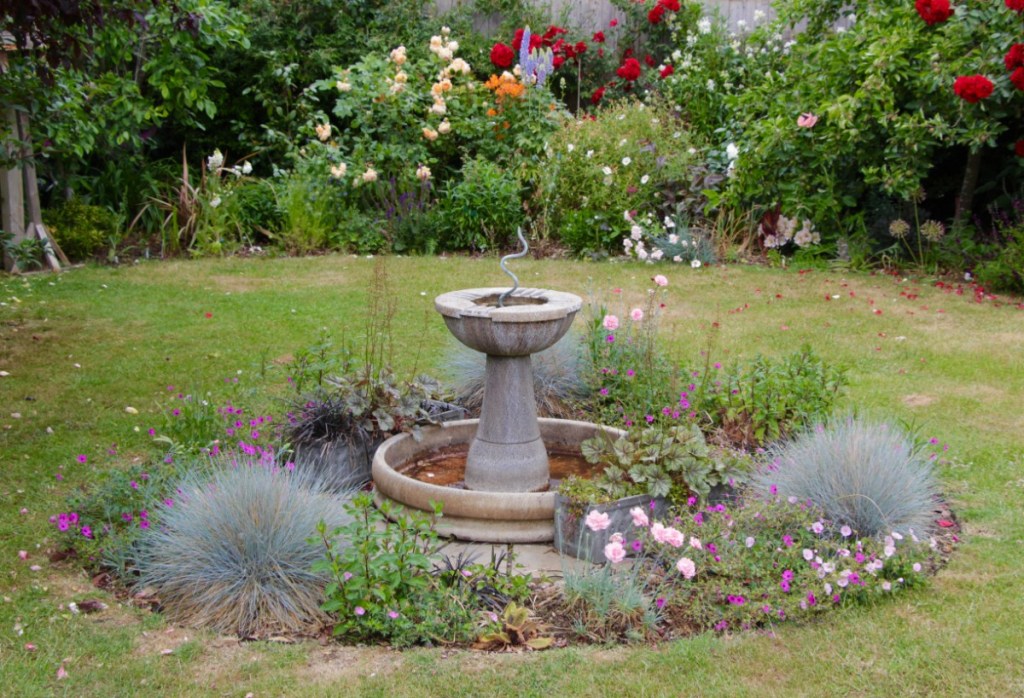
Beyond this area is the fountain and the glaucous theme is repeated around the base.
The roses have been truly floriferous this year and here is no exception. Through the arch, I walk into a little fruit area
and come face to face with some ripening greengages. The bungalow was originally built on the site of an old orchard and several fruit trees remain providing an abundance of apples, plums and quince.
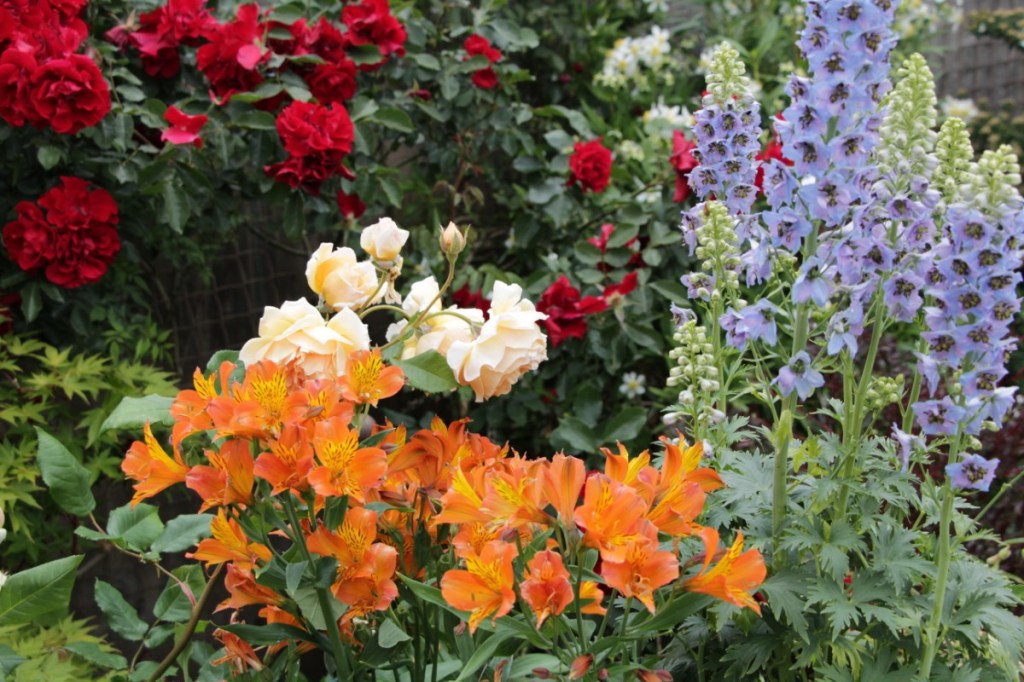
Returning through another arch I am back into the main garden where there is an explosion of colour reminiscent of the sixties, those classic summer plants roses, alstroemeria and delphiniums.
Roses planted by previous owners are blooming everywhere mingling with shrubs including the sweet-scented philadelphus.
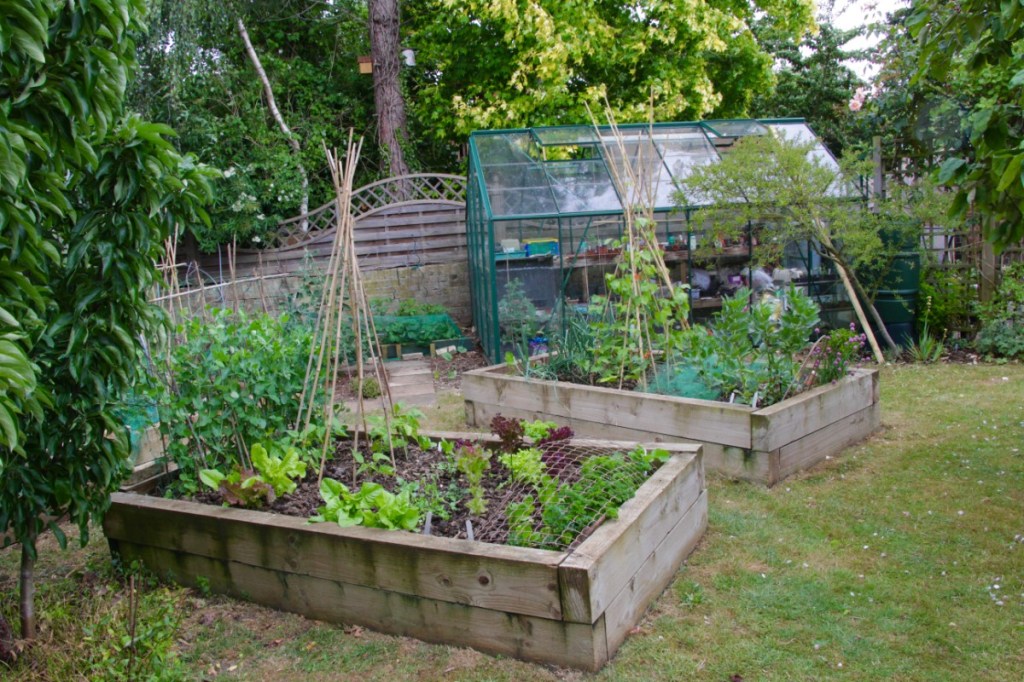
Over in the corner are the raised beds, the perfect size for vegetables, and close by is the all-essential greenhouse where Julia’s skills raise many a plant.
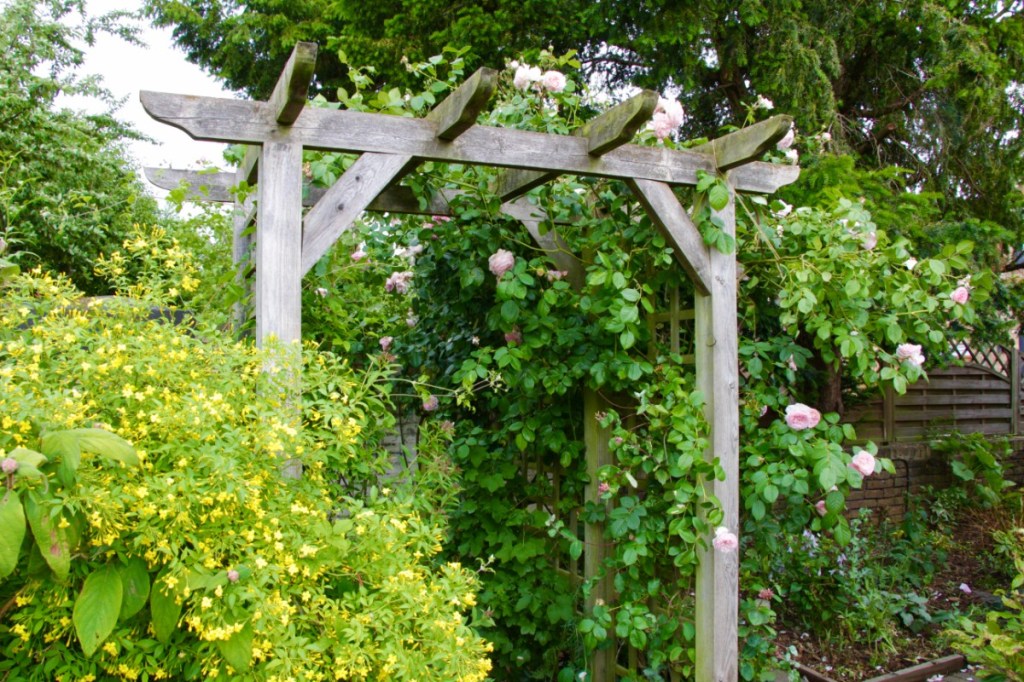
The garden is well screened being surrounded by mature trees, and several wooden arches provide height and interest. Here it is a perfect support for the pink climbing rose, and the yellow jasmine fruticans is pure joy.
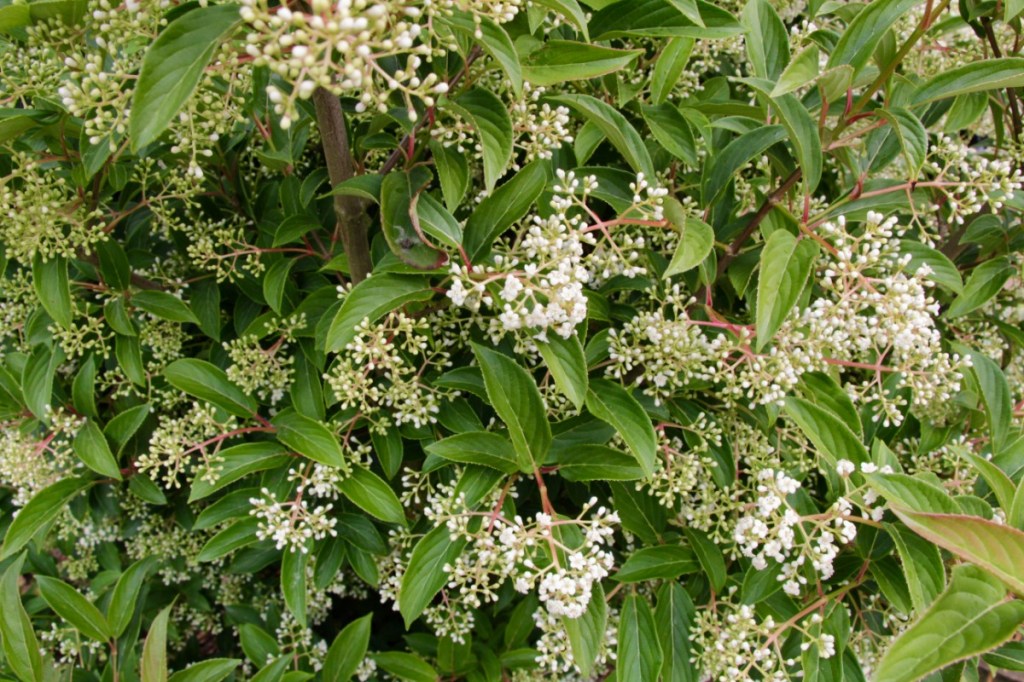
Wafts of honey fragrance fill the air and I know it is not from the jasmine but am unsure where it is coming from until I discover this lovely unusual viburnum japonicum just by the house.
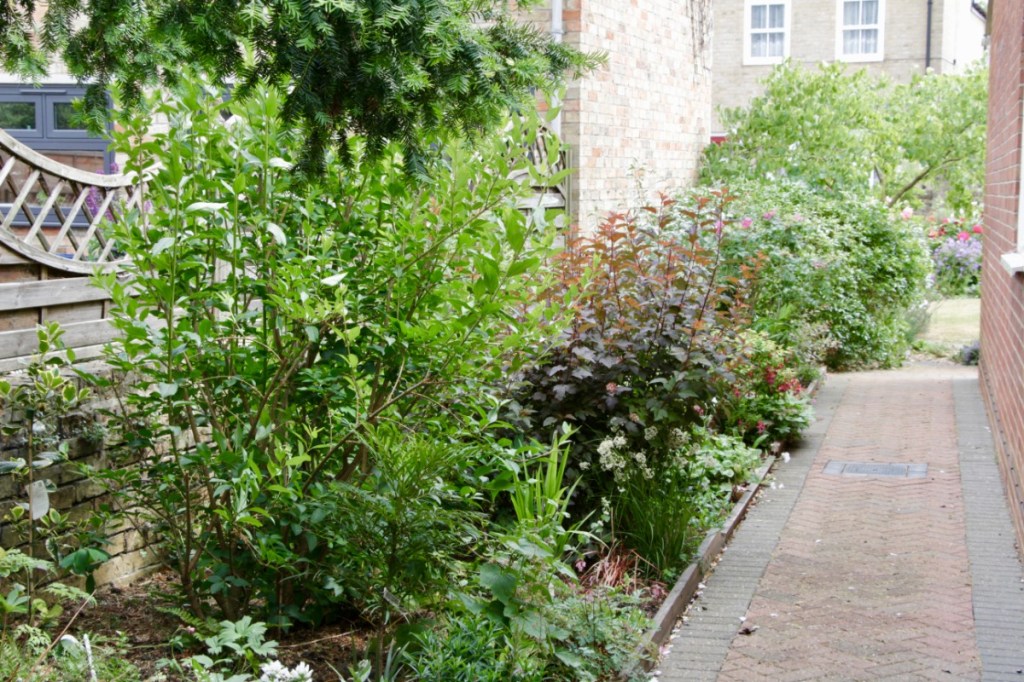
There is a convenient one way system, and along the east side of the house a border has been designed to give form and foliage colour,
with astrantia major popping up below to add to the colour.
Out in the front again where the Judas tree is in full leaf, salvias, geraniums alstroemerias are just a few of the plants in this dry open space.
This small daisy-like perennial Erigeron karvinskianus is so useful for softening those hard areas.
Garden owners are prohibited from providing teas, and it is a blessed relief to those of us who have added centimetres to our waist lines during the lockdown. So I head for home, the recommended distance for visiting is about 20 miles, and I must admit to have slightly exceeded this suggestion, but for those of us living in rural places the requirement might have to be more. However, you must remember that no facilities can be available and on the way home I was glad that my journey was not longer and next time I will remember not to have that second cup of coffee before I set out.
Gardens will be uploaded each week on http://www.ngs.org.uk where you can purchase your tickets. If you cannot get to a garden or do not wish to venture out, why not enjoy one of the NGS video virtual tours?
There has been no greater time when we need to support our nurses, and the all-round benefits of visiting a garden are huge.
There are an incredible 340 gardens open for the National Garden Scheme during August. Sadly I have been unable to visit any so far partly because I am busy with my own garden being one of the 340, added to which my ‘under-gardener’ had an unfortunate accident resulting in him being confined to crutches and so leaving me with much to do.
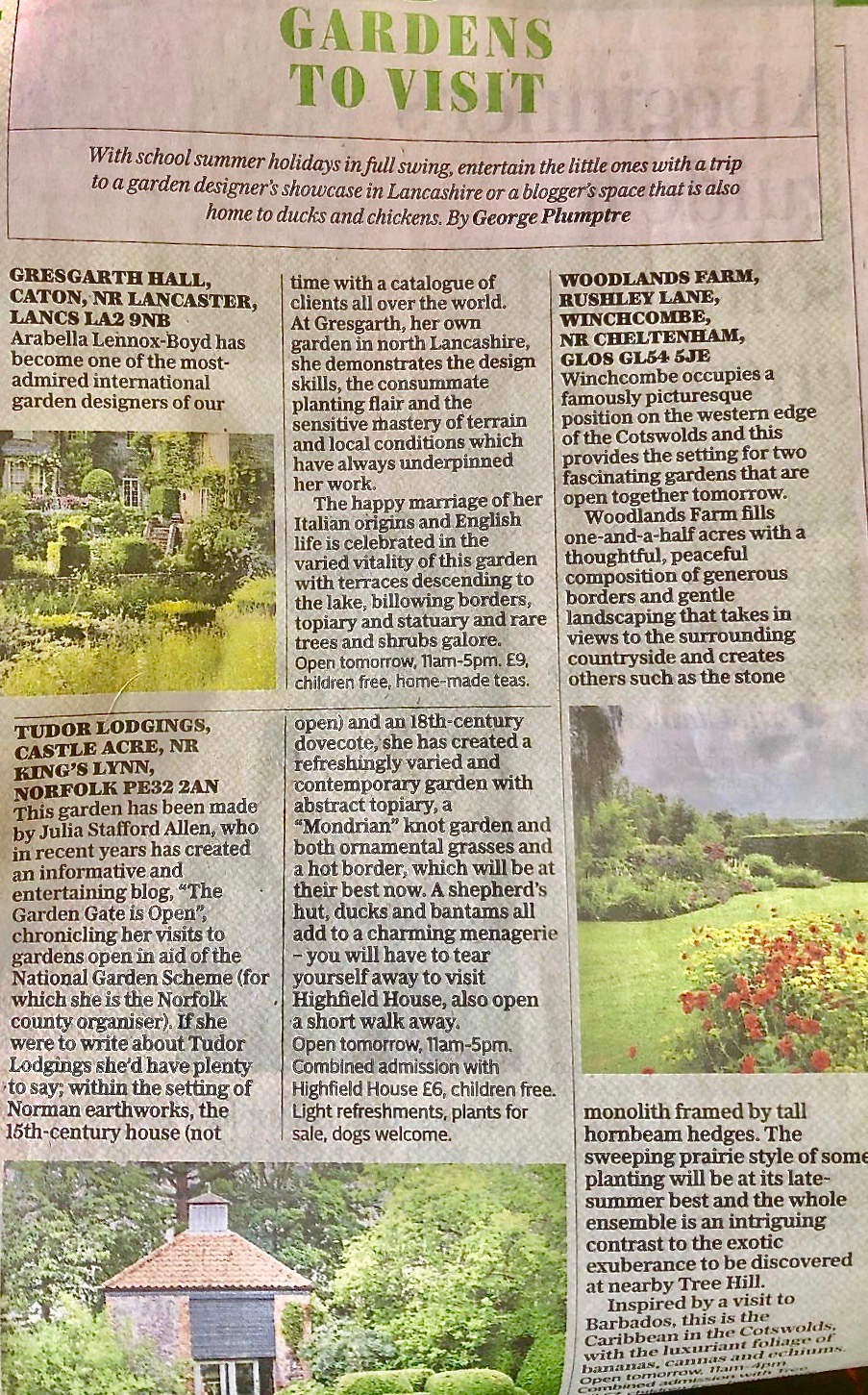
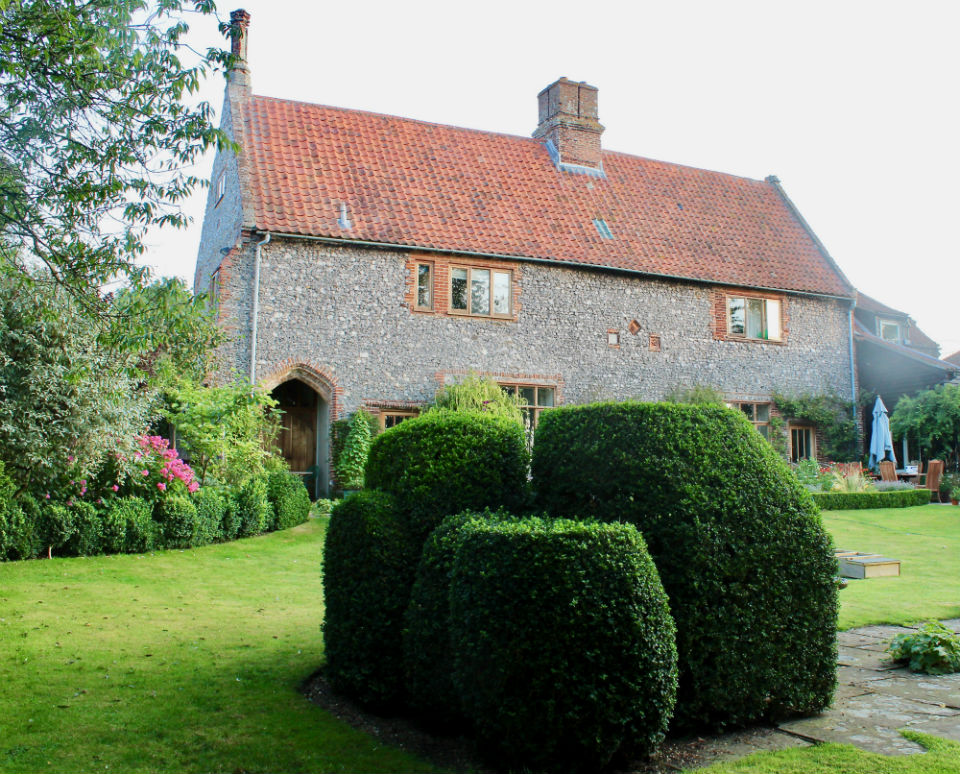
So forgive me, it has to be a tour of my own garden. Tudor Lodgings is perched on the edge of the historic village of Castle Acre, and was built in the late 15th Century.
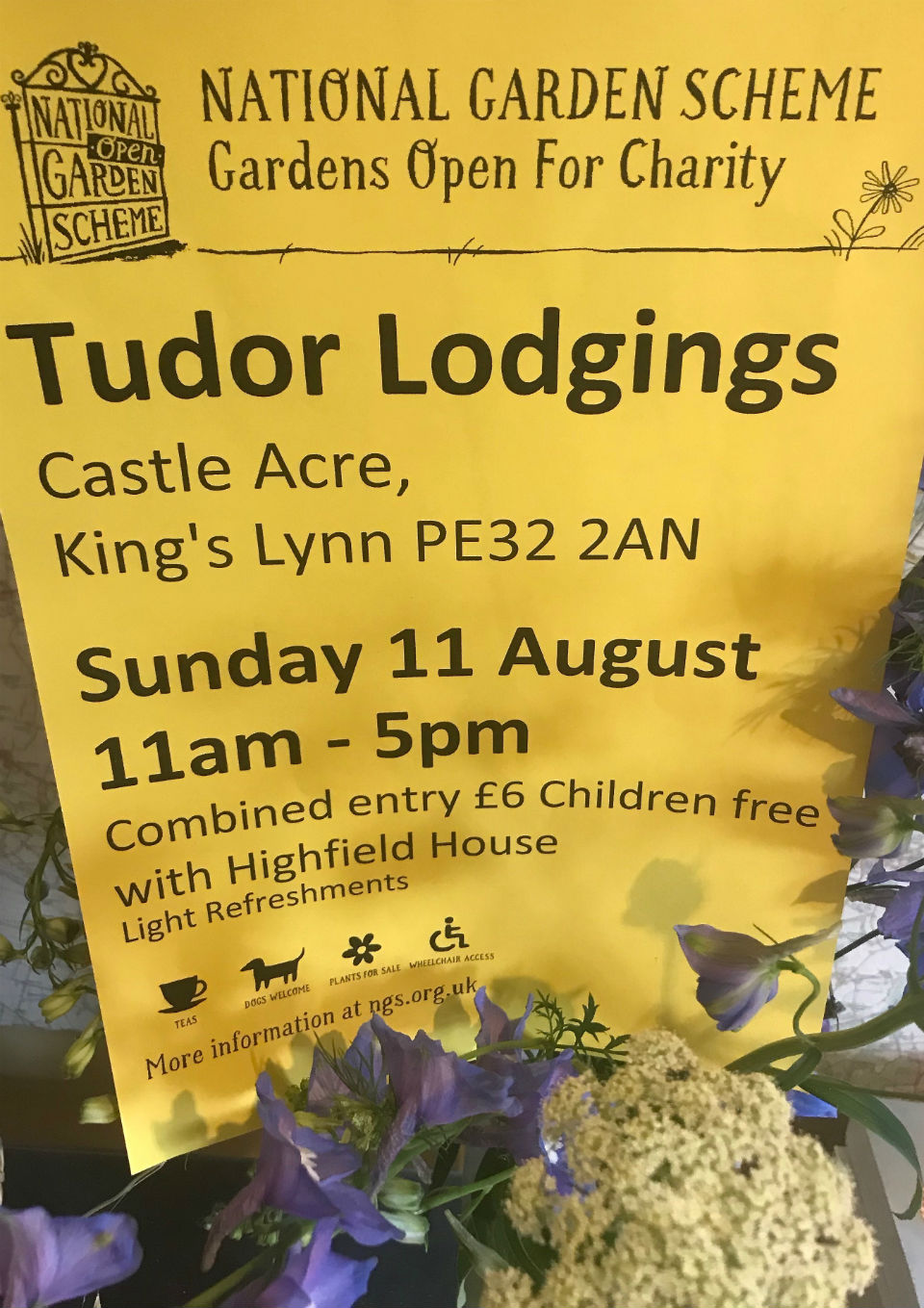
Thank heaven we were open combined with Highfield House, as lovely Jackie and David were very supportive and brilliant at putting up the posters and all the important signage.
As you can imagine much preparation goes into opening the garden, and always as the day approaches I never feel that the garden is quite ready and as I would like it to be. Radio Norfolk announced its opening and a very complimentary write up in the Saturday Telegraph the day before did nothing to relieve my anxiety. Was the garden really up to this sort of standard?
Whilst you can work your socks off, you can do absolutely nothing about the weather; the view from my bedroom window on the Sunday looked promising. Swinging into action frighteningly early I began the day by putting the first of the home-made sausage rolls and quiches into the oven, timing each bake between walking dogs and watering.
Mowing the lawn and knocking in the final notices is usually the job of the under-gardener. This year he had to give instructions from his incapacitated position in the sunroom. Our sons rose to the occasion (forgive the pun).
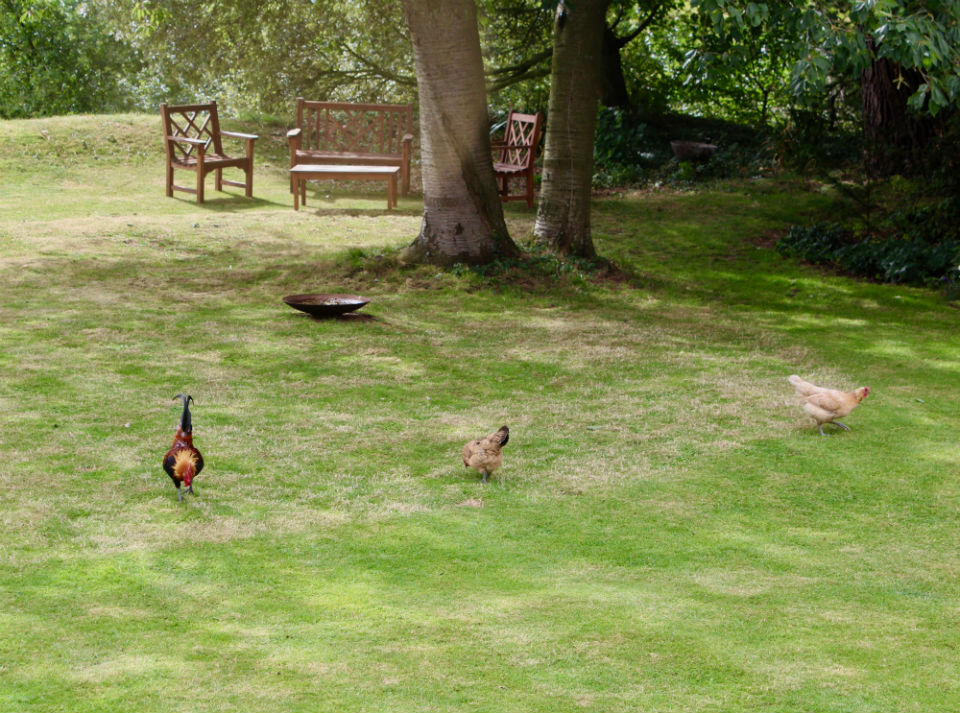
With the final inspection of the lawn being undertaken by our friendly fowl, the under-under-gardener team took up position in the lower paddock.
Here they turned their attention to parking cars, skilfully maximising the open space until for a short moment there was no more room to be had. It was fortunate they had opened the gates earlier than scheduled and the first car or two began to leave just in time to allow others in.
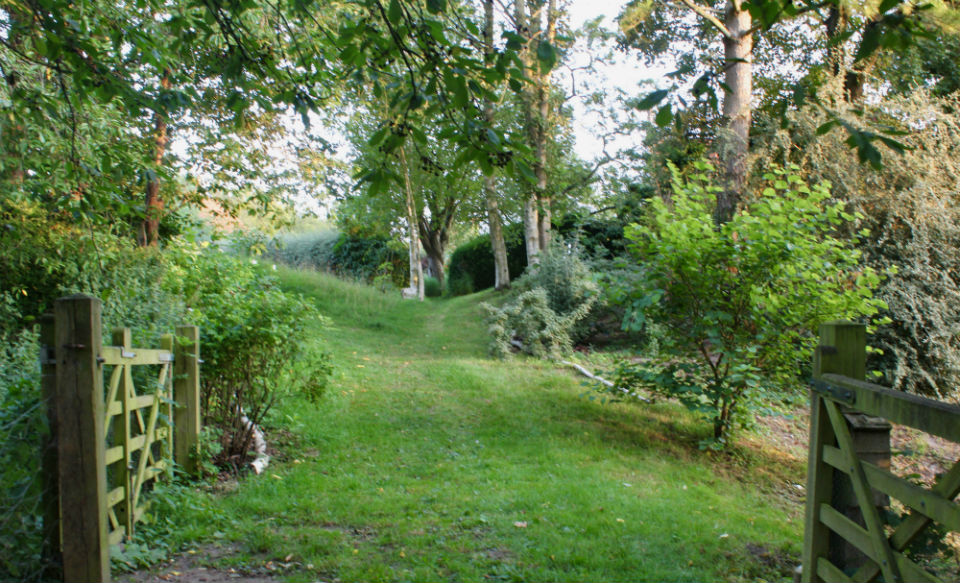
Access to the garden is by walking up the slope through the field gate,
and it is worth just pausing a second here to look at the old medieval wall, in effect a large dry ditch and bank, which surrounds the garden on two sides. An ancient listed monument, it is very steep and therefore tricky to maintain plus the added fact that there are restrictions. We keep the bank directly below the house neatly strimmed,
whilst on the other side we allow the nettles to grow. Both these areas are carpeted with snowdrops in the winter months.
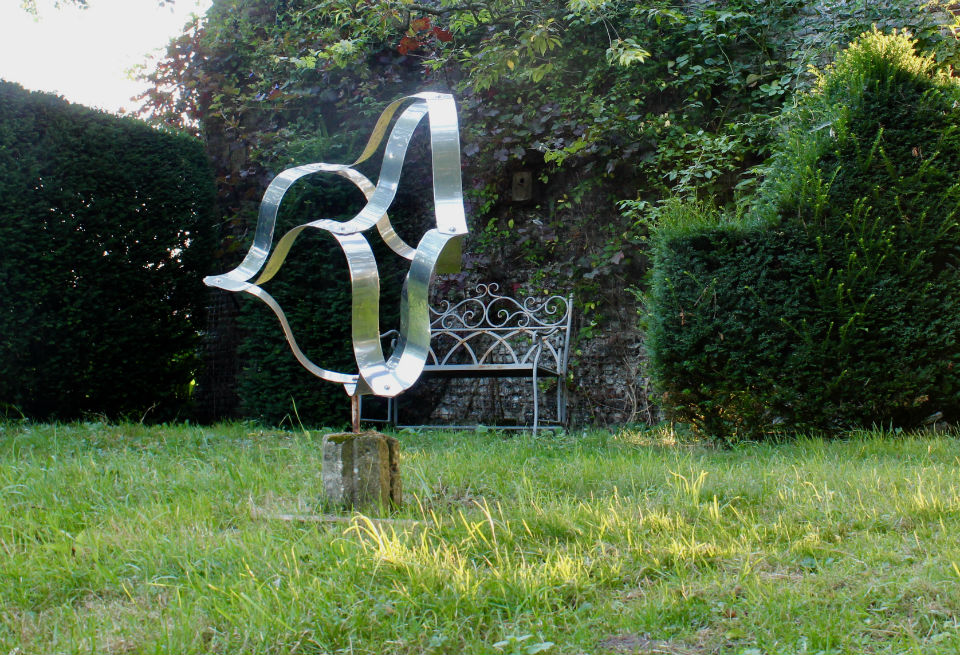
Moving on up towards the garden and situated west of the dovecote is a sculpture by Matthew Frere-Smith (1923-1999). This piece was already here when we arrived and we have become rather fond of it, endlessly moving it around to several different sites within the garden. It has come to rest here which we feel might at last be its proper resting place.
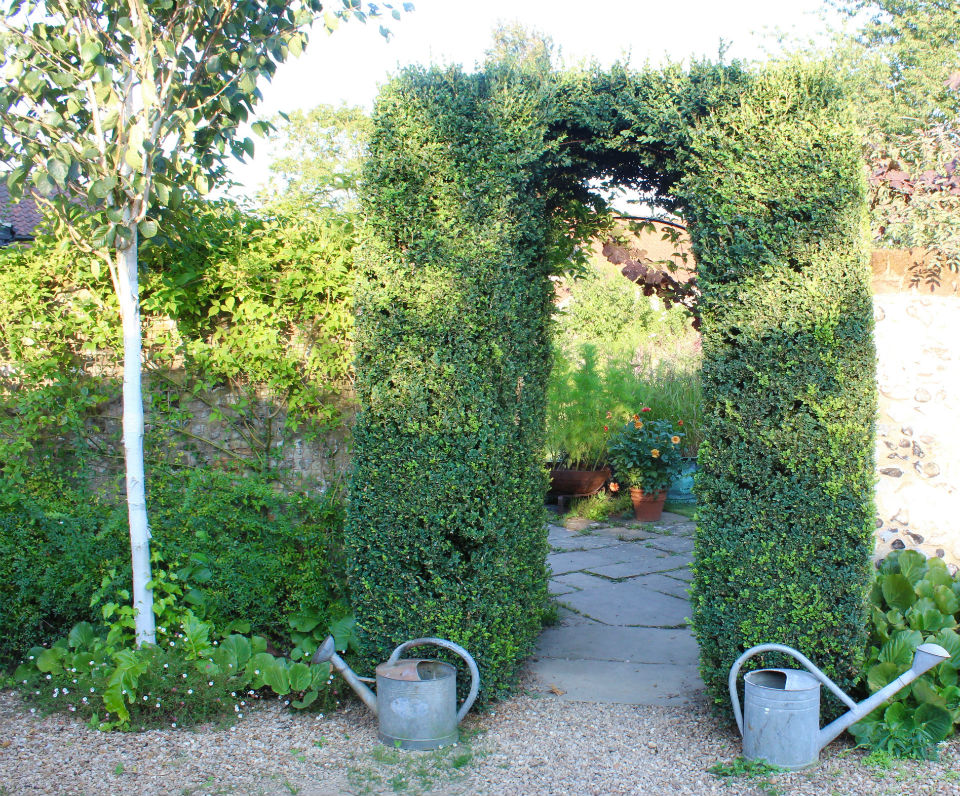
There is no set route around the garden and slipping through the gap in the yew hedge you can go either,
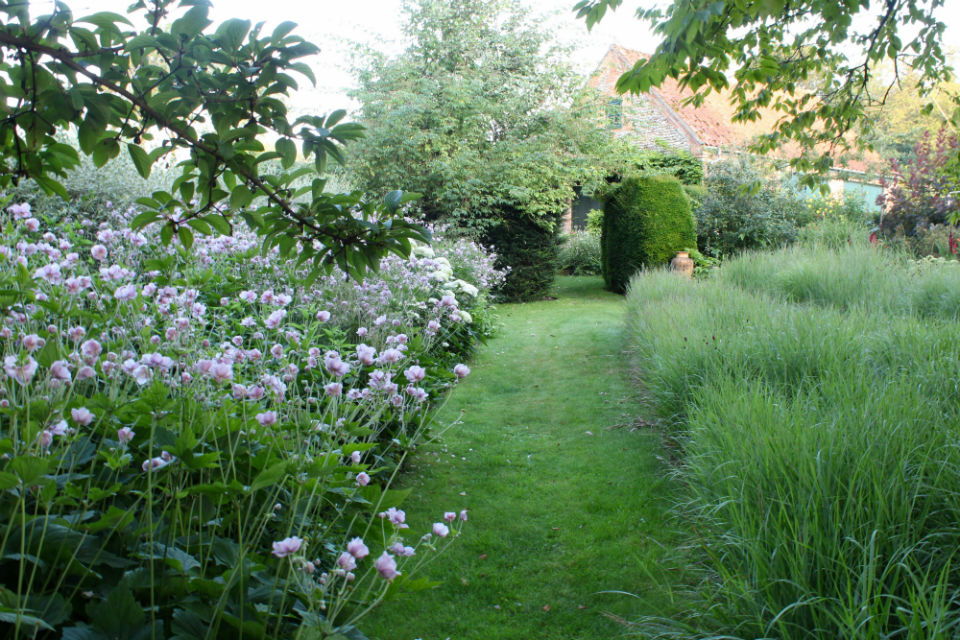
straight up the path bordered on one side with anenomes and hydrangeas and with a block of panicum virgatum on the right,
or you can turn right and head towards the house. Perhaps this is a good starting point. When we moved here in 1985 with toddler and babe in arms, I, and the ‘under-gardener’ knew very little about gardening.
There were certainly the beginnings of a garden here; trees, hedges and topiary had been planted, the paving and steps laid, all sketched out on the back of an envelope by Brenda Colvin, a friend of my predecessor http://www.colmog.co.uk/brenda-colvin/. It is a family garden which has evolved over time and we have simply added to the original design.
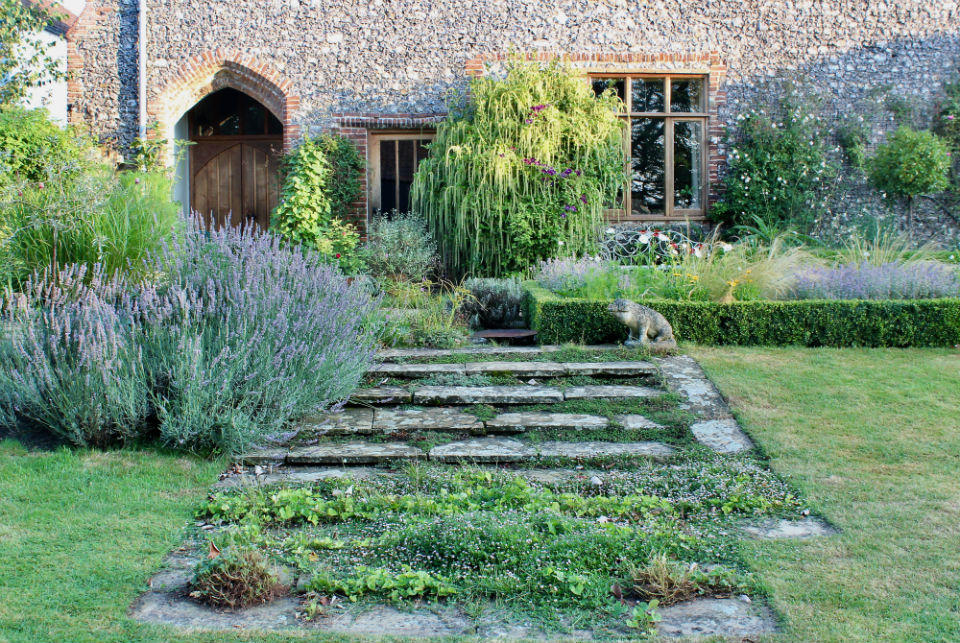
The house faces south and visitors are drawn to the shrub growing up in between door and window.
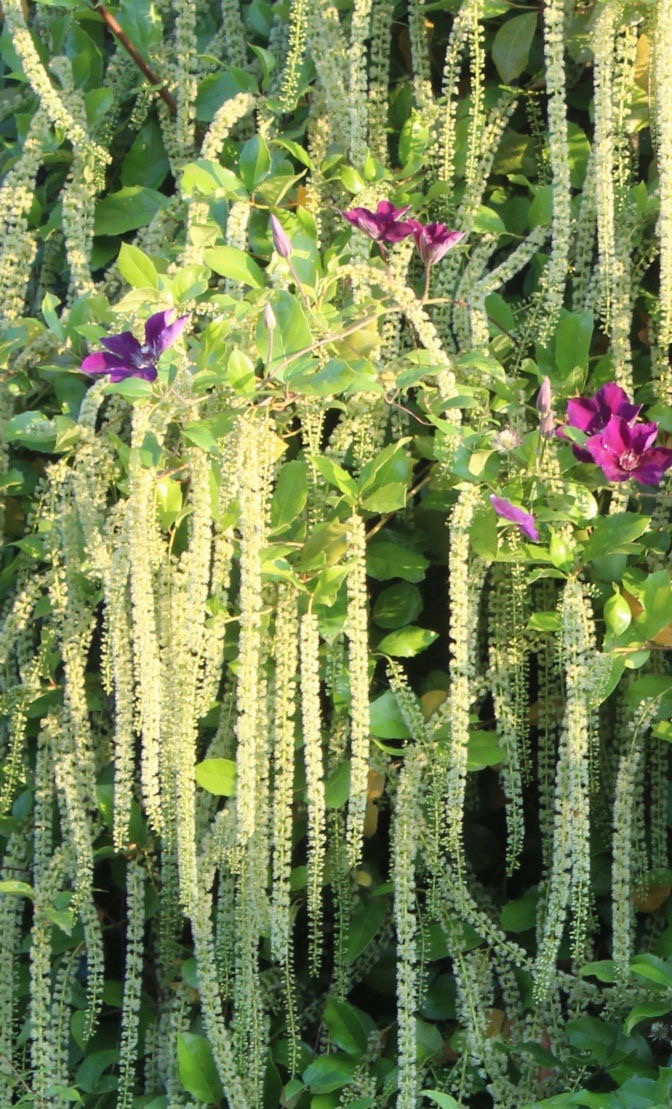
It is Itea illicifolia and the long fragrant catkin-like flowers fill the air with the aroma of honey. The unknown clematis winds itself through and is happy to flower for most of the summer.
Between the house and the lawn is a knot garden. Created in 2013 we did not want a traditional design, but instead were inspired by the artist Mondrian, and within the straight lines of box, the loose planting tries to keep within his palette; blue nepeta, red echinacea, yellow stipa tenuissima mixed with coreopsis, and white cosmos combine with Japanese anenome and gaura. In spring there is a showing of galanthus,muscari and tulips.
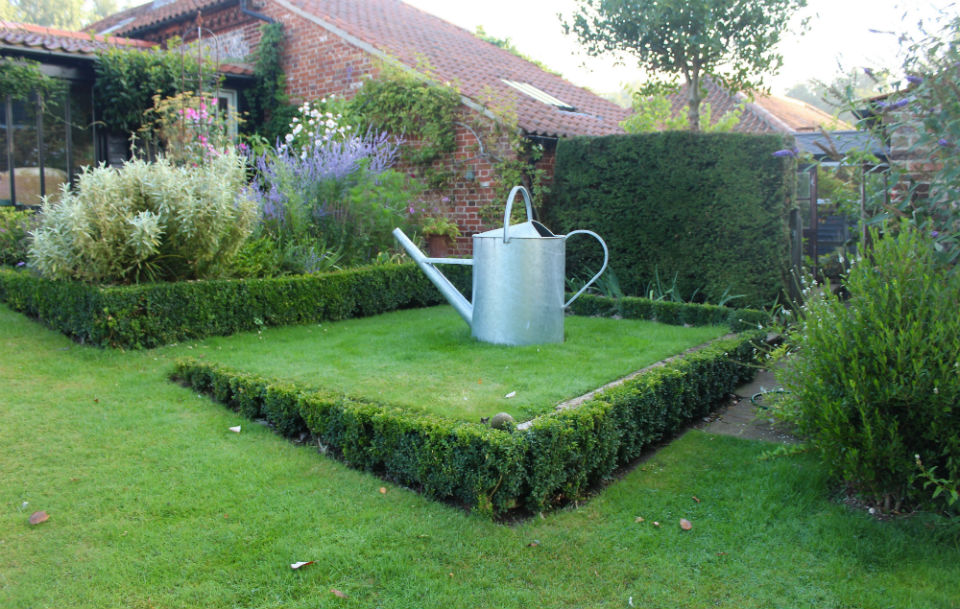
From the house there is a slight incline and for years we gardened on the slope until one day we decided to terrace it. So much easier. In the upper section hibiscus, roses, perovskia and phlomis fight for space while below sits a ridiculously large watering can; well what else do you do with an empty green expanse?
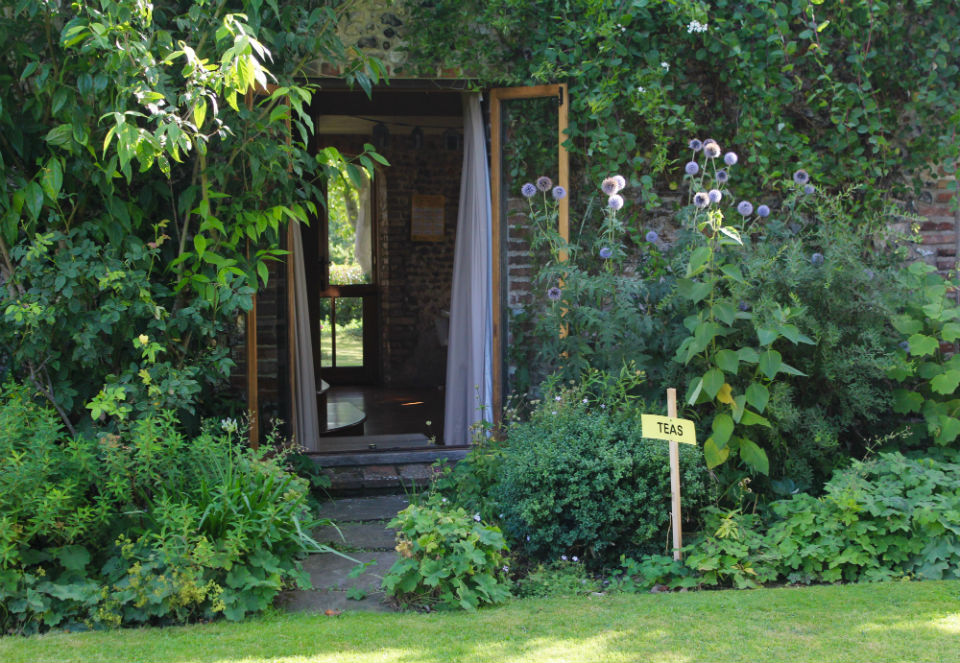
The Barn which we let out for self-catering holidays, is kept vacant, and stepping through a border of echinops, kirengeshoma and senecio tangutica it becomes the tea room. Indeed for some this is the most important area of the garden.
It is at this point that I should mention the tea team, led by ‘the nurse’ who has been administering injections twice daily for the past fortnight to the under-gardener whilst at the same time filling my deep freeze with an amazing selection of cakes. There is no doubt that not only are her nursing qualities superb but also she bakes a perfect sponge. The nurse cajoles her family to drive the distance from Gloucestershire to Norfolk to help, and together with over a dozen kind friends from the village they serve and wash up the entire day. It would quite simply be impossible without them.
From the end of the Barn, and the end of the lawn you see gently rolling fields; please don’t think of Norfolk as being flat.
You might think the table and chairs have been moved here to enjoy the view. That is partly true but while showing a group around the garden the day before opening, a gust of wind brought the rather poorly Judas tree in the centre of the lawn crashing down. Just what you need before an opening. With no alternative but to leave it, I moved the table and chairs further away. There is also another reason why it was best to move them; it is the low table that was the cause of the crutches. Let’s say no more and carry on.
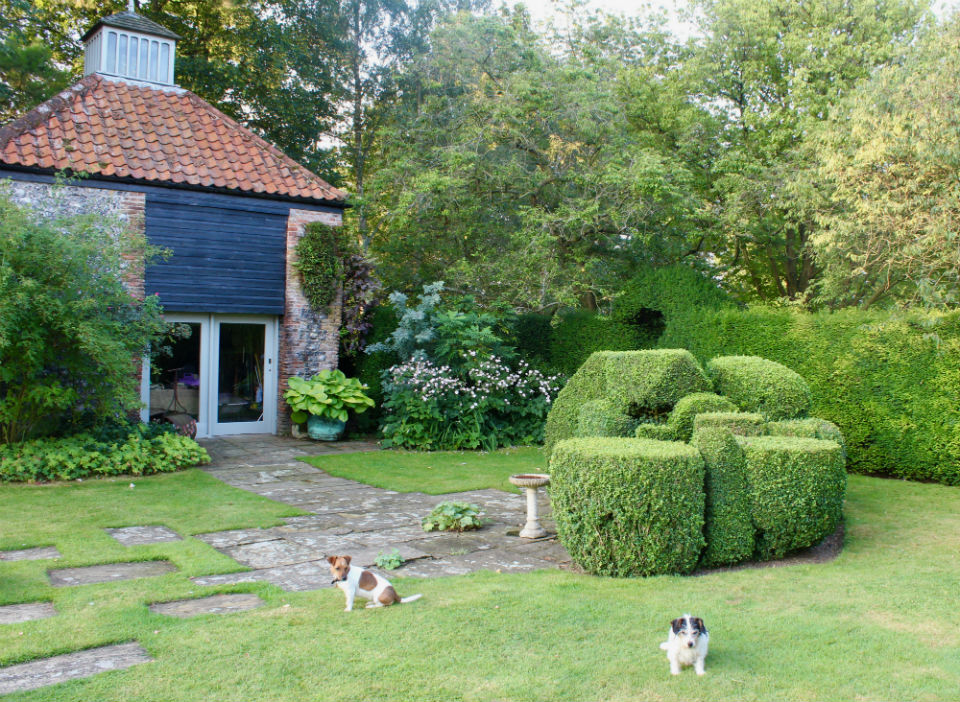
Tulip and Jesus (he came at Christmas) are sitting in front of the former dovecote. Built in C16 it is square in plan with the remains of the nesting boxes formed of brick and clunch. There are no doves now but it houses the garden tools instead. The abstract topiary known affectionately as the ‘Bun of box’ is a great place for terriers to play hide and seek.
In the shady corner the hosta fills the copper pot, all summer long its large leaves are never touched by slug or snail.
Squeezing through the keyhole in the yew hedge you re-enter the area where the centre is filled with ornamental grass.
This was originally just long grass with mown paths but we got tired of it becoming unsightly by the end of June and so planted a block of Panicum virgatum ‘Shenandoah’; the seed heads which turn red compliment the hot border to the right,
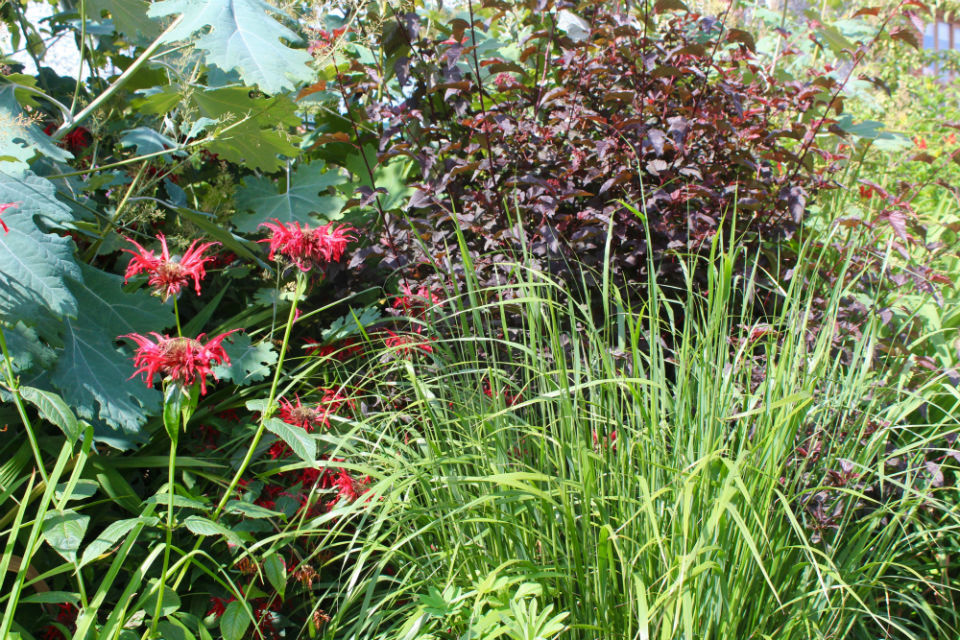
where more ornamental grasses thread through red-leaved shrubs and bright flowers such as crocosmia, hemerocallis and monarda,
Further round the corner, the campsis radicans this year has been positively trumpeting with flowers climbing over a brick wall by the garage.
Originally I planted this tunnel with roses and apples but as one never saw the rose flowers unless flying overhead, which I seldom did, I removed the roses and now have just apples and pears. The apple is an old variety called Norfolk Beefing, a lovely cooker which never seems to let us down.
The tunnel is a link to the wilder part of the garden but as you move through, on the right there are autumn raspberries and on the left in the fruit cage are various currants. The vegetable area has now been planted up with cutting flowers. I am hopeless at growing vegetables and cannot see the point when I have a perfectly good greengrocer in Swaffham. What I love is being able to pick flowers and this year, cornflower, sweet peas and sunflowers have been a delight.
You come through the tunnel to the wilder part of the garden. The shepherd’s hut, where, as it faces west we can catch the evening sun; the perfect place for a sundowner.
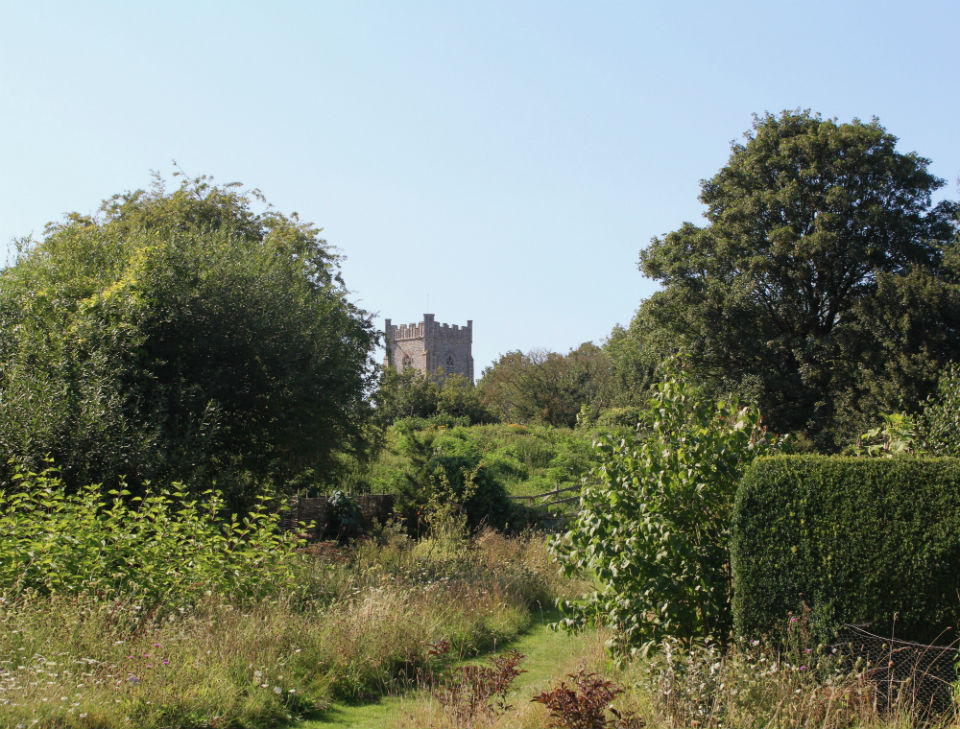
From here we can enjoy the tower of the fine church of St James the Great,
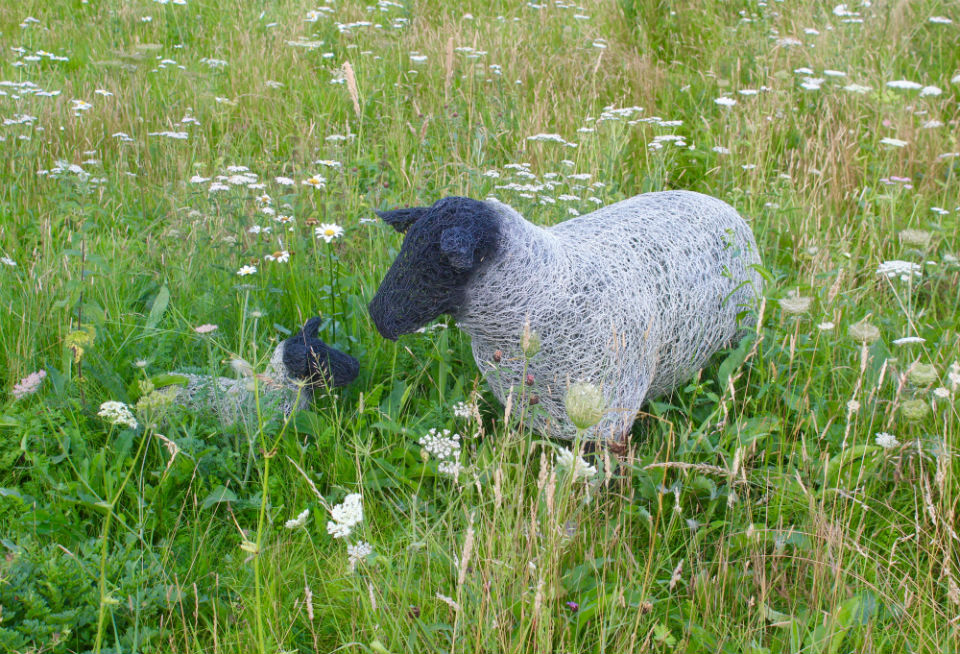
and can also watch the sheep safely graze amongst the wild carrot and oxeye daisies.
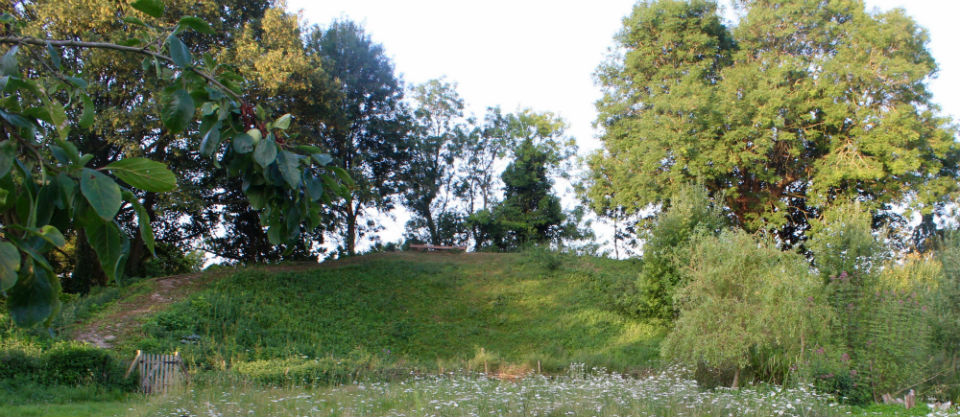
The ancient monument rises up behind the shepherd’s hut to the south west corner and many years ago we dragged a railway sleeper up there to use as a bench. From here you get a marvellous view:
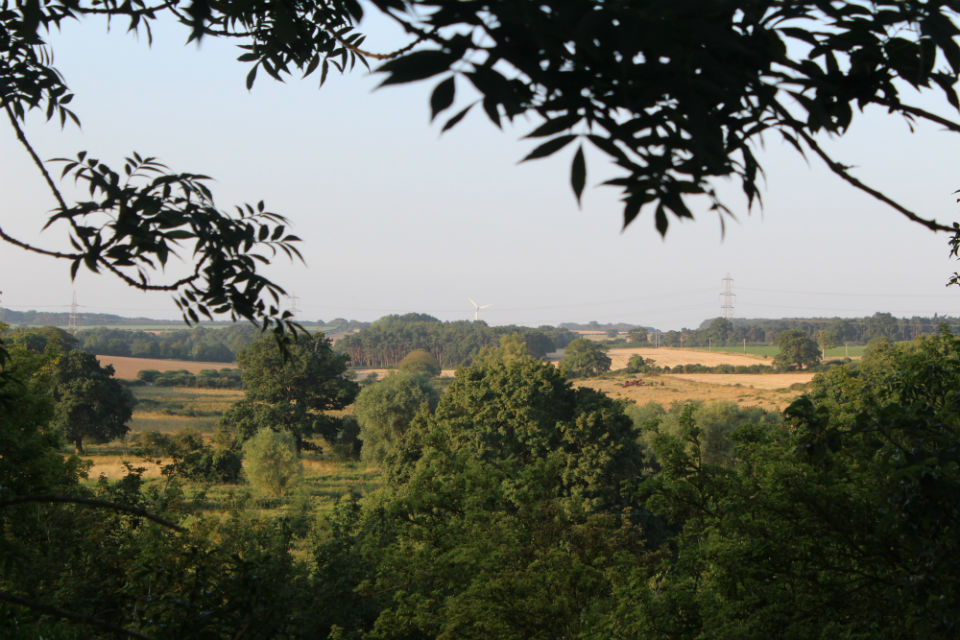
Due south towards Swaffham, and if you look carefully you can see the wind turbine,
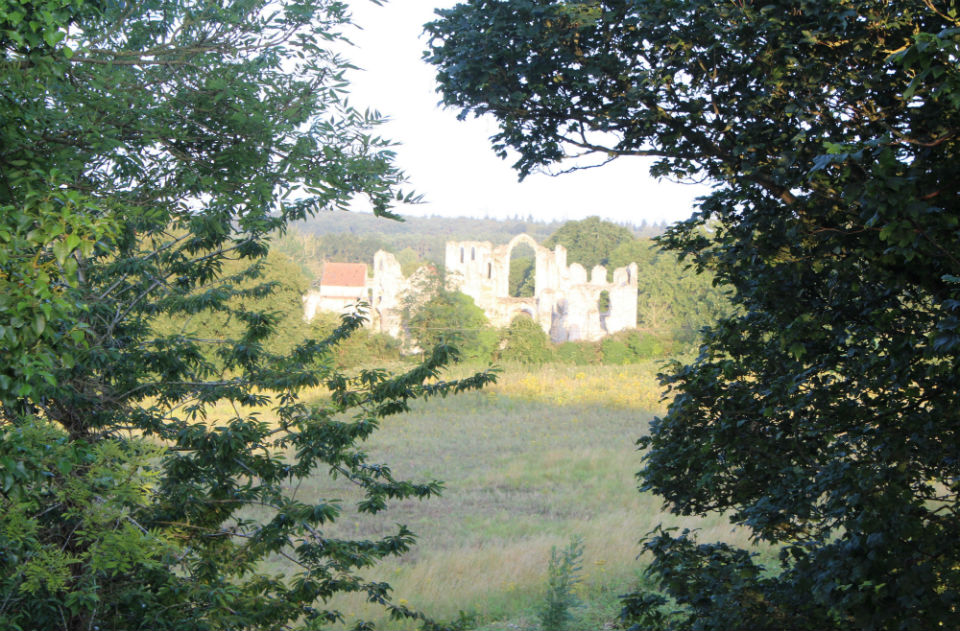
and to the west are the ruins of the priory.
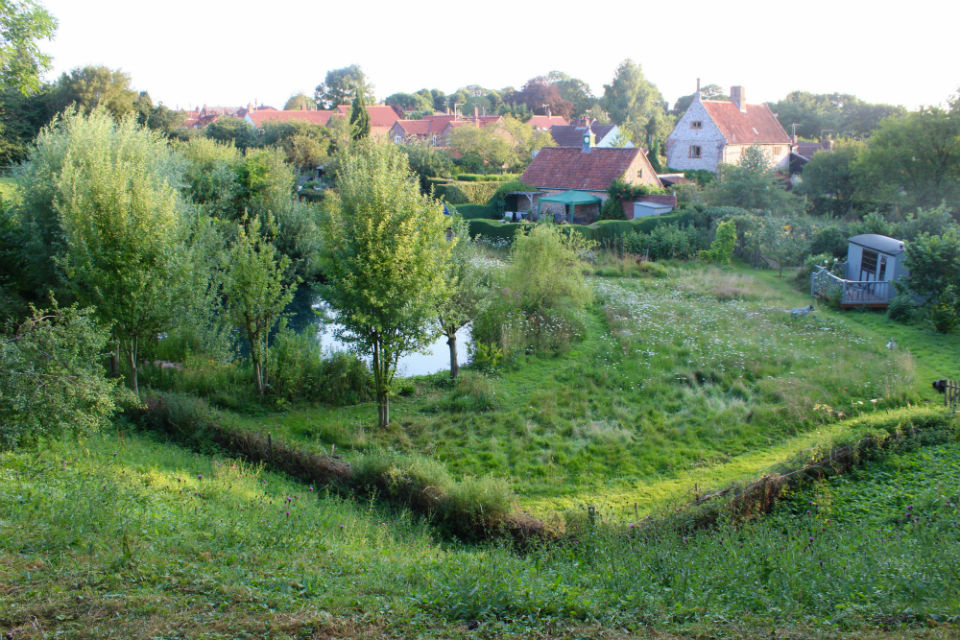
It is a great look out from up here not just for our visitors,
and looking across our property in the far distance beyond the house and hidden by trees are the ruins of the castle.
Having retraced the uneven way down you can then take the path around the pond. Wild it may be but this part of the garden takes a lot of looking after. One day it is our intention to make this wheelchair friendly.
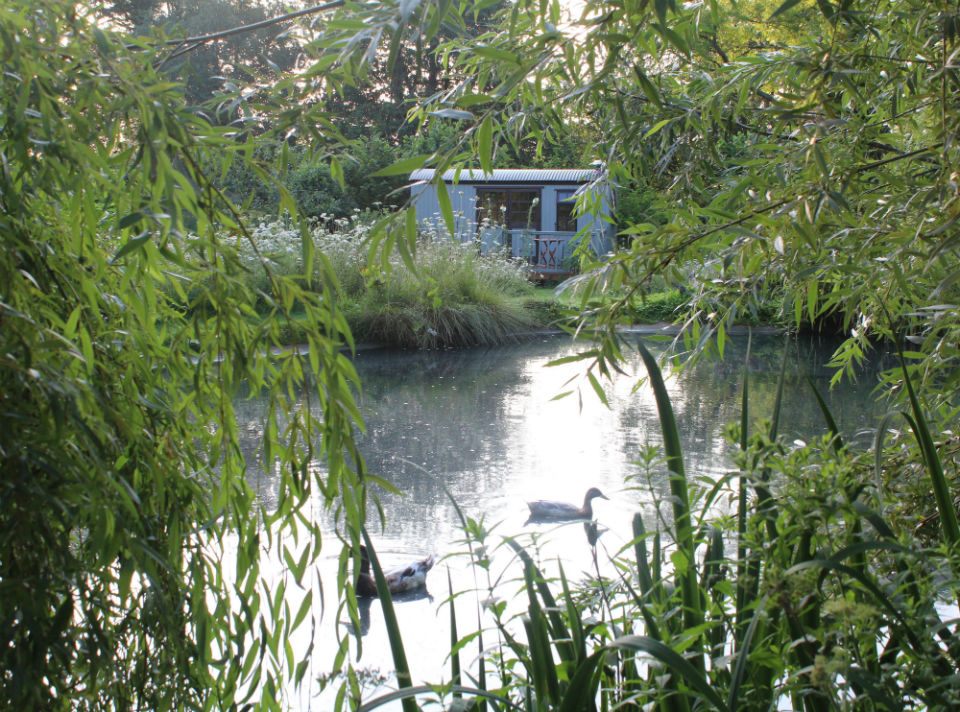
A peaceful place, with just the sound of the little stream behind, you can glimpse the drakes swimming on the pond, sadly their ladies were taken earlier this year by Mr Fox.
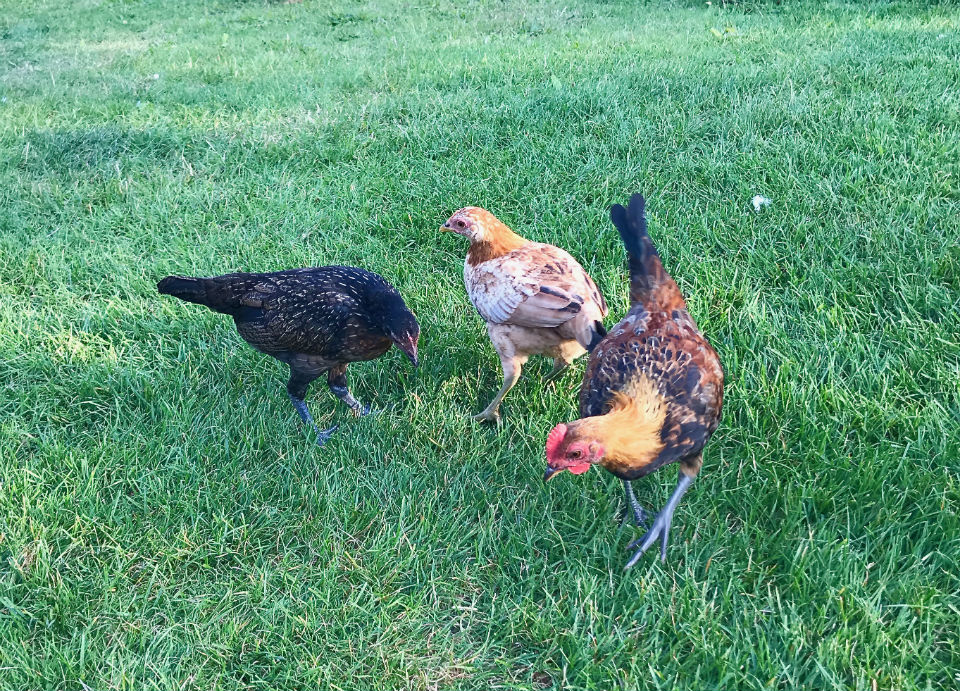
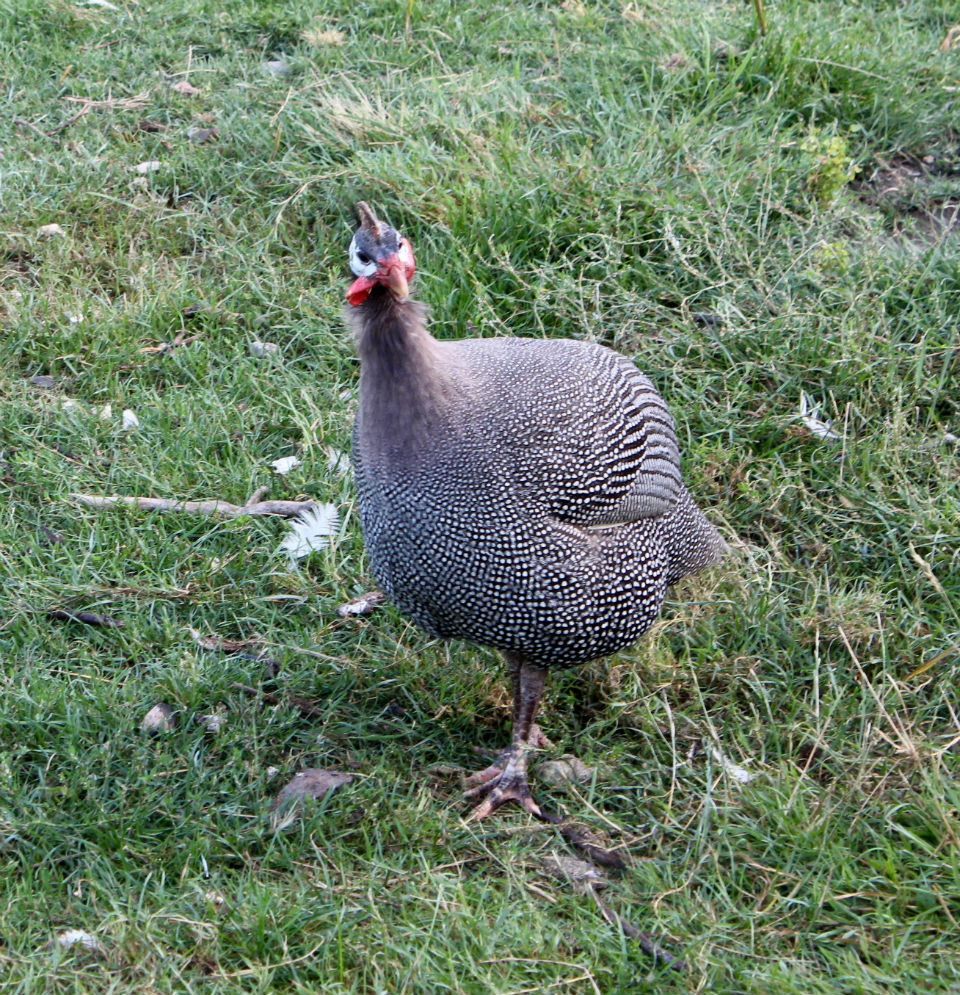
The chickens, bantams, guinea fowl and Richard the rhea are safe at the moment and roam the top field during the day and are locked up at night.
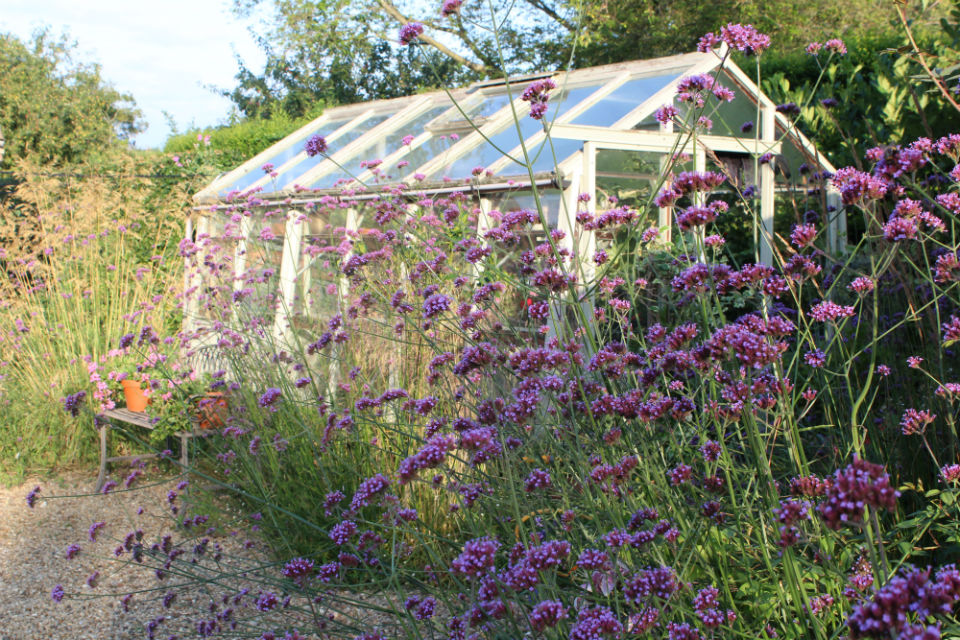
We used to keep horses but they have now given way to horticulture, and the potting shed and greenhouse now occupy the yard where the ponies were stabled. Verbena bonariensis happily seeds itself in a riot of colour as does the Stipa gigantea.
Agapanthus grown in pots find it warm enough to stay out all year round,
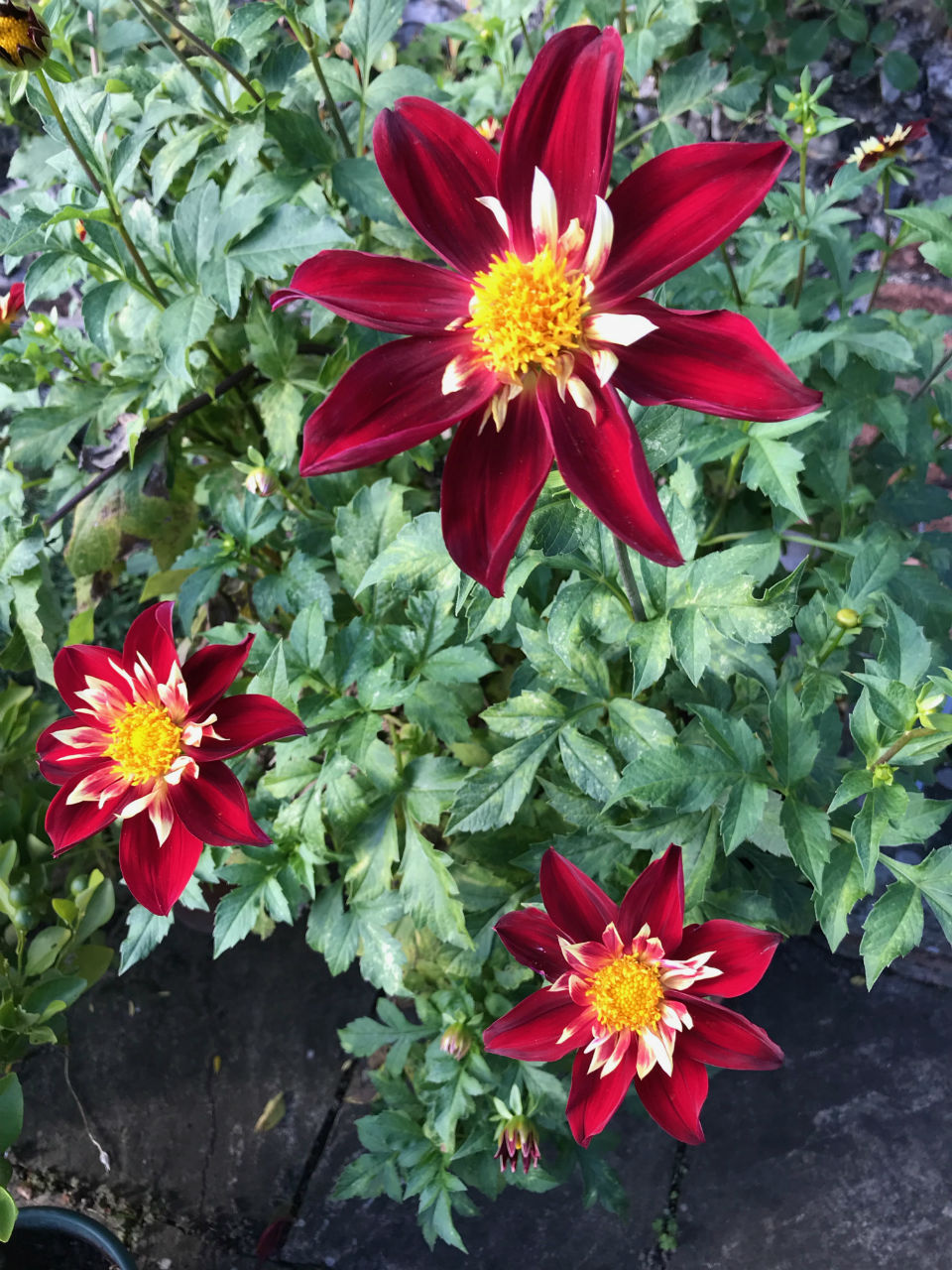
but we have to bring in the dahlias for the winter; it is surely worth the trouble
Pooh
Chimborazo
Jescot Julie
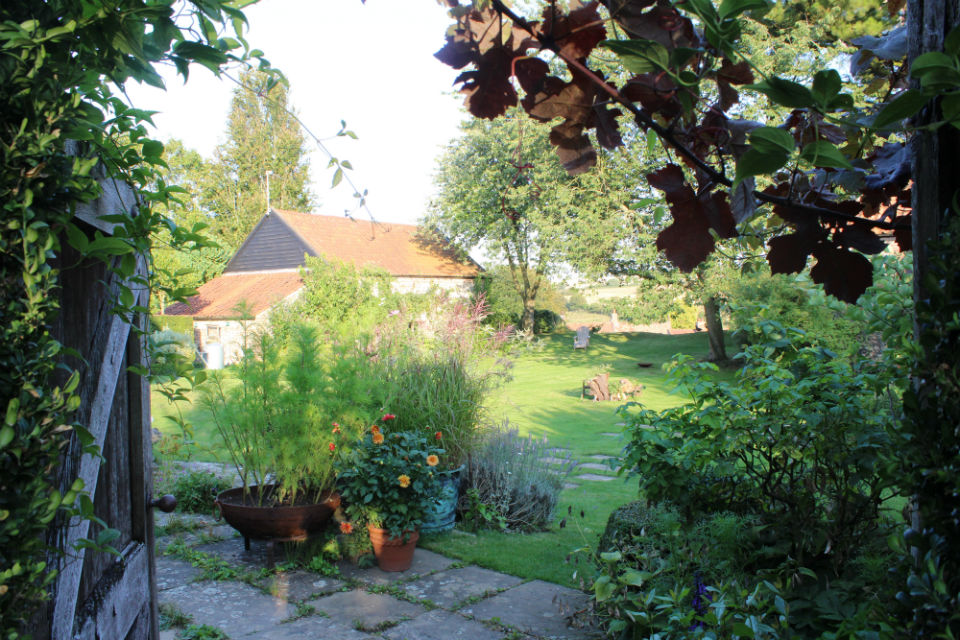
A few steps on brings us to the garden gate, this is in fact the main entrance for visitors walking in from the village, and here on open day you can buy the inexpensive but brilliant plants from the stall set up by West Acre Gardens http://www.westacregardens.co.uk/nursery.html
after making your purchases you can then head for the delicious teas in the Barn.
I am glad to report that approximately 520 visitors came on 11th August and the two gardens raised just under £5,000 for the National Garden Scheme. If you missed it this year we will be open again next August. In the meantime there are still plenty of other gardens to visit: https://ngs.org.uk/ Thank you George Plumptre for including us within your section of Gardens to Visit in the Daily Telegraph, and for the prompt to write this blog.
It is a glorious time of year for garden visiting, however I fear many of us this afternoon will be staying at home to watch the Wimbledon finals. So I am going to take you around Batteleys Cottage Garden which I very much enjoyed last Sunday when it was open for the National Garden Scheme.
Situated in the village of Wortham on the Norfolk/Suffolk border I parked on the sandy heathland and walked up the drive admiring first the charming little corner on the right,
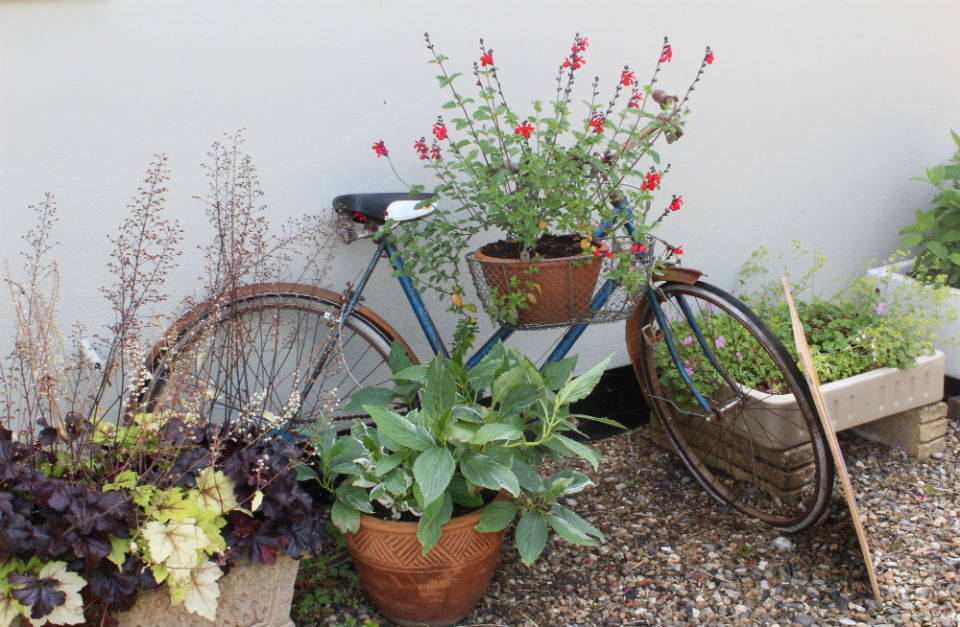
and then decorative bicycle propped against the wall on the left.
Like so many of the gardens open for the scheme, this is privately owned, created by the owners and has a delightful element of surprise when you enter. Stepping onto the lawn to the right of the cottage you are drawn in by this intriguing centrepiece.
The neatly mown lawn (no worn Wimbledon patches here), is surrounded by borders packed with plants; a perfect place to pause awhile and take in the beautiful surroundings.
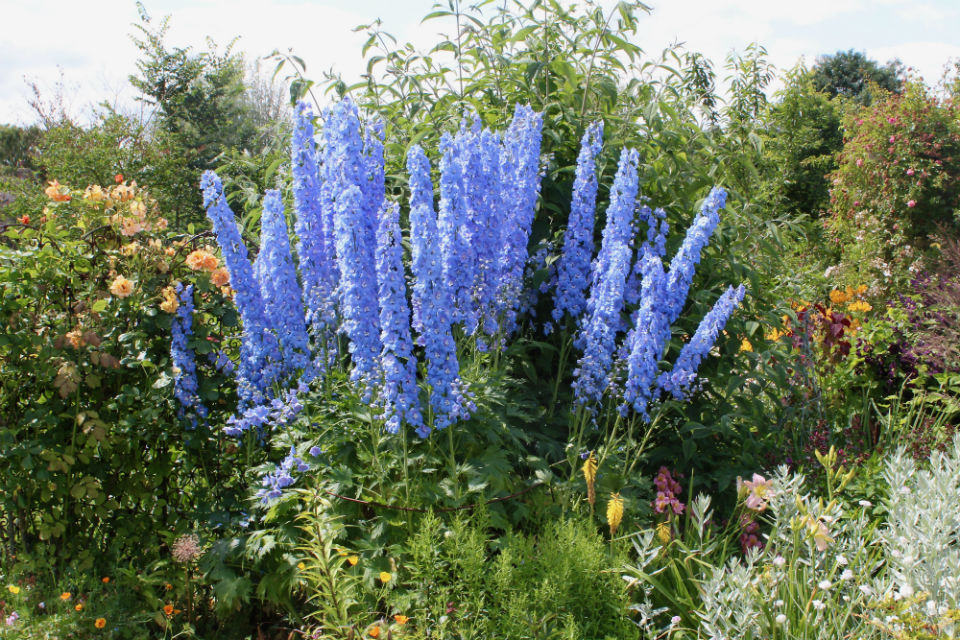
Across the way bursting out of the perennials, is an explosion of soft blue delphiniums.
It is not just the colour of these borders that is so attractive, but the texture, the rhythm and the movement. It is hard to believe that not that long ago the area was a mass of blackthorn and bramble and not a single herbaceous plant to be seen.
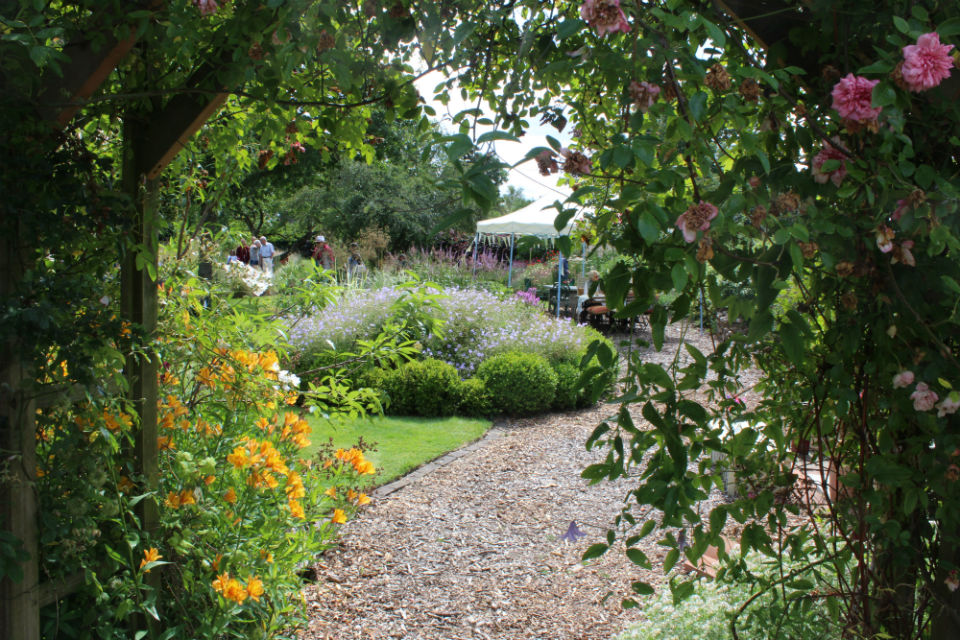
When Andy and Linda began to work on the garden some seven years ago they had to clear 30 huge Leylandii from the boundary. Now a gravel path winds around the perimeter allowing views across the neighbouring fields and letting in light onto the roses cascading around the arches.
The garden is seamlessly divided into different spaces; from the more formal area closer to the house,
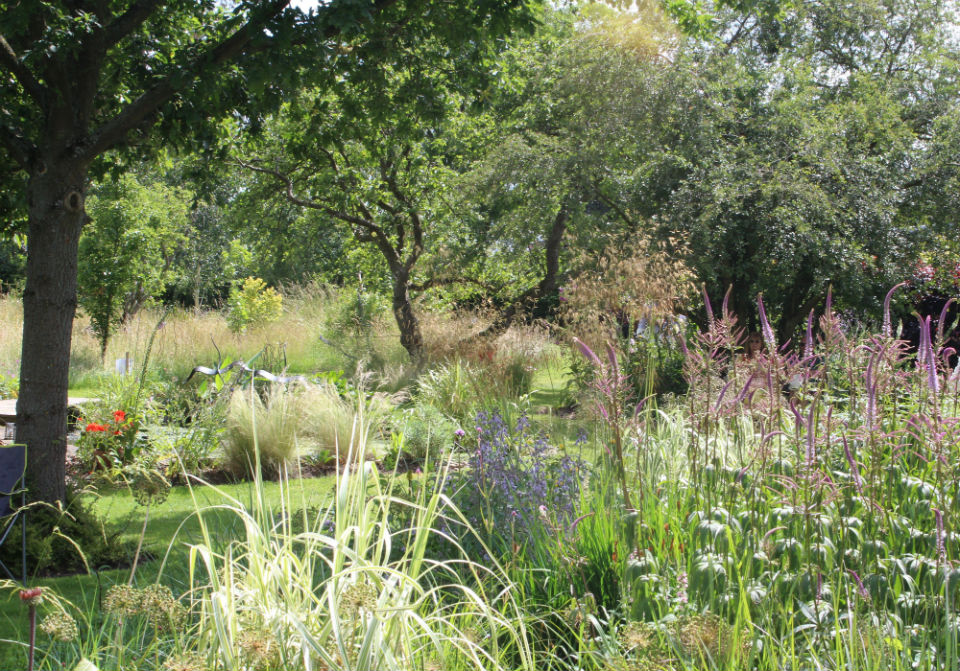
through to a wilder area further away, creating a different atmosphere and making the whole one acre garden feel much larger.
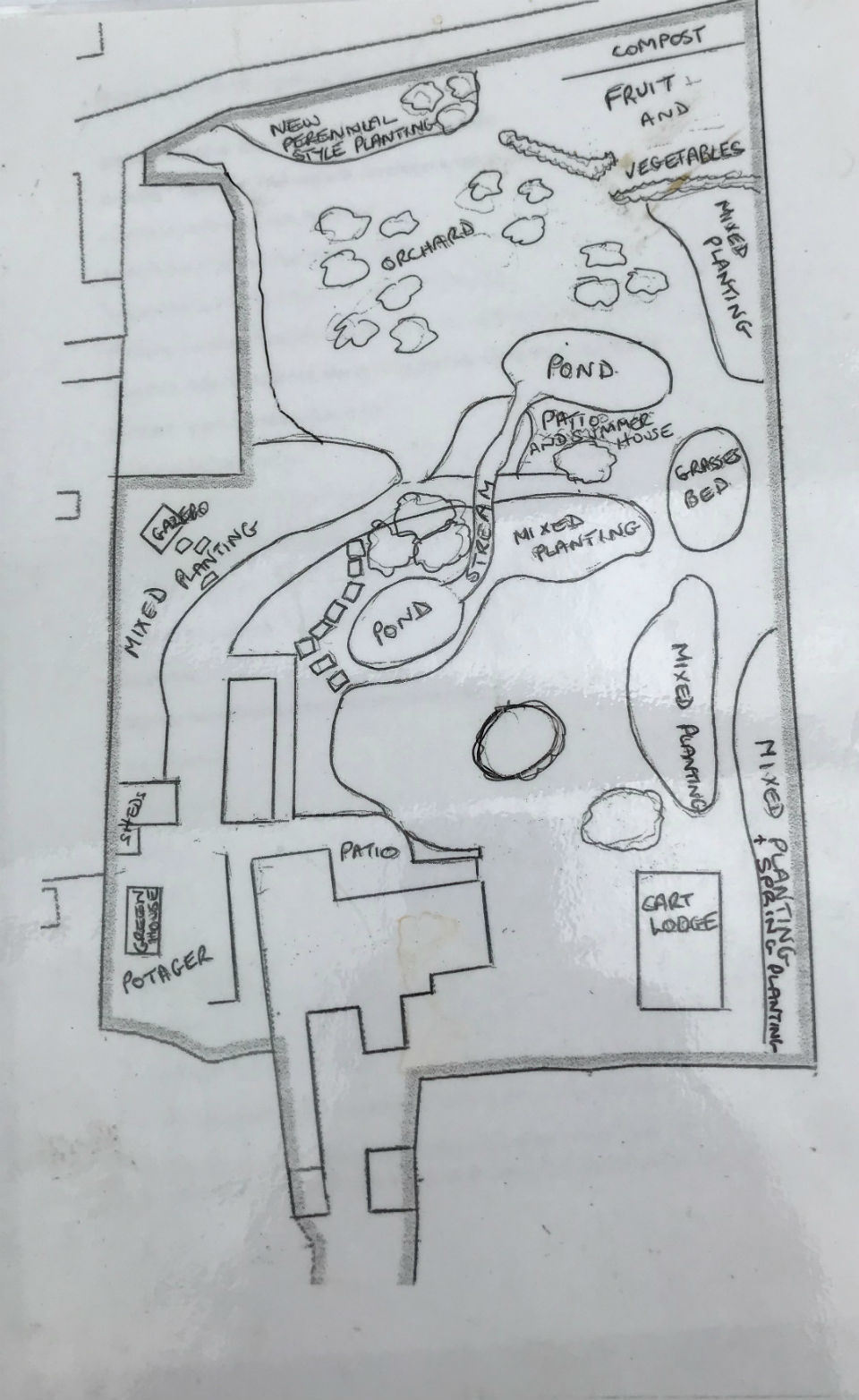
This simple map explains the outline but does not show the tremendous impact of the rich planting.
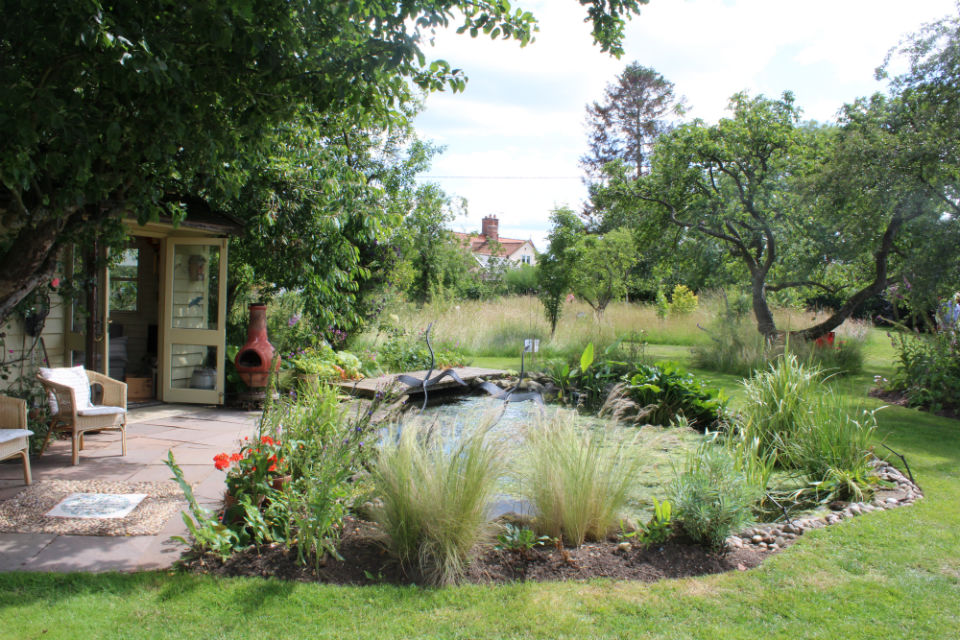
In the centre of the garden is the summer house looking out on to a delightful pond,
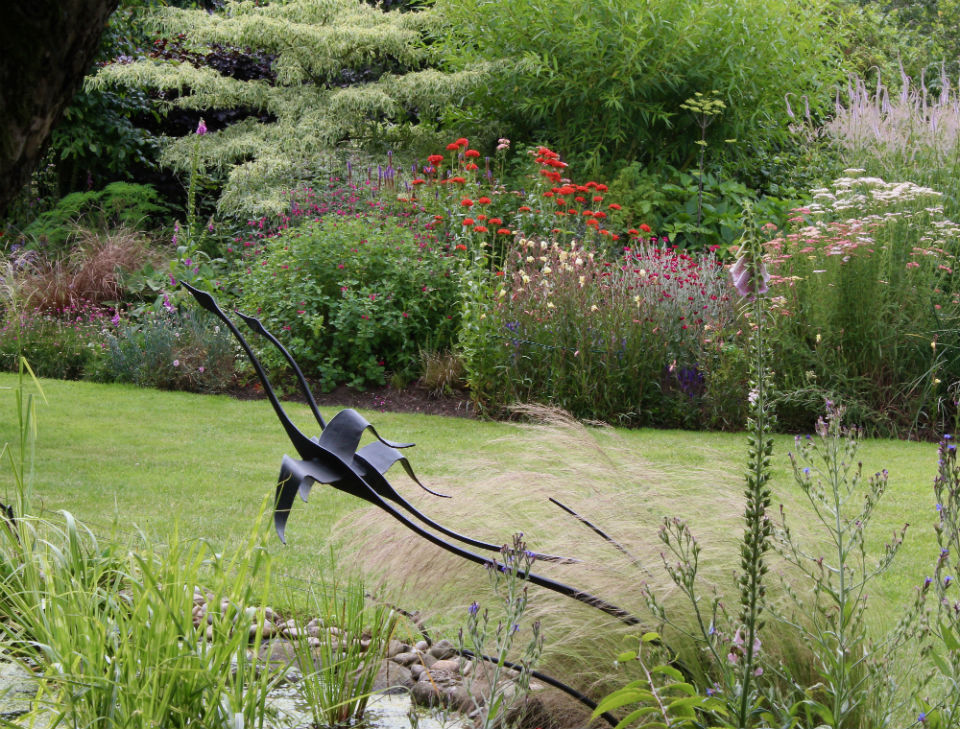
an area not only perfect for wildlife but also a place where winged sculptures gracefully fly.
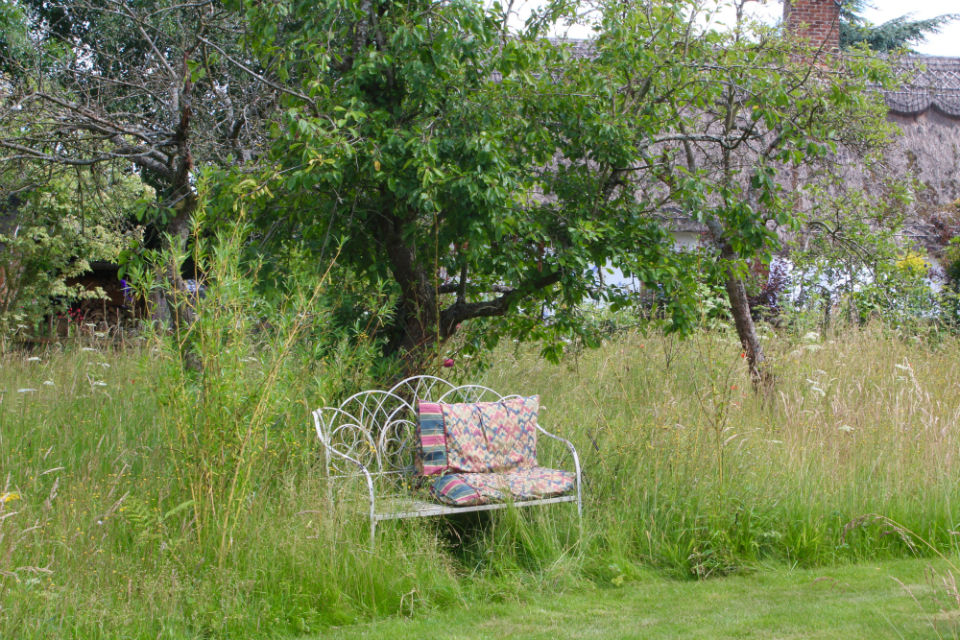
Andy and Linda have no help in the garden each working on average two full days a week. They do however find time to enjoy the results of their labour positioning the many seats around the garden to their best advantage. This elegant seat is set in the long grass in the orchard.
Clematis come into play in every part of the garden, either scrambling with roses against trees,
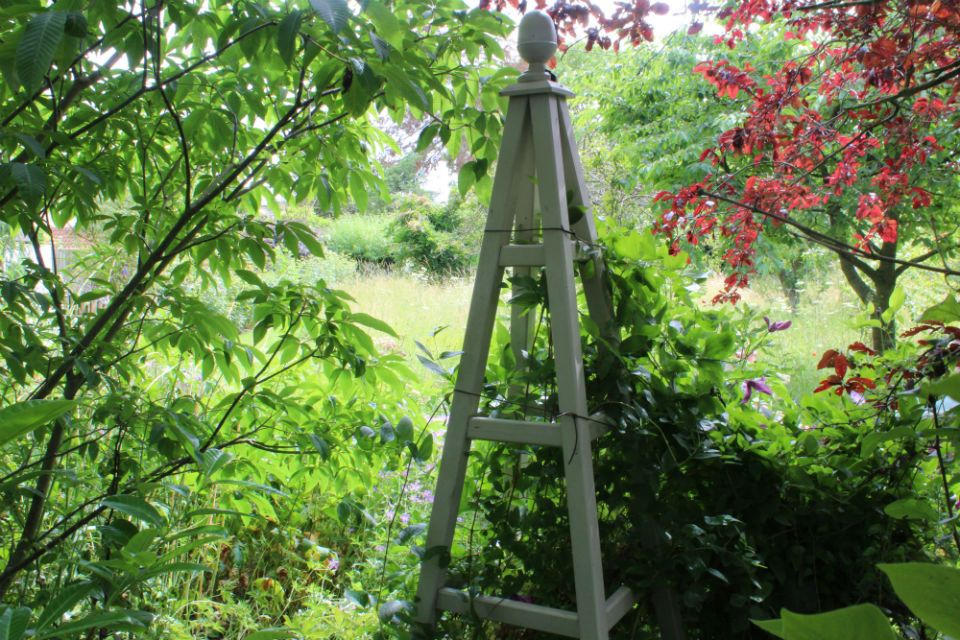
or climbing up well positioned obelisks,
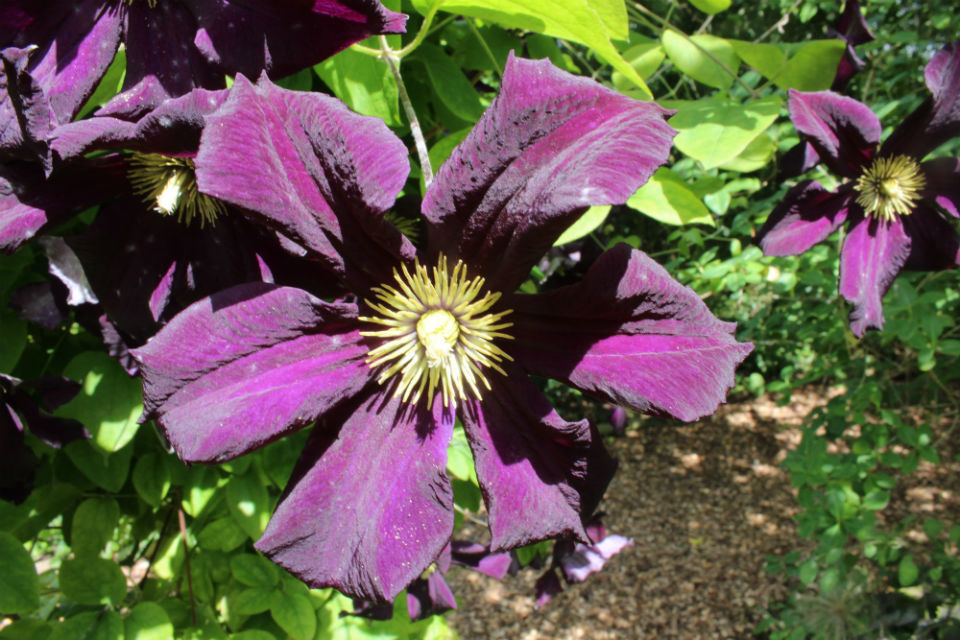
this is the handsome, velvety ‘Romantika’ who will flower through to the Autumn.
The mix of light and shade has a soothing quality,
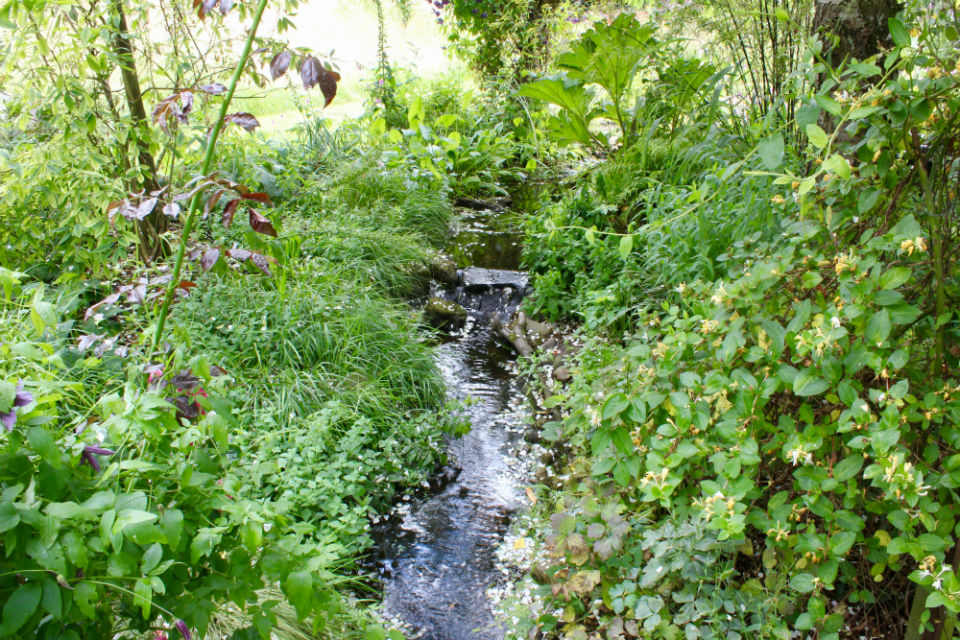
as does the gentle sound of the water flowing in the stream.
Around every corner there is something different,
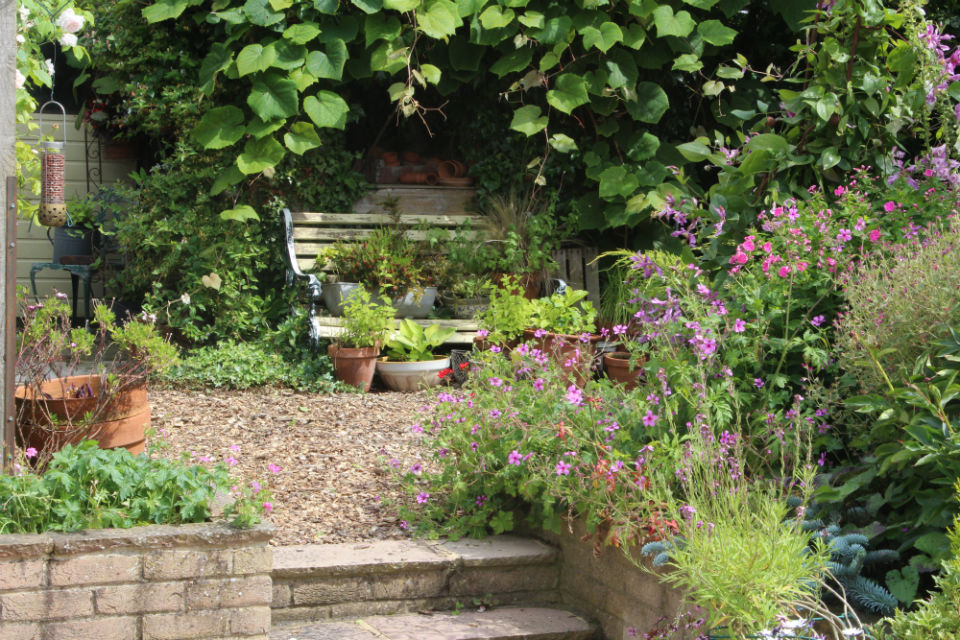
sunny, characterful and almost quirky.
There are two areas for vegetables and it is a delight to see this potager sited conveniently right outside the back door.
Linda has a family link with India and it was on a trip there that she was able to purchase this stone plinth.
Returning to the lawn in front of the house I find this bewitching couple emerging gently from the mixed planting.
Inevitably I succumb to the delicious tea and apricot cake, and it is from the colourful patio outside the sun room that I can really take in the splendour of this beautiful garden.
Thursday 13th June was an exceedingly wet day. This neither deterred nor detracted from a delightful day tour of three gardens in the village of Bedmond in Hertfordshire, owned by various members of the Stuart-Smith family and organised by James Bolton of Border Lines http://border-lines.co.uk/
We began the day at The Barn, Serge Hill, the home of the famous designer Tom Stuart-Smith and his wife Sue. Renowned for his landscape artistry with a fresh mix of naturalism, together with contemporary, I had for some time been interested in seeing his own private garden. In the pouring rain we first of all admired the courtyard garden in front of the Barn, richly planted, there was plenty of colour.
Tom’s landscape design practice has won eight gold medals at Chelsea with three winning ‘Best in Show’. Some of the materials here are recycled from the 2005 Daily Telegraph show garden; you may remember the rust coloured corten steel water tanks surrounded by the red coloured Astrantia major, euphorbias and other perennials.
The fresh new growth of Hakonechloa macra softens the steel and cascades in front of the tank and wall. You can perhaps appreciate how very wet it was from the surface of the water.
Taking cover under the tree I view the native meadow in the foreground. Sown some 25 years ago it is cut for hay in the late summer. Although the sound of the M25 can be heard in the distance, the countryside is green and gently rolling.
Before taking one of the mown paths through the long grass I explore the west side of the Barn where the patio is a delightful area with table and chairs,
and leads onto a verdant lawn with floriferous borders either side. It is hard to imagine that twenty years ago this richly planted area was once an empty wheat field.
Looking back you can see that it is in fact a series of enclosed spaces divided by hedges. These spaces are either packed with plants,
or simply empty, compelling you to walk on through to the path beyond.
Following the path there is mature woodland on one side and meadow on the other. Today I can only imagine that the swimming pond must be enticing on a hot summer’s day.
Turning back towards the Barn and walking across the meadow there is a slight touch of ‘Out of Africa’, well, perhaps if the sun was shining.
The exotic meadow created in 2011 is not yet in flower; the exquisite pink flower heads of Dianthus cruentas are just a taster of what is to come.
I do find a splash of colour by following the mown path away through to the left where a little wooden gate opens up to a display of white iris, foxglove and cornus.
There is sadly no time to linger in the greenhouse, so, a little wet from our ramblings we leave the Barn to walk over the road to Serge Hill.
This is the family home where two generations of Stuart-Smiths have gardened. Roses adorn the pillars of the elegant Edwardian veranda. Tom’s sister is now in charge and explains that she is assisted by a team of Wwoofers; for those not familiar with these guys I suggest you take a look at the website https://wwoof.org.uk/. Kate provides a potted history of the garden and explains how her mother was an avid gardener.
Through the relentless rain we turn our backs on the white Regency house and look out over lawn and parkland beyond.
I follow the meandering gravel path alongside the border brightly billowing with June colour,
and enter the walled garden through the gate curiously positioned at the far corner.
Here too is sumptuous planting; climbers cover the walls, roses and clematis vigorously clamber over arches. Hardly an inch of ground is bare, covered with an enviable assortment of perennials.
Even the paths are sometimes difficult to detect.
This half-acre walled garden is fully working with an abundance of first class vegetables.
It is a relief to shelter in the greenhouse for a while, a hive of industry and fully operational with old fashioned handles still in use.
There is a splendid display of ‘down tools’. I imagined the Wwoofers must be at lunch,
and that is exactly where we head off to, mounting the steps through the climbing rose and crossing the courtyard to the backdoor where we are pleased to shed some of our wet clothes.
Lunch, delicious and most welcome is served in the dining room where it transpires the Wwoofers have left off work to serve us.
After lunch we drive the short distance taking the foxglove-lined track to Pie Corner, the home of Tom and Kate’s brother Jeremy and Bella Stuart-Smith. Bella is also a garden designer and plantswoman and has created the house and garden.
We park in the field below this interesting recently-built house.
Gathering near the tulip tree liriodendron tulipifera we hear about its creation from Bella.
Around the corner the deer appears to be galloping towards us,
viewed from the house she appears to be just passing through.
The swimming pool is situated so close to the house and, hidden from the windows by the clipped box and santolina is very much part of the garden.
Moving round to the side of the house it is a wonderful vista from the terrace through the valley.
On the other side of the house from the swimming pool side stands another pool, not for swimming it dominates the dry garden planted with a mix of herbs and summer flowering perennials. An archway in the hedge invites us through to a less formal area
where we find the pretty vegetable garden.
Another gate leads out into woodland.
This wooded area which rises up behind the house has recently been cleared and replanted, the foxgloves have sprung to life. I follow the paths and
return to this light, contemporary and comfortable house where we enjoy tea and a glorious piece of coffee cake.
These three gardens are open for the National Garden Scheme; The Barn and Serge Hill which open together have already opened this year so make a note not to miss them next year when hopefully the rain will have stopped. Pie Corner is open “By Arrangement” through July, August and September. Visit the website https://www.ngs.org.uk/find-a-garden/
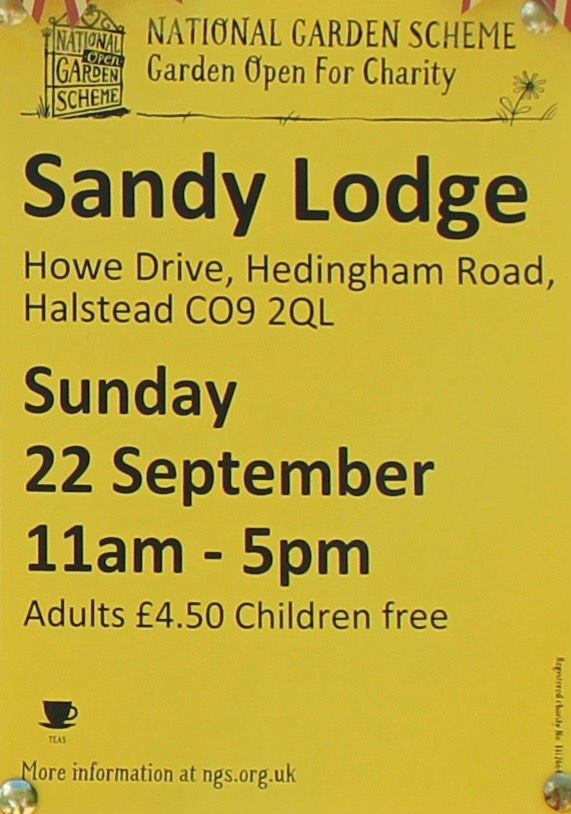
Last Sunday the sun came out, the sky was blue, and it was a perfect day for the Halstead Marathon in Essex. No, no don’t be silly I wasn’t the runner, that was my daughter. I would rather visit a garden any day so I waved her off at the start and nipped off to nearby Sandy Lodge, opening for its second year for the National Garden Scheme.
With a little time to kill before it was to be open, I walked around the delightfully well kept cemetery situated opposite the Marathon start. Calming soft summer greens and birdsong, a haven of peace after the giddying gathering of over 400 runners, lycra, gels and a plethora of multi-coloured trainers.
The garden was just a short distance away up the hill on the North side of Halstead. I had arranged to meet a friend and what better place to catch up before she moves to her new garden in Devon.
As always with people who so kindly want to share their much-loved garden there was a warm welcome at the entrance.
The house was built during the 1960s with large replacement windows added in recent years. You are drawn in through the open gates and the driveway is softened by the pretty combination of mainly tulips and irises interplanted with Stipa tenuissima,
and there is a touch of the Beth Chatto influence here as the planting seamlessly spills out from the raised border on the left.
Looking back from the house the low hedge of Pittisporum tenuifolium echoes the sweep of the drive, snaking round from the pale stone face, asleep in the morning sunlight.
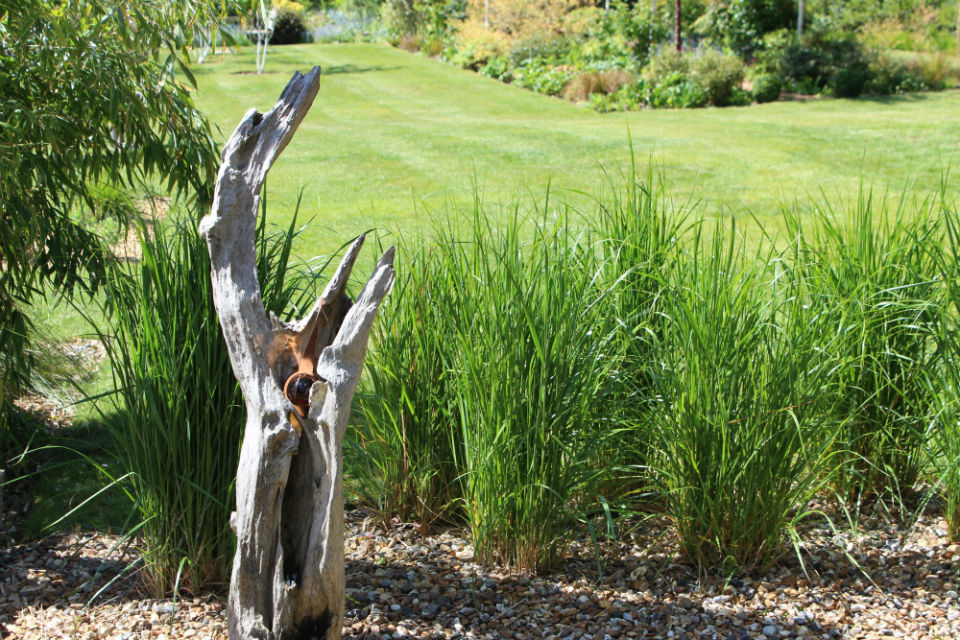
The gravel spreads underneath a cherry tree where the solid wooden benches have been arranged amongst the driftwood pieces,
which adds a sculptural element, with the Feather Reed grass providing a strong vertical accent and creating a division between the gravel and lawn. This ornamental grass, Calamagrostisx acutiflora ‘Karl Foerster’ is an early perennial, already grown to a good height, a lush green now but will turn golden in the summer, and bringing a suggestion of movement to an otherwise static area.
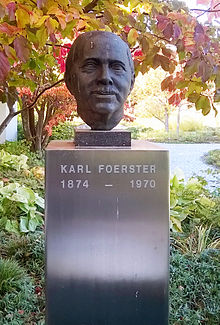
So who exactly was Karl Foerster? Born in 1874 in Germany his life was caught up in the turmoil of 20th Century Europe, and defying the Nazi regime he employed Jews to help in his nursery near Berlin which he had set up in 1903. After the war, the nursery was nationalised as it was located in East Germany, but Foerster remained there for a number of years. We have him to thank for this Calamagrostis which he found in the Hamburg Botanical garden listing it in his catalogue of 1939 and describing it a decade later in his garden book, The Use of Grasses and Ferns in the Garden.
There are several varieties of ornamental grass at Sandy Lodge. The house has substantial decking on two sides and from here you can survey the 3/4 acre garden created over the past 5 years. A high standard of horticulture is maintained, neatly mown lawns, razor sharp edges and not a weed in sight.
The double borders in front of the decking were created just last year. Inspired by the great Dutch nursery man and designer Piet Oudolf, they are planted in the prairie style and in addition have a generous covering of stone, more for aesthetics rather than as a mulch.
We head out across the lawn to the ‘Winter Wedding Border’ so called because when the garden owners Emma and Rick married in December of 2014 they asked for Garden Voucher wedding presents. A fun idea and now they have a living memory of their special day.
My friend and I haven’t seen each other for awhile; we usually meet in a cafe but what better way than in a garden in the presence of nature where the background music is bird song. We had to stop our flow of chat for a moment to admire the all-essential compost bins; sturdy and neat they endorse the gardening skill practised in this garden.
We wander along the woodland path which runs across the bottom of the garden, late spring flowering shrubs at their best; broom, lilac and varieties of pittisporum.
We emerge through a small group of silver birch, their leaves flitting in the sunlight. The grass around the trunks has been left to grow and with some blue camassia growing through it gives contrast to the expanse of newly cut lawn.
Those mown stripes with that runway feel draws us up to top of the garden passing the house on the sunny left hand side. Bushes of bright photinia hide the barbecue standing in place of a once derelict greenhouse.
When Emma and Rick came here over seven years ago this corner was overgrown with brambles and that delightful sense of shabby chic remains, a nod to how the garden once was.
But this is not the only reason we have walked up to this point, it is near the kitchen where refreshments are served. The cakes are sublime, home-made with generous portions,
and we find comfortable chairs on the decking, so inviting with freshly picked flowers,
and finding a spot of shade from the bamboo rustling in the breeze,
we admire the view over Halstead, the factory chimney and the the church tower,
and are drawn back to thinking of the marathon runners.
If you missed it there is another opening in September but if it is the marathon you are after you will have to wait another year. I know which I would choose…….
Last weekend we were staying in Lyme Regis and by way of using the National Garden Scheme App, I discovered that Frankham Farm some 18 miles away was open on the Sunday.
We drove through the delightful Dorset lanes, narrow with neatly trimmed bare brown hedges and banked with primroses.
Situated in the extraordinary sounding village of Ryme Intrinseca, south of Yeovil, Frankham Farm is a well established working farm and we were directed through the farm buildings situated north of the house to park in front of the cattle yard.
It had amused us that the garden description contained the encouraging words ‘New toilets in 2019′, so having had a lengthy drive through the little lanes of Dorset what a joy it was to find them. Heated too. I felt they deserve recording.
This three-and-a-half acre garden was created in 1959 by Mrs Jo Earle mother of the present occupant. I imagined this magnificent magnolia against the house might have been one of her first plantings.
She loved the Spring but March is that time of year when the weather is so unpredictable and whilst the wintry snowdrops were just going over,
the clumps of delicate daffodils were giving a nod to spring in the morning sunshine.
Defying the chilly wind of “Storm Gareth” and unusually in flower for this time of year, it was a surprise to find Cerinthe major a hardy annual blooming amongst the paving in front of the house.
The Earles planted shelter belts on the east and west sides of the garden, and a low wall surrounds the lawn and its borders to the south. It is obvious that the soil is improved by the occupants of the farmyard. I expect in those early days when the garden was first developed there was labour at hand. Now the mature garden waits for its spring tidy up, and areas like this will come into their own during the summer months.
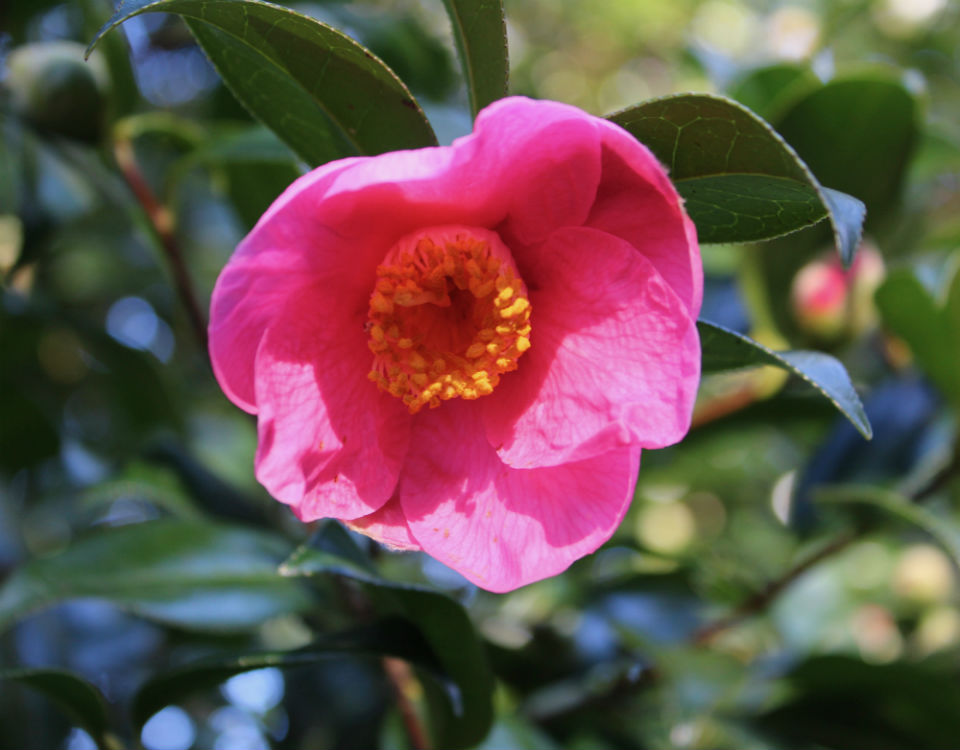
Not far from this bench (and this photo does not do it justice), is a handsome camellia; the flower a deepest of red and the leaf the darkest of glossy green.
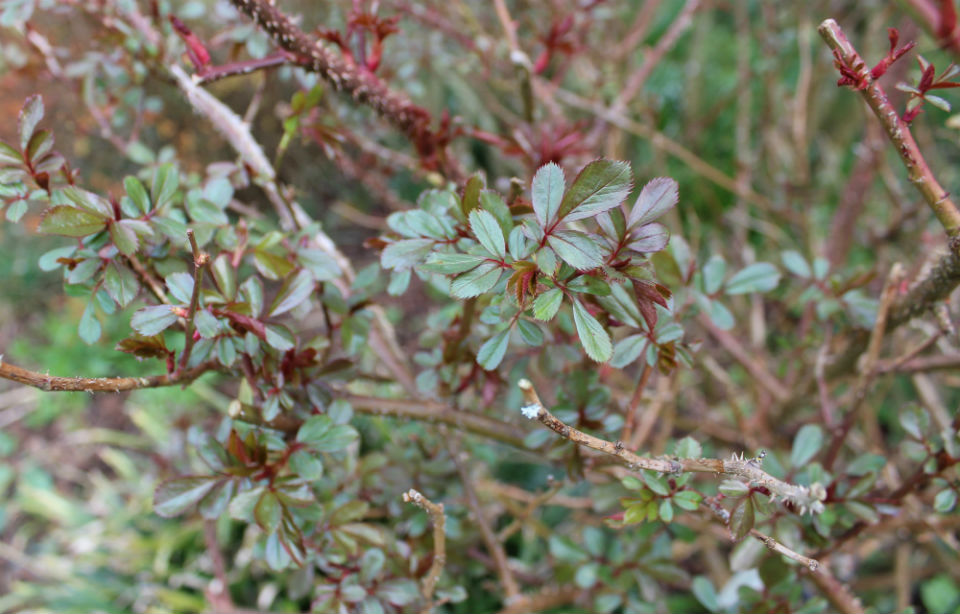
This rose is keen to get going, pushing out its red shoots and dainty leaves.
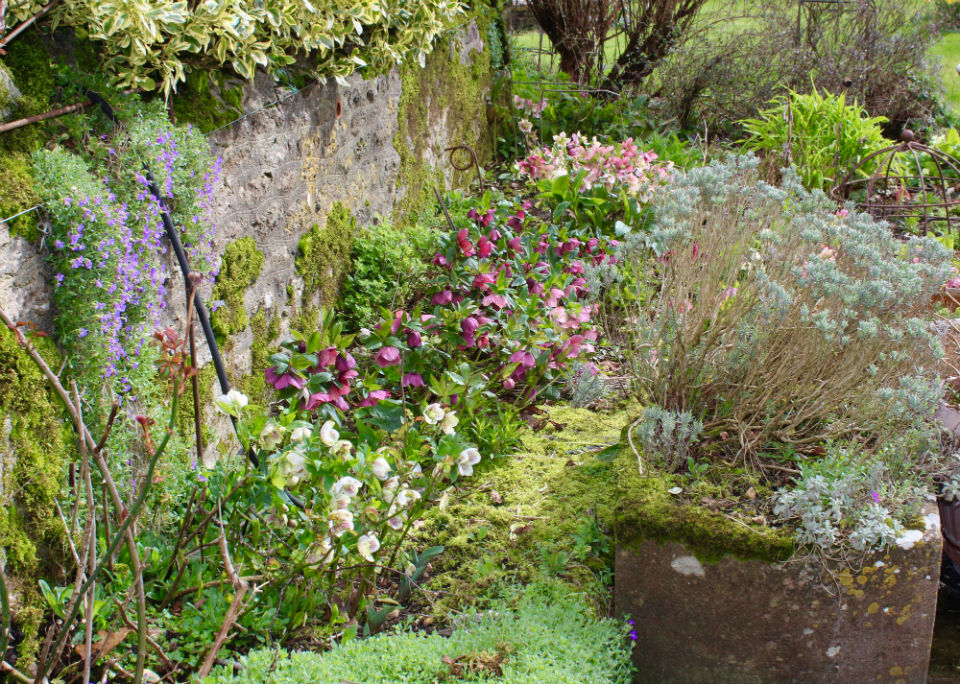
Aubretia tumbles down from the walls under which happy hellebores flower.
It is an intense blue from this Pulmonaria officinalis. In times past, doctors believed that plants that resembled any body part could be used to treat illnesses of that part. The leaves of Pulmonaria officinalis commonly known as lungwort held to be representative of diseased lungs so this plant was used to treat coughs and diseases of the chest.
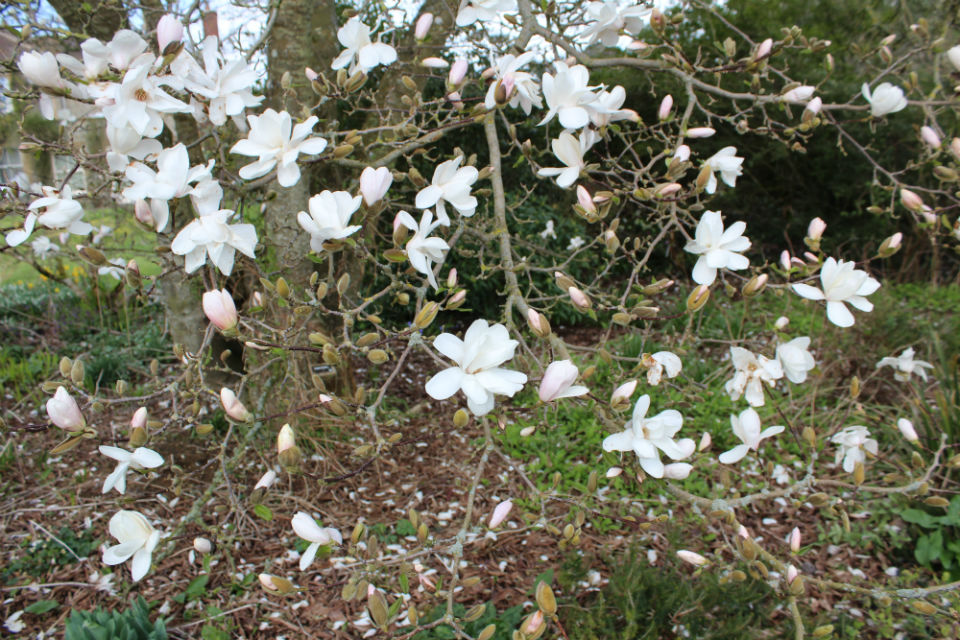
A splash of white and a strong fragrance comes from the Magnolia x loebneri ‘Merrill’,
and round the corner the winter-flowering honeysuckle Lonicera fragrantissima clambering along the wall, smells delicious too.
In the vegetable garden brick paths lead around a fine Bramley apple. The area is not only busy and productive
but also decorative too, with paths edged by a variety of low shrubs and arches adorned with a selection of old climbers.
There is even a small rockery arranged like a back-bone of some creature – the perfect place for small alpines.
The terracotta rhubarb forcers at their jaunty angle seem to be enjoying their role.
Rising up behind the vegetable garden adjoining the shelter belts is a particularly spectacular specimen of Photinia x fraseri.
Plant combinations can be enlightening and this healthy skimmia looks so good with a fern. There is no doubt that plants benefit from the enriched soil.
It is a very informal area, wild may be a better description, I worry that the Ivy may take control however the path leads you through Camellias of every colour.
I can’t grow them on my alkaline soil so I take a little time to admire them.
It is an enviable list of trees planted within the shelter belt, their names helpfully identified on a map. Many of the trees were grown from seed and it is easy to forget that in the early sixties there existed few of the garden centres and nurseries open to us now.
On this windy day the canopy sways above us but the intriguing cork oak Quercus suber stands solid.
Mrs Earle’ s final project was a booklet about the garden; it would be interesting to know the story behind this gentleman, alone amongst the trees.
This morning plenty of fir cones lie on the ground but none are as large as this carved wooden sculpture sited at the end of the belt.
We decide to take a break for a bite. Served above the stables it is a relief to get out of the wind. The church ladies are charming, and serve us soup and pulled pork, a skill they have been exercising for many a year. A gentle touch that each table has an arrangement of flowers picked from the garden,
and proudly displayed on the wall is a faded photo of Mr and Mrs Earle and the trowel presented to them back in 2003 by the National Garden Scheme for long service.
We resume our tour through a rustic arch entering the old paddock,
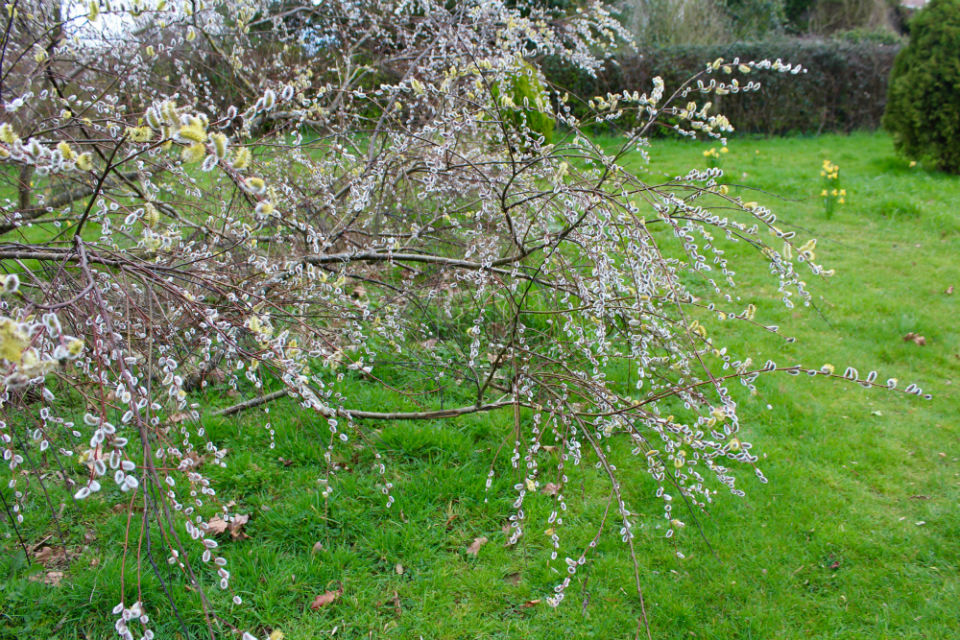
where more-recently planted trees have been sited, perhaps taken over from ponies that once grazed this grassland. The tangle of willow with its silvery catkins is surely the harbinger of spring and this garden opening signifies the visiting season is just beginning. Download that App, get out into a garden, and remember that while it is good for you, you are also raising funds for the health and nursing charities that the National Garden Scheme supports.
You always come away from a garden with something; an idea, a plant or even on this occasion the purchase of a very nice table and chairs, now relocated to my garden.
Inspired by the eloquent voice of George Plumptre CEO of the National Garden Scheme announcing the start of the Snowdrop Festival I decided to visit East Ruston Old Vicarage Garden http://www.e-ruston-oldvicaragegardens.co.uk who were hosting their own Snowdrop Specialist Growers Day.
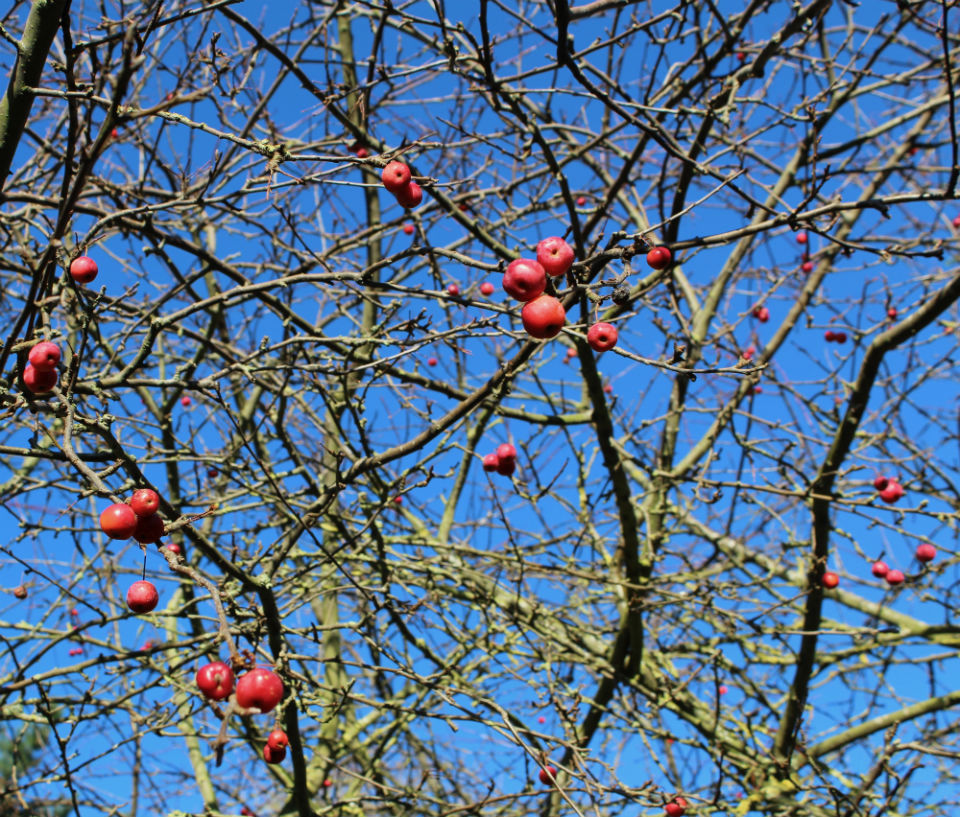
The owners Graham and Alan warmly welcomed us in the car park directing us to park under the crab apple trees which despite the cold, were still looking so good against today’s blue sky.
The entry fee was modest and it was good to see the knowledgeable Ian handing out the newly printed NGS Norfolk “Gardens open for charity” booklet. Nearby a Chusan palm trachycarpus fortunei, bathed in morning sunlight seemed to wave us on,
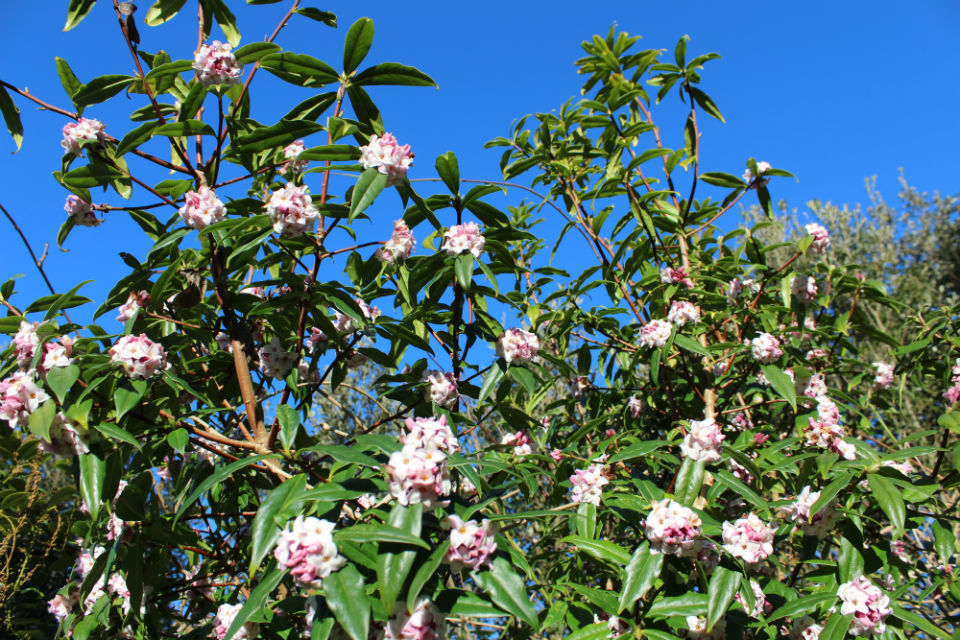
and around the corner the air was filled with the delicious scent of Daphne Bhoula ‘Jacqueline Postill’.
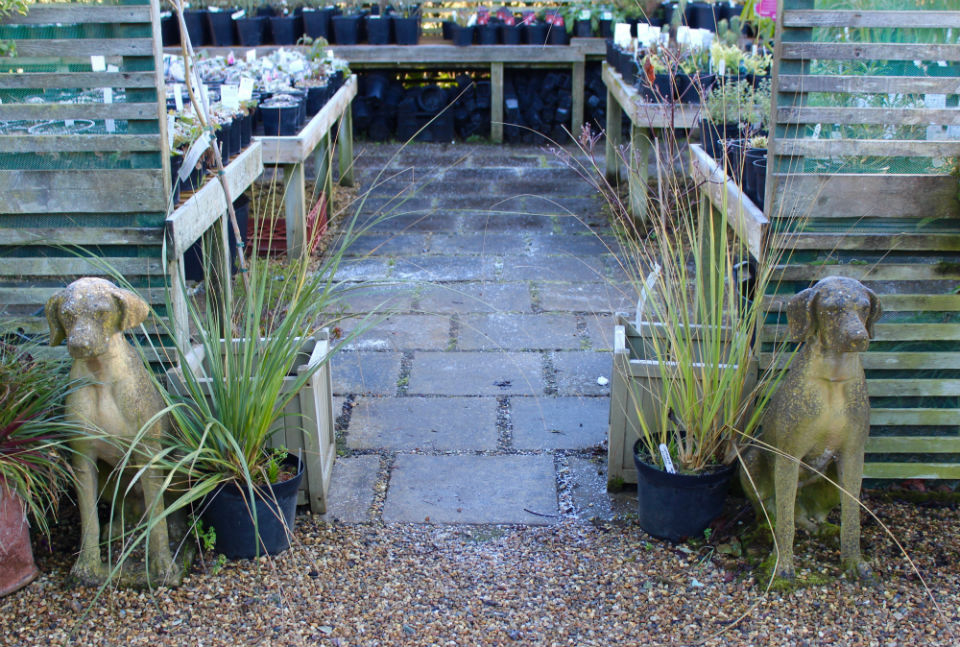
East Ruston has its own nursery, guarded by friendly dogs,
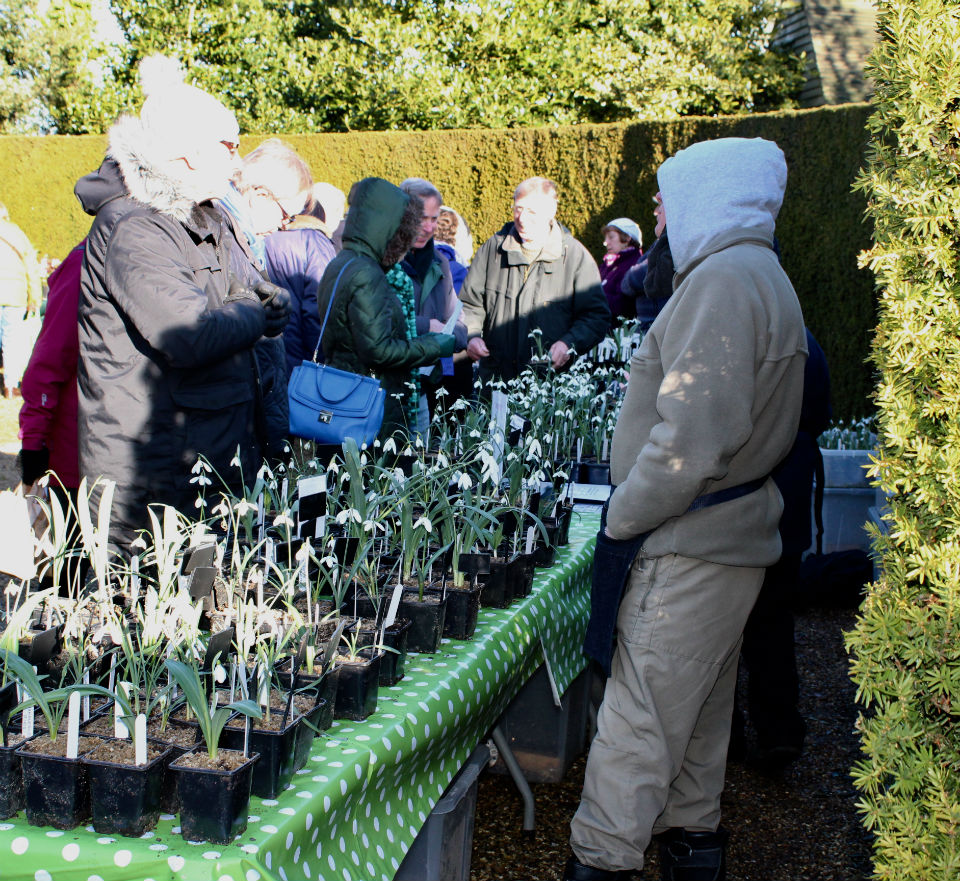
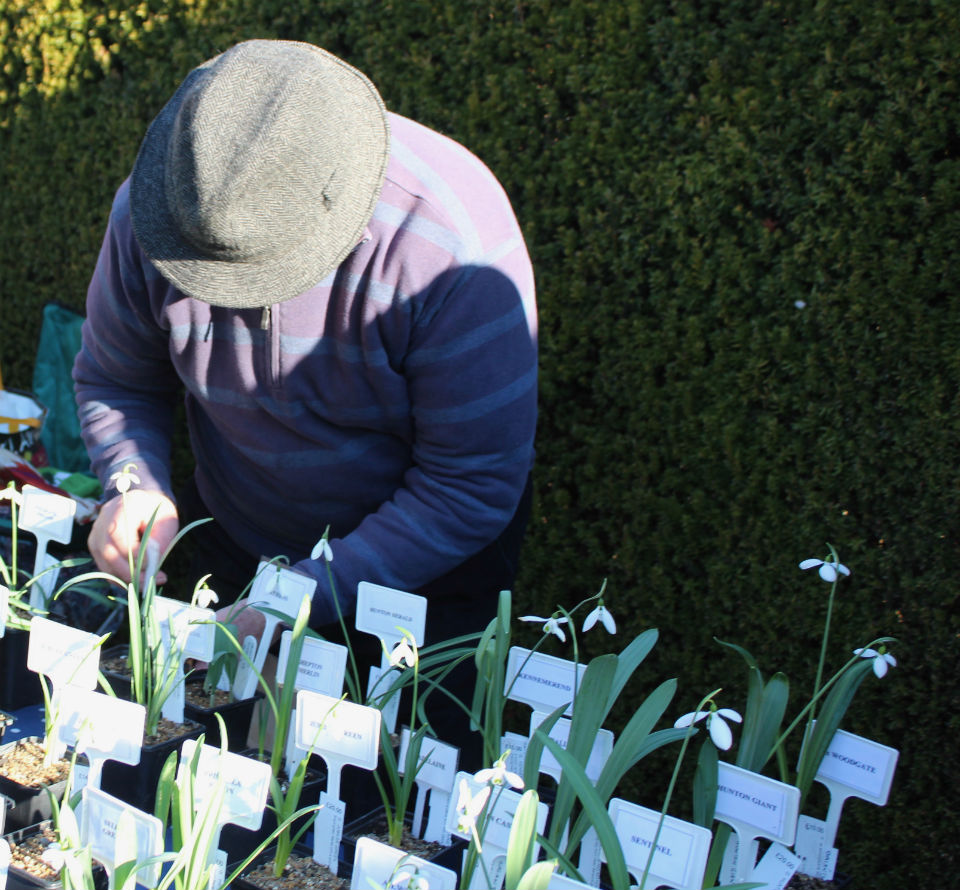
but it is for the snowdrops that we have really come, not carpeted on the ground but displayed in neat rows on tables by the keen and knowledgeable nursery people who breed them.
Known as ‘Galanthophiles’, it seems such a chunky word for these delightful collectors of such a tiny flowers. With so very many varieties how do you choose?
I am still very much in the learning stage, but with what might seem rather oversized labels it is easy to read their charming names. I am looking for Galanthus plicatus ‘Three ships’, an early flowering snowdrop often out before Christmas and discovered in a garden in Suffolk; I discover it is not on display so order if from Joe Sharman from Monksilver Nursery.
I spy a tray on the ground; characters in the waiting so to speak, and looking just how they do peeping through the snow.
Under this hat is John. It was in his garden a couple of years ago that I began to have my first stirrings of galanthomania and bought the beautiful ‘Tilly’. John and his wife Brenda will be opening their garden Gable House just south of Beccles for the National Garden Scheme on Sunday 17th February. Today I buy three more beauties to add to my modest collection, Trumps, Chequers and my first yellow Spindlestone Surprise.
With such fine purchases made, my friend and I celebrate with a sausage roll and a cheese scone in the tea room before walking round the garden. I have only ever been here in the summer so it is interesting to see the bare bones of the garden.
In the winter you notice the structures so much more, the archways, hedges and the elegant metal obelisks with their neatly trained roses.
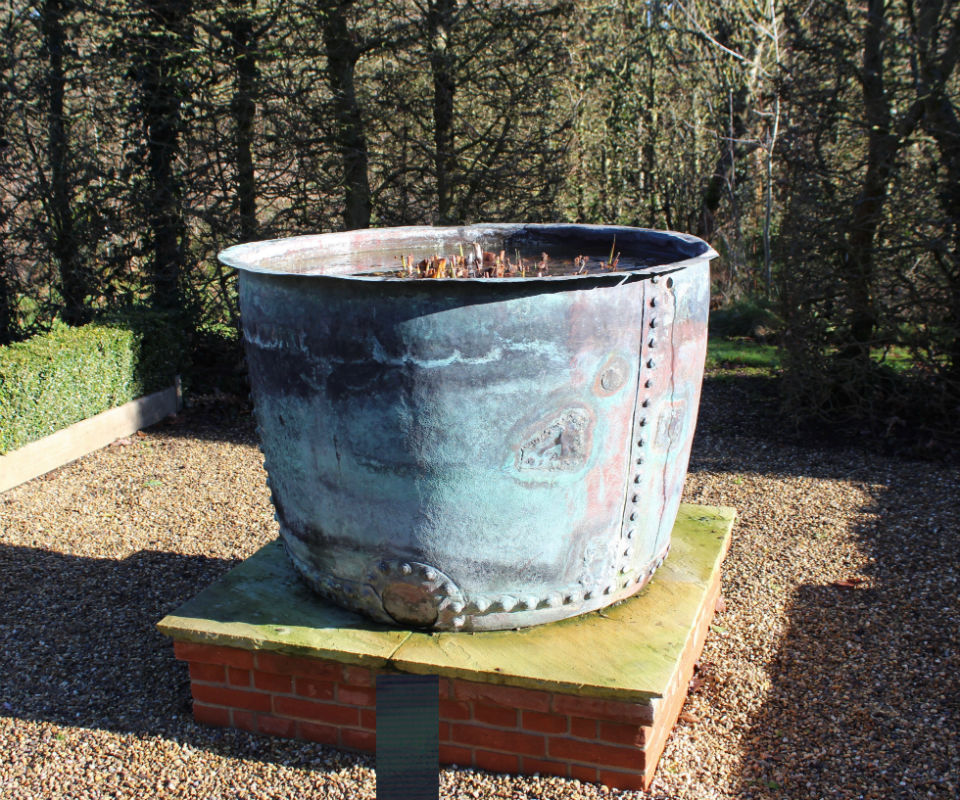
It will be awhile before the plants emerge from this (frozen) water-filled magnificent container, but along with its great size it is the weathering of the copper to an attractive verdigris which we can admire today.
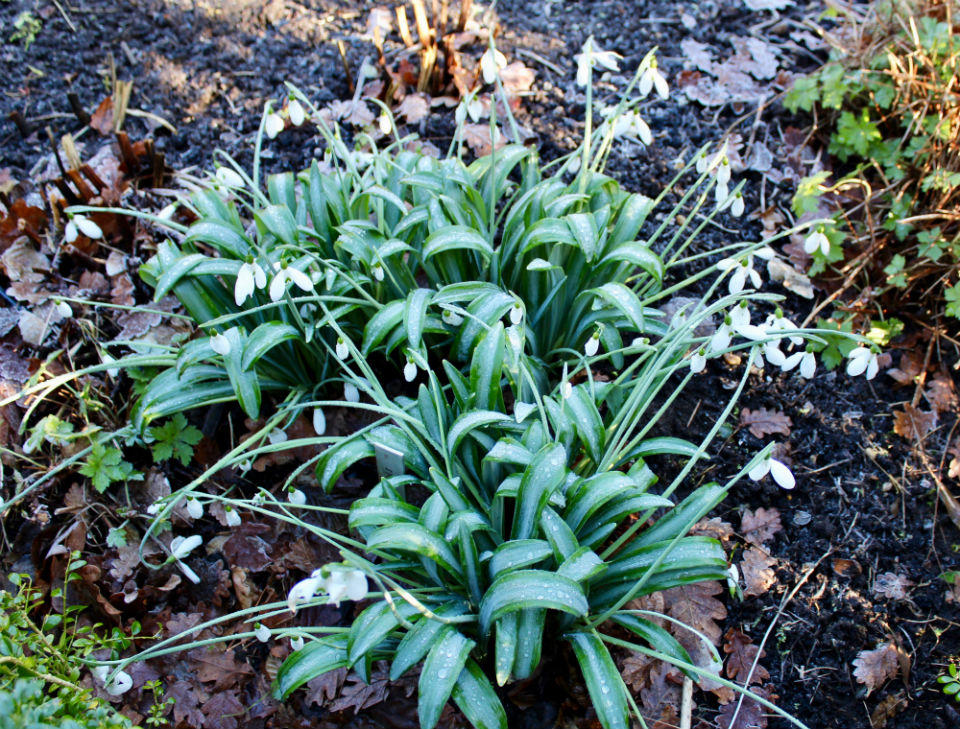
Planted in the beds are a variety of snowdrops; this good sized clump is ‘Colossus’ which sports rather handsome foliage.
With 30 acres of gardens to explore, it is easy to immerse oneself and forget that there is a world outside, just occasionally there is a little reminder; in the far distance Happisburgh lighthouse can be seen,
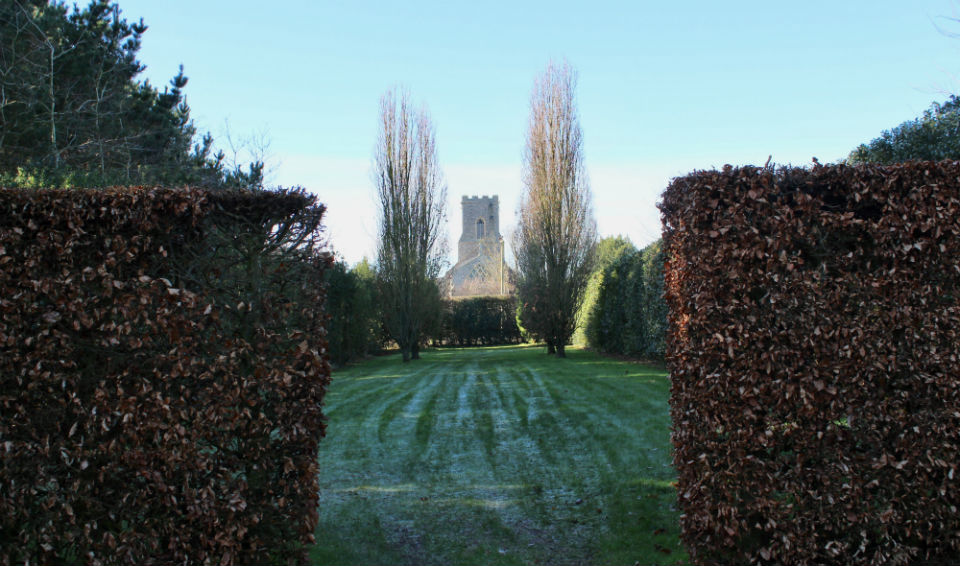
and on the other side of the garden the parish church is framed in the view.
It amazes me how some flowers can survive undamaged following a severely frosty night and this joyful Camellia is seemingly untouched.
It is during these winter months that we can appreciate and enjoy the rich tapestry of greens from stems and leaves,
and you cannot help but enjoy this great combination of Silver Birch, Cornus and Skimmia.
At first I am not sure whether it is my eyesight but this Pussy Willow growing gracefully in a pot is definitely pink; originally from Japan it is Salix gracilistyla ‘Mount Aso’.
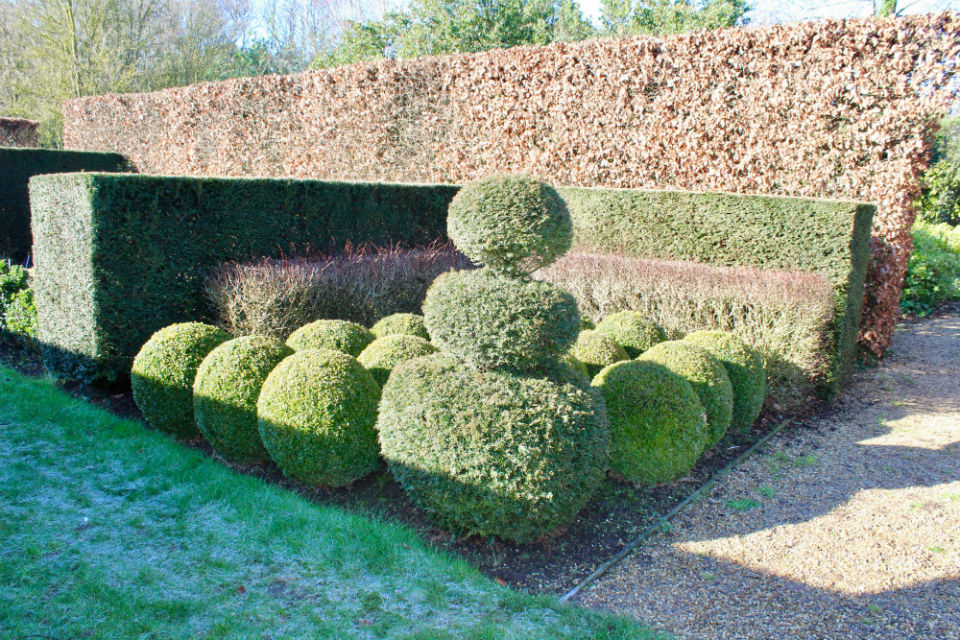
It is at this time of year that you appreciate those clipped shapes whether it is in Box, Beech or Yew.
This tree on a corner is firmly rooted into the swirl of low Box hedging that seamlessly runs into the wooden bench.
The garden is divided into so many different areas, many of which will come into play in those warm summer months ahead; you might be forgiven for thinking the Desert Garden might be one of those, however today you would never know it is winter.
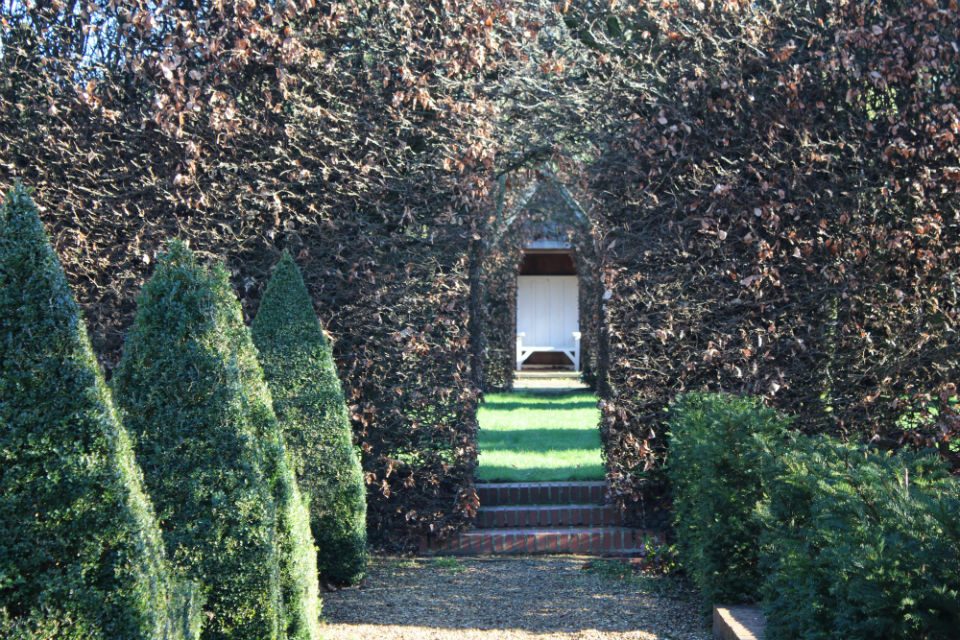
Walking back to the house we admire this striking seat framed by the hedge,
and the collection of neatly clipped topiary.
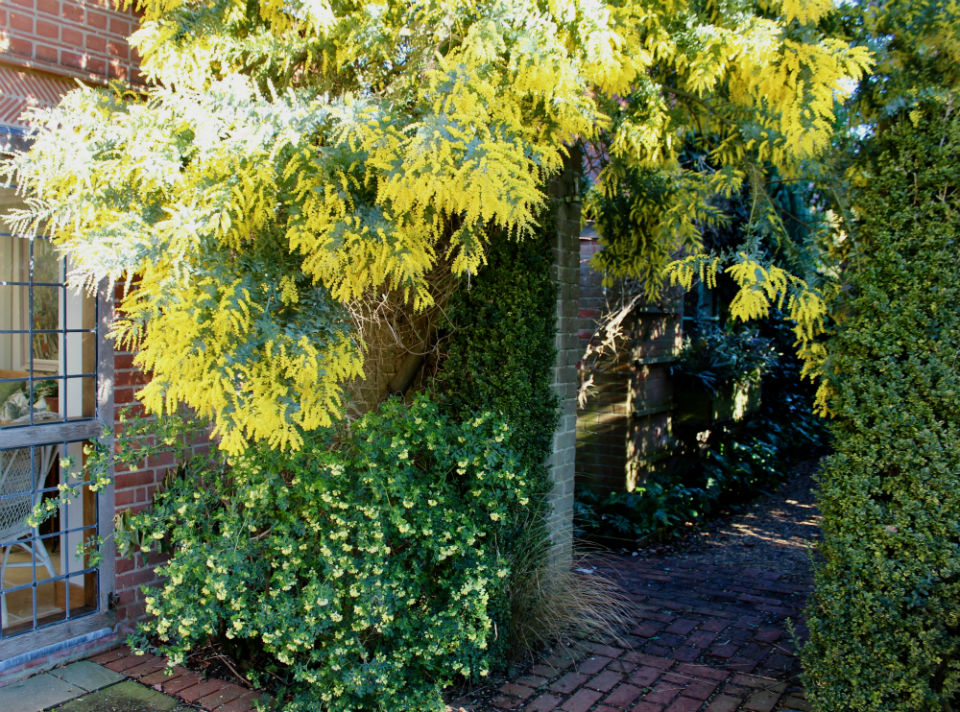
Then just by the house in the perfect place is an explosion of colour and scent, a Golden Mimosa Acacia baileyana is underplanted with Coronilla glauca ‘Citrina’.
Alan Gray can be heard most weeks on Radio Norfolk’s ‘Garden Party’ programme. He is an Ambassador for the National Garden Scheme and he will be opening his amazing gardens at East Ruston, Norfolk twice this year on Saturday 9th March and Saturday 12th October https://www.ngs.org.uk/find-a-garden/garden/12923
If you find yourself in London and you simply can’t face the noise and swirl of shoppers and traffic then I can recommend a quiet visit to the delightful Garden Museum located south of the river in a church right next door to Lambeth Palace.
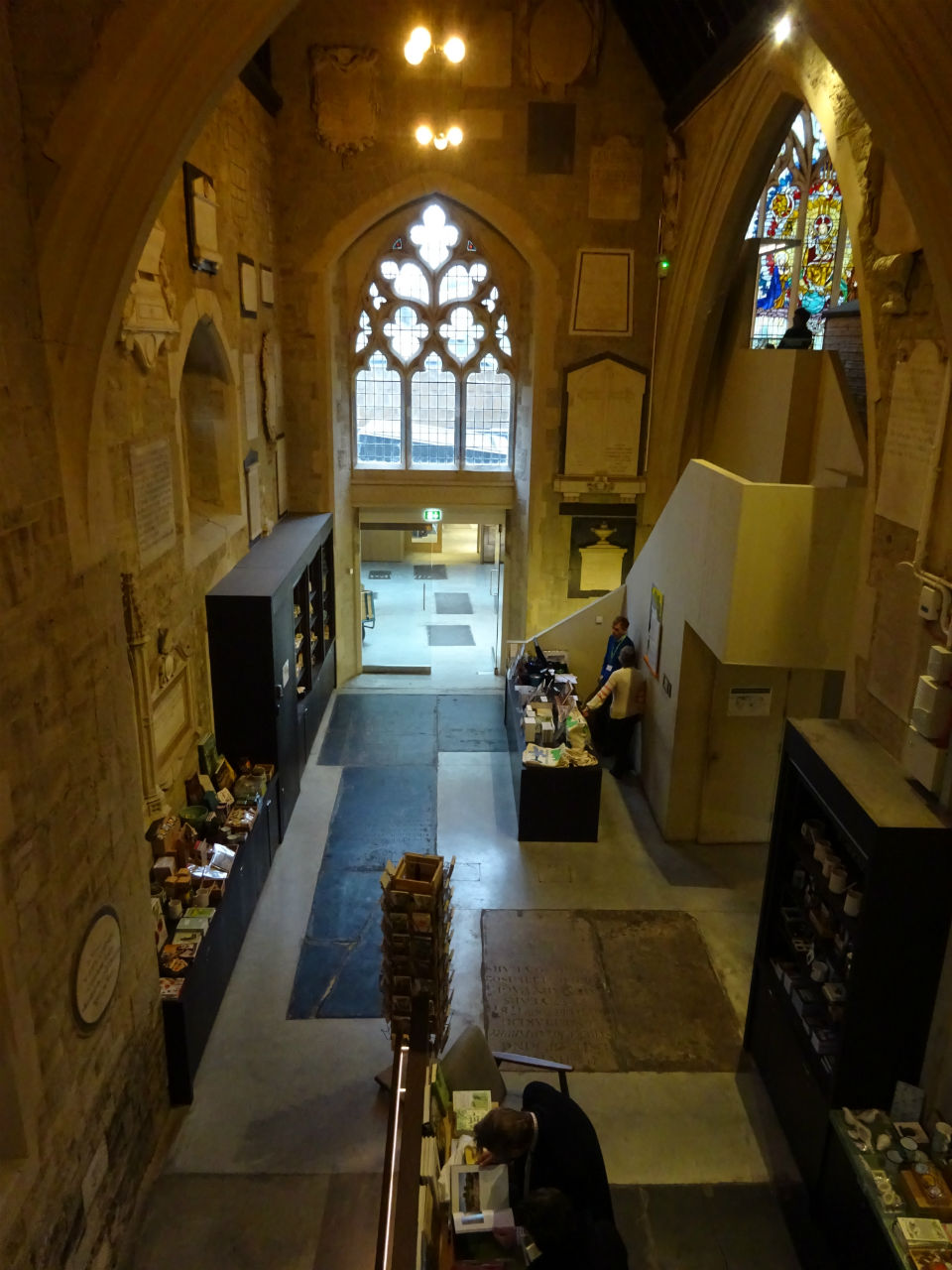
The Church of St. Mary-at-Lambeth was made redundant in the early 1970s. Boarded up and ready for demolition it was fortunate that Rosemary and John Nicholson visited the churchyard in search of the tombs of the gardeners and plant collectors father and son John Tradescant . Subsequently the Nicholsons formed the Tradescant Trust which basically saved the church and converted it into the worlds first museum dedicated to Garden History. Glass doors quietly slide open doing away with that hideous clerical creaky door syndrome….
….inside it is spacious and well lit; a fantastic use of a parochial building, modern but without destroying that old ecclesiastical feel.
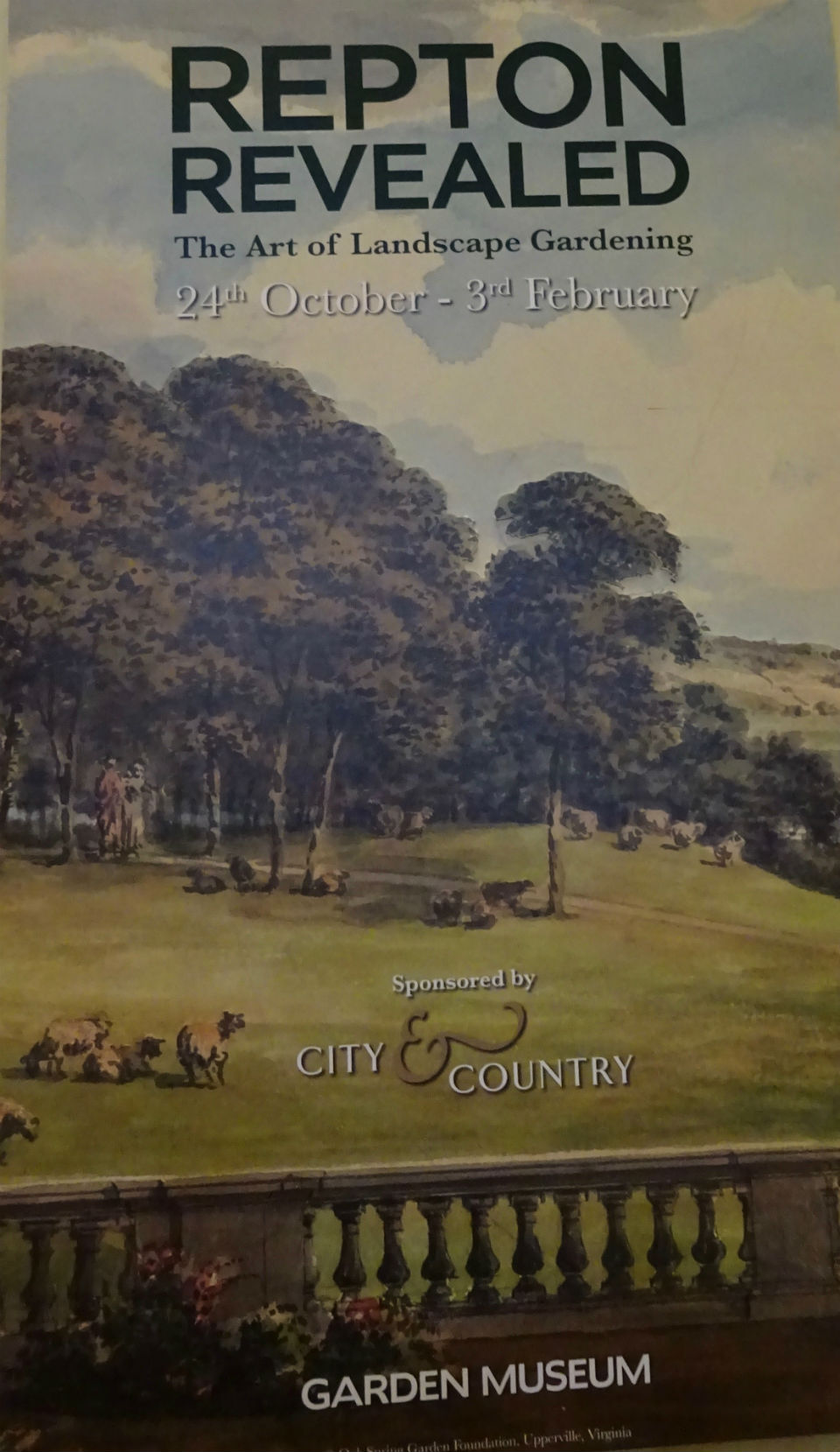
Delighted that my Art Fund pass ( https://www.artfund.org/national-art-pass) allowed me half price entrance I headed for the small room to the side which holds the present exhibition on the life and career of Humphry Repton (1752 – 1818).
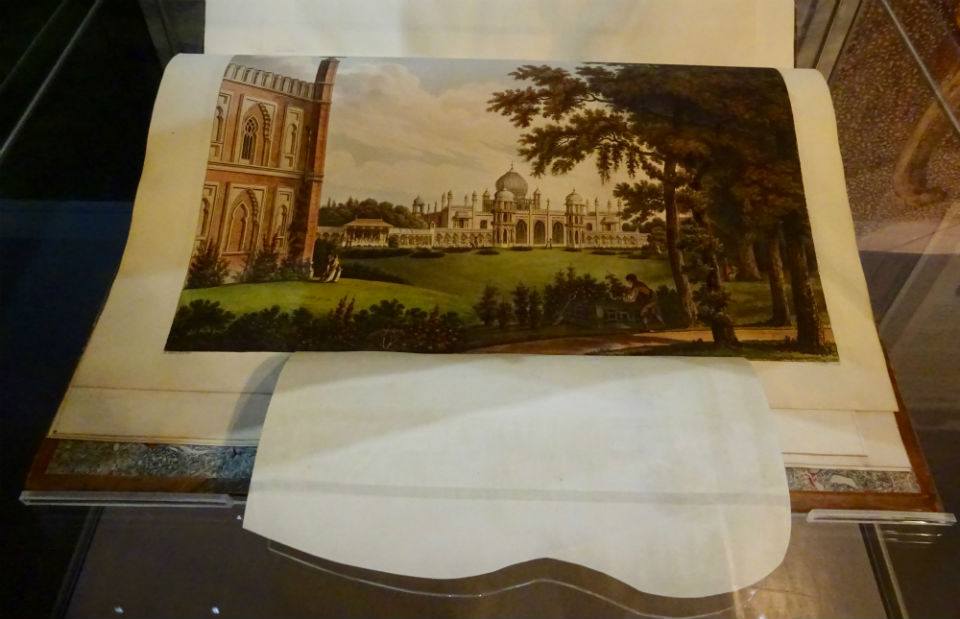
Last year was the bicentenary of Repton’s death and there has been much research undertaken. This exhibition brings together objects, watercolours and some 24 of his Red Books. These leather bound books were his designs, works of art and a clever marketing tool for his commissions from clients up and down the country. One book stands out that is the grand design for Brighton Pavilion, yet it proved to be a commission Repton failed to win possibly due to the fact that he failed to respond quickly enough; you just cannot keep Royalty waiting.
Included in the exhibition is a short film, a clever digital animation bringing the art of Repton alive; the smoke seems to drift away in the far distance and with the soothing narration from Jeremy Irons you feel you are part of that landscape.
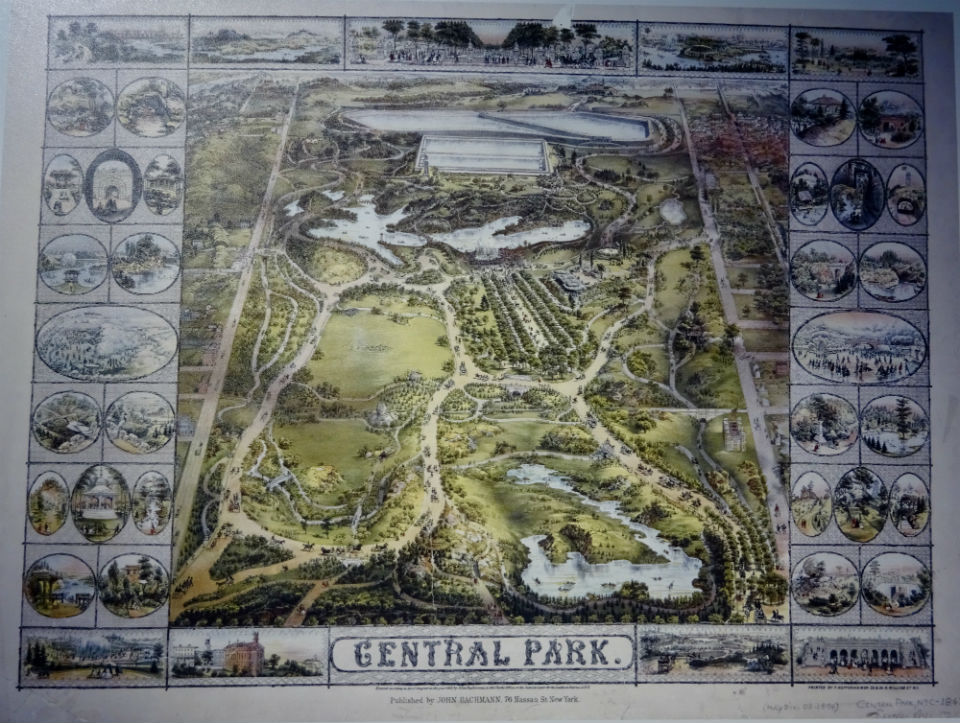
What I really enjoyed about this exhibition is how Repton’s legacy lives on. Although after his death he seems to have been rather forgotten in this country, he became a role model for American landscape architects who wanted to combine the design of buildings and landscape with horticulture and the science of transportation. Repton had advised his clients of the importance of ‘The approach’ incorporating it as a feature in the landscape. He was very interested in travel, enjoying roads as ‘a constant moving scene’ and felt they should not be hidden. His ideas influenced the design of the carriage rides in Central Park, New York.
‘Others prefer still-life, I delight in movement’ and Repton realised that we observe landscape at a fast pace (even from a carriage) very often from the curving sightline of a road and this theory of optics was applied to the new roads being developed for Americans to enjoy their scenery such as the Parkway and the Sky Drive.
With his ideas of integrating architecture and landscape, Repton became a major influence on Denis Lasdun, he of University of East Anglia fame.
A small photo shows Lasdun visiting Repton’s grave (which Repton designed himself) made into a Christmas card that I realise was sent from a family I had known in my childhood and suddenly I too felt I had made a tiny connection with the great landscape designer himself.
With much still to see of the museum I hurried on past a group being shown the Walcot room, a small library tucked behind the rood screen,
just glancing up at the little stained glass window above.
I moved on into a small room that houses a collection of ‘curiosities’. These items were collected by John Tradescant, gardener to Robert Cecil and later to King Charles 1. Tradescant created Britain’s first Museum not far away in Lambeth which became known as The Ark. Lawyer, friend and neighbour Elias Ashmole published a catalogue and when Tradescant junior died the collection was bequeathed to Ashmole and became the foundation of the Ashmolean Museum.
Such items range from the cast of a Dodo head,
the rather quirky Barometz or ‘Vegetable Lamb’ believed to be half-lamb and half-plant from the 18th century,
a glittering collection of shells,
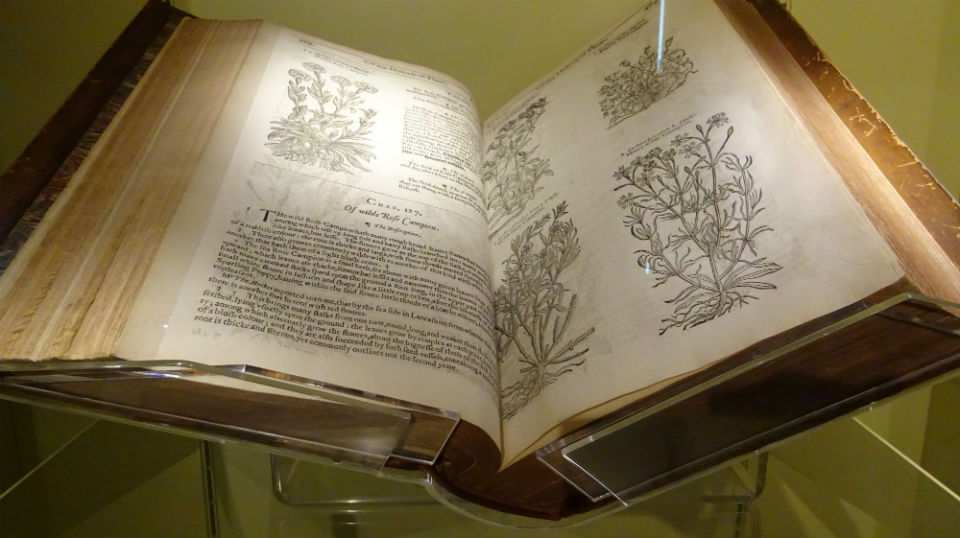
to a Herball by John Gerard dated 1597 in which over 1,000 plants are described.
It is a very active museum and I suddenly realise that Elias Ashmole is speaking to me.
Upstairs is a glorious collection celebrating British gardening through the years. Suitable for all ages it is a delightful mix from paintings…
a portrait of a relaxed Prince Charles greets us at the top of the stairs.
Many famous people connected to gardening have contributed archives and objects and it is a wonderful eclectic mix. Amongst the many items in the collection is a gardening hat belonging to garden designer Nancy Lancaster (1897 – 1994),
a Certificate of Good Service in the Women’s Land Army, yes that is all they got after ten years hard work.
And wouldn’t you have longed to give your wife this glorious lawn mower.
Amongst the displays are interesting information boards on a variety of plants – not too many just enough to realise the serious side of gardening.
and of course there just had to be a jolly old gnome.
From a small window in the Finnis Scott Gallery where you can become totally absorbed on the works of the Artist gardeners, you can look down and once again remember that you are in a fine building .
There is a good display of plans executed by various Garden Designers over the years, this masterpiece is by Sir Geoffrey Jellicoe (1900 -1996).
Video clips introduce us to influential landscape architects like Charles Jencks.
At the other end of the raised gallery there is a fine collection of tools;
a 17th century glazed earthenware watering pot,
and even a standard potting shed with audible displays of the stories of six people and the different ways they have utilised their sheds.
The shed comes complete with a fine weather vane.
Within the walls of the museum is a small charming courtyard garden designed by Dan Pearson; all the plants growing are helpfully listed in a book,
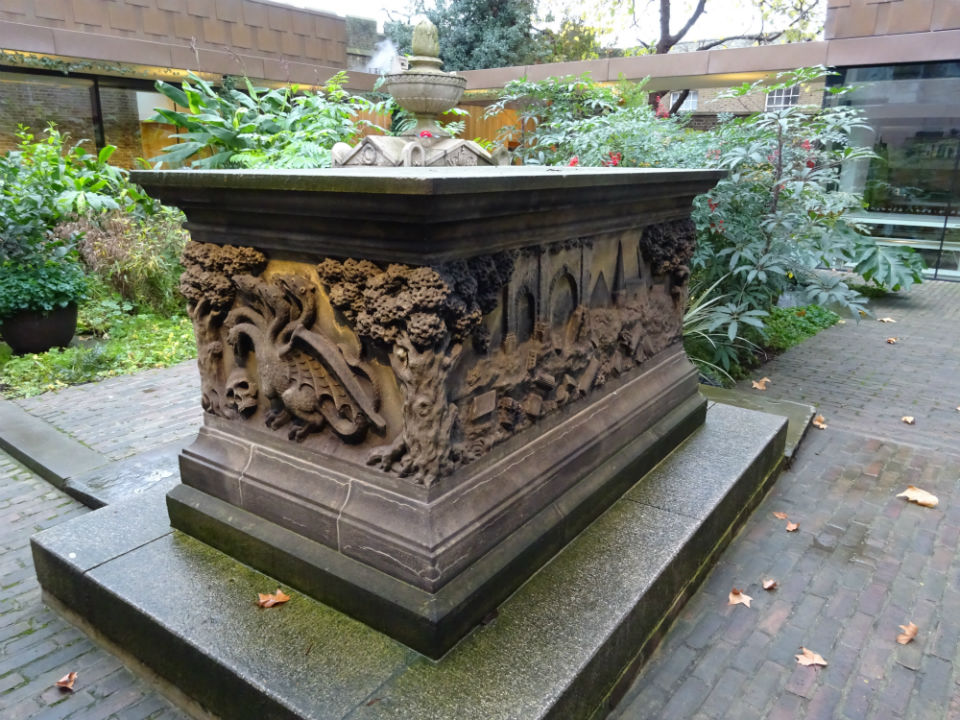
and it is here that the fine tomb of John Tradescant can be found,
surrounded by a variety of all-year-round plants including the bright berries of Nandina domestica which reminds me that I still have not purchased this beautiful shrub yet.
Sadly on this occasion I do not have time to visit the award-winning restaurant; it is buzzing and smells divine and I can really recommend it from a previous visit.
The Garden Museum is a charity and the National Garden Scheme annually funds a trainee gardener here. Before today I had never really thought about the definition of a gardener, but the museum informs me that the first recording was ‘Edmund the Gardener’ who worked at Windsor Castle during the reign of King Edward l. In 1605 the profession was recognised by James l “for the trade, craft or misterie of gardening” and an apprenticeship took 7 years. By 1914 there were over 4,000 Head Gardeners in this country. And now?
The Garden museum is open most days but you can check for opening times on the website: https://gardenmuseum.org.uk/ do make a visit and take the children they would love it.
Having spent a tedious morning on the phone to the Department of Work & Pensions, followed by a lengthy call to BT to try and sort out longstanding internet problems, I decided it was time to visit a garden and restore my equilibrium. Twitter brought my attention to the fact that Madingley Hall was opening its gates as part of the NGS Gardens and Health week.
Driving through the impressive iron gates and sweeping up the drive, the big blue sky and the gentle green meadow had an instant calming effect.
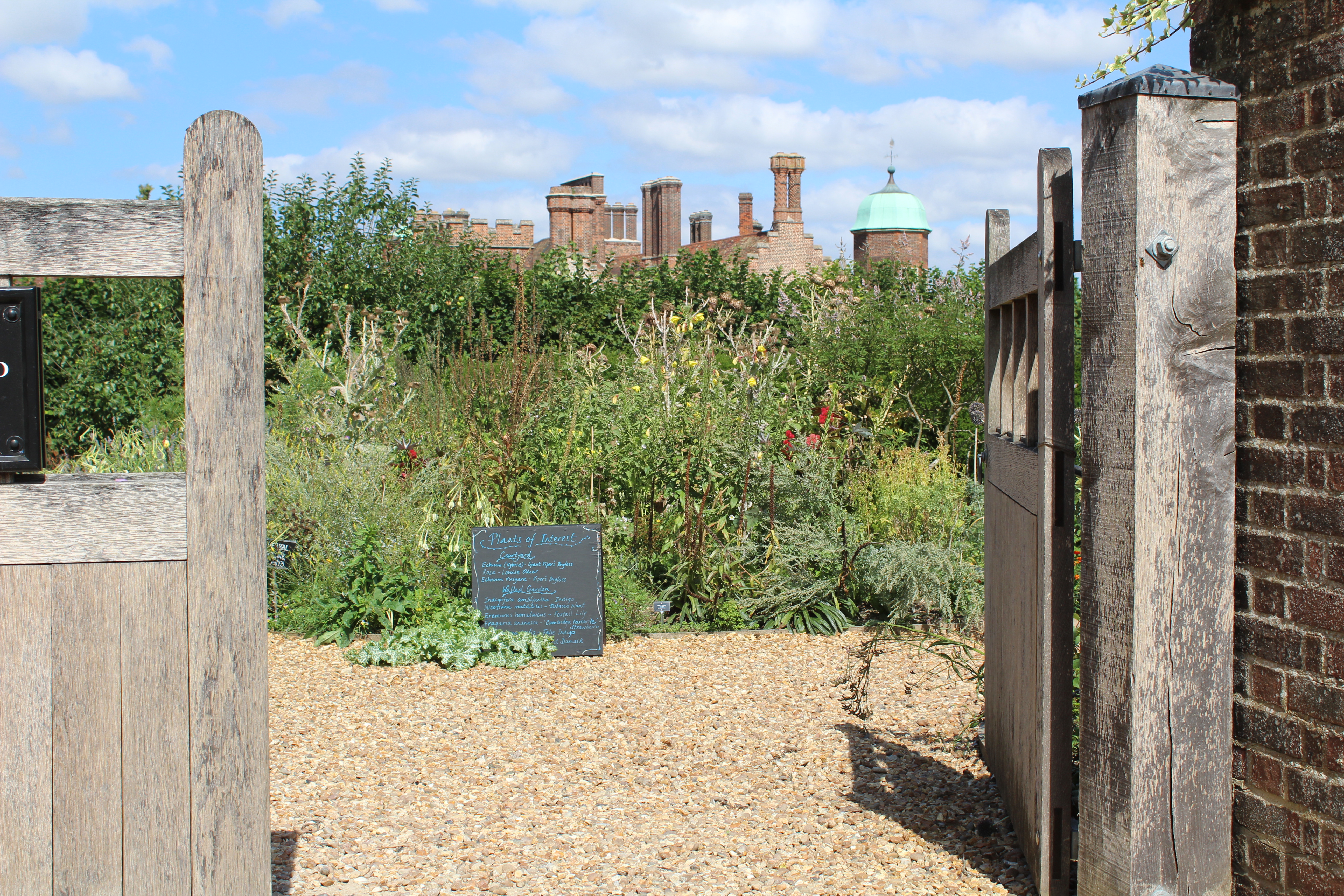
Having parked the car I found the entrance to the estate is through the walled garden. This dates back to the 18th century, with the first recording being of a plant inventory dated 1757. Today a blackboard notes the plants of particular interest.
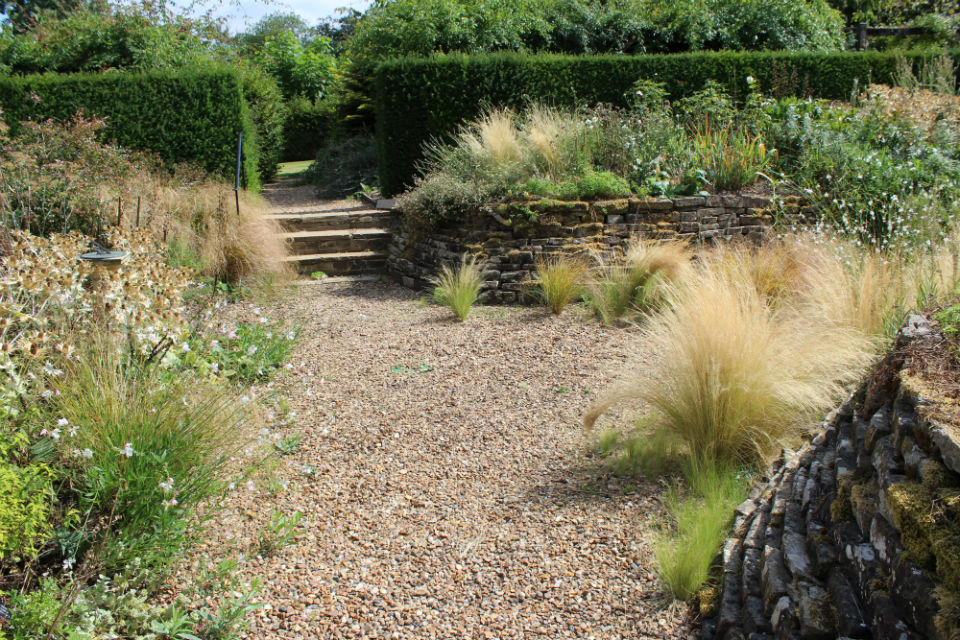
Two gravel paths diverged……… and I am faced with the age-old dilemma, which one should I take ?
The borders are overflowing with every type of herb to promote well-being;
aromatic…
medicinal…
culinary…
Not only are these plants of a curative nature, but also many can be used for dyeing. Much information about the history and use of these plants is displayed and I realise that I could do much to alter my wardrobe.
Enclosed by hedges the sunken garden is a delightful spot to sit and soak up the sun; planted with white flowers such as perennial sweet pea and gaura lindheimeri, it is softened by the gentle clumps of stipa tenuissima.
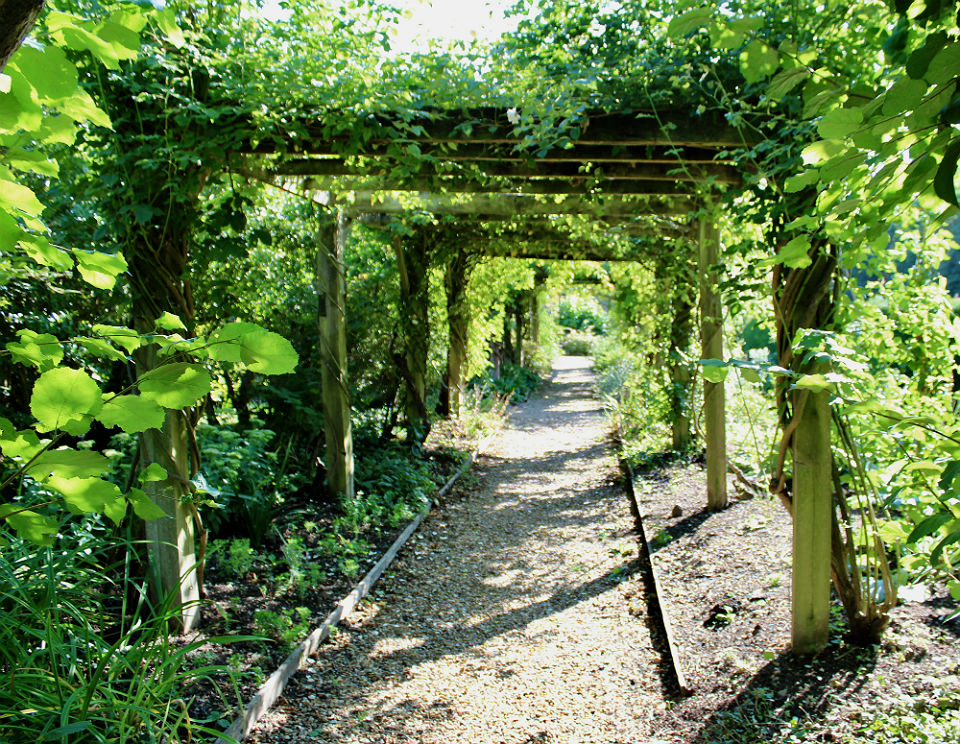
There is such variety within these walls, a wooden rose pergola runs roughly from north to south providing much-needed shade rather than colour at this time of year.
Mature trees also provide plenty of canopy and across the curiously patterned round lawn is a circular raised alpine bed.
where the tiny autumn snowflake Acis autumnalis seems a little premature on this warm summer’s day.
Running from east to west is the fine hazel walk Corylus avellana shown on the tithe map of 1849; it is a lengthy 60 metres (just under 200ft) long.
The path emerges from the mature planting into an open expanse of lawn with a thatched summerhouse nestling in the corner.
No sense of autumn approaching here; the border has plenty in flower, hibiscus, heliotrope, alstoemeria and helenium all provide late summer colour.
Leaving the walled garden through a door in the wall and passing the crenelated box hedge on my right I descend some steps to the courtyard in front of the Hall.
Over the ornamental pond and to my horror, I find a patient abandoned on a hospital trolley. Startled, I wonder that it must be the first corpse I have found in a garden, then realise I have blundered into a serious first-aid course and, being of the somewhat lightheaded disposition, I quickly scurry away and
take deep breaths in front of the heavenly hibiscus.
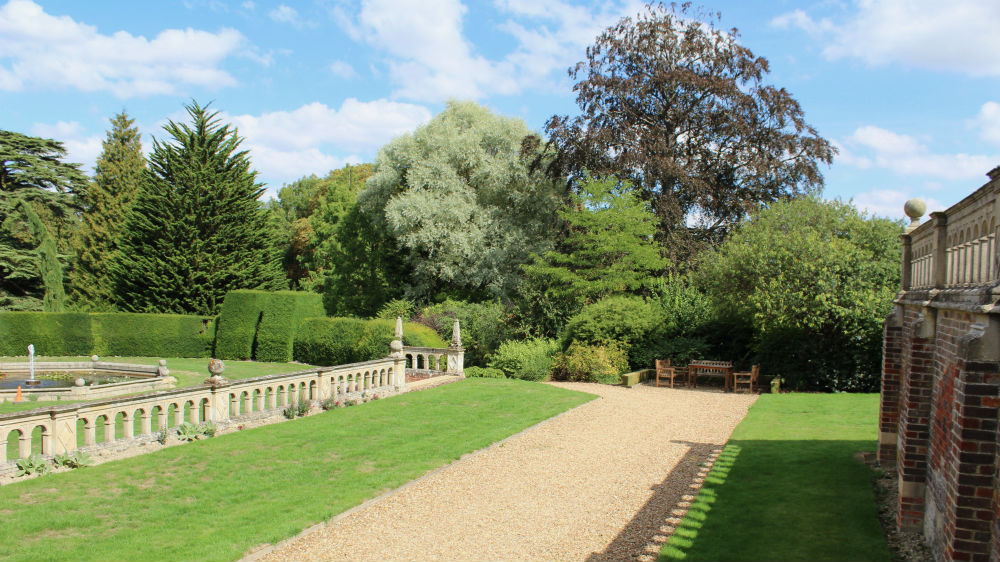
At the east end of the Hall is a formal raised terraced garden with a circular pond surrounded by smooth quirky-shaped topiary.
The view east to the lake is totally unspoilt and uncluttered.
Stepping down to the wide North Walk, I see the balustrade is repeated along the edge of the croquet lawn,
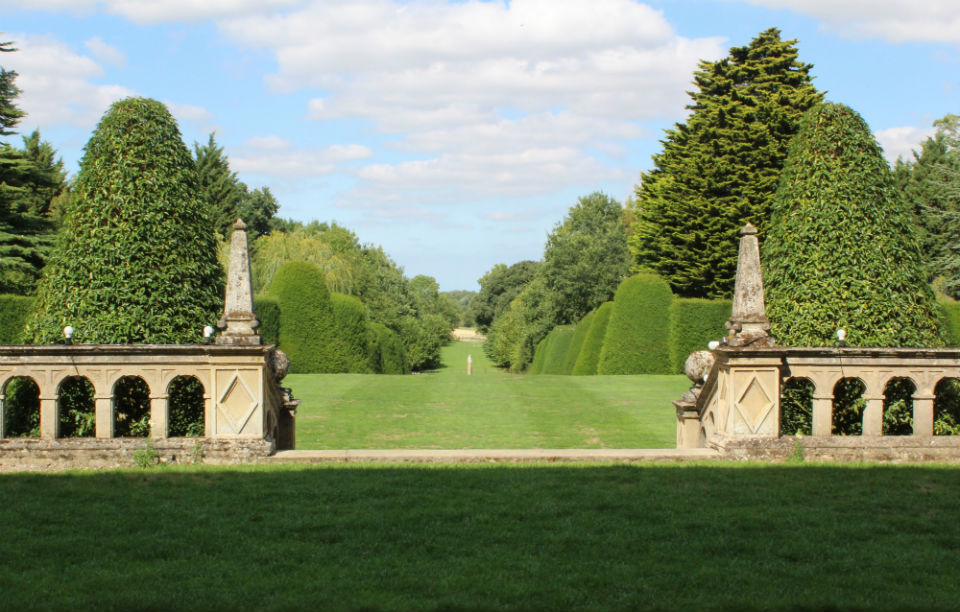
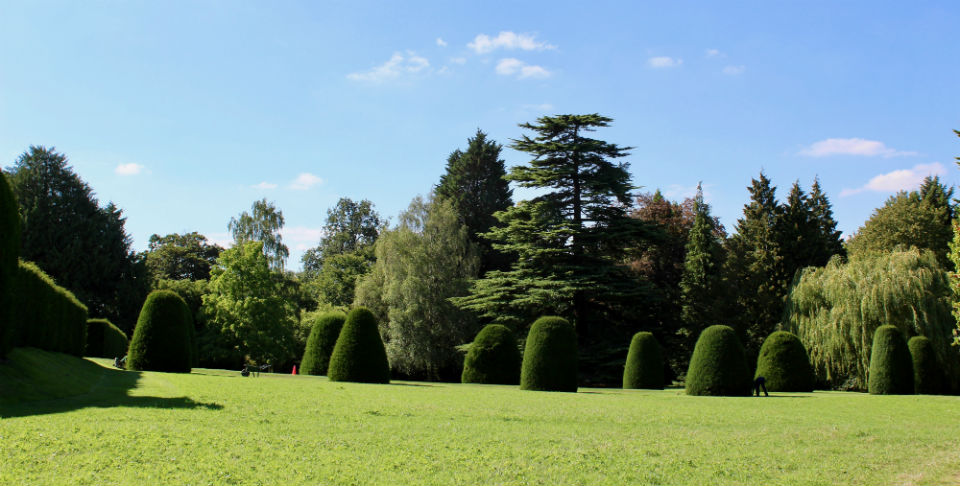
broken at the centre to reveal an avenue of giant clipped yew bollards marching into the far distance.
It is a fine view for this small statue of a buddha protected behind a semi-circular pond and perched in a recess in the wall.
Madingley Hall was built in the 1540s and the development of the garden over the years is a fine example of the history of garden design. Growing at the west end is a large yew taxus baccata, which is thought to date back to when ‘Capability’ Brown improved the estate.
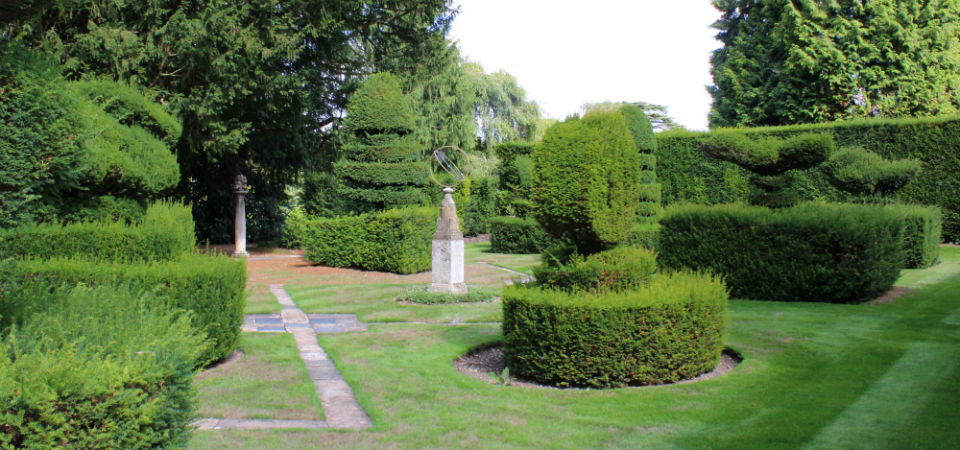
The yew topiary garden was created in the 1920s when some of the topiary were transferred from nearby Histon Manor. Waiting for their annual clip the different shapes seemingly move around an astrolabe mounted in the centre on a stone plinth.
A large elegant croquet lawn with its backdrop of mature trees, must have provided plenty of entertainment over the years. The game is still played today by the many students and staff who now occupy the Hall, which was bought by Cambridge University 1948.
There is a different feel down on this north side of the site; here it is spacious, green, still and silent. Today the majestic trees are quite lovely; upright, spreading, weeping and clipped they create a verdant theatre.
Some trees are multi stemmed and like a cluster of balloon strings they reach up to the sky.
The wild flower meadows have finished their display but next May they will return. Richard Gant, the Head Gardener is tidying the edges of the clipped yews. He has been responsible for these gardens for 30 years. The names of the trees roll off his tongue, for his knowledge and enthusiasm is truly impressive.
And it is as if this weeping Redwood, Wellingtonia (sequoiadendron giganteum ‘Pendula’) bows its head in respect.
Sadly this Cedar of Lebanon, Cedrus libani is unwell with white rot caused by a type of bracket fungus. Now fenced off, the decay of this tree is being closely monitored.
I follow the dog walkers along the wooded path, a section of the route created to celebrate the 300 years of Capability Brown.
It is a beautiful spot enjoyed by the locals. By the lakeside the remains of the footings of the old boat house are guarded by a “lake keeper” who is in fact surprisingly friendly.
From the other side of the lake you can see the small church tucked in to the left of the drive. I have completed my walk and so I return back through the gates and up the drive to the hall.
Madingley Hall is an institute of continuing education and a centre for events and conferences. The 8 acre garden sits within an estate of some 12,500 acres; it is beautifully maintained and reads like a manual on garden history with the different areas reflecting the changing trends in design throughout the garden’s life. It is impressive too and thanks to the Head Gardener, Madingley has been opening its gates for the NGS for the past 27 years.
The NGS have worked hard to highlight the connection between health and gardens, having commissioned the King’s Fund a few years ago to publish a report. My visit today endorsed the feeling of well being that a garden can induce and after such an enjoyable and peaceful afternoon, I left the Hall in a better state of mind than when I entered.
The area between Downham Market and Wisbech on the edge of Norfolk is not particularly known for its gardens. Last Sunday driving through the lanes and over the dykes between the flat fertile fields of the Fens, I discovered Bank House. The familiar yellow NGS signs were helpfully posted at all the crossroads which relieved my doubts of getting lost for ever.
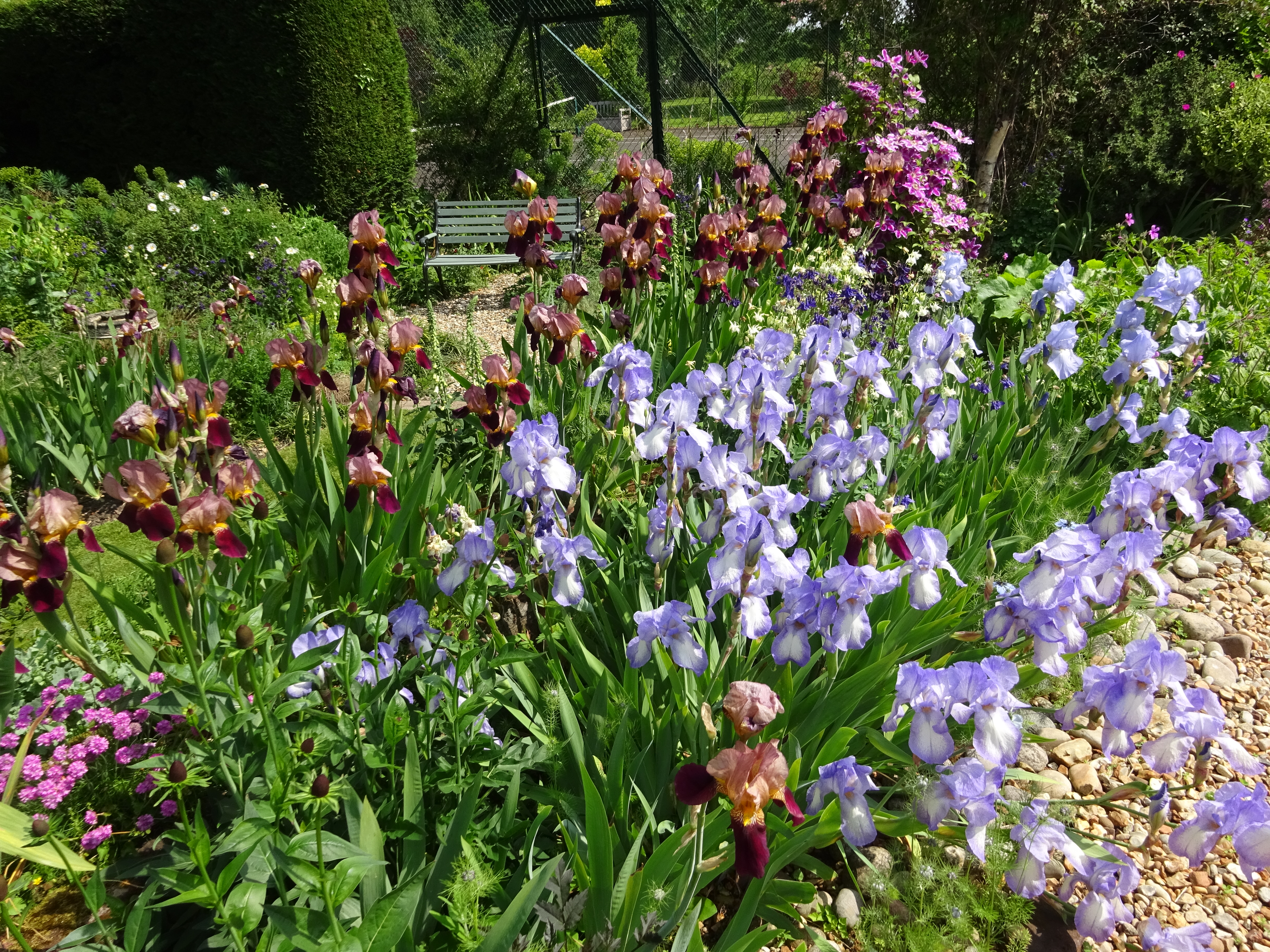
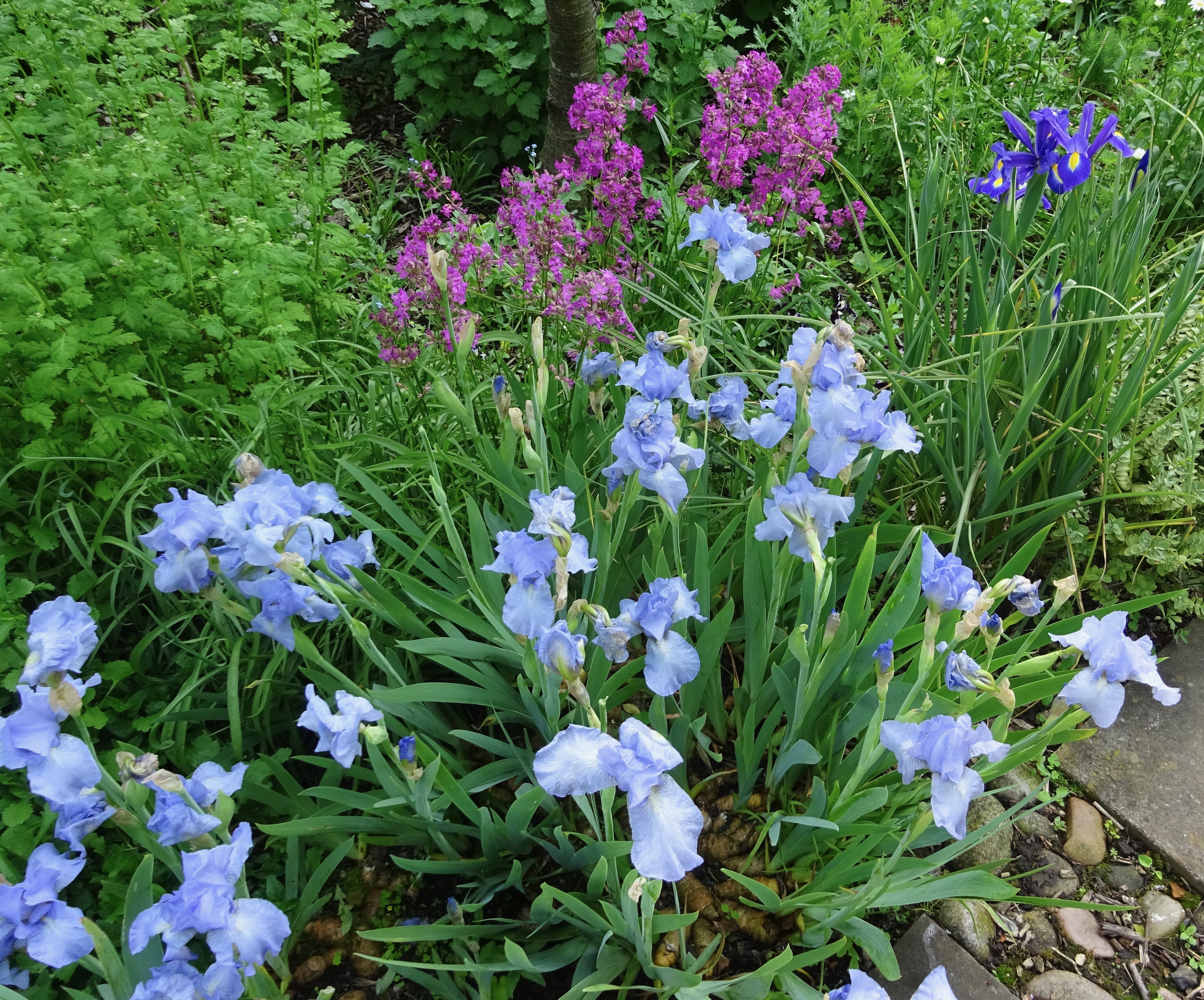
On entering the drive to left of the house, I was greeted not only by a sumptuous smell of bacon rising from the kitchen but also an explosion of irises growing along a low wall.
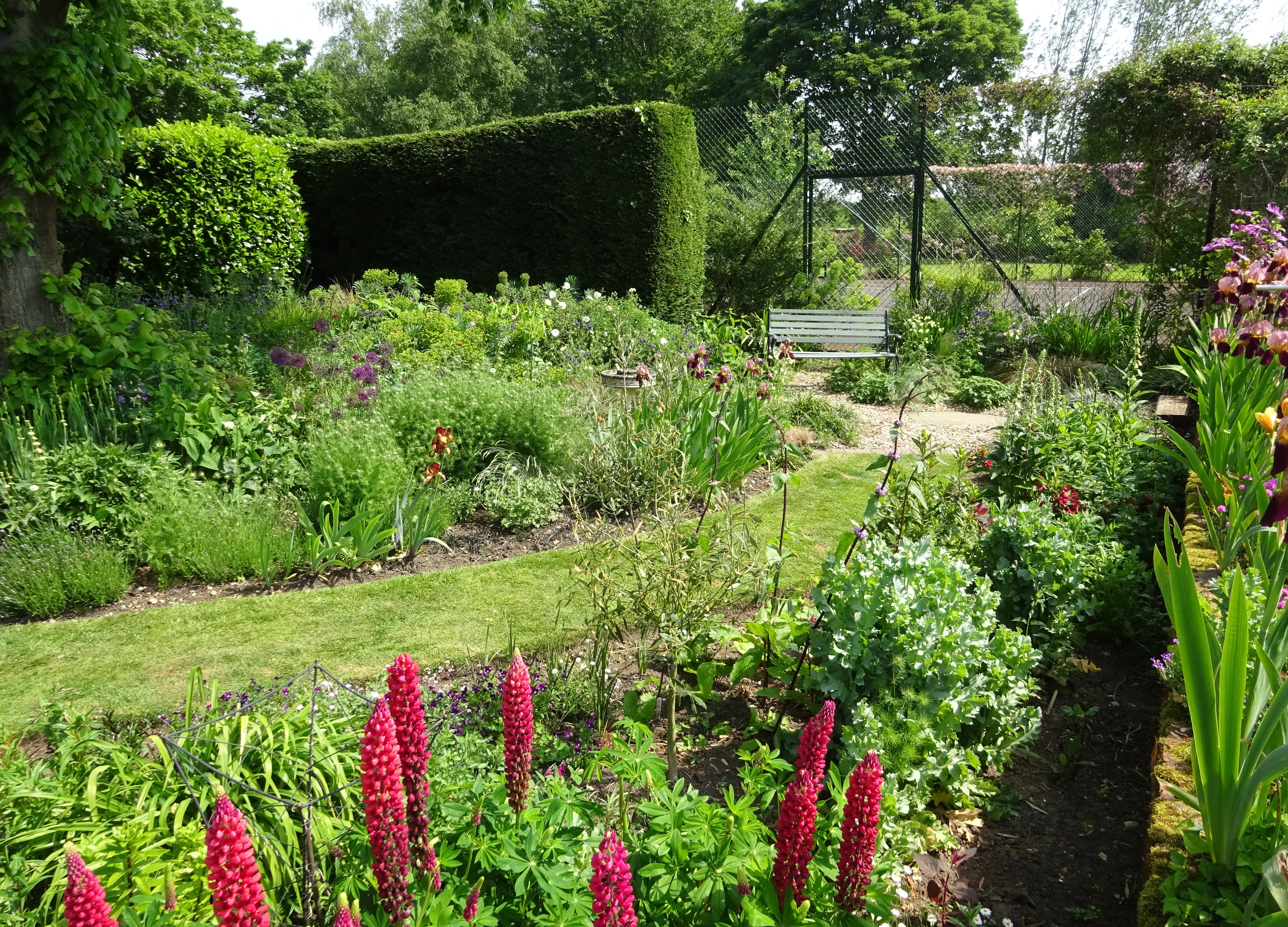
Stepping down past the joyful lupins onto the turf path you are immediately aware that the owners are keen gardeners, for this is a garden where no space is left unattended.
Packed with plants, they are even grown under the shaded canopy of the mature trees right up to the trunks.
This part of the garden is also set aside for production. Young vegetables in neat rows and greenhouses for propagation.
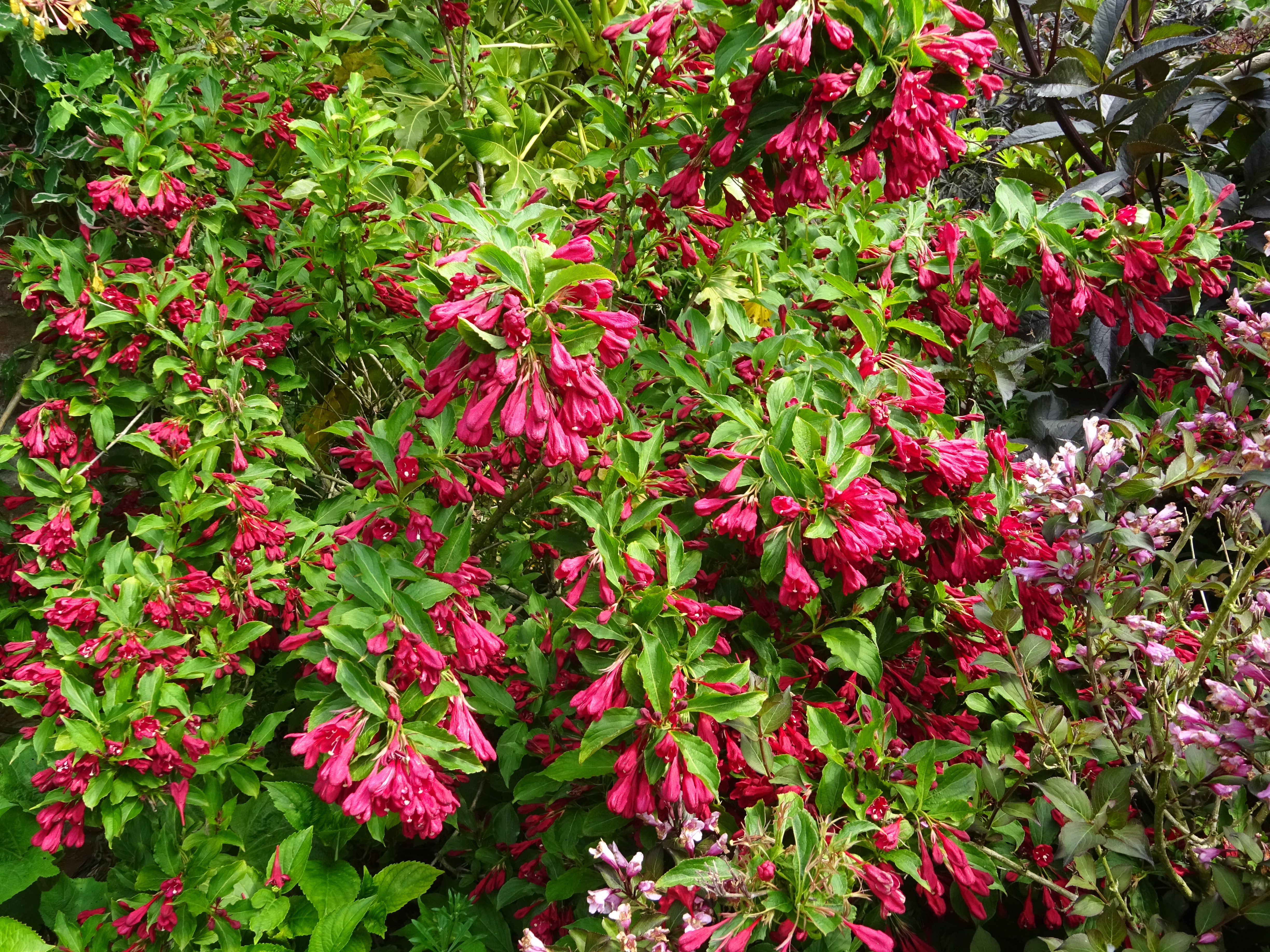
It is always such a pleasure to be able to buy plants grown in the garden but I was mortified to miss out on a purchase of this gorgeous red weigelia.
I don’t imagine the garden owners have much time to sit but all around the garden is a variety of seats delightfully placed.
Quiet areas to soak up the morning sunshine and listen to the bird song.
Or under the shade to enjoy that too tempting bacon butty.
The two acres are divided into many areas. Sometimes decisions have to be made:
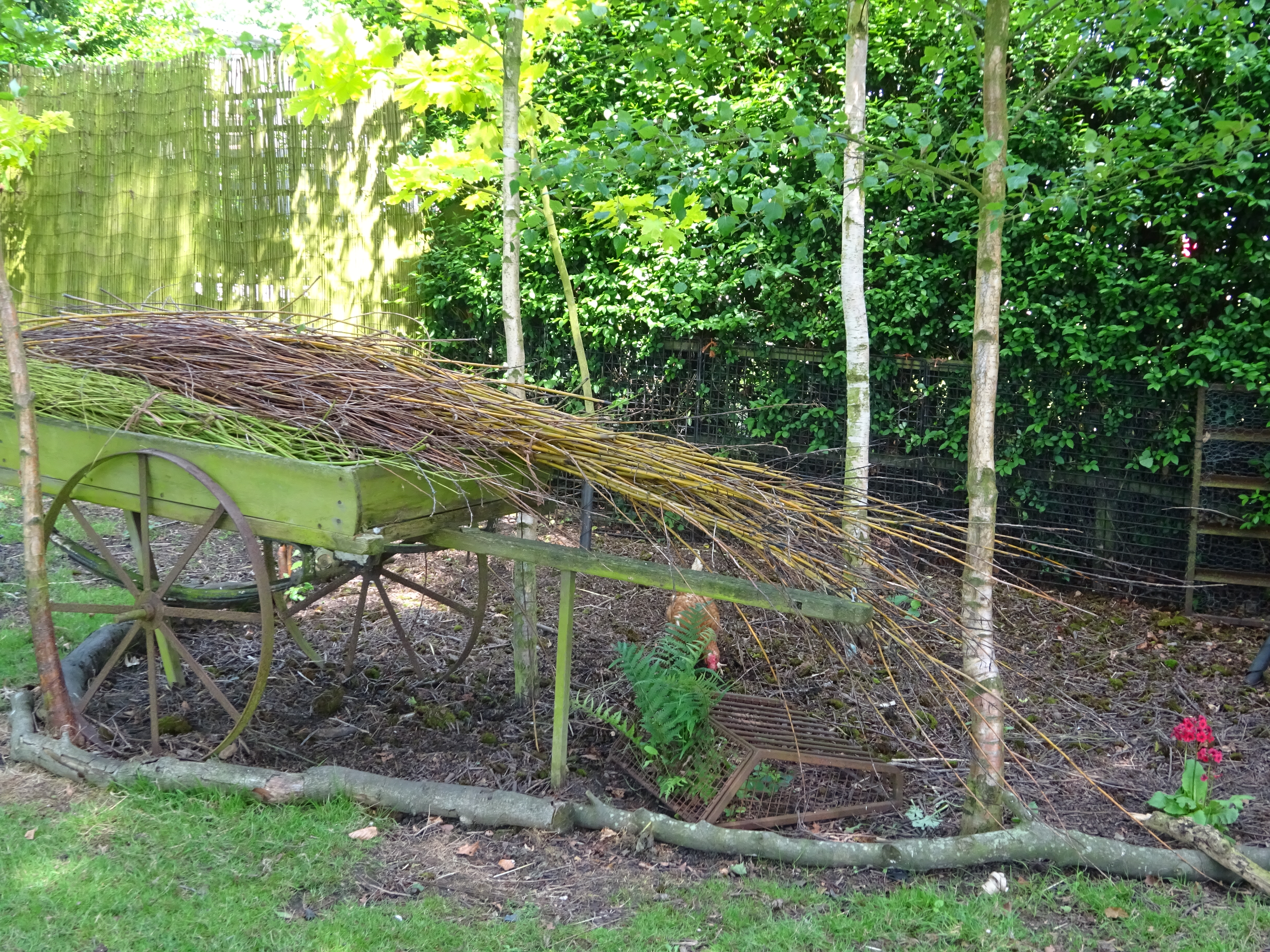
I took the brick path towards the orchard where I found some very happy hens,
pecking around an old cart filled with the cut willow.
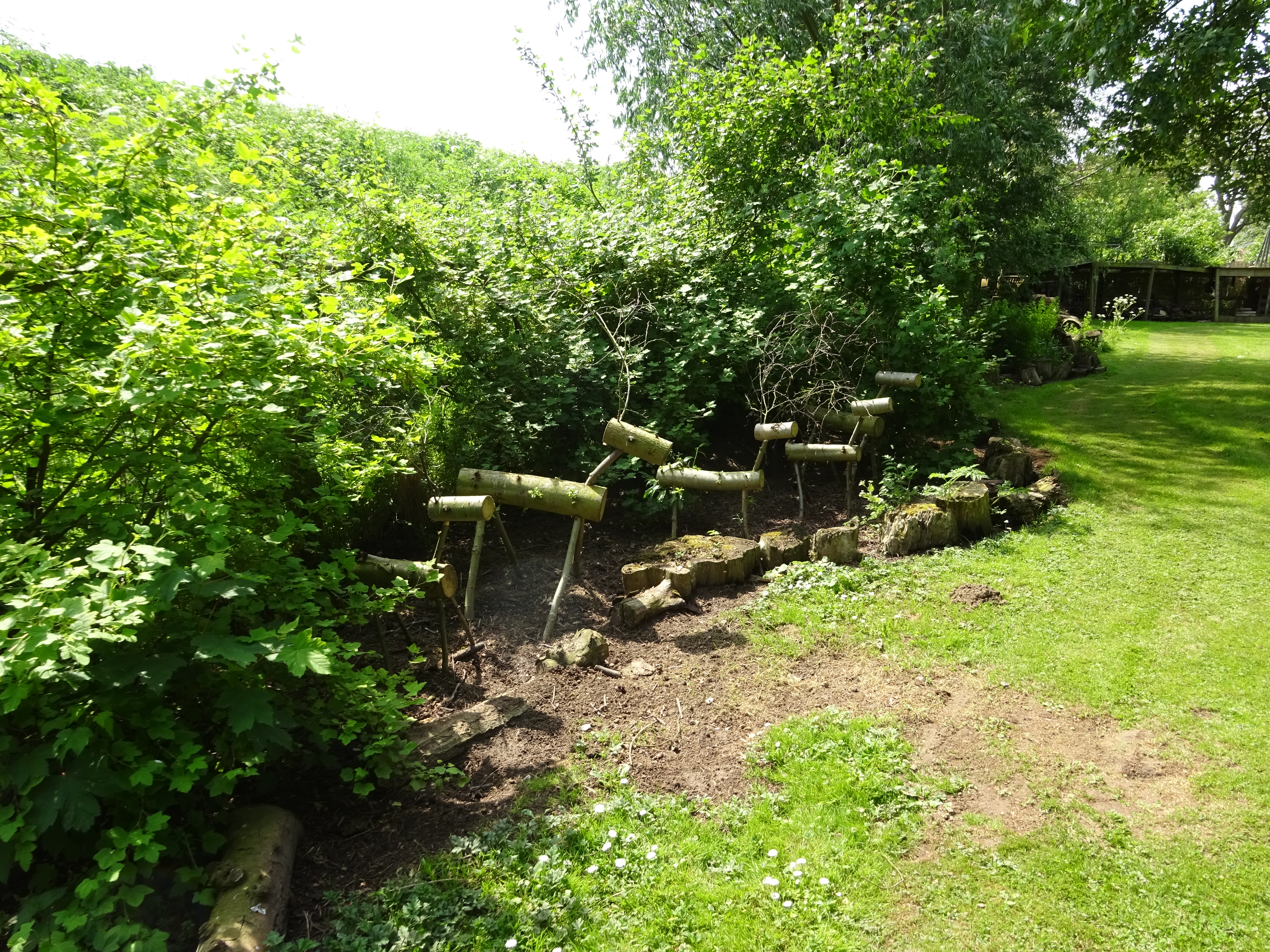
These wooden deer add a playful note to this wilder side of the garden.
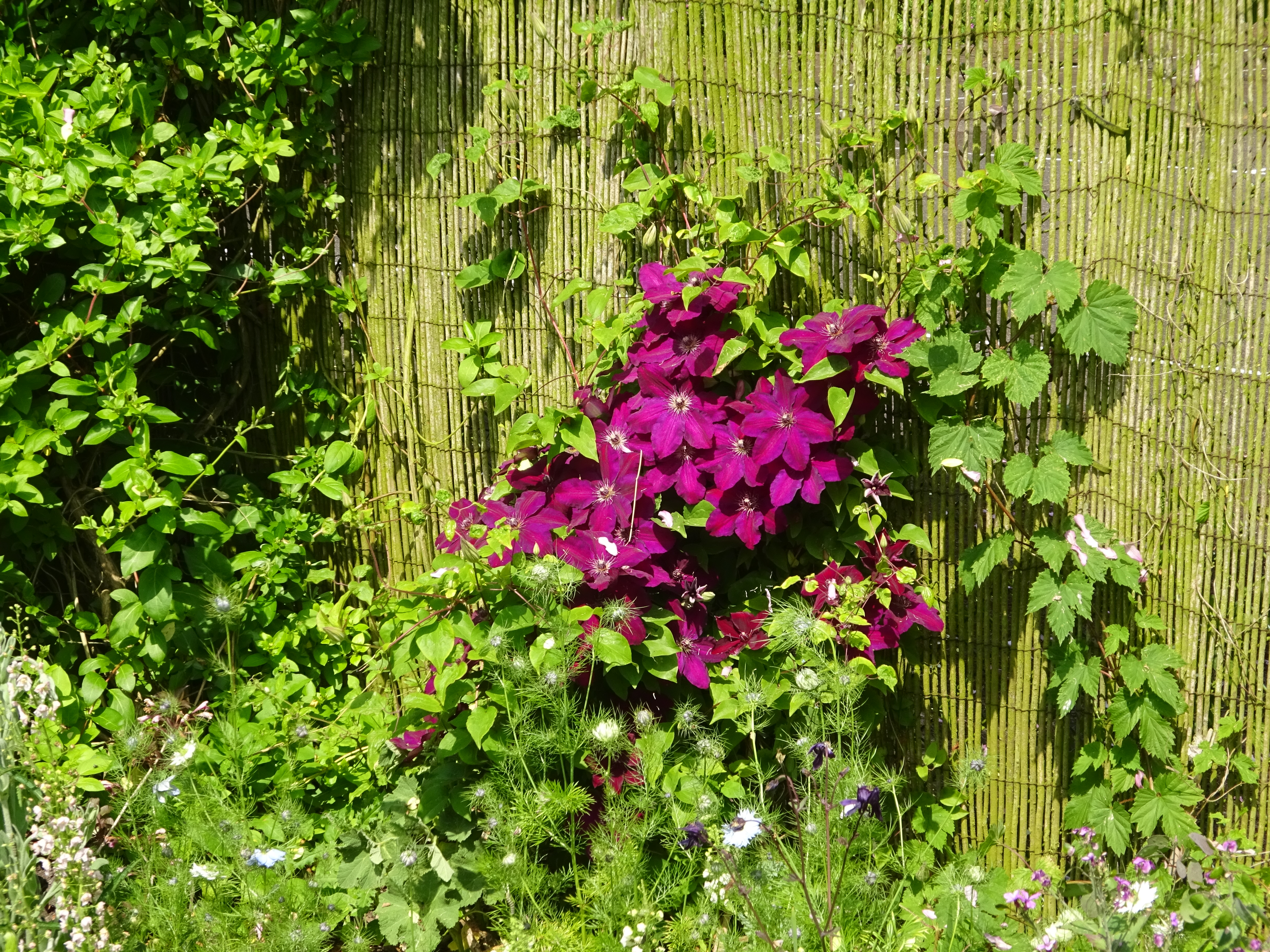
Slipping back into the main part of the garden this clematis seems to be clamouring for attention,
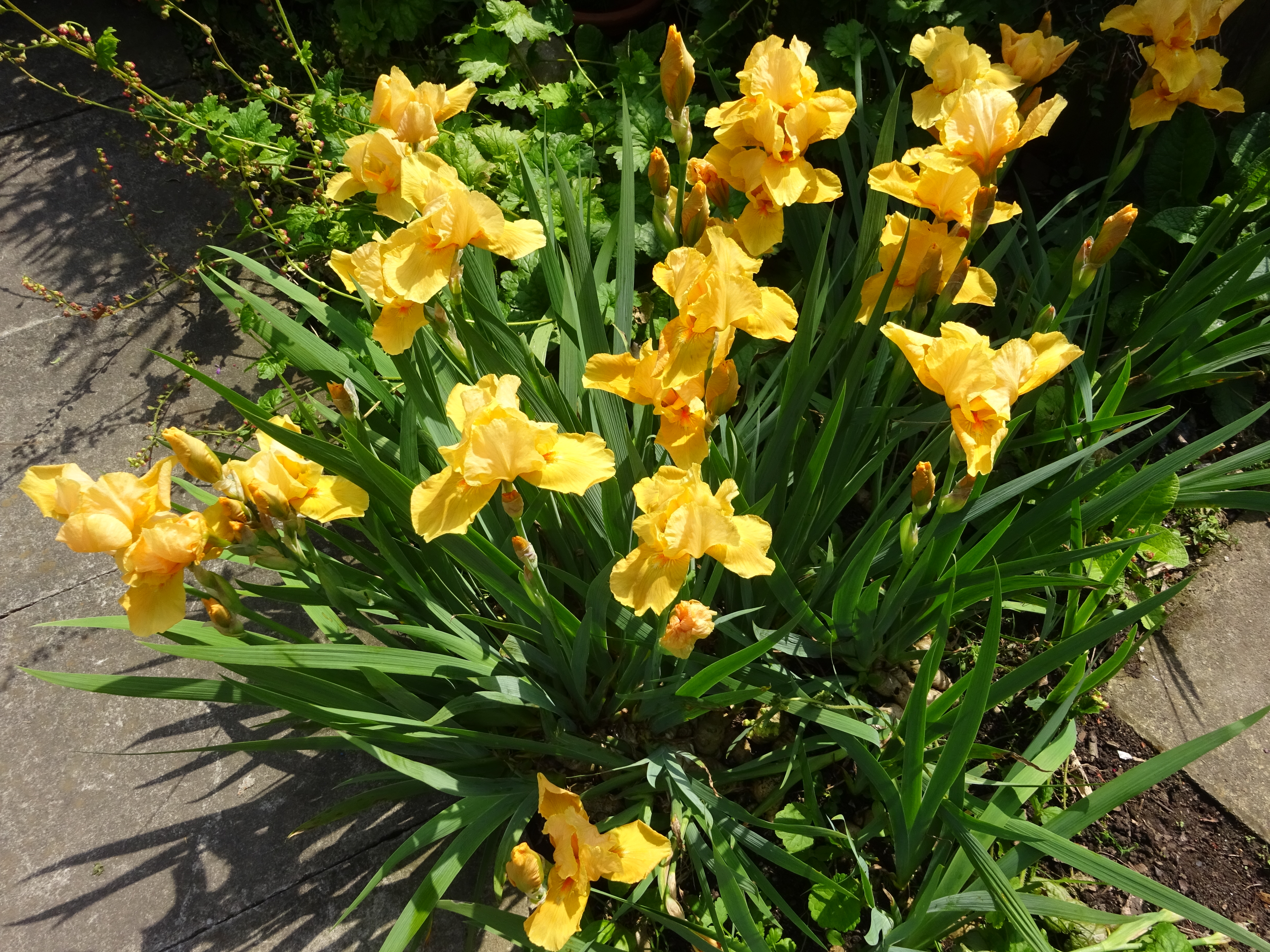
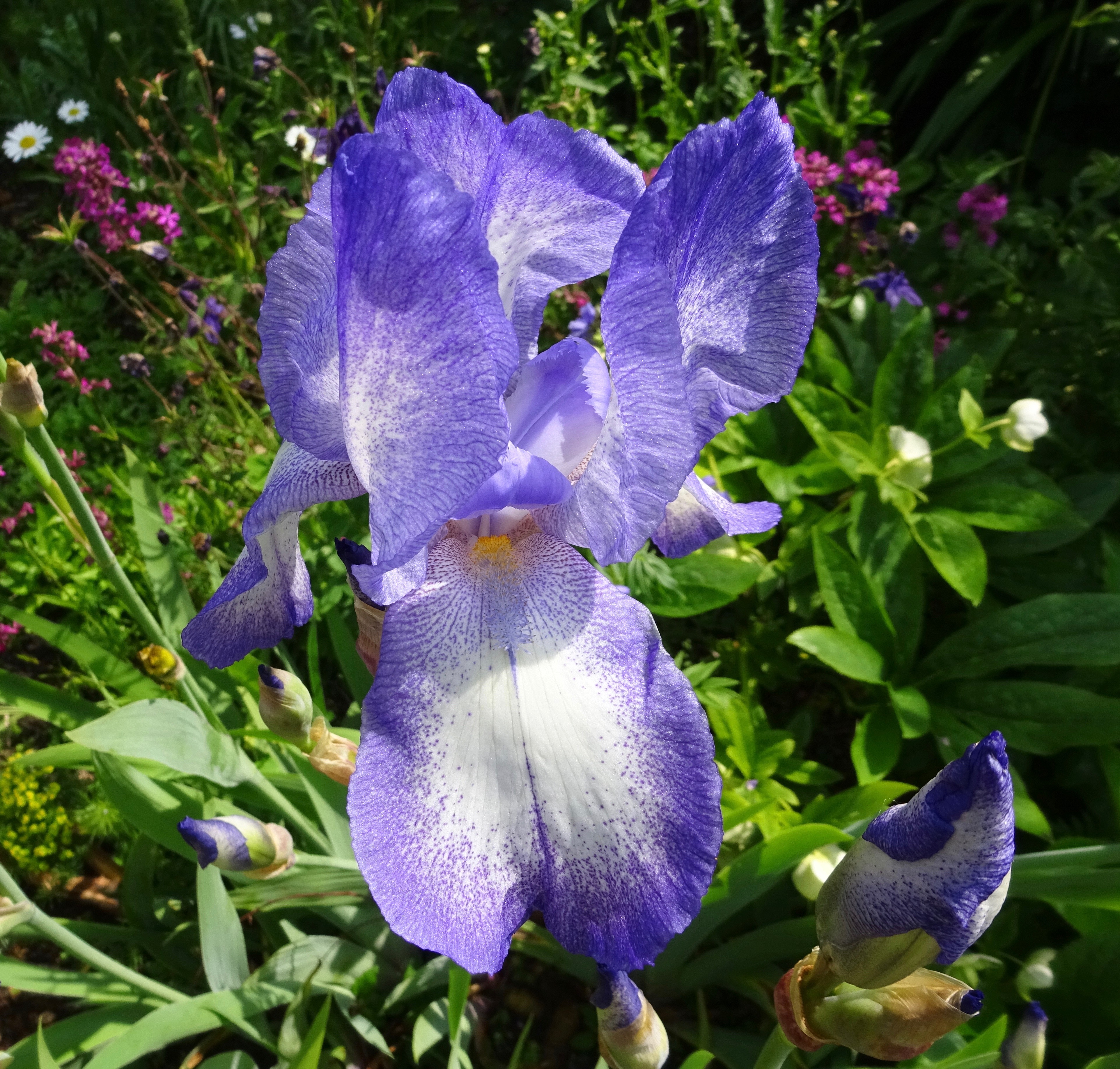
and I am not surprised because the irises are stunning. Iris was the personification of the rainbow in Greek Mythology and here there is such a variety of colour; a splash of gold,
or blending in with the soft summer palette.
You cannot help but admire this flamboyant flower.
However it is not all about vibrant colour, and within this one garden there is such a diverse range of growing conditions.
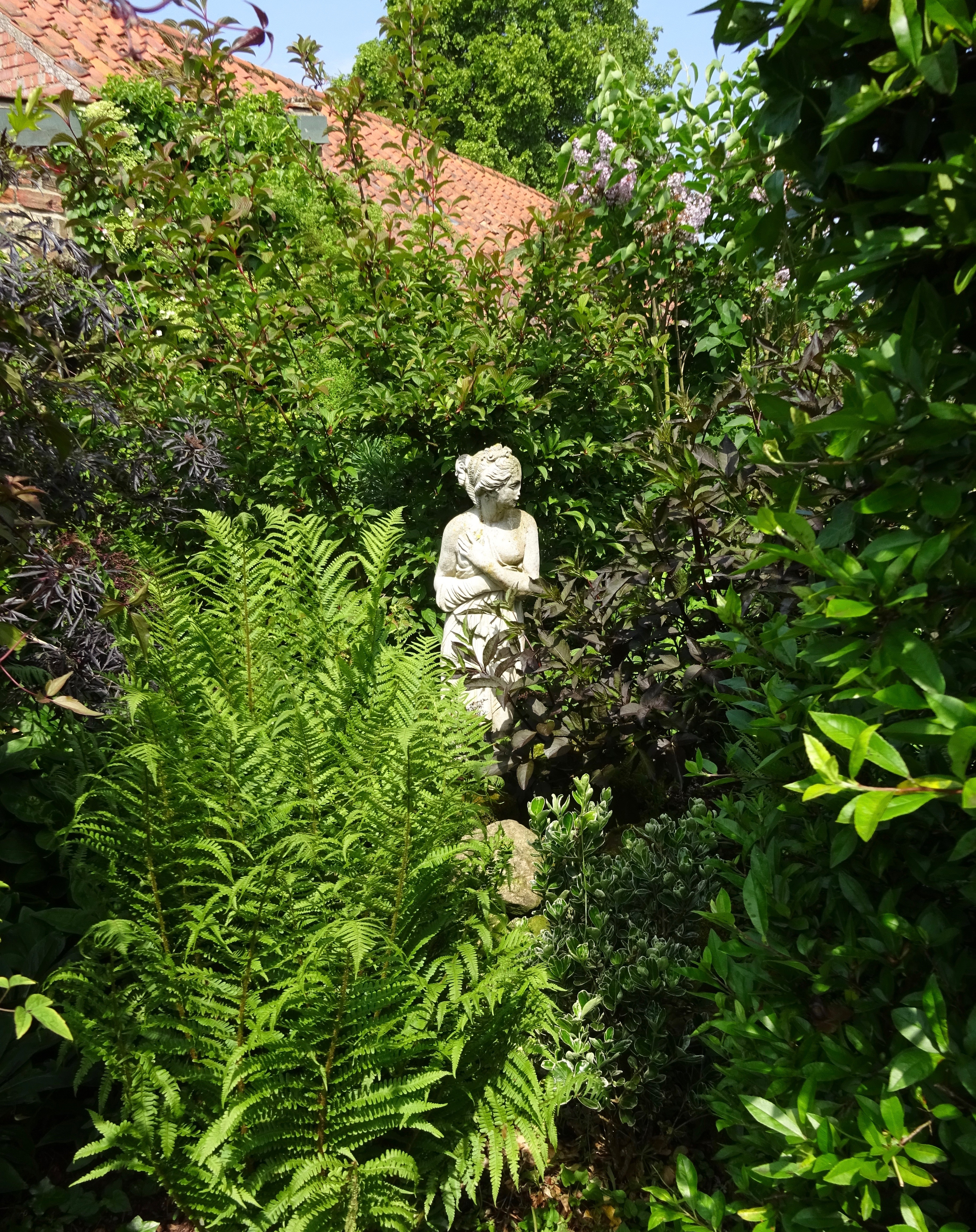
This lady catches the sun hiding modestly amongst a collection of greenery.
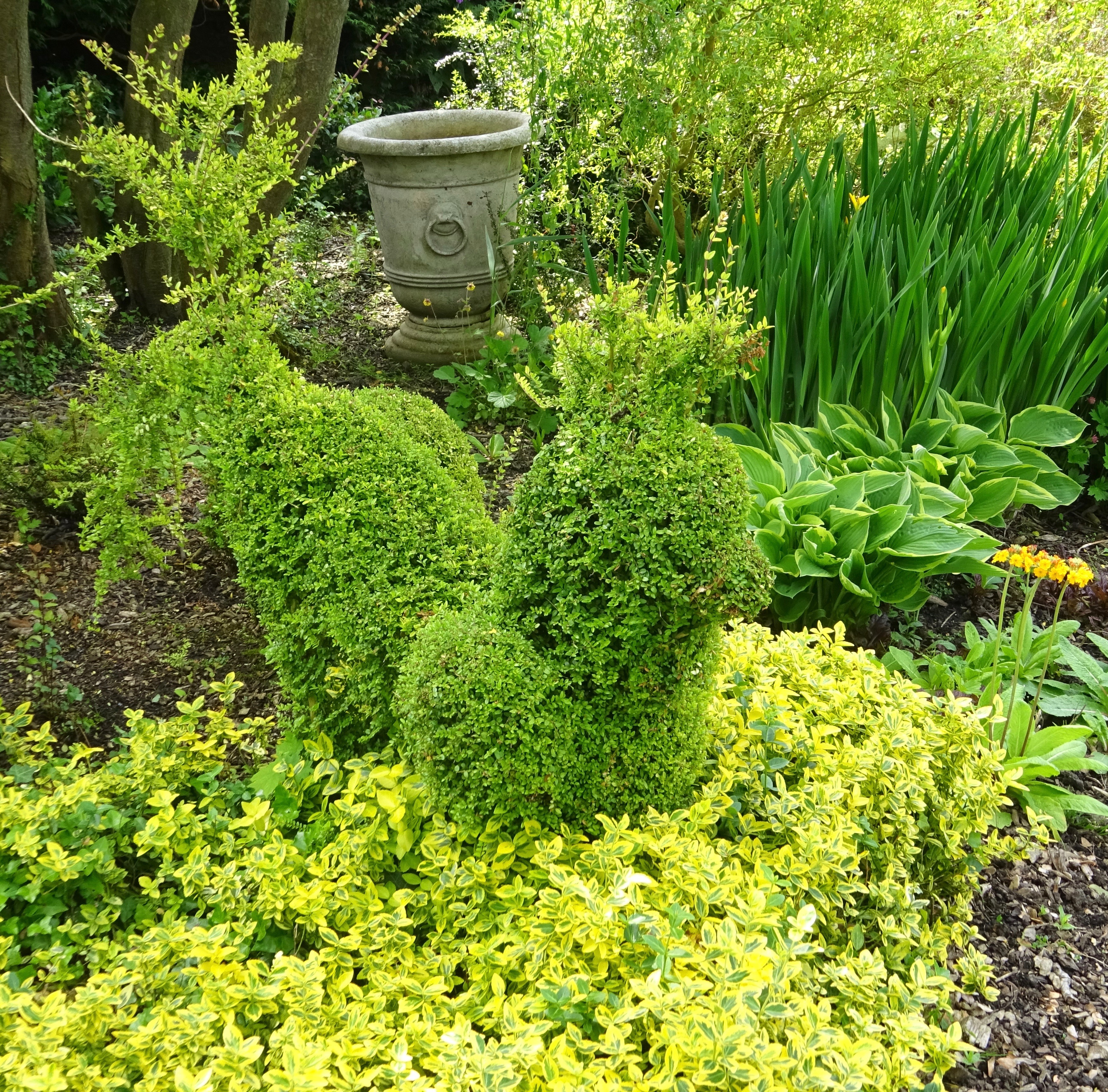
There is a selection of fun topiary in the making too,
and nearby in the long border an impressive patch of ornamental grass gently spilling over the neat edge of the well-kept lawn.
At the end the garden you are drawn towards some primulas growing in a secluded space. Here a visitor confides that he has so enjoyed his visit that he is now inspired to go home and get working on his own garden.
And that is what so often happens when visiting an NGS garden; not only are your spirits lifted and you gain that little bit of inspiration, but you have also contributed to raising much needed funds for all those marvellous caring charities that the Scheme supports.
Over two hundred people visited Bank House last Sunday, and combined with plant sales and refreshments an amazing £1,459 was raised. There is another opportunity to visit this charming garden this year as it will be open again on Sunday 26th August, or you can arrange a private group visit.
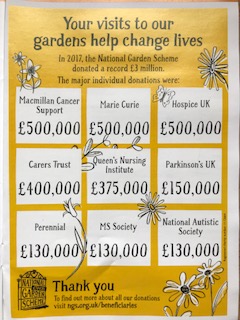
Your visit to an NGS garden really does help to change lives.






































































































 The Garden Gate is Open